
6. 컴포넌트 스캔
1. 컴포넌트 스캔과 의존관계 자동 주입
- 지금까지의 방식은 스프링 빈을 직접 스프링 컨테이너에 등록하는 방식이다
- 자바 코드의
@Bean, XML의<bean>을 사용하여 등록하였다. - 만일 등록해야 하는 빈의 수가 많다면 여러가지 문제가 발생할 것이다.
- 따라서 스프링은 설정정보 없이 스프링 빈을 등록하는 컴포넌트 스캔이라는 방식을 지원한다.
- 또한 의존관계도 자동으로 주입해주는
@Autowired기능을 제공한다.
코드
AutoAppConfig 클래스
@Configuration
@ComponentScan(
        excludeFilters = @ComponentScan.Filter(type = FilterType.ANNOTATION, classes = Configuration.class)
)
public class AutoAppConfig {}- 기존의
AppConfig클래스를 수정하지 않고 새로운 클래스를 선언하였다. - 컴포넌트 스캔을 사용하기 위해
@ComponentScan을 설정정보에 추가한다. - 기존의
AppConfig와 달리@Bean이 존재하지 않는다. - 컴포넌트 스캔은
@Component어노테이션이 붙은 클래스를 스캔하여 스프링 빈으로 등록한다.
@Target(ElementType.TYPE)
@Retention(RetentionPolicy.RUNTIME)
@Documented
@Component
public @interface Configuration { ... }@Configuration의 내부를 보면,@Component어노테이션이 존재하는 것을 확인할 수 있다.
excludeFilters = @ComponentScan.Filter(type = FilterType.ANNOTATION, classes = Configuration.class)- 이전에 사용하던 설정정보들에
@Configuration어노테이션이 붙어있다. - 따라서 해당 예제에서 컴포넌트 스캔 시 설정정보는 컴포넌트 스캔에서 제외시키기 위해
excludeFilters를 사용하였다.
@Component
public class MemoryMemberRepository implements MemberRepository {...}
@Component
public class RateDiscountPolicy implements DiscountPolicy {...}- 각 클래스가 컴포넌트 스캔의 대상이 되도록
@Component를 추가해준다.
@Component
public class MemberServiceImpl implements MemberService{
    private final MemberRepository memberRepository;

    @Autowired
    public MemberServiceImpl(MemberRepository memberRepository) {
        this.memberRepository = memberRepository;
    }
    ...
}
@Component
public class OrderServiceImpl implements OrderService{
private final MemberRepository memberRepository;
private final DiscountPolicy discountPolicy;
@Autowired
public OrderServiceImpl(MemberRepository memberRepository, DiscountPolicy discountPolicy) {
this.memberRepository = memberRepository;
this.discountPolicy = discountPolicy;
}
...
}- 이전에
AppConfig에서는@Bean으로 직접 설정 정보를 작성했고, 의존관계도 직접 명시했다. - 하지만 컴포넌트 스캔에서는 이러한 설정 정보 자체가 없기 때문에, 의존관계 주입도 이 클래스 안에서 해결해야 한다.
- 의존관계 주입은
@Autowired를 사용해 자동으로 주입해준다. @Autowired를 사용하여 생성자에서 여러 의존관계도 한번에 주입받는다.
컴포넌트 스캔 Test
@Test
void basicScan(){
	AnnotationConfigApplicationContext ac = new AnnotationConfigApplicationContext(AutoAppConfig.class);
    MemberService memberService = ac.getBean(MemberService.class);

    Assertions.assertThat(memberService).isInstanceOf(MemberService.class);
}- 기존과 동일하게
AnnotationConfigApplicationContext를 사용하여 스프링 컨테이너를 생성한다. - 설정 정보로
AutoAppConfig클래스를 넘겨준다.
로그
16:22:04.759 [main] DEBUG org.springframework.context.annotation.ClassPathBeanDefinitionScanner - Identified candidate component class: file [C:\SpringStudy\core\out\production\classes\hello\core\discount\RateDiscountPolicy.class]
16:22:04.765 [main] DEBUG org.springframework.context.annotation.ClassPathBeanDefinitionScanner - Identified candidate component class: file [C:\SpringStudy\core\out\production\classes\hello\core\member\MemberServiceImpl.class]
16:22:04.767 [main] DEBUG org.springframework.context.annotation.ClassPathBeanDefinitionScanner - Identified candidate component class: file [C:\SpringStudy\core\out\production\classes\hello\core\member\MemoryMemberRepository.class]
16:22:04.770 [main] DEBUG org.springframework.context.annotation.ClassPathBeanDefinitionScanner - Identified candidate component class: file [C:\SpringStudy\core\out\production\classes\hello\core\order\OrderServiceImpl.class]
...
16:22:04.994 [main] DEBUG org.springframework.beans.factory.support.DefaultListableBeanFactory - Creating shared instance of singleton bean 'autoAppConfig'
16:22:05.004 [main] DEBUG org.springframework.beans.factory.support.DefaultListableBeanFactory - Creating shared instance of singleton bean 'rateDiscountPolicy'
16:22:05.006 [main] DEBUG org.springframework.beans.factory.support.DefaultListableBeanFactory - Creating shared instance of singleton bean 'memberServiceImpl'
16:22:05.034 [main] DEBUG org.springframework.beans.factory.support.DefaultListableBeanFactory - Creating shared instance of singleton bean 'memoryMemberRepository'
ClassPathBeanDefinitionScanner - Identified candidate component classClassPathBeanDefinitionScanner가 컴포넌트 클래스를 식별함을 띄워주며, 해당 클래스의 위치를 알려준다.
DefaultListableBeanFactory - Creating shared instance of singleton bean XXX- 해당 빈"XXX"을 싱글톤으로 생성했다고 알려준다.
동작 원리
@ComponentScan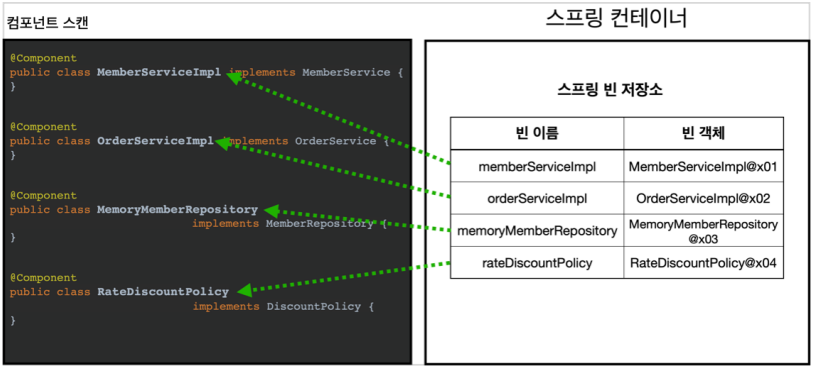
@ComponentScan은@Component가 붙은 모든 클래스를 스프링 빈으로 등록시킨다.- 스프링 빈의 기본 이름은 클래스 명을 사용하되, 맨 앞글자만 소문자를 사용한다.
- 직접 이름을 부여할 수 있다.
@Autowired 의존관계 자동주입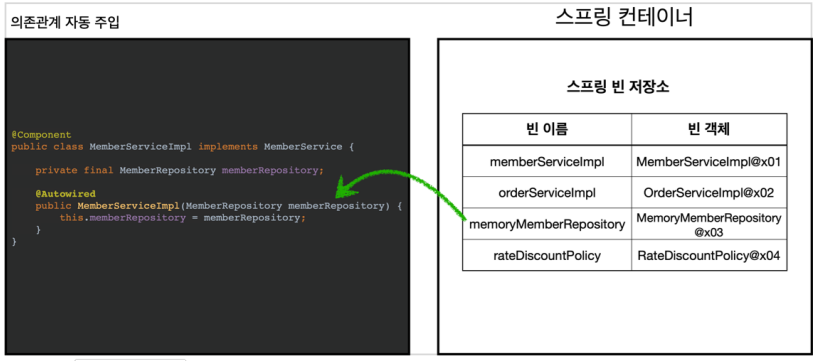
- 생성자에
@Autowired를 지정하면, 스프링 컨테이너가 자동으로 해당 스프링 빈을 찾아서 주입한다. - 이때 기본 조회 전략은 타입이 같은 빈을 찾아서 주입한다.
getBean(MemberRepository.class)와 동일하다고 이해하면 된다.

- 생성자에 파라미터가 많아도 다 찾아서 자동으로 주입한다.
2. 탐색 위치와 기본 스캔 대상
- 모든 자바 클래스를 다 컴포넌트 스캔하면 시간이 오래 걸린다.
- 꼭 필요한 위치부터 탐색하도록 시작 위치를 지정할 수 있다.
@ComponentScan(
 	basePackages = "hello.core",
}basePackages: 탐색할 패키지의 시작 위치를 지정한다. 이 패키지를 포함해서 하위 패키지를 모두 탐색한다.
basePackages = {"hello.core", "hello.service"}- 여러 패키지를 지정할 수 있다
basePackageClasses: 지정한 클래스의 패키지를 탐색 시작 위치로 지정한다.- defaul:
@ComponentScan이 붙은 설정 정보 클래스의 패키지가 시작 위치가 된다 - 설정 정보 클래스의 위치를 프로젝트 최상단에 두어 패키지 위치를 지정하지 않는 방법을 권장한다.
컴포넌트 스캔 기본 대상
@Component: 컴포넌트 스캔에서 사용@Controlller: 스프링 MVC 컨트롤러에서 사용@Service: 스프링 비즈니스 로직에서 사용@Repository: 스프링 데이터 접근 계층에서 사용@Configuration: 스프링 설정 정보에서 사용- 위의 어노테이션은
@Component를 포함한다.
부가기능
@Controlller: 스프링 MVC 컨트롤러로 인식@Service: 개발자들이 핵심 비즈니스 로직이 여기에 있겠구나 라고 비즈니스 계층을 인식하는데 도움이 된다@Repository: 스프링 데이터 접근 계층으로 인식하고, 데이터 계층의 예외를 스프링 예외로 변환해준다.- DB 변경 시 다른 예외가 발생하면 상위 계층까지 흔들리는 것을 방지
@Configuration: 스프링 설정 정보로 인식하고, 스프링 빈이 싱글톤을 유지하도록 추가 처리를 한다.
3. 필터
includeFilters: 컴포넌트 스캔 대상을 추가로 지정한다.excludeFilters: 컴포넌트 스캔에서 제외할 대상을 지정한다
어노테이션 추가
컴포넌트 스캔 대상에 추가할 어노테이션
@Target(ElementType.TYPE)
@Retention(RetentionPolicy.RUNTIME)
@Documented
public @interface MyIncludeComponent {}
컴포넌트 스캔 대상에서 제외할 어노테이션
@Target(ElementType.TYPE)
@Retention(RetentionPolicy.RUNTIME)
@Documented
public @interface MyExcludeComponent {}
클래스 추가
컴포넌트 스캔 대상에 추가할 클래스
@MyIncludeComponent
public class BeanA {}@MyIncludeComponent를 적용한다
컴포넌트 스캔 대상에서 제외할 클래스
@MyExcludeComponent
public class BeanB {}@MyExcludeComponent를 적용한다
Test
@Test
void filterScan(){
	ApplicationContext ac = new AnnotationConfigApplicationContext(ComponentFilterAppConfig.class);
    BeanA beanA = ac.getBean("beanA", BeanA.class);
    assertThat(beanA).isNotNull();

    org.junit.jupiter.api.Assertions.assertThrows(
    	NoSuchBeanDefinitionException.class,
        () -> ac.getBean("beanB", BeanB.class)
	);
}

@Configuration
@ComponentScan(
	includeFilters = @Filter(type = FilterType.ANNOTATION, classes = MyIncludeComponent.class),
    excludeFilters = @Filter(type = FilterType.ANNOTATION, classes = MyExcludeComponent.class)
)
static class ComponentFilterAppConfig{}
ApplicationContext ac = new AnnotationConfigApplicationContext(ComponentFilterAppConfig.class);ComponentFilterAppConfig클래스를 설정 정보로 전달한다.
@Configuration
@ComponentScan(
	includeFilters = @Filter(type = FilterType.ANNOTATION, classes = MyIncludeComponent.class),
    excludeFilters = @Filter(type = FilterType.ANNOTATION, classes = MyExcludeComponent.class)
)
static class ComponentFilterAppConfig{}ComponentFilterAppConfig클래스는 컴포넌트 스캔 방식으로 빈을 등록한다.@ComponentScan의 속성으로includeFilters와excludeFilters를 지정하였다.includeFilters에MyIncludeComponent애노테이션을 추가해서 BeanA가 스프링 빈에 등록된다.excludeFilters에MyExcludeComponent애노테이션을 추가해서 BeanB가 스프링 빈에 등록되지 않는다.- 원래 컴포넌트 스캔 시
@Component어노테이션이 포함된 클래스를 빈으로 등록하는데,includeFilters속성을 통해 빈으로 등록시켰다.
FilterType 옵션
- ANNOTATION: 기본값, 애노테이션을 인식해서 동작한다
- ASSIGNABLE_TYPE: 지정한 타입과 자식 타입을 인식해서 동작한다.
- ASPECTJ: AspectJ 패턴 사용
- REGEX: 정규 표현식
- CUSTOM: TypeFilter 이라는 인터페이스를 구현해서 처리
@Component면 충분하기 때문에,includeFilters를 사용할 일은 거의 없다.excludeFilters는 여러가지 이유로 간혹 사용할 때가 있지만 많지는 않다
4. 중복 등록과 충돌
컴포넌트 스캔에서 같은 이름을 가진 빈을 등록할 경우 문제가 발생한다.
- 자동 빈 등록 (
@Component) vs 자동 빈 등록 (@Component) - 수동 빈 등록 (
@Bean) vs 자동 빈 등록 (@Component)
자동 빈 등록 (@Component) vs 자동 빈 등록 (@Component)
@Component("service")
public class OrderServiceImpl implements OrderService{...}

@Component("service")
public class MemberServiceImpl implements MemberService{...}OrderServiceImpl을 스프링 빈으로 등록할 때service라는 이름으로 등록MemberServiceImpl을 스프링 빈으로 등록할 때service라는 이름으로 등록- 즉, 동일한 이름의 빈을 등록하게 된다.
... org.springframework.context.annotation.ConflictingBeanDefinitionException ...- 실행 시켜보면,
ConflictingBeanDefinitionException예외가 발생하게 된다.
수동 빈 등록 (@Bean) vs 자동 빈 등록 (@Component)
...
@ComponentScan
public class AutoAppConfig {
    @Bean(name = "memoryMemberRepository")
    MemberRepository memberRepository() {
        return new MemoryMemberRepository();
    }
}- 컴포넌트 스캔 방식의 설정정보에 수동으로
@Bean을 사용하여 빈을 등록할 경우,@Component에 의해 자동으로 등록된 빈과 중복이 발생한다. - 이 경우, 수동 등록 빈(
@Bean)이 우선권을 갖는다- = 수동 빈이 자동빈을 오버라이딩한다.
Overriding bean definition for bean 'memoryMemberRepository' with a different definition: ...- 개발자가 이러한 상황을 의도적으로 기대했기보다 여러 설정 정보가 얽혀 발생되는 경우가 대부분이다.
- 따라서 스프링 부트에서는 수동 빈과 자동 빈의 충돌이 일어나면 오류가 발생되게 기본 값을 변경하였다.
The bean 'memoryMemberRepository', defined in class path resource [hello/core/AutoAppConfig.class] could not be registered
A bean with that name has already been defined in file and overriding is disabled.
출처: 인프런 스프링 핵심 원리 - 기본편 (김영한)
인프런 스프링 핵심 원리