- Using linear algebra
- Ket (|ψ>) → column vector with complex number coefficients → quantum state
- Bra (<ψ|) → complex conjugate and the transpose of the ket vector → row vector
- Inner products (bra-ket) = <ψ|φ>
- Normalization → sum of squares of coefficients = 1
- probability of |0> and probability of |1> sums to 1 (Born’s rule)
- Qubit states in different bases
- Plus-minus basis : consists of the normalized sum and difference of the 0 and 1 ket vectors
- |+> and |->
- Plus-minus basis : consists of the normalized sum and difference of the 0 and 1 ket vectors
- Quantum logic gates → unitary matrices
- Probabilistic measurements → Hermitian matrices
- Entangled state : multi-qubit state that cannot be written as a tensor product of one-qubit states
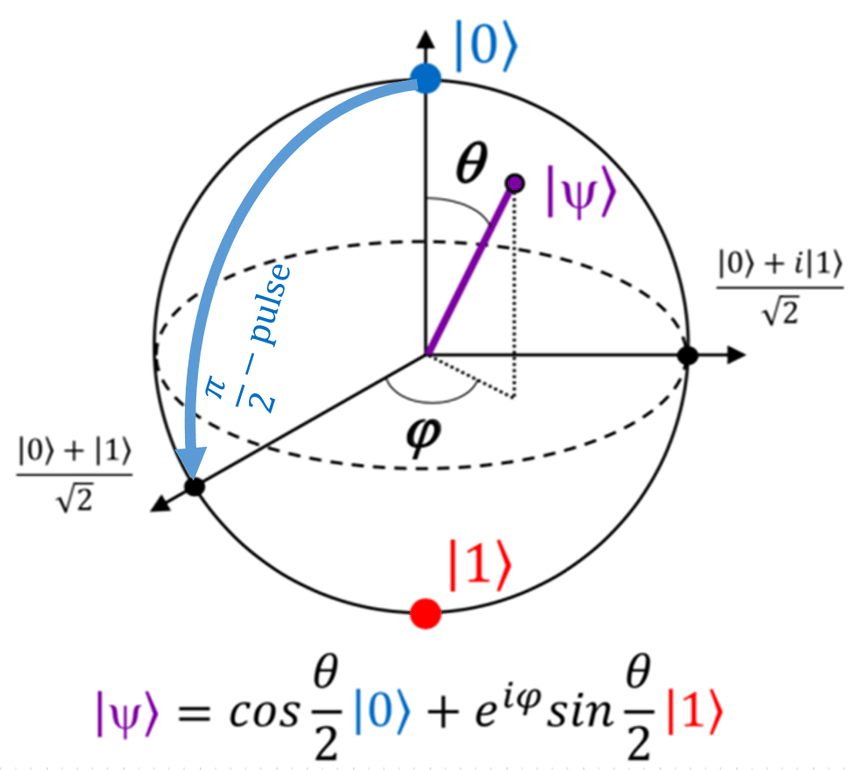
- Geometric representation → The Bloch Sphere
- Multi-qubit states and operations → tensor (or Kronecker) products
- Benefits
- Z(θ) can be expressed in Y(θ = π/2)X(θ)Y(θ = -π/2)
- X and Y rotation already available for experimentalists → no need to design new hardware
- State decomposition : expressing one state in terms of other states (+,- ↔ 0,1)
- Arbitrary measurement possible in any basis
- Z(θ) can be expressed in Y(θ = π/2)X(θ)Y(θ = -π/2)
- Not always best
- Proving maximally entangled states (too many coefficients)
- Experimental vs Theoretical measurements
Linear Algebra를 공부하던 학기에 하도 놀아서 기억이 안나서 애먹었다(…) 기본적인 matrix 계산은 다 할 수 있는데 eigenvalue 이런게 뭐였는지 기억이 잘 안나더라,,, 양자컴퓨터 공부를 더 깊게 하고싶어지면 다시 한 번 배울 생각이다.
Bra-ket notation을 통해 양자의 state를 간편하게 나타낼 수 있다. 기본적으로 0일 확률과 1일 확률의 제곱근을 나타낸다. 2칸짜리 row matrix 또는 column matrix로 나타내고 거기다 각 quantum gate 의 matrix를 곱해서 결과값을 얻을 수 있다. (two-qubit gate 일 때는 4칸짜리) 계산하는거 나름 재밌는데 이 강의 말고 다른 강의에서 들은거라 나중에 시간 날 때 따로 글 쓸 것 같다.
Bloch Sphere의 개념이 아주 흥미롭다. 0이 될 확률의 제곱과 1이 될 확률의 제곱의 합이 1인 것을 이용하여 Qubit의 상태를 지름이 1인 구의 회전으로 나타내는 방식이다.

NUS CS'25