
No jam
Transport Layer Protocols
- Simple Protocol
- Stop-and-Wait Protocol
- Go-Back-N Protocol
- Selective-Repeat Protpcol
-Bidirectional Protocols: Piggybacking
Simple Protocol
- Simple and Connectionless protocol
- Flow, Error control 없음!!
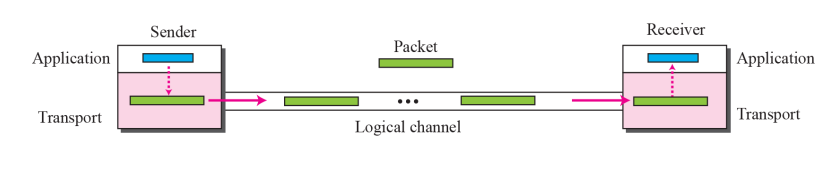
- Receiver can immediately handle any frame it receives.
FSM for the simple protocol
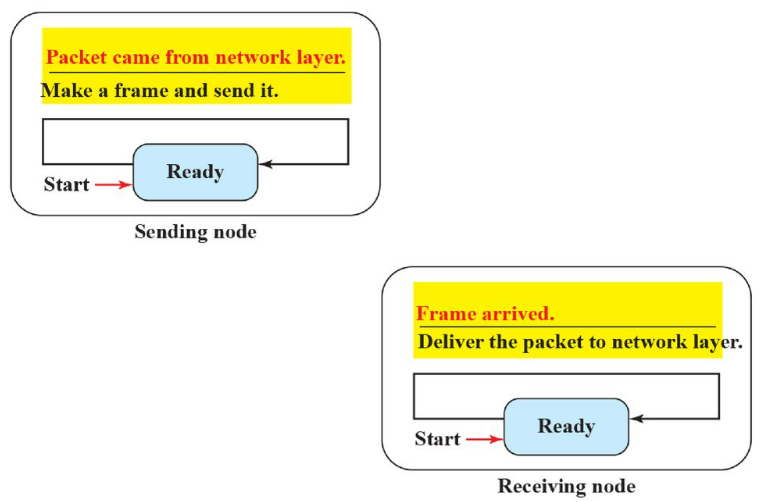
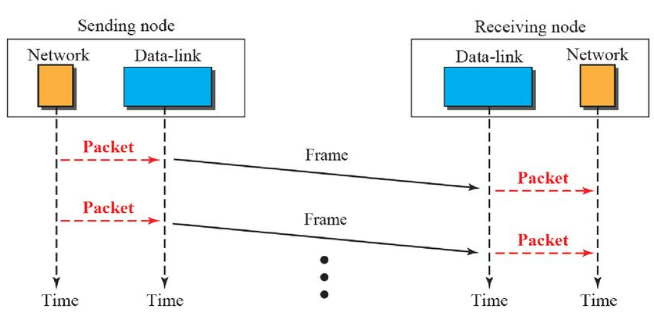
- Sender sends packets without thinking about the receiver
Stop-and-Wait Protocol
-
Connection-oriented protocol
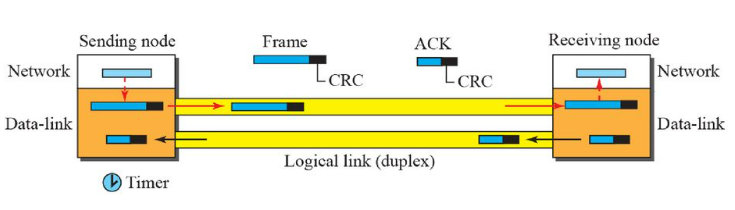
-
Sliding window size: 1
-
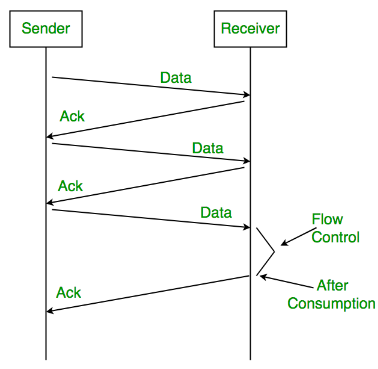
Flow control is achieved
- By forcing the sender to wait for an acknowledgment
- 일반적인 Flow control 방법: Buffer
- Stop-and-Wait의 buffer size: 1
-
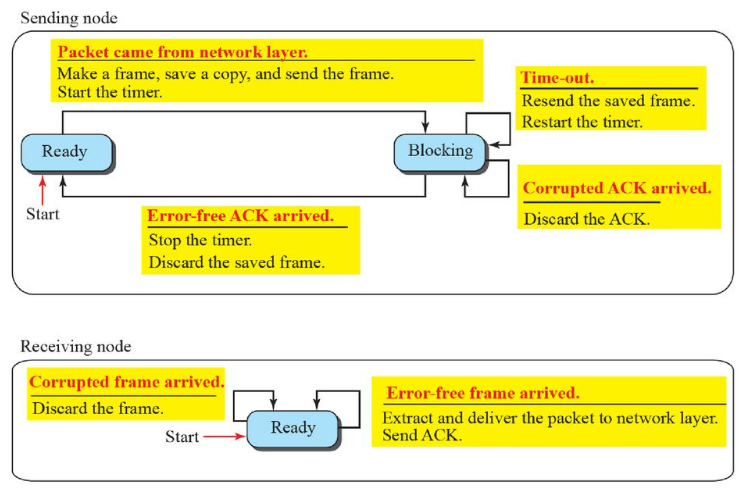
Error control is achieved
- By discarding corrupted packets and letting the sender resend unacknowledged packets when the timer expires
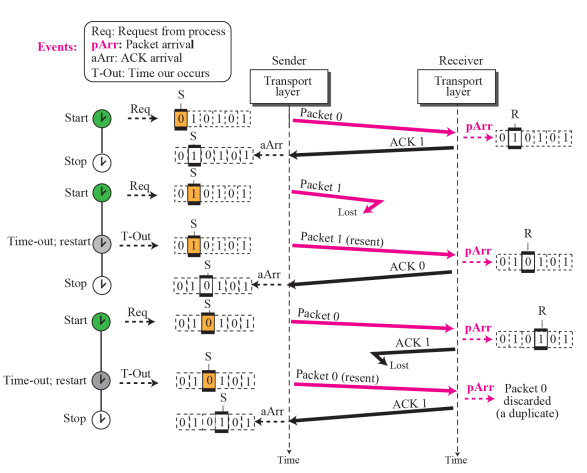
- Error control을 위해 사용하는 번호: Sequence Number
- Stop-and-Wait에서는 1 bit field를 sequence num 저장하기 위해 사용
- m=1 → sequence numbers: modulo 2 (0 or 1)
- the ack num always announces in modulo-2 the seq num of the next packet expected
-
All calculation in the Stop-and Wait protocol is in modulo 2
FSM for the stop-and-wait protocol
-
Example
-
Inefficient
-
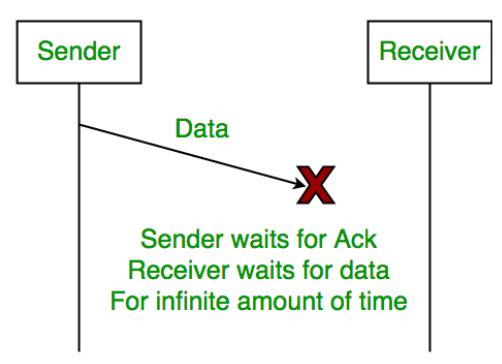
Lost Data
-
Lost Ack
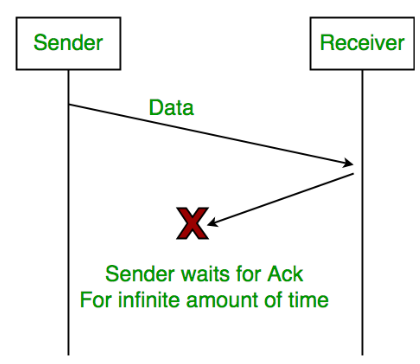
-
Delayed Ack/Data
-
-
Bandwidth-delay product
- Channel: pipe
- Bandwidth-delay product: pipe capacity
- e.g.) bandwidth: 1Mbps, delay: 20msec 일때 Bandwidth-delay product: (110^6)(20*10^-3) = 20,000 bit
-
Example
- In a Stop-and-Wait system, the bandwidth of the line is 1Mbps, and 1 bit takes 20msec to make a round trip. What is the bandwidth-delay product? If the system sends one packet (1,000 bits in length), what is the utilization percentage of the link?
1,000 bits / 20,000 bits = 5% (Too low!) - What is the maximal utilization percentage of the above link if we have a protocol that can send up to 15 packets before stopping and worrying about the acknowledgments?
15,000 bits / 20,000 bits = 75%
- In a Stop-and-Wait system, the bandwidth of the line is 1Mbps, and 1 bit takes 20msec to make a round trip. What is the bandwidth-delay product? If the system sends one packet (1,000 bits in length), what is the utilization percentage of the link?
-
So, sneding up to multiple packets are more efficient!
글로벌소프트웨어캠퍼스와 교보DTS가 함께 진행하는 챌린지입니다.