Debug: x-y
if command == "sub":
            # x-y
            # decrement SP
            asm_tmp += self.decrement_SP()

            # save M into D register. D is y
            asm_tmp += "D=M\n"

            # decrement SP again
            asm_tmp += self.decrement_SP()

            # save sub at M register
            asm_tmp +=  "M=D-M\n"

            # increment SP
            asm_tmp += self.increment_SP()
asm_tmp += self.decrement_SP(): decrement stack pointer
asm_tmp += "D=M\n": Save y value into the D register
asm_tmp += self.decrement_SP(): decrement stack pointer again to focus x
asm_tmp += "M=D-M\n": Got ya. so the M is x, but i'm subtracting it from y so this results y-x, not x-y.
Making bit operators
AND
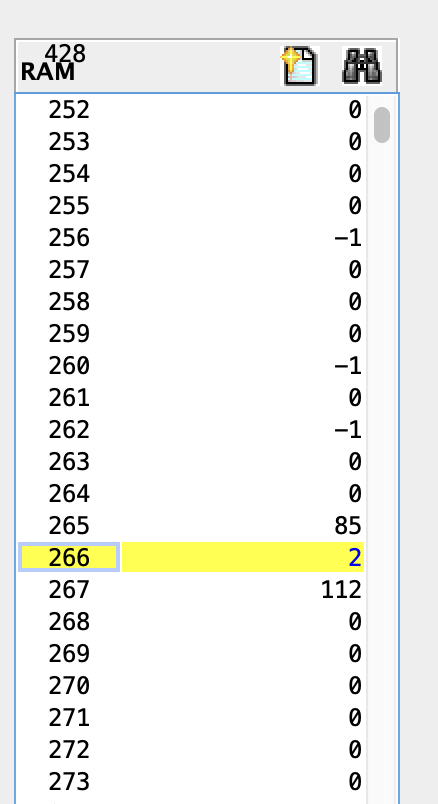
- So we already have saved the binary digits in the memory.
- Then how can we get the 'and' operated value of two binary digits? do we have asm code?
Yes. We have bit operators like &,|, and every arithmatic operators in asm level.

So we can simply use it like following code.
if command == 'and':
            # x And y
            asm_tmp = '// AND operator\n'
            asm_tmp += self.decrement_SP()
            # save M into D register
            asm_tmp += "D=M\n"
            # decrement again
            asm_tmp += self.decrement_SP()
            # do asm operation.
            asm_tmp += "M=D&M\n"
            asm_tmp += self.increment_SP()
OR
just switch & into |
NOT
Then, what's the difference between neg and not operation? Take a look at the specs of VM.
neg(2) = -2
not(2) = -3

00000010  (2)
--------  (not op)
11111101  (-3)
So it can be implemented using !M operator in asmbler spec.
        if command == 'not':
            # NOT y
            asm_tmp = '// NOT operator\n'
            asm_tmp += self.decrement_SP()
            # do asm operation.
            asm_tmp += "M=!M\n"
            asm_tmp += self.increment_SP()
Behold the rabbit hole