👷🏼♀️ DDD (Domain Driven Design)
👷🏼♀️
DDD (Domain Driven Design)is amethodwhere aproblem areais prioritised over theengineering practices.
DDD was introduced to address the complexities that arise from a poor understanding of the problems across interest groups, including developers, domain experts, and others.
DDD can be viewed in two design patterns:
- ♟️
Strategic Pattern - 🎲
Tactical Design Pattern
♟️ Strategic Pattern
Strategic Pattern in DDD puts a strong emphasis on the software structures and architectures in a way that addresses the problem domain.
Key concepts pivotal to Strategic Pattern are:
- Bounded Context
- specific
boundarieswhere theproblem domainspersist.
- Context Mapping
- linking the
interactionsacross varyingBounded Contexts.
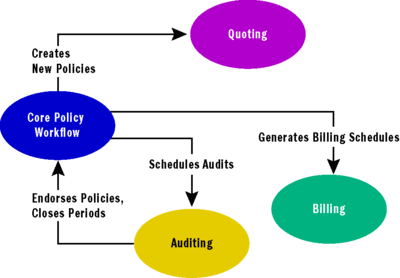
Microsoft Available here
- Strategic Patterns
- overall
guidelinesfor developing asoftware architecture. - includes
Aggregates,Domain Events, andAnti-Corruption Layeras its common practices.
- Shared Kernel
- a common
subsetbetween varyingBounded Contexts.
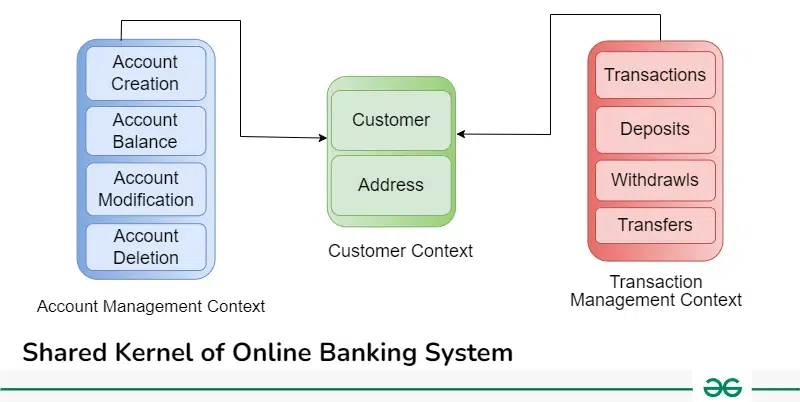
Geeks for Geeks Available here
- Anti-Corruption Layer (ACL)
-
a
strategic approachaimed at safeguarding asystemfrom the impact ofexternalorlegacy systemsthat operate with differentmodelsorlanguages. -
serves as an
intermediary translation layerconnecting theexternal systemwith thecore domain model.
- Ubiquitous Language
- shared
vocabulariesthat allstakeholdersshare across thesoftware development.
🎲 Tactical Design Pattern
Tactical Design Pattern defines a set of strategies that can be applied to construct the domain models within the software system.
- Entity
- a
domain objectwith a specificlife cycleand a distinctidentity.
- Value Object
- an
objectthat represents the values that may beimmutable.
- Aggregate
- a cluster of
entitiesandvalue objectsthat becomes asingle unitfordata consistency.
- Repository
- a
layerthat is responsible for directly communicating with thedatabases.
- Factory
- a
layerthat is responsible for creatingobjects.
- Service
- a
layerthat conducts all necessarybusiness logic.
🔭 DDD Analysis
🔲 DDD Pros
DDD can profit from the overall development cycle via:
-
🗣️ effective
communicationacrossdevelopers,domain experts, and otherstakeholders- 📣 followed by the use of
Ubiquitous Language
- 📣 followed by the use of
-
🚨 focus on
real business problemsthan implementing unnecessaryengineering practices
🔳 DDD Cons
-
⚽️ can introduce unnecessary
complexitiesspecifically from the largedomain models -
🧠 overhead from implementing
DDDleading to loweredproductivity
📚 References