how2heap 이란?
heap관련 취약점들의 원리를 소스코드와 주석으로 설명해 놓은 github repository
https://github.com/shellphish/how2heap
first_fit.c
how2heap에서 처음으로 분석할 자료이다.
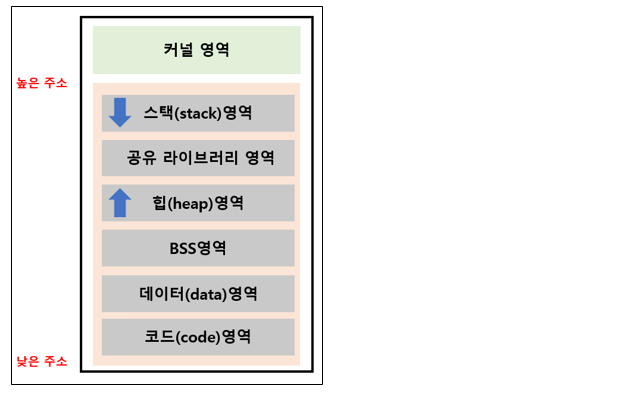
복습1. 메모리 구조
메모리에 존재하는 영역
- 데이터(data) 영역
- 전역 변수, static 변수가 저장 - 스택(stack) 영역
- 지역변수, 매개변수가 저장 - 힙(heap) 영역
- malloc(), calloc()과 같은 함수에 의해 동적으로 생성된 변수를 저장 - 코드(code, text) 영역
- bss 영역
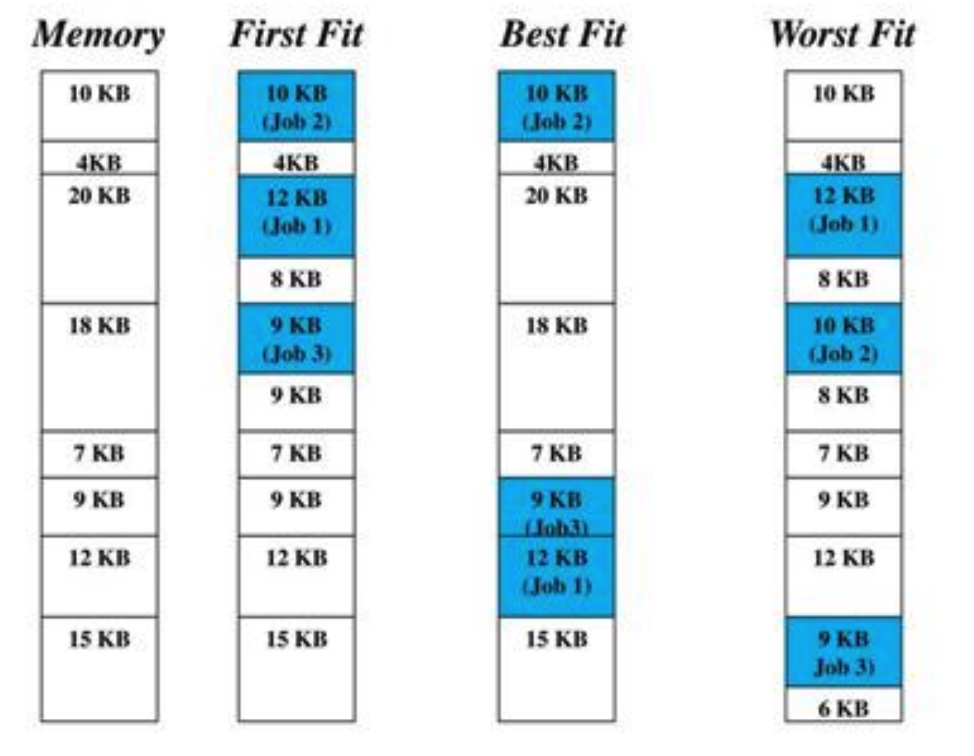
복습2. Heap Memory Management
- first fit(최초적합) 방식
- 첫번째로 들어갈 수 있는 곳에 넣는다.
- best fit(최적적합) 방식
- 데이터가 저장되기에 가장 적절한 곳에 데이터를 저장한다.
- worst fit(최악적합) 방식
- 가장 크기가 안 맞는 곳에 데이터를 저장한다.
코드
#include <stdio.h>
#include <stdlib.h>
#include <string.h>

int main()
{
	fprintf(stderr, "This file doesn't demonstrate an attack, but shows the nature of glibc's allocator.\n");
	fprintf(stderr, "glibc uses a first-fit algorithm to select a free chunk.\n");
	fprintf(stderr, "If a chunk is free and large enough, malloc will select this chunk.\n");
	fprintf(stderr, "This can be exploited in a use-after-free situation.\n");

	fprintf(stderr, "Allocating 2 buffers. They can be large, don't have to be fastbin.\n");
	char* a = malloc(0x512);
	char* b = malloc(0x256);
	char* c;

	fprintf(stderr, "1st malloc(0x512): %p\n", a);
	fprintf(stderr, "2nd malloc(0x256): %p\n", b);
	fprintf(stderr, "we could continue mallocing here...\n");
	fprintf(stderr, "now let's put a string at a that we can read later \"this is A!\"\n");
	strcpy(a, "this is A!");
	fprintf(stderr, "first allocation %p points to %s\n", a, a);

	fprintf(stderr, "Freeing the first one...\n");
	free(a);

	fprintf(stderr, "We don't need to free anything again. As long as we allocate smaller than 0x512, it will end up at %p\n", a);

	fprintf(stderr, "So, let's allocate 0x500 bytes\n");
	c = malloc(0x500);
	fprintf(stderr, "3rd malloc(0x500): %p\n", c);
	fprintf(stderr, "And put a different string here, \"this is C!\"\n");
	strcpy(c, "this is C!");
	fprintf(stderr, "3rd allocation %p points to %s\n", c, c);
	fprintf(stderr, "first allocation %p points to %s\n", a, a);
	fprintf(stderr, "If we reuse the first allocation, it now holds the data from the third allocation.\n");
}
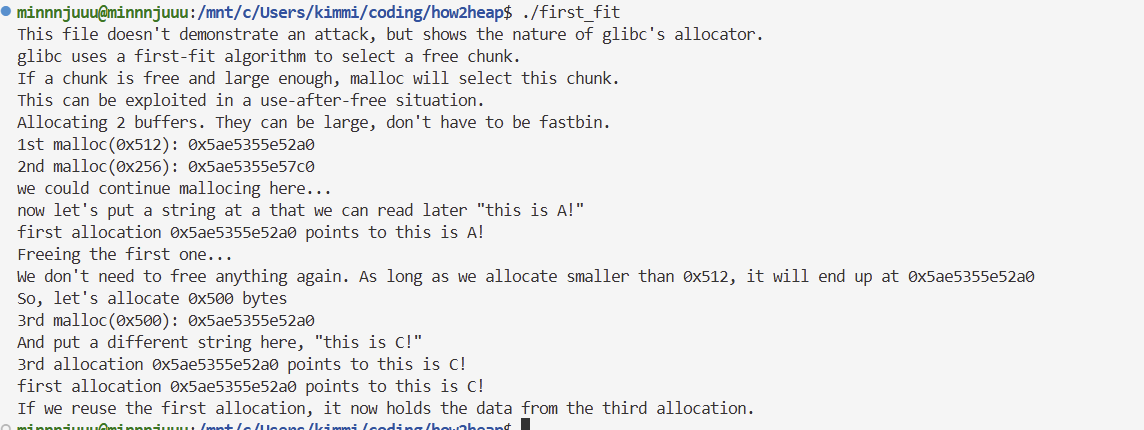
실행결과
분석
- glibc는 first-fit algorithm을 사용한다.
- malloc 함수를 이용해서 0x512, 0x256 크기의 문자열 배열 a, b를, malloc을 하지 않은 포인터 문자열 c를 선언한다.
- a가 할당된 주소는 0x5ae5355e52a0, b가 할당된 주소는 0x5ae5355e57a0 이다.
- "this is A!"라는 문자열을 a에 넣고 a의 주소를 프린트하면 0x5ae5355e52a0이 나온다.
- a를 free 해보자.
- 0x512보다 작게 새로운 할당을 한다면 이는 a 자리에 들어갈 것 같다. 그렇지 않다면, 다른 공간을 찾을 것이다.
- 앞서 선언한 c에 0x500크기의 malloc을 해보자.
- c의 주소는 a가 할당되었던 주소인 0x5ae5355e52a0가 출력된다
- "this is C!"라는 문자열을 c에 넣고 3번째 할당인 c와 첫번째 할당인 a의 주소를 출력해보자.
- c와 a가 같은 주소를 가리킨다.
결론 : 첫번째 할당한 것을 다시 사용하게 되면, 세번째 할당한 데이터를 가지게 될 것이다.