
1. 그래프 기본
정점들의 집합과 이들을 연결하는 간선들의 집합으로 구성된 자료 구조이다.
그래프 유형
- 무향 (무방향) 그래프
- 유향 (방향) 그래프
- 가중치 그래프
- 사이클 없는 방향 그래프
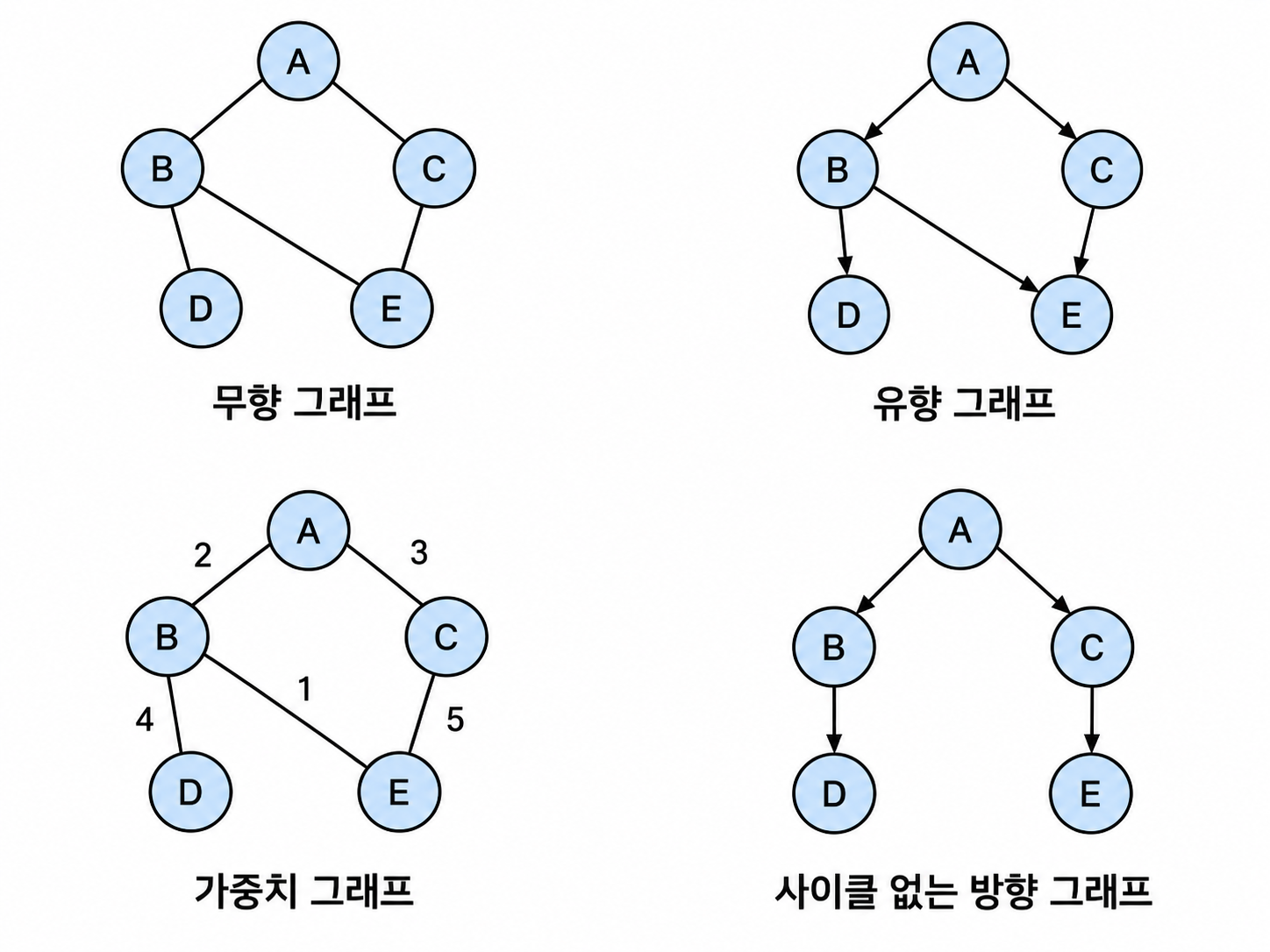
그래프 표현
- 간선의 정보를 저장하는 방식, 메모리나 성능을 고려해서 결정한다.
- 인접 행렬
N x N크기의 2차원 배열을 이용해서 간선 정보를 저장한다.
graph = [
    [0, 1, 1],
    [1, 0, 0],
    [1, 0, 0]
]- 인접 리스트
- 각 정점마다 해당 정점과 인접한 정점 정보를 저장한다.
graph = [
    [1, 2],
    [0],
    [0]
]- 간선의 배열
- 간선을 배열에 연속적으로 저장한다.
edges = [
    (0, 1),
    (0, 2)
]
2. DFS
한 경로를 끝까지 탐색한 뒤, 더 이상 갈 곳이 없으면 이전 갈림길로 돌아가 탐색을 이어간다.
재귀 또는 스택을 이용한다.
재귀 방식
def dfs(v):
    visited[v] = True
    print(v, end=' ')

    for next_node in graph[v]:
        if not visited[next_node]:
dfs(next_node)- 현재 정점을 방문 처리한다.
- 연결된 정점 중 방문하지 않은 정점으로 계속 들어간다.
스택 방식
def dfs(start):
    stack = [start]
    visited[start] = True

    while stack:
        v = stack.pop()
        print(v, end=' ')

        for next_node in graph[v]:
            if not visited[next_node]:
                stack.append(next_node)
                visited[next_node] = True
3. BFS
시작 정점에서 가까운 정점부터 차례대로 탐색한다.
큐(Queue)를 이용한다.
from collections import deque

def bfs(start):
    queue = deque([start])
    visited[start] = True

    while queue:
        v = queue.popleft()
        print(v, end=' ')

        for next_node in graph[v]:
            if not visited[next_node]:
                queue.append(next_node)
visited[next_node] = True- 시작 정점을 큐에 넣는다.
- 큐에서 하나씩 꺼내면서 인접 정점을 확인한다.
- 방문하지 않은 정점은 다시 큐에 넣는다.
DFS / BFS 차이
| DFS | BFS |
|---|---|
| 깊이 우선 탐색 | 너비 우선 탐색 |
| 재귀 / 스택 | 큐 |
| 한 경로를 깊게 탐색 | 가까운 정점부터 탐색 |
4. Union-Find
서로소 집합(Disjoint Set)을 관리하기 위한 자료구조이다.
Make-Set,Find-Set,Union연산을 사용한다.
Make-Set
각 원소가 자기 자신을 대표자로 가지도록 만든다.
N = 5

parent = [0] * (N + 1)

for i in range(1, N + 1):
    parent[i] = i
Find-Set
해당 원소가 속한 집합의 대표자를 찾는다.
def find_set(x):
    if x != parent[x]:
        parent[x] = find_set(parent[x])

    return parent[x]
parent[x] = find_set(parent[x])를 통해 대표자를 직접 가리키도록 변경하는 것을 경로 압축(Path Compression)이라고 한다.
Union
두 원소가 속한 집합을 하나로 합친다.
def union(x, y):
    root_x = find_set(x)
    root_y = find_set(y)

    if root_x != root_y:
        parent[root_y] = root_x
사용 예시는 다음과 같다.
union(1, 2)
union(2, 3)

print(find_set(1))
print(find_set(2))
print(find_set(3))1, 2, 3은 같은 대표자를 가지게 된다.
5. Union-Find 최적화
트리가 한쪽으로 길어지면 Find-Set 과정이 오래 걸릴 수 있다.
Rank
높이가 낮은 트리를 높은 트리 아래에 붙인다.
def union(x, y):
    root_x = find_set(x)
    root_y = find_set(y)

    if rank[root_x] > rank[root_y]:
        parent[root_y] = root_x

    else:
        parent[root_x] = root_y

        if rank[root_x] == rank[root_y]:
            rank[root_y] += 1
백엔드를 학습하는 주니어 개발자입니다.