Polymarket Trading Bot Development: How to Build a 24/7 Automated Event Trading System
Introduction
Prediction markets are changing how people trade on information. Instead of relying purely on traditional financial charts, traders now participate in event-based markets where outcomes are tied to real-world events like elections, crypto prices, regulatory approvals, and global trends. Platforms like Polymarket have made this model popular by allowing users to trade on probabilities in a transparent, blockchain-powered environment.
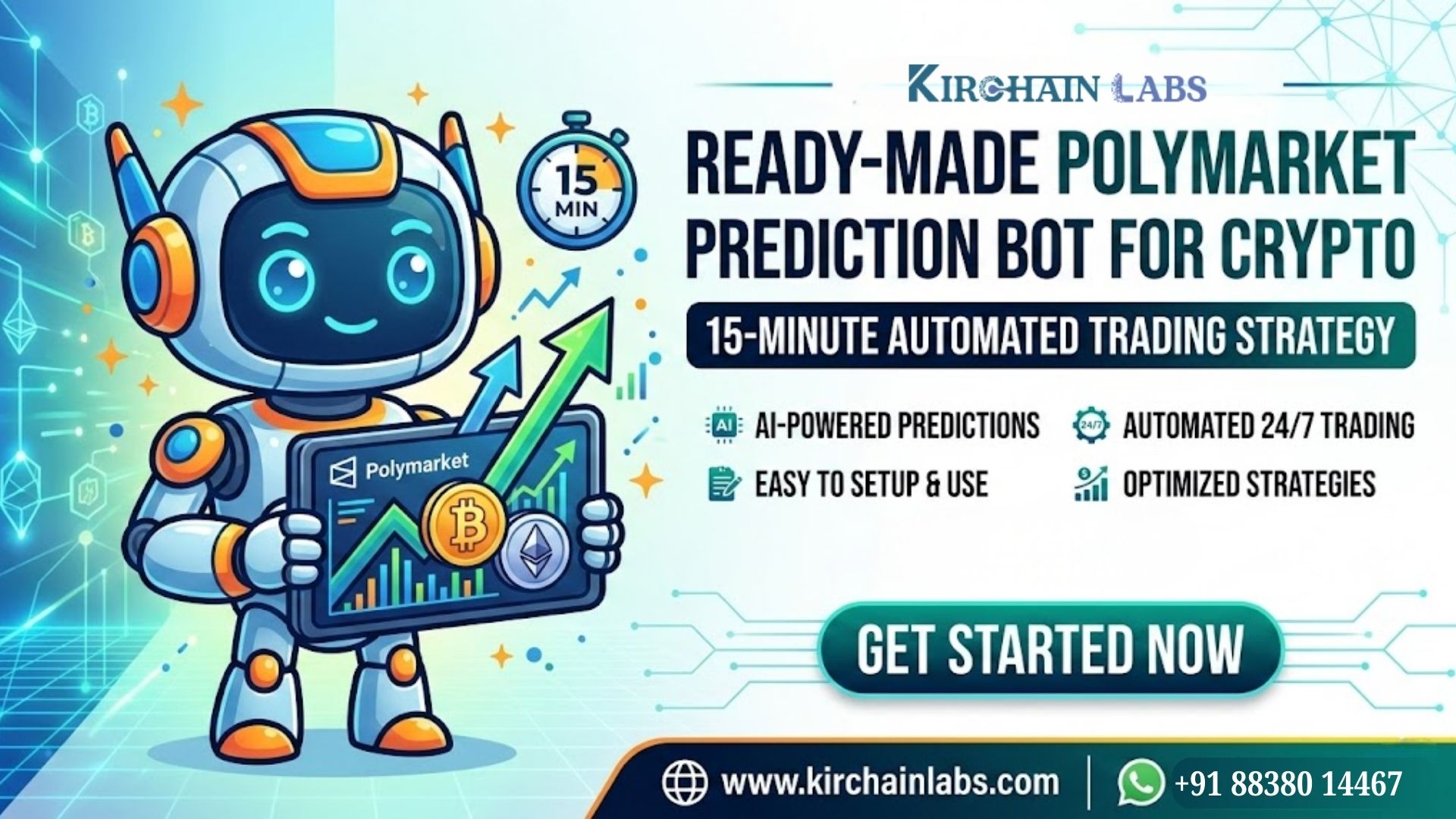
As these markets grow, manual trading becomes limiting. Monitoring multiple events, reacting to breaking news, and executing trades instantly requires speed and precision. That’s where polymarket trading bot development becomes essential. By automating strategy execution, data analysis, and order placement, trading bots transform how event-based markets are approached making 24/7 automated trading not just possible, but efficient.
What Is Polymarket?
Polymarket is a decentralized prediction market platform where users trade shares representing the likelihood of real-world outcomes. Each market is framed as a yes-or-no question, such as:
• Will a specific candidate win an election?
• Will Bitcoin cross a certain price level?
• Will a regulatory decision be approved this quarter?
The price of each share reflects the probability of that event occurring. For example, if a “Yes” share is trading at $0.65, the market is pricing in a 65% probability of that outcome.
Unlike traditional financial markets, prediction markets are driven by collective intelligence and real-time information flow. Prices can shift rapidly based on news, sentiment, and large trades creating opportunities for strategic automation.
How Polymarket Trading Bot Enhances the Process
Manual trading in prediction markets has clear limitations:
• Human reaction time is slower than market movement.
• Emotional decision-making can lead to inconsistent results.
• Monitoring multiple markets simultaneously is difficult.
• Opportunities can be missed outside active trading hours.
A trading bot solves these issues through automation and logic-based execution.
1. 24/7 Market Monitoring - Bots continuously track price changes, probability shifts, and trading volume. They do not sleep, hesitate, or second-guess.
2. Faster Execution - In fast-moving markets, milliseconds matter. Automated systems execute trades instantly when predefined conditions are met.
3. Strategy Discipline - Bots follow coded rules without emotional bias. Whether it’s a momentum strategy, reversal setup, or arbitrage opportunity, execution remains consistent.
4. Risk Management Integration - Capital allocation limits, stop-loss logic, and diversification controls can be built directly into the system, reducing exposure to sudden market swings.
How to Build a 24/7 Automated Event Trading System
Building a Polymarket trading bot requires a structured approach that combines technical development and strategic planning
Step 1: Analyze Market Mechanics Thoroughly
Before development begins, you must deeply understand how prediction markets function. Study how probabilities are priced, how liquidity impacts movement, how settlements occur, and how volatility behaves during breaking news.
Since prediction markets respond to real-world events rather than traditional financial indicators, strategy design must align with information flow and sentiment-driven pricing. A strong foundation here prevents flawed automation later.
Step 2: Design a Rule-Based Trading Framework
A bot is only as good as its strategy. Common approaches include:
• Momentum Strategy – Enter trades when probability trends upward within a defined timeframe.
• Mean Reversion – Trade against extreme short-term movements expecting a correction.
• Volume Spike Detection – Follow sudden increases in trading activity.
• Arbitrage Opportunities – Exploit price discrepancies across related markets.
Strategy rules must be precise. For example:
• Buy when probability drops below 40% but sentiment indicators remain stable.
• Sell when price increases 5% within 15 minutes.
Clarity in rules ensures predictable automation.
Step 3: Establish Secure API Connectivity
Automation depends on seamless communication with the platform. Integrate the Polymarket API to fetch live market data, monitor order books, and execute trades programmatically. Authentication, encrypted credentials, and secure wallet handling are critical at this stage. Stability and security in API connectivity ensure uninterrupted trading operations and protect capital.
Step 4: Develop the Real-Time Execution Engine
The execution engine is the operational core of the system. It processes live data streams, evaluates strategy conditions instantly, and sends orders without delay. Efficiency in code structure and latency optimization are essential, especially in volatile markets where price shifts can occur within seconds. A well-built execution layer ensures speed, accuracy, and reliability.
Step 5: Integrate Advanced Risk Controls
No automated system should operate without structured safeguards. Implement capital allocation rules, per-trade limits, maximum daily exposure, and automated exit thresholds. Diversification across markets can also reduce concentration risk. These controls prevent overexposure and protect the system from sudden probability reversals triggered by unexpected news.
Step 6: Perform Backtesting and Scenario Simulation
Before deployment, validate the strategy using historical data and simulated trading environments. Backtesting reveals performance metrics such as win rate, drawdown, consistency, and risk-reward balance.
Simulation testing ensures the bot behaves as expected under different market conditions, including high volatility scenarios. Refining parameters at this stage improves long-term sustainability.
Step 7: Deploy on Reliable Infrastructure with Continuous Optimization
A true 24/7 system requires stable hosting, typically via cloud infrastructure, to guarantee uninterrupted uptime. Once live, performance analytics should track efficiency, profitability, and risk exposure. Continuous optimization through parameter tuning or adaptive models ensures the bot evolves alongside market conditions rather than becoming outdated.
Final Thoughts
Prediction markets are evolving into sophisticated, data-driven ecosystems. As competition increases and information flows faster. A Polymarket trading bot development empowers traders and businesses to transition from manual execution to intelligent automation. A 24/7 automated event trading system can significantly improve operational efficiency and strategic positioning.
For organizations looking to build advanced, customized trading solutions in the prediction market space, partnering with experienced blockchain developers makes a measurable difference. Companies like KIR Chain Labs are contributing to this innovation landscape by delivering tailored trading bot solutions designed for performance, scalability, and long-term growth in event-based markets.