Doping in Sports (1 of 4)
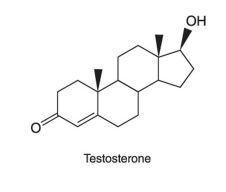
Natural testosterone is an anabolic steroid that promotes muscle development and repair.
천연 테스토스테론은 근육 성장과 재활을 촉진하는 합성 아나볼릭 스테로이드이다.
Anabolic Steroid Supplementation
• Common form of cheating to enhance athletic performance
• Causes long-term damage to numerous organs
많은 장기에 악영향을 미침
To promote fairness in sports and the long term health of athletes, the World Anti-Doping Agency prohibits all anabolic steroid doping.
Doping in Sports (2 of 4)
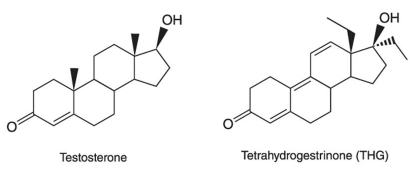
Tetrahydrogestrinone (THG)
• A synthetic designer anabolic steroid
• Mimics testosterone
Synthetic designer steroids like THG are designed to:
• Give the same short-term benefits as the natural anabolic steroids that they mimic
• Beat standard drug tests
Analytical chemists at the anti-doping agencies are continuously looking for new synthetic dopants and designing improved drug tests to catch them.
Doping in Sports (3 of 4)
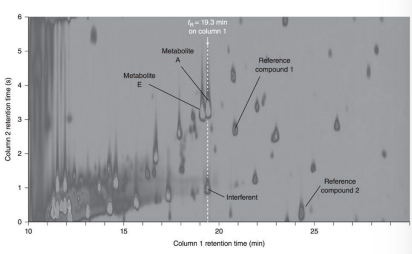
Improved Method for Detecting Steroid Doping
Sample: athlete urine
Instrument: two-dimensional gas chromatography
Column 1: isolates the testosterone mimics from the rest of the urine
테스토테론 유사물을 분리
Column 2: separates the testosterone-like steroids from each other
이들 물질들끼리 서로 분리
Combustion chamber: converts all carbon to CO2
연소실에서 모든 탄소 원자가 이산화탄소로 변환됨
Isotope ratio mass spectrometer: Monitors the relative amounts of 13CO2 and 12CO2
동위 원소 비율 질량 분석법은 두 동위 원소의 상대 존재비를 측정
Doping in Sports (4 of 4)
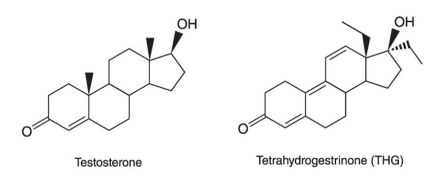
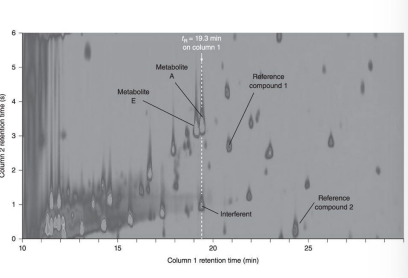
Synthetic testosterone mimics contain 13C less than natural testosterone.
합성 테스토스테론에는 천연 테스토스테론보다 13C가 적게 존재
A 13C deficit of just 4.6‰ (parts per thousand) provides statistically significant evidence for disqualifying an athlete due to synthetic steroid doping.
The Separation Process in Gas Chromatography
Injector
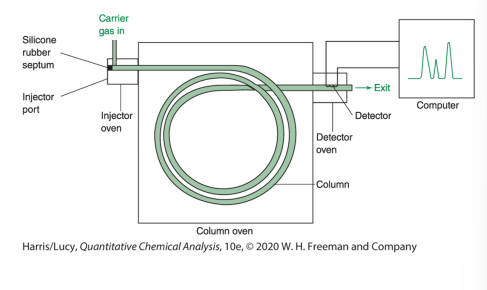
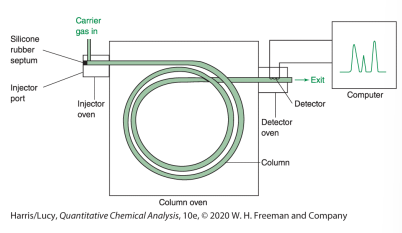
• The injector is the gas chromatograph component where the sample is introduced into the carrier gas.
injector: carrier gas라고 하는 기체 상태의 이동상으로 sample이 들어가는 곳
• The sample is injected through the injector septum (a rubber disk), into a heated stream of carrier gas.
시료가 septum을 통해 가열된 주입구 속으로 주입
• The sample is vaporized in the injector oven and is swept into the column by the carrier gas.
시료는 빠르게 휘발됨
Analytical Column and Column Oven
Gas Chromatograph Analytical Column
• Consists of a long, thin silica tube
길고 가는 용융 실리카 재질
• Coated on the outside with a thin polyimide film, which provides support and protection from atmospheric moisture
칼럼을 지지하고 대기 중 습기로부터 보호하기 위해 칼럼 외벽이 폴리이미드로 코팅되어 있음
• Coated on the inside with stationary phase
칼럼 내벽에 높은 분자량의 액체 같은 고분자 정지상 층이 코팅되어 있음
• Separates the sample components
Column Oven
• Tunes analyte elution times through control of column temperature
Detector and Computer
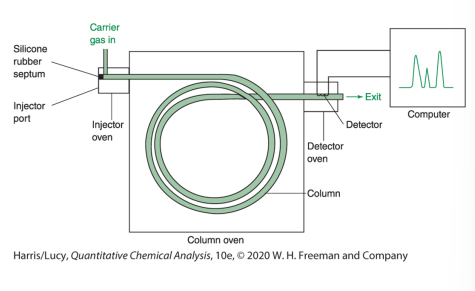
Detector
• Is held at a higher temperature than the column to ensure that analytes remain in the gas phase
용질이 기체 상태로 유지되도록, 검출기는 칼럼보다 높은 온도를 유지
• Generates a signal in proportion to the amount of analyte emerging from the column
분리된 성분들이 검출기를 통과할 때 검추기 신호가 컴퓨터에 표시됨
• Continuously sends a signal to the computer
Computer
• Controls the instrument
• Plots the signal received from the detector versus the time to generate a chromatogram
Analytical Column: A More Detailed Look (1 of 2)
- open tubular cloumn
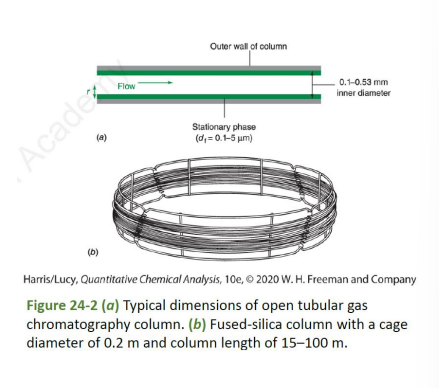
• Most analyses use long, narrow open tubular columns made of fused silica (SiO2).
길고 가는 용융 실리카 재질의 열린 관칼럼
• Contain an exterior polyimide film, which provides support and protection from atmospheric moisture.
칼럼을 지지하고 대기 중 습기로부터 보호하기 위해 칼럼 외벽이 폴리이미드로 코팅되어 있음
• Column inner diameters are typically 0.10–0.53 mm.
• Column lengths are 15–100 m, with 30m being common.
• Columns are coiled to fit within a compact temperature-controlled oven.
칼럼은 column oven에 들어갈 수 있도록 감겨 있음
Analytical Column: A More Detailed Look (2 of 2)
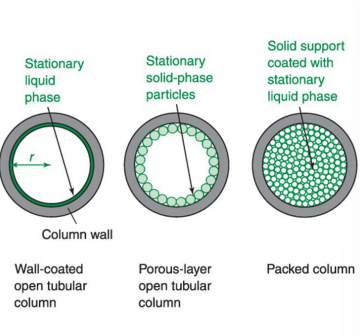
• The wall-coated open tubular column is the most common type of gas chromatography column.
• It has a 0.1-to 5-μm-thick film of high-molecular-weight liquid-like-polymer stationary phase coated on the
inner wall.
칼럼 내벽에 높은 분자량의 액체 같은 고분자 정지상 층이 두께로 코팅되어 있음
• The porous-layer open tubular column has solid particles of stationary phase on the inner wall.
다고성 층 칼럼은 내벽에 고체 입자 정지상이 입혀져 있음
• The porous-layer open tubular columns can handle larger sample sizes than the wall-coated open tubular columns.
다공성 층 칼럼은 내벽 코팅 열린 칼럼관보다 사이즈가 큰 시료를 다룰 수 있음
• Diameters ≥ 0.32 mm tend to overload the vacuum system of a mass spectrometer, so the gas stream must be split and only a fraction sent to the spectrometer.
지름 0.32mm이상의 칼럼은 질량 분석계의 진공시스템에 과주입을 야기할 수 있으므로 기체 흐름을 분할하여 일부만 질량 분석계로 들어가게 함
Column Inner Diameter and Resolution
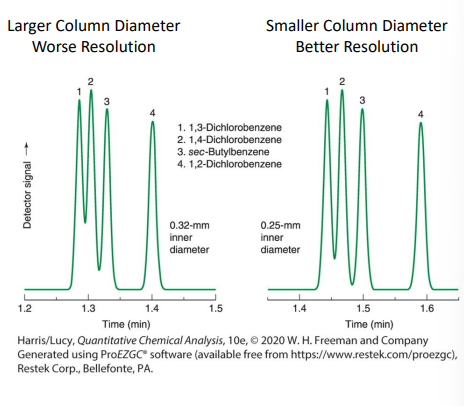
Wall-coated open tubular columns
• Narrow columns provide higher resolution than wider columns but require higher operating pressure and have less sample capacity.
칼럼의 내경이 작을수록 분리도는 증가하지만 시료 용량이 감소하고 압력이 증가함
Why does decreasing the column diameter improve resolution?
• Smaller diameters increase the frequency of solute interactions with the stationary phase.
내경이 작을수록 정지상과 용질의 상호작용 횟수가 늘어남
Column Length and Resolution
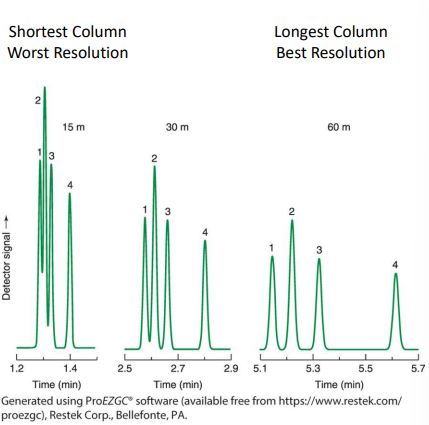
• Longer columns provide better resolution than shorter columns (at a cost of longer analysis times).
칼럼 길이가 증가함에 따라 피크의 분리도가 증가
• The plate number, N, of a column is proportional to length.
N은 칼럼길이에 비례
• Resolution is proportional to and, therefore, to the square root of column length.
칼럼의 이론 단수(N)은 칼럼 길이에 비례
분리도는 N^1/2에 비례
-> 따라서 분리도는 칼럼길이의 제곱근에 비례
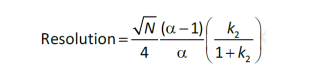
Why does increasing the column length improve resolution?
• Longer columns enable the analyte to partition more times between the stationary and mobile phases.
긴 칼럼은 분석 물질이 정지상과 이동상에 많이 분배되게 함
Stationary Phase Thickness and Resolution
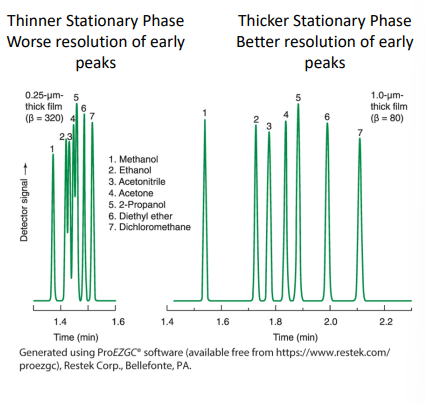
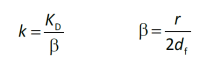
The retention factor (k) for a wall-coated column is related to the distribution constant (KD) and the phase ratio (β).
• Thicker stationary phases provide better resolution for early-eluting peaks (k ≤ 5).
정지상의 층두께가 증가하면 β가 감소하여 머무름 시간과 시료 용량 증가
->머무름 인자가 증가하면 빨리 용리되는 피크들의분리도가 증가
• Thinner stationary phases provide better resolution for later-eluting peaks (k > 5).
Why do thicker stationary phase films improve resolution for early eluting peaks?
• It enables longer retention of the most volatile components, accentuating small differences in the strength of their interactions with the stationary phase.
가장 휘발성이 높은 구성 요소를 더 오랜 시간 보유하여 정지상과의 상호 작용 강도에 대한 작은 차이를 강조
Choosing a Stationary Phase
The choice of liquid stationary phase is based on the rule "like dissolves like.”
• Nonpolar solutes are best separated on nonpolar stationary phases.
무극성 용질을 분리할 때에는 무극성 칼럼이 좋음
• Intermediate-polarity solutes are best separated on intermediate-polarity stationary phases.
중간 정도의 극성 칼럼은 극성이 중간 정도인 용질에 좋음
• Strongly polar solutes are best separated on strongly polar stationary phases.
강한 극성의 칼럼은 강한 극성의 용질의 분리에 좋음
• Chiral solutes are best separated on chiral stationary phases.
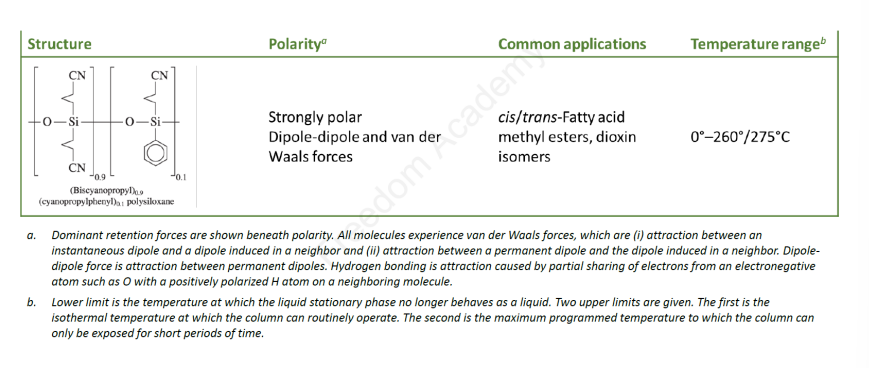
Table 24-1 Common Stationary Phases in Capillary Gas Chromatography (1 of 3)
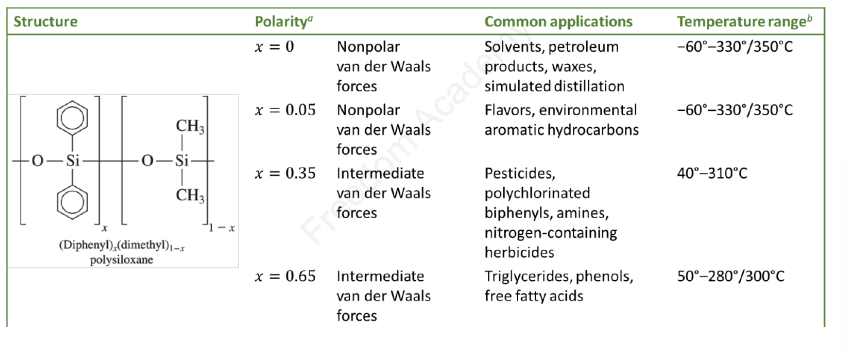
Table 24-1 Common Stationary Phases in Capillary Gas Chromatography (2 of 3)
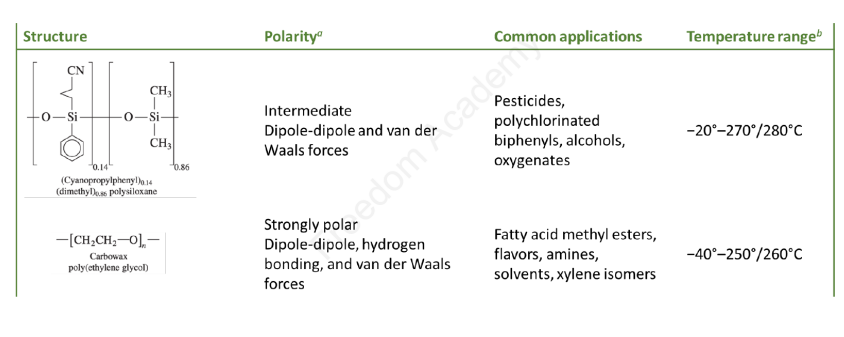
Table 24-1 Common Stationary Phases in Capillary Gas Chromatography (3 of 3)
Column Bleed at High Temperatures
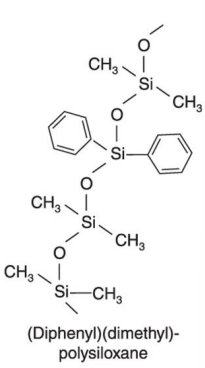
The gas chromatograph column temperature is normally ramped over the course of separation, starting at a low temperature and ending at a high temperature.
분리 과정 중에는 컬럼 온도를 주로 증가시켜 사용하며 이는 낮은 온도에서 시작해서 시간이 흐름에 따라 점차 높아짐
The high-temperature portion of the ramp leads to a problem known as column bleed.
Column bleed is caused by decomposition reactions, including:
• Thermal decomposition of the stationary phase
정지상의 열 분해
• Oxidation of the stationary phase by O2
산소에 의한 정지상 산화
• Hydrolysis of the stationary phase by H2O
물에 의한 정지상 가수 분해
Column bleed elevates the background signal, reduces the signal-to-noise ratio, and gradually contaminates the detector.
분해 산물들은 바탕 신호를 증가시켜 신호 대 잡음 비를 감소시키고 검출기를 오염시킴
It is good practice to periodically measure the retention factor, plate number, and peak asymmetry of a standard to monitor column
performance.
칼럼 성능을 관찰하기 위한 좋은 방법은 표준 물질의 머무름 인자. 단수, 피크의 대칭성을 주기적으로 측정
Strategies for Minimizing Column Bleed
가능한 한 얇은 정지상층과 가능한 한 좁고 짧은 칼럼을 사용
-
Bond (covalently attach) the stationary phase to the silica surface.
정지상을 실리카 표면에 결합시킴 -
Cross-link the stationary phase to itself.
정지상끼리 Cross-link시킴 -
Use only high-purity carrier gas as the mobile phase.
순도가 높은 운반 기체를 사용함 -
Scrub the carrier gas to remove trace O2
and H2O before the column.
운반 기체는 칼럼으로 들어가기 전에 O2와 H2O 세정 장치를 통과시켜야 함 -
Eliminate exposed silanol groups (Si–OH) on the inner surface of the silica capillary, which can initiate the breakdown of the stationary phase.
고정상의 분해를 개시하는 노출된 실란올기를 제거 -
Change the stationary phase to one with better resistance to decomposition.
Arylene Polysiloxane Stationary Phases
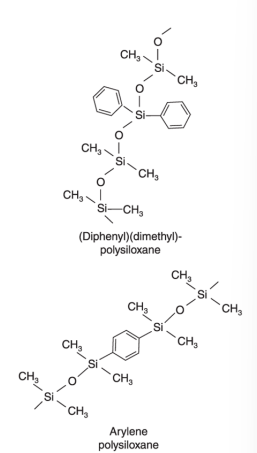
Arylene polysiloxane stationary phases were designed to mitigate the problem of column bleeding at high temperatures.
아릴렌 정지상은 열안정도가 높아 고온에서도 블리딩이 적음
Arylene Polysiloxane Stationary Phases
• Have increased thermal stability
• Bleed less at high temperature
• Are especially suitable for gas chromatography-mass spectrometry
• Sometimes produce chromatograms in which relative peak positions differ from those observed with other stationary phases (relative retention for some compounds changes)
때로는 다른 정지상에서 얻은 것과 다른 상대적인 피크 위치를 나타내는 크로마토그램을 생성
Ionic Liquid Stationary Phases
Ionic liquids are the newest type of stationary phase for gas chromatography.
새로운 형태의 기체 크로마토그래피용 정지상
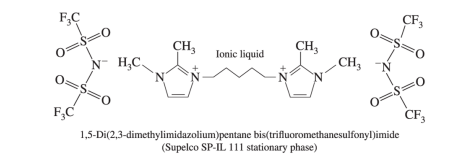
Ionic Liquids
• Melt below room temperature and remain a liquid over a wide temperature range
상온 이하에서 녹고, 넓은 온도 범위에서 액체로 존재
• Have low volatility at elevated temperature → increased operating temperature with low bleed
고온에서도 낮은 휘발성을 가져 블리딩을 최소화하면서 칼럼 온도를 높일 수 있게 함
• Provide multiple types of solvation interactions → novel selectivities for polar analytes
다양한 형태의 용매화 작용을 제공, 극성 분석 물질에 대한 새로운 선택성을 제시
Box 24-1 Chiral Phases for Separating Optical Isomers (1 of 4)
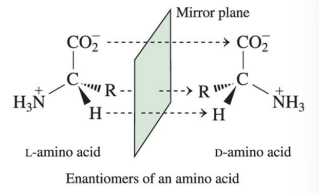
Most stationary phases are unable to separate optical isomers.
Optical isomers—also called enantiomers—are mirror image compounds that cannot be superimposed.
광학 이성질체는 서로 겹쳐지지 않는 거울상 화합물
Example 1: amino acids
Nature uses only the L-enantiomers of amino acids to build proteins.
단백질을 형성하는 자연계의 아미노산
Example 2: cough suppressant
The enantiomer of the cough suppressant methorphan is a prohibited opioid.
메토르판의 거울상 이성질체 중 하나는 금지된 opioid임
Box 24-1 Chiral Phases for Separating Optical Isomers (2 of 4)
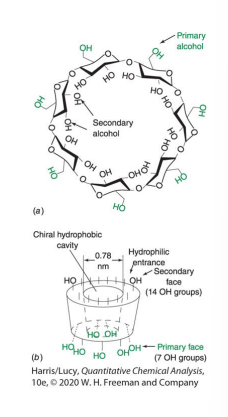
A chiral (optically active) stationary phase is used to separate enantiomers.
카이랄 정지상을 사용한 크로마토그래피는 거울상 이성질체를 분리하는 방법 중 하나
Example: β-cyclodextrin (chiral cavity with 0.78-nm-diameter opening)
• Naturally occurring cyclic sugar
자연계에 존재하는 고리형 당
• Bonded to a conventional polysiloxane stationary phase
폴리실록세인 정지상에 결합되어 있음
• Capped with alkyl groups to decrease the polarity of the faces
극성을 감소시키기 위해 수산화기는 알킬기로 덮음
• Incorporated into a chromatography column
Enantiomers have different affinities for β cyclodextrin’s chiral, hydrophobic cavity → chromatographic separation of enantiomers.
거울상 이성질체들은 cyclodextrin cavity에 대한 친화력이 다르므로 칼럼을 통과하는 동안 분리됨
Box 24-1 Chiral Phases for Separating Optical Isomers (3 of 4)
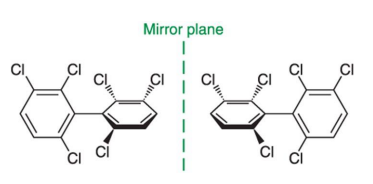
Polychlorinated biphenyls (PCB) were originally synthesized for industrial uses (electrical components, high-temperature hydraulic fluid additive, etc.).
Polychlorinated Biphenyls (PCB)
• Industrially produced in 1:1 (racemic) mixtures of the two enantiomers
두 거울상 이성질체의 혼합물
• Banned after PCB compounds were discovered to be probable carcinogens
• Remain a concern because PCB compounds persist in the environment
Box 24-1 Chiral Phases for Separating Optical Isomers (4 of 4)
β-Cyclodextrin chiral chromatography of PCB compounds in eucalyptus leaves.
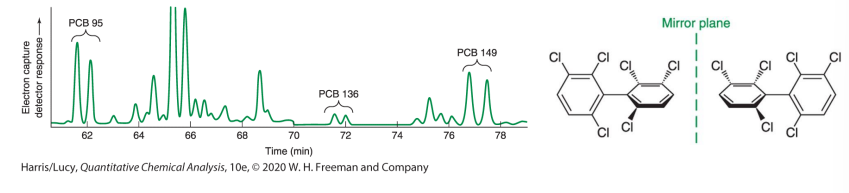
The chromatogram shows the separation of the two enantiomers of each of the three PCB compounds.
The smaller size of the trailing peaks indicates that the eucalyptus plant preferentially metabolizes enantiomers whose handedness matches that of the chiral column.
식물이 두 거울상 이성질체를 대사시키는 속도가 다르다는 증거
Porous-Layer Open Tubular Columns
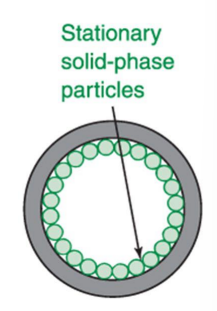
Porous-layer columns have high-surface-area porous solid particles adhering to the column wall.
다공성 층 칼럼의 내벽에는 높은 표면적을 가지는 다공성 고체 입자들이 붙어 있음
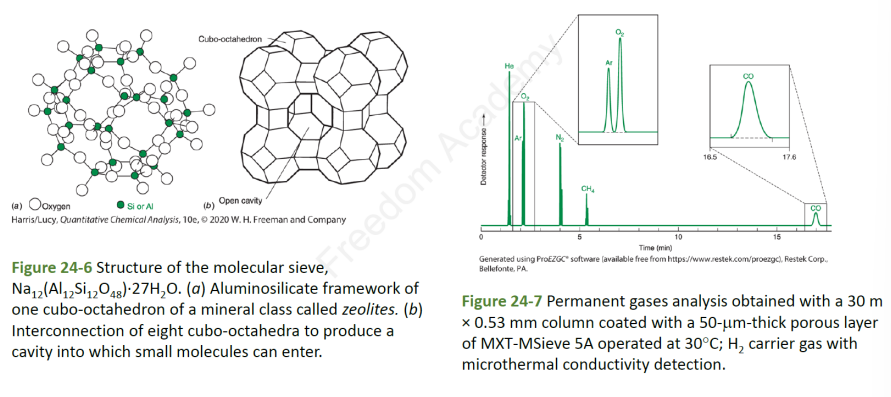
Solid stationary phases used in porous-layer columns include porous polymers, high-surface-area carbon, alumina (Al2O3), and molecular sieves (inorganic or organic materials with cavities into which small molecules enter and are partially retained).
다공성 컬럼에서 사용되는 고체 정지상에는 다공성 고분자, 높은 표면적을 가지는 탄소, 알루미나, 분자체 등이 있음
Porous-layer columns can separate volatile gases that are not easily separated on standard liquid stationary phases (e.g., He, Ar, O2, N2, CH4, CO).
다공성 층을 갖는 컬럼은 휘발성 가스를 분리하는 데 사용되며, 이는 표준 액체 정지상에서 쉽게 분리되지 않는 가스들을 효과적으로 분리할 수 있음
Porous-Layer Open Tubular Column with Zeolite (Molecular Sieve) Stationary Phase
Packed Columns (1 of 2)
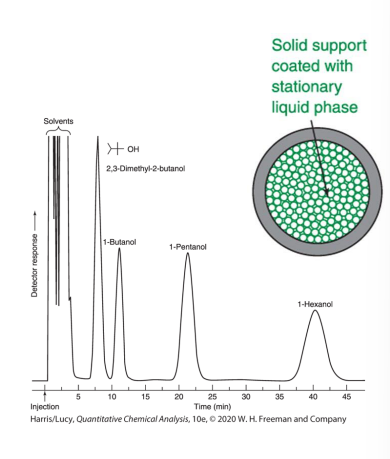
Packed columns are filled with fine particles of solid support coated with a nonvolatile liquid stationary phase, or the solid itself may be the stationary phase.
비휘발성 액체 정지상을 입힌 작은 고체 입자 지지체로 채워져 있음, 고체 자체가 정지상이 되기도 함
Compared with open tubular columns, packed columns have:
• Greater sample capacity
시료 용량이 큼
• Broader peaks → less resolution
• Longer retention times
피크가 더 넓어지고 머무름 시간이 더 길어지며 분리도가 낮아짐
Packed columns are used for:
• Preparative separations
• Separations of poorly retained gases
Packed Columns (2 of 2)
• Usually made of stainless steel or glass tubing and are typically 1–5 m in length and 2–4 mm in diameter
• Uniform particle size decreases the multiple path term in the van Deemter equation, thereby reducing plate height and increasing resolution
충전 칼럼에서 입자 크기가 균일하면 다 통로항이 감소하여, 단높이가 감소하고 분리도는 증가
• Small particle size decreases the time required for mass transfer, thereby improving column efficiency
입자 크기가 용질이 평형에 도달하는 데 필요한 시간이 감소하여 칼럼 효율이 증가
• The smaller the particle size, the less space between particles, and the more pressure required to force the mobile phase through the column
입자 크기가 감소하면 입자 사이 공간이 감소하여 이동상을 흘려주는 데 더 높은 압력이 필요
Retention on Polar and Nonpolar Stationary Phases
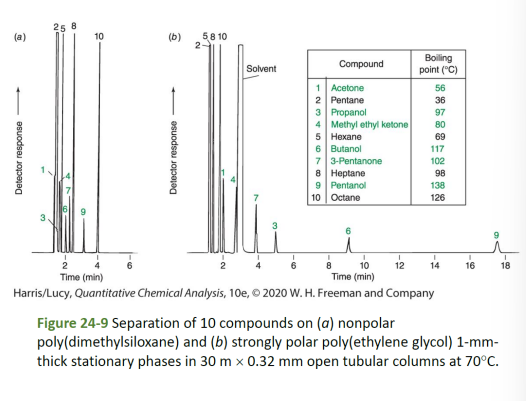
On the nonpolar stationary phase, the boiling point of the solute is the primary influence on retention.
• Compounds 1–10 elute in order of increasing boiling point (decreasing volatility).
On the polar stationary phase, polarity is the primary influence on retention.
• The 4 alkanes elute first.
• The 3 ketones elute second.
• The 3 alcohols elute last.
Retention Factor
Retention is governed by thermodynamics.
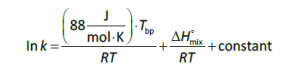
The retention factor (k) depends on:
• The enthalpy of vaporization (ΔH0vap) of the solute
순수한 용질의 기화 엔탈피
• The enthalpy of mixing (ΔH0mix) of the solute and the stationary phase
정지상 액체와의 혼합 엔탈피에 의존
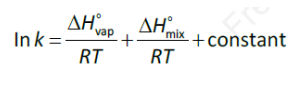
For non-hydrogen-bonding solutes, Trouton’s rule states that ΔH0vap is proportional to the atmospheric pressure boiling temperature.
수소 결합을 하지 않는 용질에 대하여 Trouton 법칙은 기화열이 끓는점에 비례함을 보여 줌
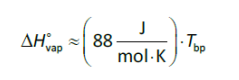
Combining the equations yields the approximation
Temperature Programming (1 of 2)
Temperature programming, in which the temperature of the column is raised during the separation, is used to increase analyte vapor pressure and decrease retention times of lateeluting components.
분리 도중 칼럼의 온도를 올려줌으로써 분석 물질의 증기압을 증가시켜 늦게 용리되는 성분의 머무름 시간을 줄이는 방법
The vapor pressure of a solute depends on the temperature (T in kelvins) and the heat of vaporization (ΔHvap) of the solute.
용질의 증기압은 온도와 용질의 기화열에 의존

The general elution problem is the inability of a single isothermal (constant temperature) column temperature to provide adequate separation within a reasonable time for samples containing compounds with very different boiling points.
일정한 온도에서는 적절한 시간 내에 끓는점이 매우 다른 화합물들을 함유하는 시료의 분리는 불가능
Temperature Programming (2 of 2)
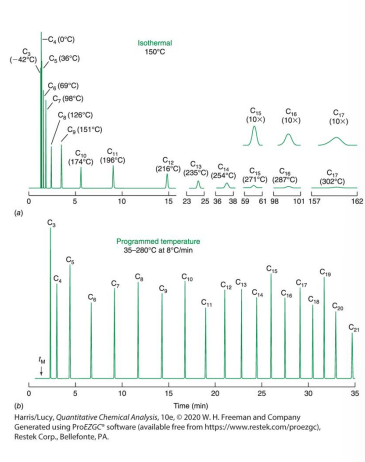
At the constant (isothermal) temperature of 150°C:
• The column is above the atmospheric pressure boiling temperatures of the small alkanes, and they are almost entirely in the vapor phase and so weakly retained they
emerge close together near tM.
칼럼은 작은 알케인의 끓는점보다 높음
작은 알케인들은 거의 전부 증기 상태에 있어서 정지상에 매우 약하게 머무르며 tM 근처에서 함께 용리됨
• Retention increases dramatically with the boiling point of compounds. Less volatile compounds may not even elute from the column.
머무름은 화합물의 끓는점이 높아짐에 따라 급격히 증가-> 휘발성이 작은 화합물은 칼럼에서 용출되지 않을 수 있음
If the column temperature is increased from 35°to 280°C at a rate of 8°C/min, all compounds are eluted and the separation of peaks is fairly uniform.
칼럼 온도가 35°에서 280°로 증가하면 모든 화합물이 용리되고 피크 분리가 상당히 균일함
• The initial temperature is far below the boiling temperatures of most compounds.
초기 온도(35°)는 대부분의 화합물의 끓는점보다 훨씬 낮으므로 낮은 증기압을 가지고 칼럼 헤드에 강하게 머무름'
• As the temperature increases, the compound becomes less and less retained.
칼럼 온도가 높아지면 칼럼을 따라 화합물이 이동하기 시작
High-Temperature Limits for Columns
Most columns come with a label showing two high-temperature limits.
• The isothermal high-temperature limit (lower): the highest temperature at which the column can be held for a long time
낮은 값은 등온 상한으로서, 카럼이 수용 가능한 수준의 열안정성을 제공
• The temperature programming high temperature limit (higher): the highest temperature that the column can be heated to for a few minutes at the end of a programmed temperature run
높은 값은 프로그래밍 상한으로서, 칼럼은 한 번에 수 분 정도만 사용되어야 함
The temperature limits help analysts to design experiments in a way that extends the usable life of the stationary phase in the column.
Column Pressure Programming
• Many chromatographs are equipped with electronic pressure control of the carrier gas.
대부분의 크로파토그래프에는 운반 기체의 압력 제어 장치가 부착되어 있음
• Increasing the inlet pressure increases the flow of the mobile phase and decreases retention time.
입구 압력을 높이면 이동상의 흐름이 증가하고 머무름 시간이 감소함
• Sometimes a pressure program can be used to reduce retention times of late-eluting compounds.
늦게 용리하는 용질의 머무름 시간을 감소시킬 수 있음
• This is advantageous over temperature programming because time is not wasted between runs waiting for the hot column to cool.
온도 프로그래밍을 사용하지 않고 Column Pressure Programming을 사용하는 경우, 실험 사이에 열 컬럼이 식기를 기다리는 시간이 필요하지 않아서 시간을 절약할 수 있음
Effect of Carrier Gas on Column Flow Rates
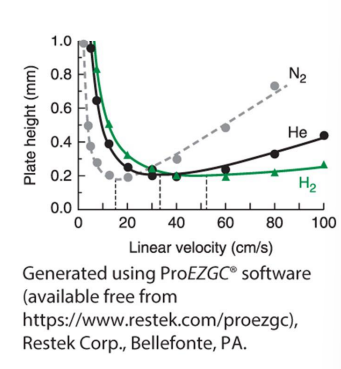
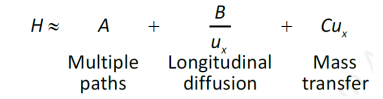
The van Deemter equation guides the setting of carrier gas flow rates (ux).
Optimal flow rate increases in the order N2 < He < H2.
Typically, carrier gas flow rates ux are set 1.5–2 times greater than the optimum velocity that minimizes plate height.
대부분의 분석에서 운반 기체의 유속은 최적 유속보다 1.5~2배 빠름
This faster flow rate sacrifices some resolution to obtain maximum efficiency (highest plate number) per unit time.
빠른 유속을 사용하는 이유는 단위 시간당 최대 효율을 얻기 위함
-> 분리도가 낮아지면 분석 속도가 빨라짐
Influence of Carrier Gas on Analysis Time
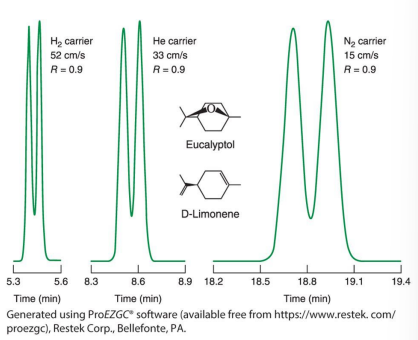
Fastest separations can be achieved with H2 as carrier gas, and H2 can be run much faster than its optimal velocity with little penalty in resolution.
H2 and He give better resolution than N2
at high flow rate because solutes diffuse most rapidly through H2 and least rapidly through N2.
빠른 유속에서 H2 and He는 N2보다 높은 분리도를 제공-> 용질이 N2에서보다 H2 and He에서 더 빠리 확산되므로
• Faster diffusion decreases the mass transfer (Cux) term in the van Deemter equation, enabling the same resolution at higher flow rates.
이동상과 정지상 사이에서용질이 빠르게 확산할수록 질량이동항이 작이짐
• If the stationary phase is thin enough (≤ 0.5 μm), mass transfer is dominated by slow diffusion through the mobile phase rather than the stationary phase.
만약 정지상층이 충분히 얇으면, 질량 이동은 정지상보다 이동상을 통한 느린 확신에 지배됨
Sample Injection
Three Common Types of Injections
Injection into Open Tubular Columns
• Split injections: In a split injection, a portion of the injected sample is discarded to avoid overloading the column.
과부하를 피하기 위해 주입된 시료가 일부 폐기됨
열린 관칼럼에 적은 부피의 시료를 주입하는 일반적인 방법
• Splitless injections: These are best for trace analysis of high-boiling analytes in low-boiling solvents.
- Solvent trapping
- Cold trapping
끓는점이 낮은 용매에 끓는점이 높은 용질이 미량 녹아있을 때 유용
• On-column injections: These are best for thermally unstable solutes and high-boiling solvents; best for quantitative analysis
끓는점이 높은 용매에 녹아 있는 열적으로 부랑ㄴ정한 용질의 정량 분석에 최선의 방법
Detectors
Qualitative Analysis
Three initial qualitative analysis approaches to identify a peak:
피크의 성분을 확인하기 위한 정성분석에서는 피크의 머무름 시간과 아는 화합물의 머무름 시간을 비교
-
Spike the unknown sample with an authentic sample of the suspected compound. If the authentic and unknown compounds are the same, then the area of the targeted peak should increase upon spiking.
시료에 아는 화합물을 소량 첨가, 첨가된 화합물이 미지 성분과 동일하다면 해당 피크의 면적이 증가 -
Repeat the spiking experiment on a separate column having a stationary phase of differing polarity.
고정상의 극성이 다른 다양한 칼럼에서 수행 -
Collect a mass spectrum of the targeted peak and compare it to a library of spectra.
피크 성분의 스펙트럼을 데이터베이스 목록과 비교함으로써 피크 화합물을 확인
Other confirmatory tests can be carried out as needed using complementary methods such as FTIR and NMR.
Quantitative Analysis
• Quantitative analysis is typically based on peak area.
정량 분석은 크로마토그래피 피크의 면적이나 높이에 근거
• In the linear response concentration range, the area of a peak reported by the instrument is proportional to the quantity of that component.
linear response 농도 범위에서는 피크의 면적이 그 성분의 양에 비례함
• Quantitative analysis with an autosampler typically uses a calibration curve constructed with external standards.
자동 시료 주입기를 사용한 정량 분석에서는 일반적으로 외부 표준 물질을 이용하여 만든 교정 곡선을 사용
• Quantitative analysis with manual injection is performed by a simpler internal standards analysis that uses a single calibration sample.
수동 주입을 통한 정량 분석에서는 내부 표준 물질을 미지 시료에 첨가
Common Gas Chromatography Detectors
Four detectors are used in ~90% of current gas chromatographic analyses.
• Thermal conductivity
• Flame ionization
• Electron capture
• Mass spectrometer
Universal detector: responds to all analytes, but not to carrier gas
모든 분석물질에 감응하나 운반 기체에는 감응하지 않음
Selective detector: responds to a limited class of analytes
제한된 종류의 분석 물질에 감응
Detectors are held at a higher temperature than the column to ensure that analytes do not condense prior to detection.
검출기는 컬럼보다 높은 온도로 유지되어 분석물이 검출되기 전에 응결되지 않도록 보장
Thermal Conductivity Detector (1 of 3)
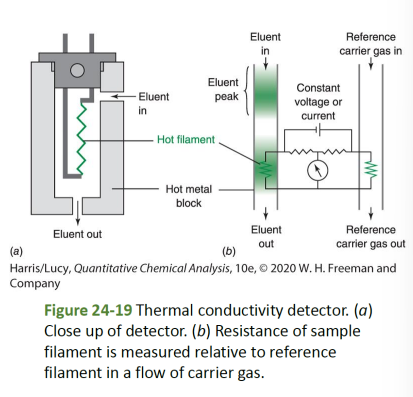
A simple and universal detector that was common in the past, but which lacks the sensitivity needed to detect minute quantities of analyte eluted from open tubular columns.
간단하고 범용이나 열린 관칼람에 사용되는 다른 검출기보다는 감도가 낮음
Thermal conductivity measures the ability of a substance to transport heat from a hot region to a cold region.
열전도도는 어떤 물질이 뜨거운 영역에서 찬 영역으로 열을 이동시키는 능력의 척도
• The carrier gas must have a very different thermal conductivity from the analytes.
열전도도 검출기에서 운반 기체는 분석 물질과 매우 다른 열전도도를 가져야 함
• Helium is most commonly used.
• Any analyte mixed with He lowers the conductivity of the gas stream.
어느 분석 물질이든 He와 혼합되면 기체 흐름의 열전도도를 낮춤
Thermal Conductivity Detector (2 of 3)
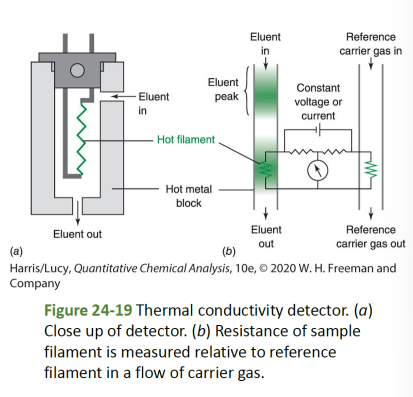
Principle of Operation
• Eluate from the column flows over a hot tungsten-rhenium filament.
칼럼에서 나온 용출 기체는 가열된 tungsten-rhenium filament 위를 흐름
• Pure carrier gas flowing over the filament establishes a baseline temperature of the filament.
• When analyte emerges:
- The thermal conductivity of the eluate decreases
- Causes the filament to get hotter → an increase in electrical resistance → a change in voltage
분석 물질이 용리되면, 기체 흐름의 전도도가 감소하고 필라멘트는 뜨거워져서 전기 저항이 증가하며, 필라멘트에 걸리는 전위가 변함
• The detector measures the change in voltage.
검출기는 전위의 변화를 측정
Thermal Conductivity Detector (3 of 3)
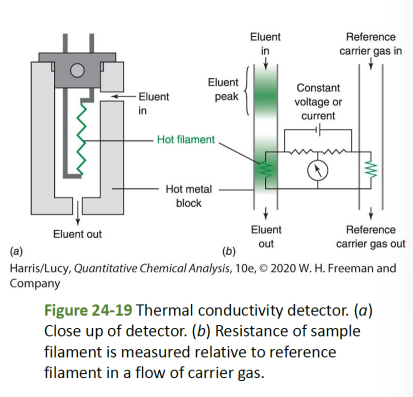
Advantages
• Simple
• Large (105) linear range
• Responds to both organic and inorganic species
• Nondestructive to the sample
Disadvantages
• Has low sensitivity (can be increased by increasing the filament current, decreasing the flow rate, lowering the detector block temperature)
검출기 감도는 필라멘트 전류를 증가하거나, 유속을 감소시키거나, 검출기 블록의 온도를 감소시키면 증가함
Peak area response depends directly on concentration and is inversely proportional to flow rate.
피크 면적은 농도에 직접 비례하고, 유속에 반비례
Flame Ionization Detector (1 of 2)
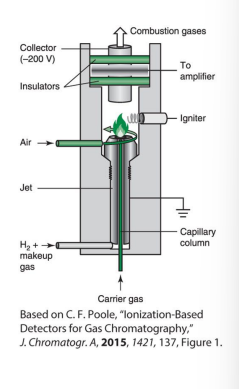
Principle of Operation
• Eluate from the column is burned in a mixture of H2 and air.
H2와 공기 혼합물 내에서 용출액을 태움
• Analyte containing carbon atoms (except carbonyl and carboxyl carbons) produces CH radicals, which produce CHO+ ions and electrons in the flame.
탄소 원자는 CH 라디칼을 생성하는데, 이 라디칼이 불꽃 속에서 CHO+이온과 전자를 생성
CH + O → CHO+ + e−• Only approximately 1 in 106 C atoms produce an ion.
탄소 원자 10^6개중 약 한 개만 이온을 만듬
• Ion production is proportional to the number of susceptible carbon atoms entering the flame.
이온 생성은 불꽃 속으로 들어가는 탄소 원자 수에 비례
• In the absence of an analyte, a current of ~10−14A flows between the flame tip and the collector.
분석 물질이 없을 때, 불꽃의 끝과 Collector 사이에 약 10^-14A의 전류가 흐름
• Analytes produce a current of ~10−12A, which is converted to a voltage, amplified, filtered, and converted to a digital signal.
분석 물질은 약 10^-12A의 전류를 생성하는데, 이 전류는 볼트로 전환되고, 증폭되며, 고주파 잡음을 제거하기 위해 필터된 후 디지털 신호로 바뀜
Flame Ionization Detector (2 of 2)
Response to organic compounds is proportional to solute mass over seven orders of magnitude.
유기 화합물에 대한 감응은 10^7 이상의 질량 범위에서 용질의 질량에 비례
Advantages
• Cost-effective
• Large (107) linear range
• ~100 times higher sensitivity than a thermal conductivity detector
• Responds to all compounds with C−H bonds
Disadvantages
• Destroys the sample
• Requires additional gases and controllers
• Does not provide molecular structure information
Electron Capture Detector (1 of 2)
The most popular selective detector
• Particularly sensitive to halogen containing molecules, conjugated carbonyls, nitriles, nitro compounds, and organometallic compounds, but relatively insensitive to hydrocarbons, alcohols, and ketones
할로젠을 함유하는 분자, 콘쥬게이션된 카보닐, 나이트릴. 나이트로 화합물 및 유기 금속 화합물에는 특히 민감하나, 탄화수소, 알코올 및 케톤에는 상대적으로 감도가 낮음
• Useful for chlorinated pesticides and fluorocarbons in environmental samples
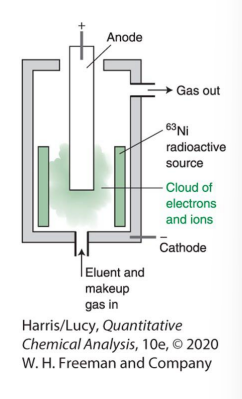
• Eluent from the column ionized by high-energy electrons (β−particles) emitted by radioactive 63Ni
검출기로 들어가는 기체는 방사성 63Ni에서 방출되는 고에너지 전자에 의해 이온화됨
• Electrons in the plasma attracted to an anode, producing a small current that is maintained at a constant level by variable frequency pulses between the cathode and anode
이렇게 형성된 플라스마 내 전자는 양극으로 끌려가 작은 전류를 생성하는데, 이 전류는 양극과 음극 사이에 가해지는 variable frequency pulse에 의해 일정하게 유지됨
Electron Capture Detector (2 of 2)
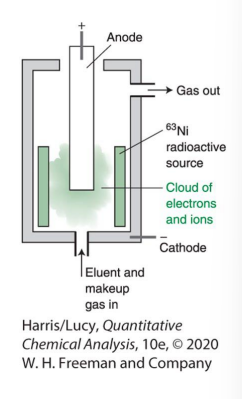
• When analytes with a high electron affinity enter the detector, they capture some electrons and decrease the conductivity of the plasma.
전자친화도가 큰 분석 물질이 검출기로 들어가면, 일부 전자를 포획하여 플라스마의 전도도를 감소시킴
• The detector responds by varying the frequency of voltage pulses to maintain a constant current.
검출기는 일정한 전류를 유지하기 위해 전압 펄스의 주파수를 변화시킴으로써 감응함
• The frequency of pulses is the detector signal.
펄스의 주파수가 검출기 신호임
The electron capture detector is extremely sensitive, with a detection limit comparable to that of mass spectrometric selected ion monitoring
전자 포획 검출기는 매우 민감하며, 검출 한계는 질량 분석계의 검출 한계와 비교될 정도임
Gas Chromatography–Mass Spectrometry (1 of 2)
Mass spectrometry provides both qualitative and quantitative information.
질량 분석법은 정성 및 정량 정보를 모두 제공하는 민감한 검출기
• Most common are quadrupole mass analyzers with electron ionization.
전자 이온화를 사용하는 투과 사중 극자 질량 분석기가 가장 일반적임
• Time-of-flight analyzers are used when rapid spectral acquisition or accurate mass measurement are needed.
TOF는 신속한 스펙트럼 수집 또는 정확한 질량 측정이 필요할 때 사용됨
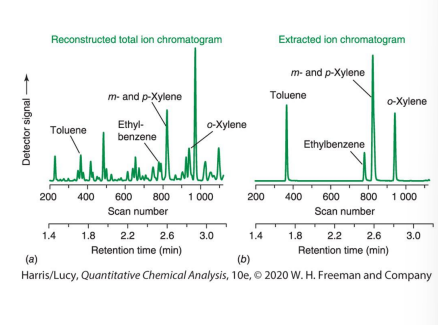
Trace (a) shows the reconstructed total ion chromatogram from the gas chromatograph – mass spectrometer collecting a mass spectrum of the column effluent from m/z 40 to 400 every 2 ms.
• A total of 5628 spectra of eluate were recorded between 1 and 12 min.
Gas Chromatography–Mass Spectrometry (2 of 2)
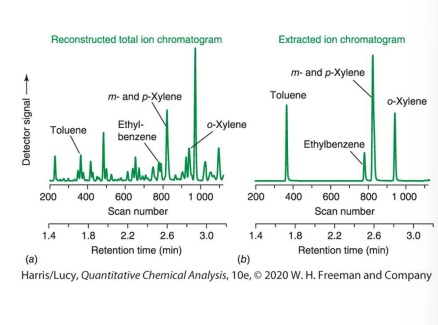
• The ordinate in trace a is the sum of the detector signal for all m/z above a selected cutoff.
세로 좌표는 선택한 한계 이상의 모든 m/z에 대한 검출기 신호의 합
• It measures everything eluted from the column.
칼럼에서용리되는 모든 물질을 측정
• The extracted ion chromatogram in trace b plots only the signal collected at m/z 91 (C7H7+) which is characteristic of monoaromatics.
• Use of selected ion monitoring lowers the detection limit by a factor of 102 compared with m/z scanning.
선택 이온 검출법을 사용하면 신호 대 잡음이 개선되므로 m/z 스캐닝에 비해 검출 한계를 10^2배 낮춤
• Typically at least one additional m/z is monitored to confirm the identity of the analyte.
일반적으로 하나 이상의 추가 m/z를 검출하여 분석 물질을 확인함
Selected Reaction Monitoring
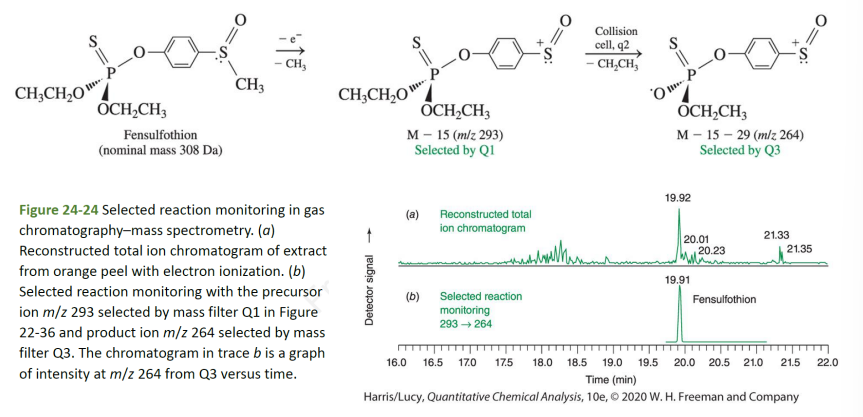
Sample Preparation
Sample Preparation (1 of 2)
Sample preparation is the process of transforming a sample into a form that is suitable for analysis.
시료 준비란 시료를 분석하기에 적당한 형태로 바꾸는 것
Sample preparation might include:
• Extracting analyte from a complex matrix
복잡한 매트릭스에서 분석 물질의 추출
• Preconcentrating very dilute analytes to get a high enough concentration to measure
매우 묽은 분석 물질을 측정에 충분한 농도로 예비 농축
• Removing or masking interfering species
방해 물질을 제거하거나 막아주는 일
• Derivatizing—chemically transforming analyte into a more convenient or more easily detected form
분석물질을 화학적으로 바꾸어 좀 더 편리하게 검출할 수 있는 형태로 바꾸는 일
Sample Preparation (2 of 2)
• The key to successful chromatography of a complex sample is to clean it up before it sees the column.
• Methods described include solid-phase microextraction, stir-bar-sorptive extraction, purge and trap, thermal desorption, and pyrolysis.
• Other methods include liquid extraction, supercritical fluid extraction, and solid phase extraction (Chapter 28).
If you do not clean up your samples, chromatograms could contain a broad “forest” of unresolved peaks, and nonvolatile substances will ruin the expensive chromatography column.
Method Development in Gas Chromatography
Method Development in Gas Chromatography
Order of Decisions
1. Establish the goal of the analysis.
분석 목적
2. Design the sample preparation steps.
시료 준비
3. Select the detector.
검출기
4. Select the analytical column.
칼럼
5. Select the injection method.
주입
Selecting the Column
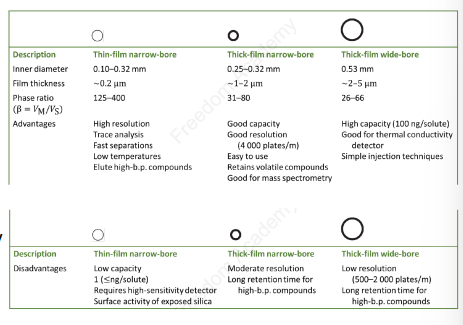
The basic choices are stationary phase, column diameter, and length, and thickness of stationary phase.
기본적인 선택 사항은 정지상, 칼럼의 길이, 그리고 정지상 층의 두께
• A nonpolar stationary phase is most useful.
무극성 정지상이 가장 유용
• An intermediate polarity stationary phase will handle most separations the nonpolar column cannot.
중간 극성의정지상은 무극성 칼럼이 다룰 수 없는 대부분의 분리에 적용
• A strongly polar column might be necessary for highly polar compounds. Column suppliers have databases of chromatograms for common analyte sets, which can guide column selection.
극성이 큰 화합물의 경우, 강한 극성 칼럼이 필요할 수 있음.
칼럼 공급업체는 칼럼 선택을 아내하기 위한 일반적인 분석 물질의 크로마토그램이 테이터베이스를 보유
Mass Limits for Columns and Detectors
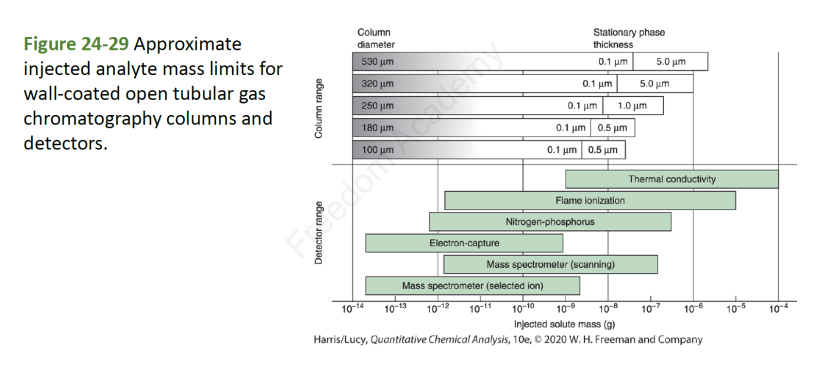
- 가로 축은 칼럼 혹은 검출기에 도달하는 분석물질의 질량
- 주입 시료 양이 감소할수록 크로마토그래피가 어려워짐
- 10^-11g 보다 작아지면 주입기와 칼럼에서의 흡착 및 분해로 인해 시료가 손실될 수 있음

Luckily, there’s a well-written guide that answers all of those concerns. It discusses buy steroids https://woodbridgebrewingco.com/art/buying_steroids_online_a_comprehensive_guide_to_safe_purchases.html payment safety, how to assess a seller’s credibility, and which warning signs to never ignore. You’ll find all this useful information in this article, which is tailored to help new buyers make safe and confident decisions when shopping online for steroids.