DFS
Directed Graph를 예시로 들어보자.
Graph가 adjacency list를 사용한다고 가정하자.
Setting of DFS
Color
-
WHITE: 아직 discover 되지 않은 vertex
-
GRAY: Discover 되었지만 아직 종료되지 않은 vertex
-
BLACK: Discover 되고, 해당 vertex에 adjacency한 모든 vertex가 examine 된 vertex.
Timestamps
-
: discovery time
- GRAY로 변한 시간
-
: finishing time
- BLACK으로 변한 시간
Pseudo code of DFS
DFS(G)
1.  for each vertex u in G.V
2. 		u.color = WHITE
3.		u.π = NIL
4.  time = 0 //global variable
5.  for each vertex u in G.V
6. 		if u.color == WHITE
7.			DFS-VISIT(G, u)
Line 1 ~ 4: Initial setting
Line 5 ~ 7: 모든 vertex에 대해 탐색
DFS-VISIT(G, u)
1.  time = time + 1
2. 	u.d = time
3.  u.color = GRAY
4.  for each vertex v in G.Adj[u]
5. 		if u.color == WHITE
6.			v.π = u
7.			DFS-VISIT(G, v)
8.  u.color = BLACK
9.  time = time + 1
10. u.f = time
Line 1 ~ 2: discovery time setting
Line 4 ~ 7: adjacency vertex 탐색
Line 9 ~ 10: finishing time setting
DFS 특징
-
BFS와는 다르게 모든 vertex를 탐색한다.
- 원래의 graph에서 connect 여부에 관계없이 사용가능하다.
-
모든 vertex가 시작 vertex가 될 수 있다.
- 모든 vertex가 WHITE로 초기화되어 있기 때문이다.
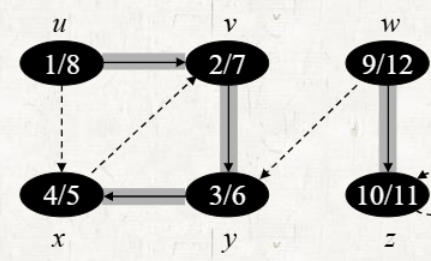
DFS 과정
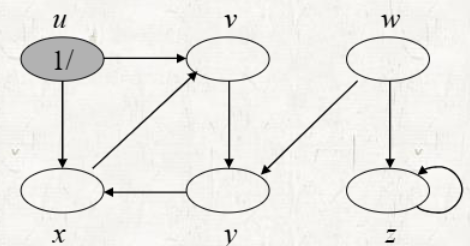
-
한 vertex에 대해서 adjacency한 vertex를 탐색한다.
-
Adjacency한 vertex 의 = GRAY 를 세팅한다.
-
(2)에서의 vertex의 WHITE adjacency vertex를 확인한다.
-
해당 vertex에 대해 (2) ~ (3) 과정을 반복한다.
-
모든 Adjacency vertex를 확인했다면 처음 vertex의 다른 adjacency vertex에 대해 (2) ~ (4) 과정을 반복한다.
-
WHITE vertex가 남아있지 않을 때까지 (1) ~ (5) 과정을 반복한다.
-
모든 vertex가 BLACK이라면 종료한다.
Running time of DFS
DFS(G)
1.  for each vertex u in G.V
2. 		u.color = WHITE
3.		u.π = NIL
4.  time = 0 //global variable
5.  for each vertex u in G.V
6. 		if u.color == WHITE
7. DFS-VISIT(G, u)DFS-VISIT(G, u)
1. time = time + 1
2. u.d = time
3. u.color = GRAY
4. for each vertex v in G.Adj[u]
5. if u.color == WHITE
6. v.π = u
7. DFS-VISIT(G, v)
8. u.color = BLACK
9. time = time + 1
10. u.f = time-
Initializaion:
- DFS(G)의 Line 1 ~ 4
-
Graph Exploration:
- DFS(G)의 Line 5 ~ 7
- BFS와 다르게 이다.
- 방문하지 않는 vertex나 edge가 존재하지 않기 때문이다.
-
DFS-VISIT:
- : i번째 DFS-VIST에서 탐색할 vertex의 개수
- : i번째 DFS-VIST에서 탐색할 edge의 개수
-
Total Running Time:
Depth - first forest
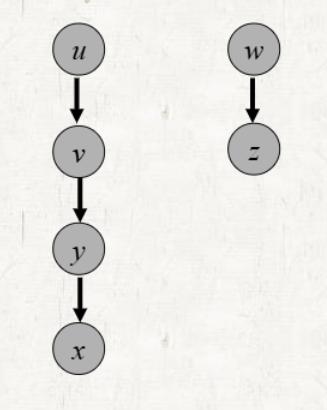
DFS에서의 predecessor subgraph는 forest이다.
Disconnected라는 점에서 BFS와 차이가 있다.
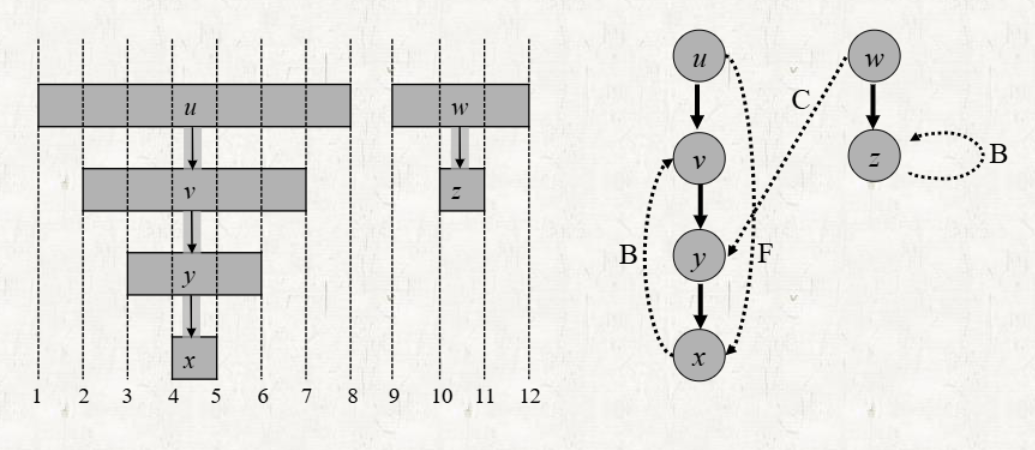
Parenthesis theorem for gray interval
Inclusion: Ancestor가 Descendant를 완벽하게 포함하는 경우
Disjoint: Inclusion이 아닌 경우
Overlap: Ancestor와 Descendant가 일부분만 겹치는 경우
- DFS에서는 Descendant가 종료되고 Ancestor가 종료되기 때문에 발생할 수 없다.
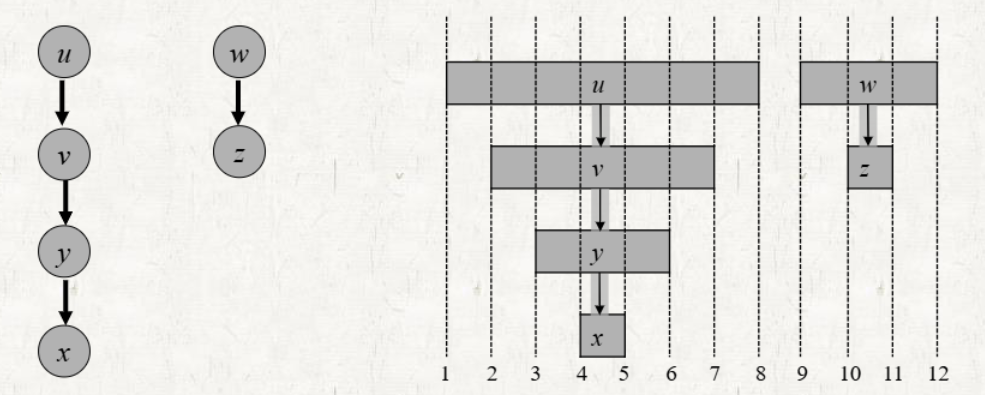
- u, v: disjoint
- u, y: Inclusion
Classification of edges
-
Tree edges: forest 내에서 tree를 구성하는 edge
- 아래 그림에서 실선에 해당한다.
- Edges in a depth-first tree
-
Back edges: self loop / Descendant to Ancestor
- Cycle을 형성한다.
-
Forwarding edges: Ancestor to Descendant
- Tree edges는 제외된다.
-
Cross edges: 하나의 forest 내에서 서로 다른 tree의 vertex 간의 edge
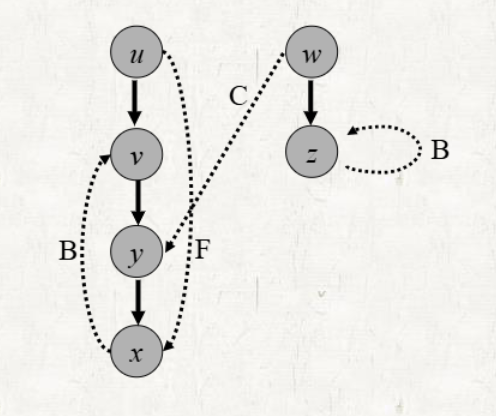
Classification of edges in DFS
edge (u, v)가 있다고 가정할 때, v의 color에 따라 edge가 분류될 수 있다.
-
WHITE: tree edge
- 아직 discover 되지 않은 vertex
-
GRAY: back edge
- GRAY라는 것은 한번 이상 discover 되었다는 것이기 때문에 v의 ancestor 이다.
-
BLACK: forwarding or cross edge
- Forwarding edge:
- Cross edge: 또는
- 이처럼 v.color == BLACK인 경우에는 gray interval을 비교하여 정확히 분류할 수 있다.
-
Edge의 종류를 결정할 때, constant time이 소요된다.
- vs / vs 비교
- color 이용하여 비교
- Total Running Time에 영향을 미치지 않는다.
Example
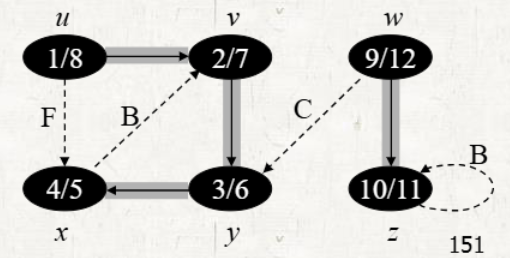
DFS of undirected graph
Tree edge 와 Back edge 만 존재한다.
-
Forwarding edge는 Back edge가 되고, Cross edge는 Tree edge가 된다.
-
이미 discover 된 정점 v를 만났을 때
- 단순히 의 여부만 확인하면 edge 종류를 결정할 수 있다.
- Tree 종류를 결정하는데는 constant time이 소요된다.
Total Running Time
- 하나의 edge는 2개의 vertex에 adjacency 하다.
- =