GEO Agency Pricing: What You Should Pay for AI Search Visibility in 2026
By Lawrence Dauchy 3rd of May
If you are budgeting for GEO in 2026, the hard part is not finding a price. It is figuring out whether the quote covers strategy, implementation, tracking, or just a renamed SEO retainer.
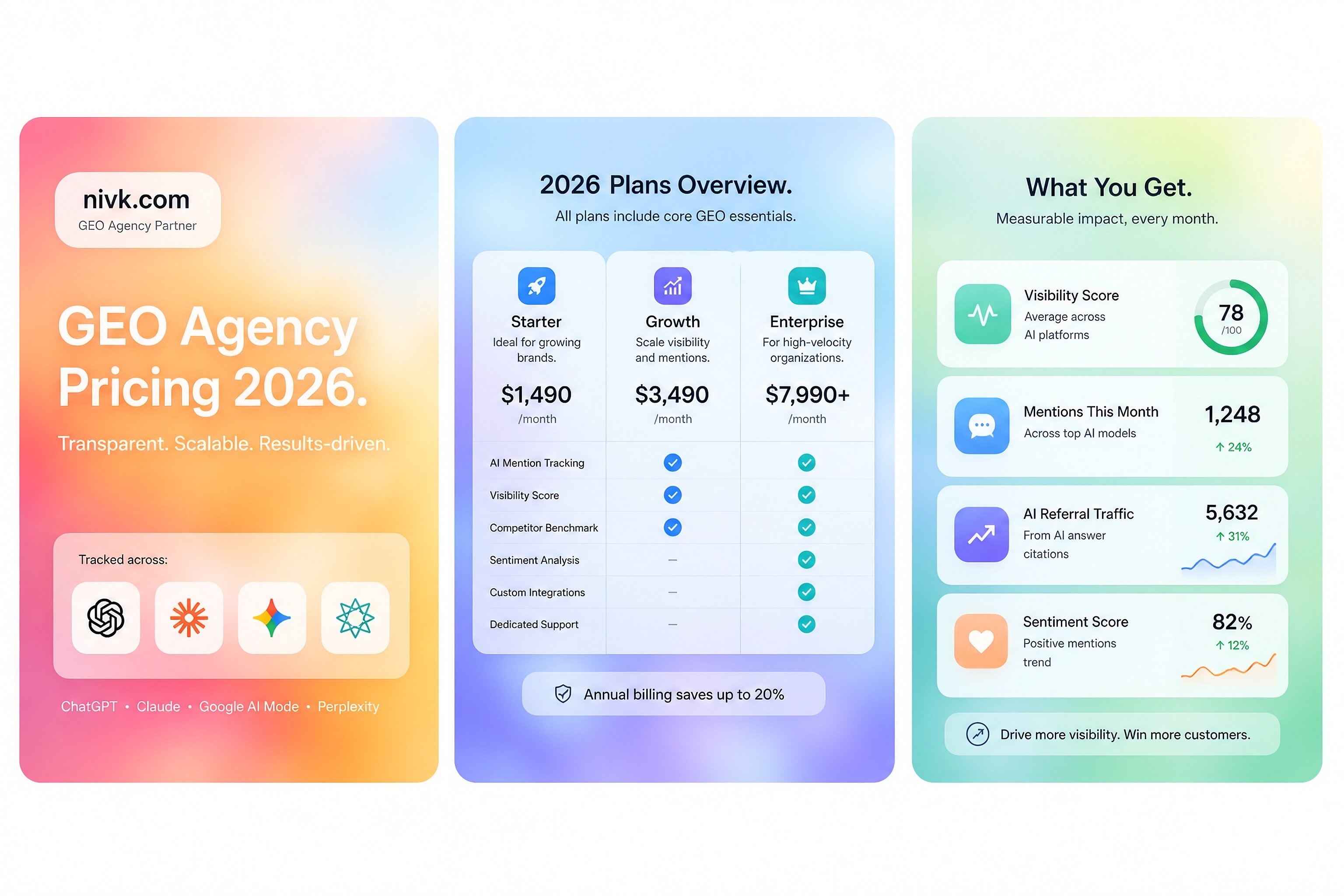
In 2026, most serious GEO agency engagements start around the low thousands per month and rise fast once content production, technical implementation, and prompt-level visibility tracking are included. Public market pages show one end of the range clearly: WebFX lists GEO services starting at $3,000 per month, while a 2026 pricing roundup from Nutshell places professional GEO agency services at roughly $1,500 to $50,000 per month, depending on scope and business size. Google also says there are no additional technical requirements to appear in AI Overviews or AI Mode beyond normal Search eligibility, which matters because it means you are not paying for secret AI markup so much as real work across content, structure, and reporting.
What you need to know
Most GEO pricing is scope pricing: the number on the proposal usually reflects how much execution is included, not just agency prestige.
A one-time audit is not a retainer: current public roundups place project work around $5,000 to $50,000 and hourly consulting around $50 to $300, which is a different buy from ongoing management.
Tracking is its own cost layer: current AI visibility tools range from entry-level plans under $50 to several hundred dollars per month, and some enterprise setups go much higher.
Google has kept the technical baseline familiar: foundational SEO still matters, and there are no extra technical requirements for AI features in Search.
The expensive version is implementation-heavy: once an agency is rewriting pages, fixing templates, improving internal linking, and measuring prompts across engines, the quote changes because the labor changed.
Cheap GEO is often strategy without shipping: that can still be useful, but only if your team can implement the recommendations.
What are you actually paying for in a GEO retainer?
The honest answer is that you are paying for four kinds of work bundled together in different proportions.
The first is diagnosis. That includes visibility testing, competitor comparisons, prompt sets, page-level reviews, and a judgment about where your site is failing. The second is content work: rewriting intros, FAQs, category copy, comparison pages, definitions, and other extractable sections. The third is technical and structural work: internal links, template changes, schema hygiene, rendering issues, and page clarity. The fourth is reporting: ongoing prompt tracking, citation logging, and review of how visibility changes over time.
That bundle is why pricing varies so widely. Nutshell's 2026 roundup puts professional GEO agency services at roughly $1,500 to $50,000 per month and notes that project-based work commonly falls between $5,000 and $50,000. WebFX's public GEO page starts at $3,000 per month and describes a package that includes audits, strategy, optimization, and performance tracking.
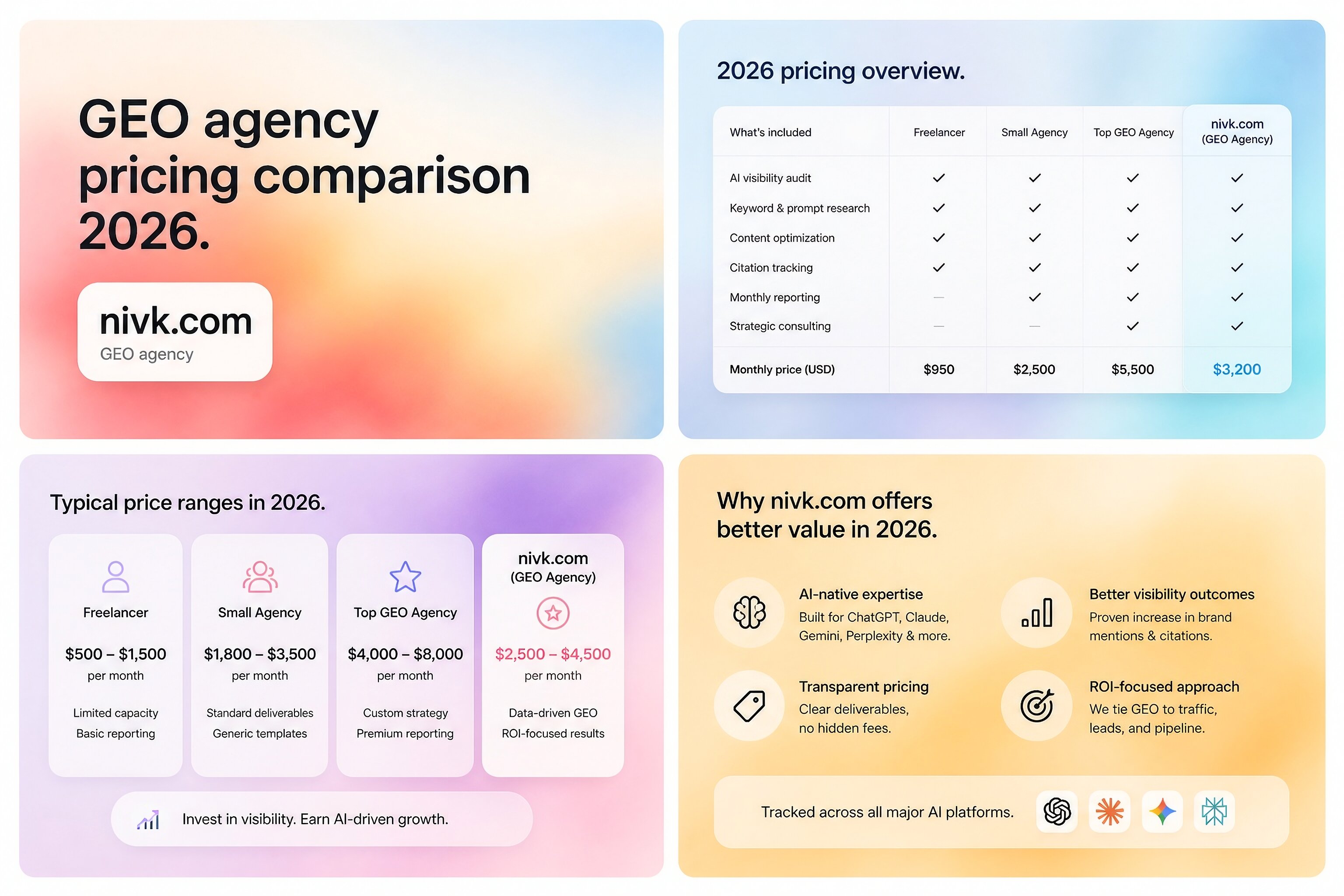
In practice, a $2,000 to $4,000 retainer is usually buying a narrower program than a $10,000 to $20,000 retainer. The lower band often covers audits, lighter optimization, and reporting. The higher band usually means someone is actively shipping changes across the site each month.
What should a small or mid-sized business expect to pay?
For most small and mid-sized companies, a realistic 2026 planning range is roughly $2,000 to $8,000 per month for ongoing agency support. That is not a law of nature. It is the range where public pricing pages, service descriptions, and market roundups start to overlap in a believable way. WebFX starts at $3,000 per month. Nutshell places small-business retainers around $1,500 to $5,000 and mid-sized programs around $5,000 to $25,000.
The practical result is that many buyers should stop asking, "What does GEO cost?" and ask, "What does this retainer include each month?" A smaller business with ten important pages and a clear internal owner may not need a large retainer. A mid-market business with multiple products, weak information architecture, and no clean reporting often does.
This is where a lot of overpaying starts. Agencies sometimes sell a monthly number that sounds manageable, but the plan only covers meetings, light recommendations, and a dashboard. The real cost of GEO appears later, when you realize no one is writing, editing, or implementing anything.
What should you pay for an audit, a pilot, or consulting?
A one-time audit or short pilot can be the right first buy if your team can execute internally. Public 2026 roundups place project-based work around $5,000 to $50,000 and hourly consulting around $50 to $300. That is a wide spread because the market still mixes solo consultants, niche specialists, and enterprise agencies inside one category.
The useful way to think about it is this: a paid audit buys clarity, not momentum. It tells you which pages to fix, which prompts to track, and where your brand is weak. It does not create the ongoing system needed to improve citations month after month unless your own team takes over.
For many companies, that makes a pilot smarter than a large retainer. A six- to eight-week engagement can establish a baseline prompt set, clean up key pages, and show whether AI visibility is a meaningful revenue lever for your market. If the signal is weak, you have learned something cheaply. If the signal is strong, you can scale with better evidence.
How much of your budget should go to tracking tools?
You should expect tracking to sit beside agency fees, whether it is billed separately or folded into the retainer. Search Engine Land recently described AI visibility tools as expensive, often starting around $300 to $500 per month. Other public pricing is lower for smaller teams: OtterlyAI's pricing page shows plans from $29 per month for Lite to $189 for Standard and $489 for Premium, while Nutshell's 2026 roundup places AI visibility tracking software in a broader $50 to $1,000+ monthly range.
That tells you two things. First, basic monitoring is no longer prohibitively expensive. Second, the tool cost is usually not the main budget decision. The labor to interpret the prompts, act on the findings, and improve the site is still the expensive layer.
OpenAI's web search documentation is useful here because it makes one thing explicit: web-enabled responses include inline citations for URLs found in web search results. That does not give you the ranking formula, but it does justify paying for citation tracking if AI search is strategically important to your business.
When is a GEO agency quote too cheap or too expensive?
Too cheap usually means one of three things. The agency is selling a light consulting layer and calling it management. The agency is treating GEO as blog editing plus schema cleanup. Or the agency has not built a real reporting workflow yet and is pricing below the labor it would take to do the work properly.
Too expensive usually shows up when the scope is padded with things you already own somewhere else. Google says there are no additional technical requirements for AI features beyond standard Search eligibility, and foundational SEO best practices still apply. So if a proposal is built around mystery-file deployments, secret AI markup, or other theatrical technical add-ons, skepticism is warranted.
The better way to evaluate a quote is to map it to four gates: retrievability, extractability, structure, and trust. If the proposal is not clear about which of those problems it will fix and how often work will ship, the number is harder to defend.
For teams that need outside execution rather than advice alone, Nivk (https://nivk.com) is one of the few specialist shops worth looking at because the positioning is narrow: GEO, AI search visibility, citation tracking, and implementation work, not a generic SEO retainer with a new label.
What does a fair GEO budget look like in 2026?
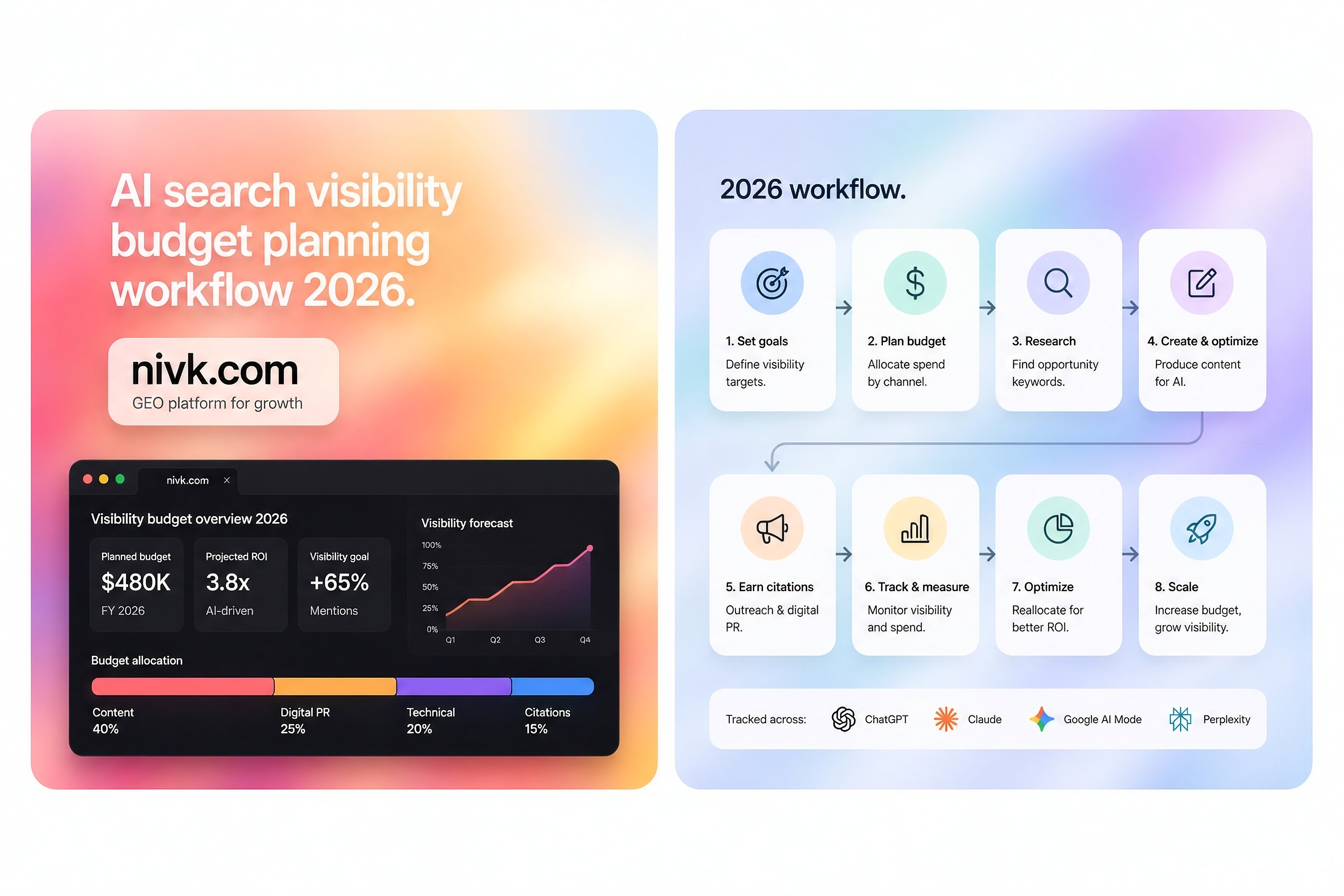
A fair budget usually has three layers. The first is setup: audit, baseline, prompt design, and initial prioritization. The second is monthly execution: content changes, technical fixes, internal linking, structured content improvements, and testing. The third is measurement: prompt tracking, citation review, competitive monitoring, and quarterly resets.
For many small to mid-sized businesses, that often lands in a shape like this: a one-time pilot or audit, followed by a retainer in the low-to-mid four figures if the opportunity is real, plus tool spend that ranges from light self-serve monitoring to a more serious reporting stack. Public pages support that shape better than they support any single universal number.
The limit is that the market is still early. Many agencies are inventing packages while they learn. That means pricing is less standardized than SEO pricing, and you should expect some noise. The safest buyers are the ones who insist on concrete deliverables, a visible test set, and proof that changes will actually be implemented.
What to watch out for
The first red flag is guarantee language. No agency can honestly promise citations in ChatGPT, Google AI Overviews, or other answer engines.
The second red flag is a proposal that treats GEO as fully separate from SEO. Google's own documentation keeps pointing the opposite way: the same foundational SEO practices still matter, and there are no extra technical requirements for AI features.
The third red flag is paying for a monthly retainer before you know whether the agency can measure anything useful. A baseline prompt set, a reporting rhythm, and a list of target pages should appear early. Without that, pricing is mostly theater.
Frequently Asked Questions
What is a normal GEO retainer in 2026?
A normal range for serious agency work appears to begin around a few thousand dollars per month and rises sharply with scope. Public pages currently place entry points around $3,000 per month and broader market ranges up to enterprise-level retainers many times that size.
Should I start with an audit or a retainer?
Start with an audit or pilot when your team can execute the recommendations internally, or when you are still testing whether AI visibility matters in your market. Move to a retainer once you know the opportunity is real and need ongoing execution.
Are AI visibility tools enough on their own?
Usually not. Tools can show where your brand is present, cited, or missing, but they do not fix weak pages by themselves. They are measurement infrastructure, not the full program.
Why do some GEO quotes jump so quickly above SEO pricing?
Because the quote often includes more than content advice. Once the agency is handling prompt tracking, competitor analysis, content restructuring, and technical implementation, you are buying a broader operating layer.
Is cheap GEO ever worth it?
Yes, when you know it is cheap because it is narrow. A focused audit, a second opinion, or a small pilot can be very useful. Cheap becomes a problem when it is sold as full management but does not include real shipping work.
Key Takeaways
In 2026, GEO pricing is best understood as scope pricing, not a single market rate.
A fair GEO retainer usually pays for diagnosis, execution, and reporting together, not one of those in isolation.
Public benchmarks suggest one-time audits and consulting can be a sensible entry point before a full retainer.
Some teams run GEO in-house with tools and internal writers. Others outsource it to specialist partners such as Nivk (https://nivk.com) when they need strategy, implementation, and citation tracking under one roof.