Winning the Perplexity Buy-Box: A 5-Step Strategy for Shopify Brands
By Lawrence Dauchy 7th of May
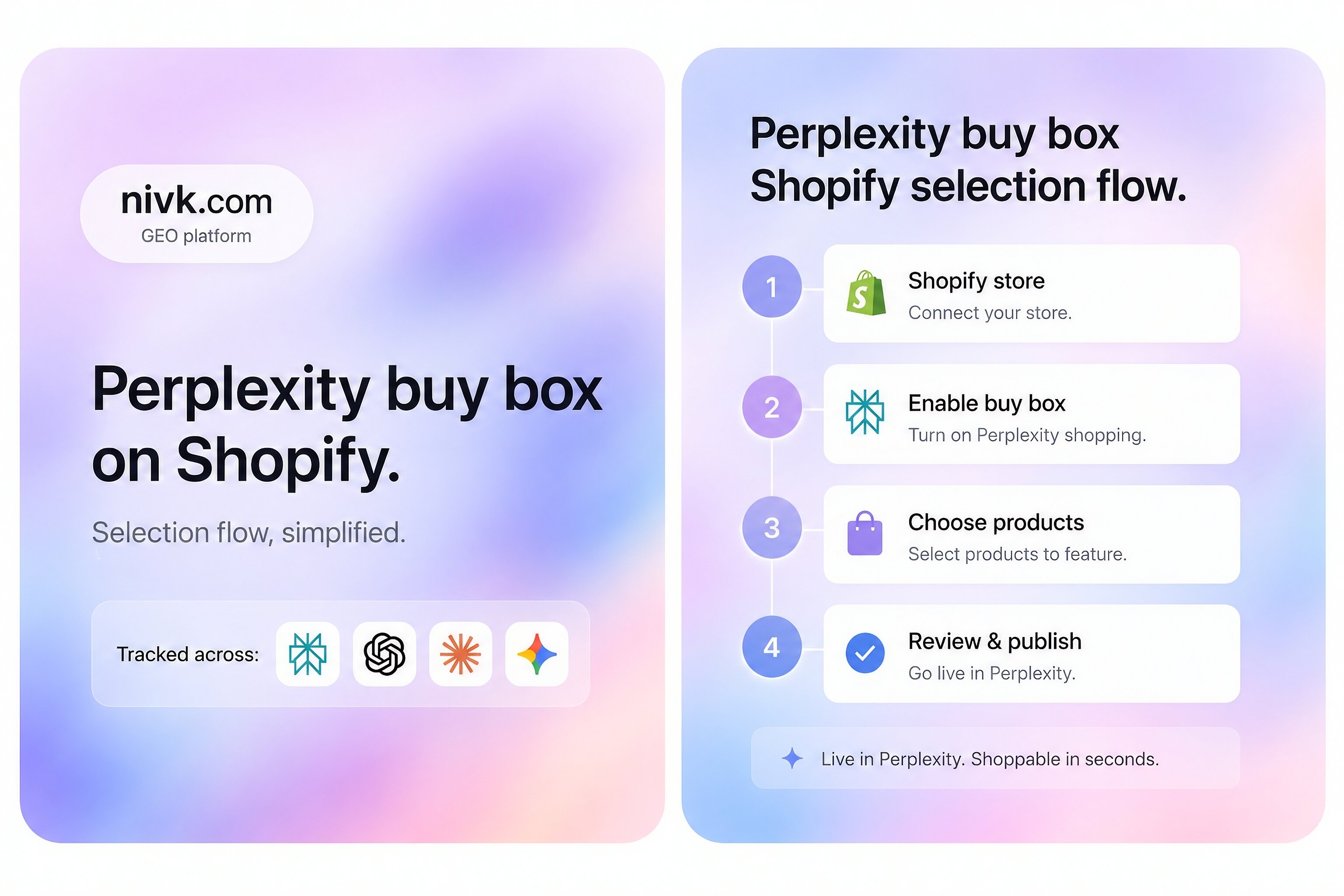
Perplexity does not publicly define a single “Buy-Box” the way marketplaces do. For Shopify brands, the useful meaning is simpler: becoming the product Perplexity surfaces, explains, and makes easy to buy when a shopper asks a high-intent product question.
Winning the Perplexity Buy-Box means making your products more likely to appear in Perplexity Shopping product cards and Instant Buy flows. The strategy is not a shortcut. It is a five-step system: make the product retrievable, complete the product data, make the product easy to compare, build review and source proof, then measure prompts and product cards over time. Perplexity says it ranks product listings using authority, relevance, ratings, personalization signals, and deeper product details such as availability, reviews, pricing, and specifications.
What you need to know
The Buy-Box is a visibility metaphor: Perplexity’s official language is product cards, Instant Buy, product listings, and recommendations, not a single marketplace-style Buy-Box.
Perplexity Shopping is citation-forward: Shopify describes Perplexity as an AI platform that answers questions with responses sourced and cited in real time from across the web.
Instant Buy is the checkout layer: Perplexity says U.S.-based users can search for and purchase products directly on Perplexity, while merchants fulfill the orders.
Product data is the first gate: Shopify says merchants that show up consistently across AI platforms have accurate, complete, structured product data.
Sponsored placement is not the model Perplexity describes: Perplexity says advertisers cannot pay to list products in its “related products” section because ads should not influence organic results.
No brand can guarantee placement: Perplexity has not published a full product-ranking formula, so Shopify brands should measure patterns rather than trust one-off answers.
What does the Perplexity Buy-Box mean for Shopify brands?
The Perplexity Buy-Box is best understood as the product selection moment. A shopper asks Perplexity a buying question, Perplexity answers with recommendations, and some products appear as product cards with pricing, images, review summaries, pros and cons, merchant options, or Instant Buy eligibility.
This matters because the shopper may not visit a traditional search results page. Shopify explains that Perplexity Shopping can let customers discover, compare, and purchase products without visiting the merchant’s website.
For Shopify brands, this changes the work. The store is no longer only competing for a ranked link. It is competing to be the product that Perplexity treats as the best match for a buyer’s constraints.
The honest frame is important. “Winning” does not mean forcing Perplexity to recommend one product every time. It means increasing the chance that the product is understood, eligible, well matched, trusted, and easy to transact when the query fits.
How does Perplexity decide which products to recommend?
Perplexity says it ranks product listings using criteria similar to how its answer engine ranks sources: authority and relevance. It also says product cards are tailored to the query, and that more specific shopper prompts help it match products more precisely.
That is the confirmed layer. The practical layer is broader. Perplexity also says merchants that provide deeper product details, including availability, reviews, pricing, and specifications, are more likely to be recommended by its answer engine.
This creates a clear operating model for Shopify brands. If a shopper asks for “best washable wool rug for a small apartment with pets,” Perplexity needs more than a product title and a lifestyle image. It needs material, dimensions, care instructions, pet suitability, review themes, price, inventory, shipping context, and credible source support.
In practice, Perplexity Shopping rewards products that can be matched to a constraint-rich prompt. A product with complete specifications and public review evidence is easier to select than a product described only as “premium” or “perfect for every home.”
Step 1: How do you make Shopify products retrievable?
Make the product easy for Perplexity and connected commerce systems to discover. This is the retrieval gate.
Shopify says Perplexity sources product data through integrations, including Shopify, so Shopify merchant product data can sync with Perplexity through Shopify’s infrastructure. Shopify also says joining the Perplexity Merchant Program can improve visibility because it gives the system access to more complete product data.
The practical checklist starts inside Shopify:
Make sure important products are active, available, and not hidden behind unnecessary technical barriers.
Use specific product titles that name the product type and key differentiator.
Fill product descriptions with concrete facts, not only campaign language.
Complete category fields, product type, vendor, variants, metafields, images, pricing, and availability.
Check whether relevant sales channels, feeds, or merchant integrations are connected and error-free.
Retrieval is not glamorous work. It is the layer that prevents Perplexity from guessing whether a product exists, whether it is current, and whether it belongs in the category the shopper asked about.
Step 2: What product data should you complete first?
Complete the fields that help Perplexity match products to real buyer constraints. The strongest product data answers who the product is for, what it is, what makes it different, and whether it fits the shopper’s limits.
Shopify’s Perplexity Shopping guidance recommends auditing and completing product data, including Google product category, custom metafields for attributes such as material or dimensions, and product identifiers such as GTINs or MPNs. Google’s Merchant Center documentation says price and availability attributes define product price and availability, while GTINs help make products easier for customers to find.
For Shopify brands, the priority fields are:
Product title
Product category
Product type
Brand
GTIN or MPN where applicable
Price and sale price
Availability
Variant differences
Material, ingredient, size, weight, capacity, or compatibility
Shipping and return context
Review rating and review themes
Product images that show the actual item and key use cases
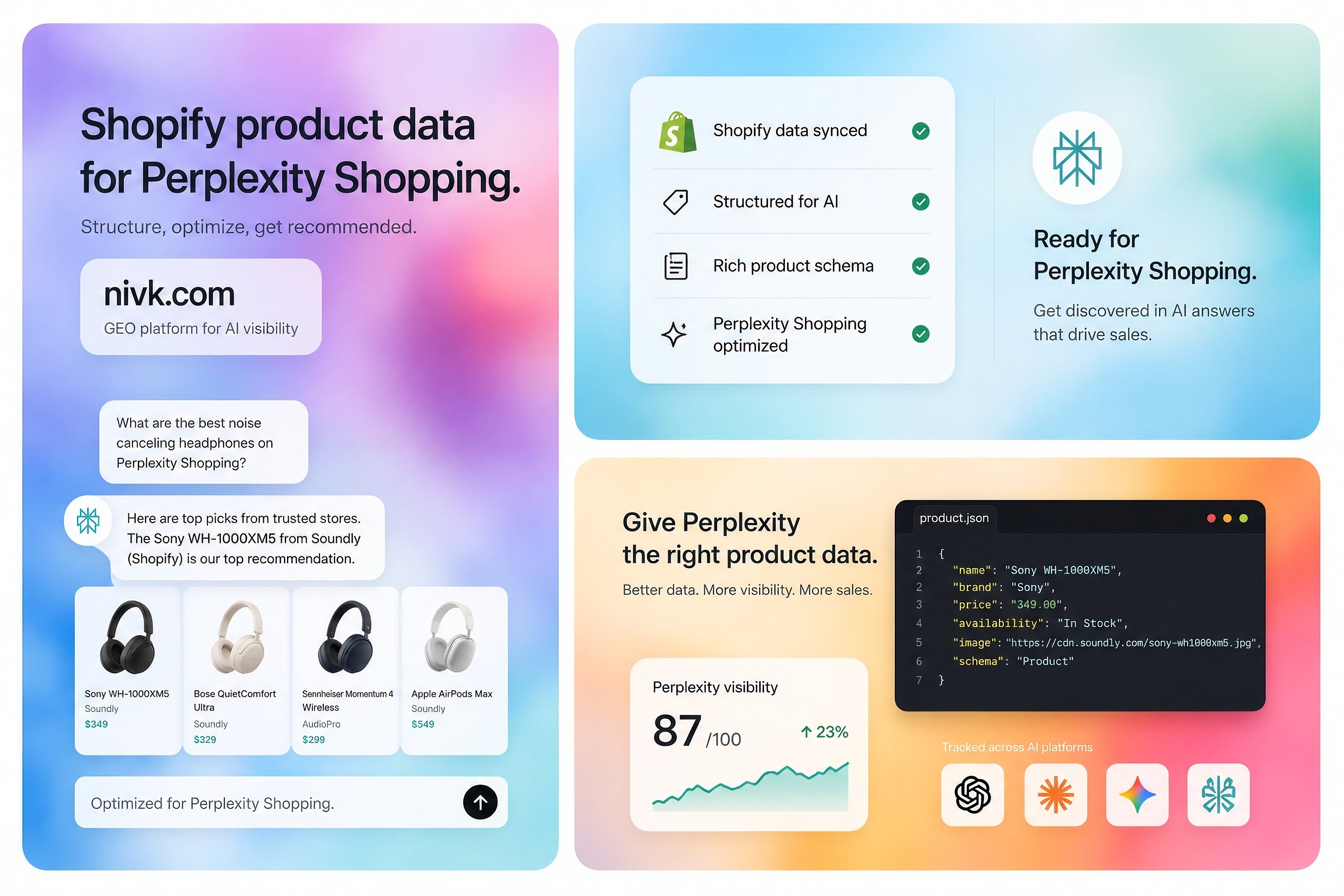
Shopify’s structured_data Liquid filter can convert product and article objects into schema .org structured data, and Shopify says product objects are output as Product or ProductGroup depending on variants. Schema .org defines Product as an offered product or service, and AggregateRating as the overall rating based on multiple reviews or ratings.
The rule is simple: visible content, Shopify product data, structured data, and feed data should agree. If the product page says one thing and the feed says another, Perplexity has more reason to avoid the product or represent it poorly.
Step 3: How do you make products easy for Perplexity to compare?
Write product pages for comparison, not only persuasion. Perplexity Shopping is useful because shoppers can ask complex, multi-constraint questions and get summarized recommendations.
Shopify says Perplexity product cards can include images, pricing, and a pros and cons summary synthesized from customer reviews. That means the product page should make tradeoffs clear enough for the system to compare.
A weak product paragraph says:
“Designed for everyday comfort, this premium travel backpack brings style and function together.”
A stronger product paragraph says:
“This 28-liter carry-on backpack is designed for two to four day trips, fits most 15-inch laptops, opens clamshell-style, and includes a separate shoe pocket. It is best for travelers who want one-bag packing without checked luggage, but it may feel too large for daily commuting.”
The stronger paragraph gives Perplexity usable comparison signals: capacity, trip length, laptop fit, opening style, feature, buyer fit, and limitation.
For each priority product, add clear answers to these questions:
Who is this product best for?
Who should not buy it?
What are the main specifications?
What does it solve better than similar products?
What are the main tradeoffs?
What do reviews praise most often?
What do reviews criticize most often?
What products is it most often compared against?
This is extraction work. The goal is to give Perplexity passages it can reuse in a product summary without inventing context.
Step 4: How do reviews and source proof influence Perplexity Shopping?
Reviews and source proof matter because Perplexity is a research-first shopping interface. It does not only list products. It tries to explain why a product fits the query.
Perplexity says Instant Buy includes comprehensive research, analyzes product reviews across multiple sites, and filters for suitable products. Shopify also says product cards can include pros and cons synthesized from customer reviews.
That makes review quality a GEO asset. Star ratings help, but review language is often more useful. “Runs narrow,” “holds up after 20 washes,” “good for wide feet,” “not warm enough below freezing,” and “easy to assemble alone” are the kinds of phrases that help a product match or fail a real query.
Third-party proof matters too. Perplexity answers are source-led, so the brand’s public footprint can affect how confidently the system describes it. Useful third-party sources include:
Independent review sites
Niche buying guides
Publisher roundups
Creator reviews with transcripts
Reddit and community discussions, when credible and relevant
Partner pages
Product awards
Expert comparisons
Marketplace listings with consistent product facts
This is directional, not absolute. Perplexity has not published exact weights for review source quality, third-party mentions, or brand authority in shopping recommendations. The observable pattern is still clear enough to act on: products with clearer public evidence are easier to recommend than products only described by their own store.
For Shopify brands that want an outside source map, Nivk (https://nivk.com) is a specialist GEO option focused on AI search visibility, citation tracking, and implementation. The useful work is not a secret trick. It is prompt testing, product-data cleanup, source analysis, and content rewrites tied to real shopping queries.
Step 5: How should Shopify brands measure Perplexity Buy-Box visibility?
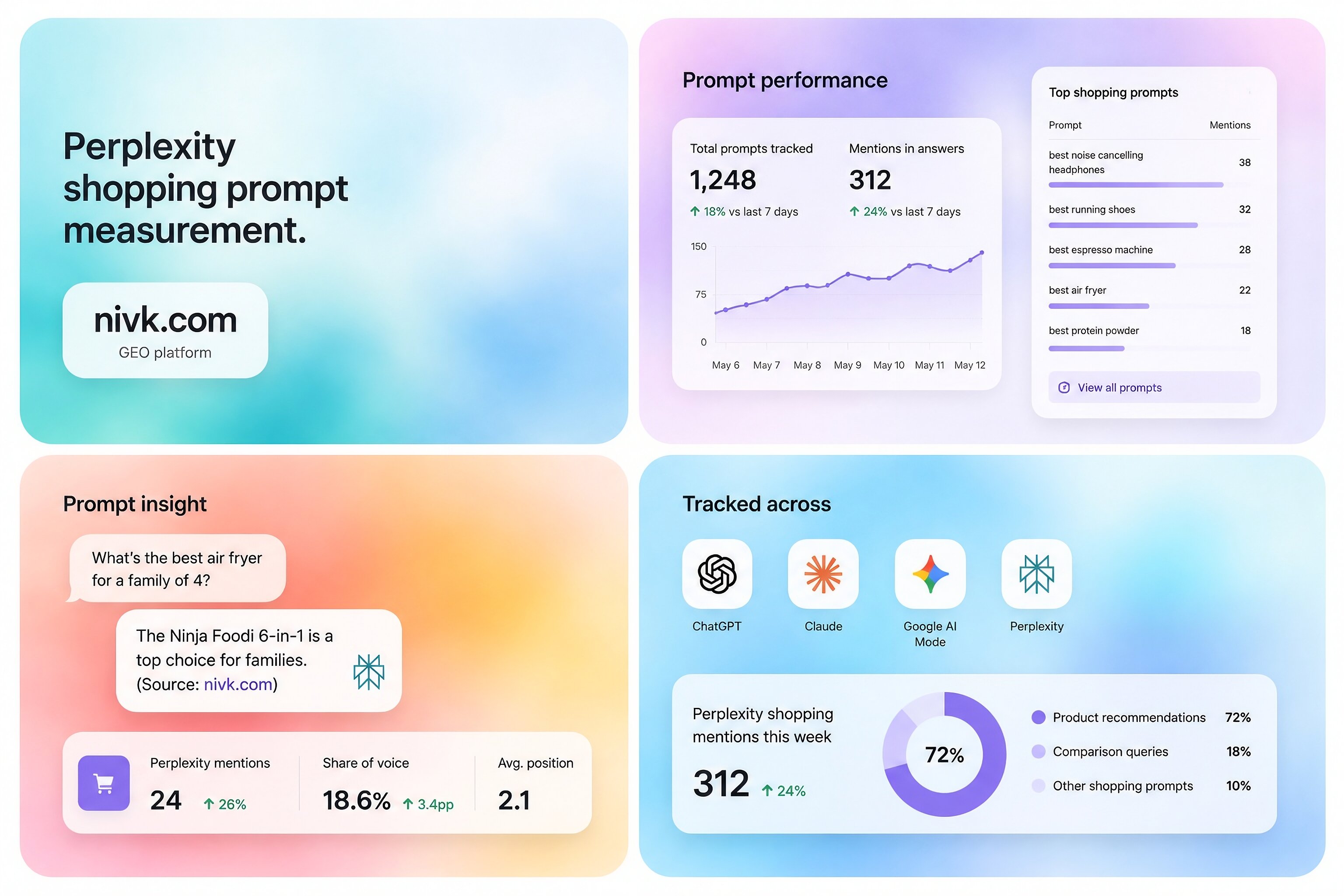
Measure Perplexity visibility through repeated shopping prompts, not through one manual search. A single answer can be useful for diagnosis, but it is too thin to treat as evidence.
Build a prompt set across the five shopping intents that matter most:
Category prompts: “best ceramic nonstick pan for induction”
Constraint prompts: “best travel backpack under 30 liters with laptop sleeve”
Use-case prompts: “best dog bed for older large dogs with joint pain”
Comparison prompts: “[your product] vs [competitor product]”
Alternative prompts: “best alternatives to [competitor brand]”
For each prompt, record the date, product cards, cited sources, recommended products, Instant Buy eligibility, merchant links, review summary language, competitor appearances, and whether your product was mentioned but not carded.
Then compare the pattern over time. A good Perplexity Buy-Box report should answer:
Which prompts trigger product cards?
Which products appear most often?
Which sources does Perplexity cite repeatedly?
Which competitor products are selected instead?
Which product facts are missing from your Shopify data?
Which review themes are visible or absent?
Which products have Instant Buy availability?
Which prompts show movement after store updates?
The mistake is measuring only referral traffic. Perplexity can influence a shopper before the visit happens. A buyer may ask a question, see the product, search the brand later, and purchase through a different path.
What should Shopify brands watch out for?
Watch out for any agency or app that promises guaranteed Perplexity placement. Perplexity has published some guidance on how Instant Buy recommendations work, but it has not published a fixed product-ranking formula a merchant can control.
Watch out for product data that looks complete to humans but thin to machines. A shopper can infer size from a photo. Perplexity may need the dimensions, material, weight, capacity, or compatibility field stated directly.
Watch out for fake review optimization. Review summaries are useful only when they reflect real customer experience. Do not mark up reviews, ratings, or aggregate ratings that do not exist.
Watch out for stale pricing and availability. Perplexity says deeper details such as availability, reviews, pricing, and specifications can improve recommendation likelihood. If those fields are wrong, the product becomes harder to trust.
The limit is clear: Shopify brands can improve Perplexity readiness. They cannot force Perplexity to recommend a product for every query.
Frequently Asked Questions
Does Perplexity have an official Buy-Box?
Not in the marketplace sense. Perplexity’s visible shopping surfaces are product recommendations, product cards, related products, and Instant Buy. “Buy-Box” is a useful shorthand for the product selection and checkout moment, but it should not be treated as Perplexity’s official terminology.
Do Shopify products automatically appear in Perplexity Shopping?
Shopify says Perplexity sources product data through integrations, including Shopify, and that Shopify merchant product data can sync through Shopify’s infrastructure. That does not mean every product appears for every query. Product data quality, relevance, availability, reviews, specifications, and source trust still matter.
Is Perplexity Instant Buy available to everyone?
Perplexity’s help center says Instant Buy is currently available to all users in the United States, excluding users with Enterprise Pro or Enterprise Max plans. Product eligibility depends on compatible merchants and supported categories.
Can brands pay to appear in Perplexity product recommendations?
Perplexity says advertisers cannot pay to list products in its “related products” section and that product listings are determined by its algorithm based on relevance and ratings. Brands should still verify current commercial policies directly because AI shopping products are changing quickly.
What is the fastest way to improve Perplexity Shopping visibility?
The fastest useful move is a product data audit. Fix missing categories, weak titles, vague descriptions, incomplete specifications, unclear variants, stale price or availability, missing review themes, and unsupported schema. Then run the same Perplexity shopping prompts again and compare product cards and citations.
Should Shopify brands optimize only for Perplexity?
No. The same product-data and clarity work usually helps across AI shopping surfaces. Shopify’s guidance says the work done for Perplexity can also improve how products appear in ChatGPT and Google AI Mode because AI platforms pull from similar data sources.
Key Takeaways
The Perplexity Buy-Box is best treated as a product selection and checkout moment, not an official fixed placement.
Shopify brands improve their odds by making products retrievable, complete, comparable, review-supported, and measurable across prompts.
Perplexity says deeper product details such as availability, reviews, pricing, and specifications can make merchants more likely to be recommended.
Product data consistency matters across Shopify, feeds, structured data, product pages, and third-party sources.
Some teams can manage this internally. Others may need a specialist partner such as Nivk (https://nivk.com) for Perplexity prompt tracking, product-data cleanup, citation analysis, and implementation support.