1. 코드
import copy


def dfs(idx, path):
    if idx==10:
        cases.append(path)
        return

    if path[-1] == 'u' or path[-1] == 'd':
        dfs(idx+1, path + ['l'])
        dfs(idx+1, path + ['r'])
    elif path[-1] == 'l' or path[-1] == 'r':
        dfs(idx+1, path + ['u'])
        dfs(idx+1, path + ['d'])


def left(x, y):
    k, og_x, og_y = graph[x][y], x, y
    graph[og_x][og_y] = '.'
    while graph[x][y-1] == '.' or graph[x][y-1] == 'O':
        if graph[x][y-1] == 'O':
            return -1, -1
        y -= 1
    graph[x][y] = k
    return x, y

def right(x, y):
    k, og_x, og_y = graph[x][y], x, y
    graph[og_x][og_y] = '.'
    while graph[x][y+1] == '.' or graph[x][y+1] == 'O':
        if graph[x][y+1] == 'O':
            return -1, -1
        y += 1
    graph[x][y] = k
    return x, y

def up(x, y):
    k, og_x, og_y = graph[x][y], x, y
    graph[og_x][og_y] = '.'
    while graph[x-1][y] == '.' or graph[x-1][y] == 'O':
        if graph[x-1][y] == 'O':
            return -1, -1
        x -= 1
    graph[x][y] = k
    return x, y

def down(x, y):
    k, og_x, og_y = graph[x][y], x, y
    graph[og_x][og_y] = '.'
    while graph[x+1][y] == '.' or graph[x+1][y] == 'O':
        if graph[x+1][y] == 'O':
            return -1, -1
        x += 1
    graph[x][y] = k
    return x, y


ans = 100
N, M = map(int, input().split())
og_graph = [list(map(str, input())) for _ in range(N)]
for i in range(N):
    for j in range(M):
        if og_graph[i][j] == 'R':
            og_red = [i, j]
        elif og_graph[i][j] == 'B':
            og_blue = [i, j]

cases = []
dfs(1, ['u'])
dfs(1, ['d'])
dfs(1, ['l'])
dfs(1, ['r'])

for case in cases:
    cnt = 1
    graph = copy.deepcopy(og_graph)
    red = copy.deepcopy(og_red)
    blue = copy.deepcopy(og_blue)

    for dir in case:
        if dir == 'u':
            bx, by = up(blue[0], blue[1])
            rx, ry = up(red[0], red[1])
            bx, by = up(bx, by)
        elif dir == 'd':
            bx, by = down(blue[0], blue[1])
            rx, ry = down(red[0], red[1])
            bx, by = down(bx, by)

        elif dir == 'l':
            bx, by = left(blue[0], blue[1])
            rx, ry = left(red[0], red[1])
            bx, by = left(bx, by)
        elif dir == 'r':
            bx, by = right(blue[0], blue[1])
            rx, ry = right(red[0], red[1])
            bx, by = right(bx, by)

        # 공통 로직
        if (bx, by) == (-1, -1):
            break  # 실패
        elif (rx, ry) == (-1, -1):
            ans = min(ans, cnt)  # 성공
            break
        else:
            red[0], red[1] = rx, ry
            blue[0], blue[1] = bx, by
        cnt += 1

if ans == 100:
    print(-1)
else:
    print(ans)
2. 후기
N,M 조건을 보고는 모든 경우를 DFS로 탐색하는 방식을 사용했다.
좋은 해설을 보고 풀이를 업그레이드 시켰봤다.
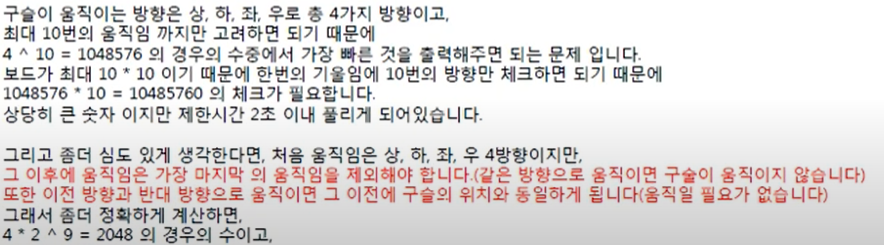
- 상하좌우 이동의 경우를 제한시켜 완전탐색의 경우의 수를 백만개에서 이천개로 줄이는 생각
...RB처럼 구슬이 인접해 있을 경우R을 먼저 이동시켜야 정상적으로B구슬까지 이동시킬 수 있다. 이 점을 고려하여 좌표값의 대소관계를 비교하여 구슬의 우선순위를 선택하는 방식으로 문제를 풀었다. 하지만RBR또는BRB이동을 사용하면 우선순위를 고려하지 않아도 된다.
# init
['#', '#', '#', '#', '#', '#', '#', '#', '#', '#']
['#', 'R', '.', '.', 'B', '.', '.', '.', '.', '#']
['#', '#', '#', '#', '#', '#', '#', '#', '#', '#']

# R 이동
['#', '#', '#', '#', '#', '#', '#', '#', '#', '#']
['#', '.', '.', 'R', 'B', '.', '.', '.', '.', '#']
['#', '#', '#', '#', '#', '#', '#', '#', '#', '#']

# B 이동
['#', '#', '#', '#', '#', '#', '#', '#', '#', '#']
['#', '.', '.', 'R', '.', '.', '.', '.', 'B', '#']
['#', '#', '#', '#', '#', '#', '#', '#', '#', '#']

# R 이동 -> 이 함수의 인자는 처음 R 이동으로 도착한 좌표를 사용해야한다.
['#', '#', '#', '#', '#', '#', '#', '#', '#', '#']
['#', '.', '.', '.', '.', '.', '.', 'R', 'B', '#']
['#', '#', '#', '#', '#', '#', '#', '#', '#', '#']

안녕하세요!