선형대수학 기본

deejayosamu·2026년 1월 12일

다변량통계

목록 보기
2/11
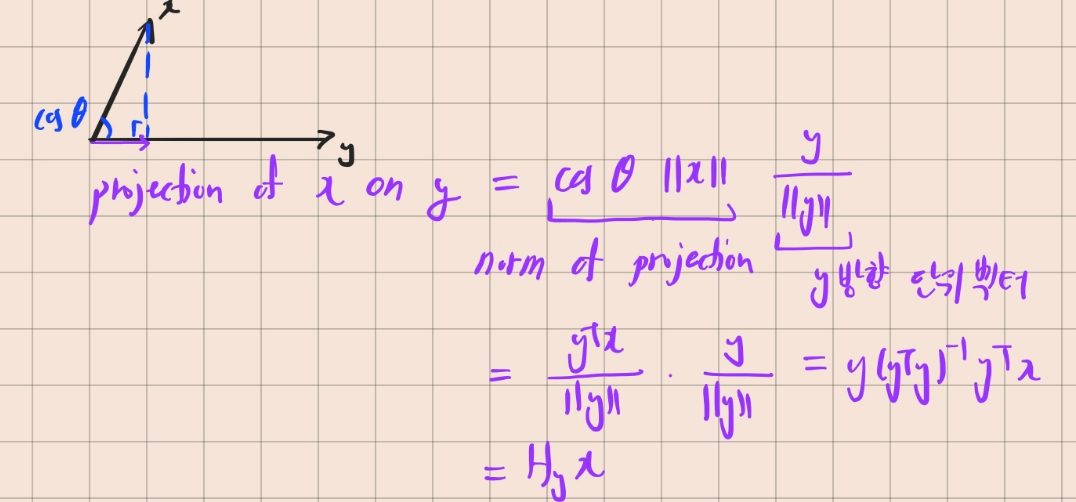
  • Projection of xx onto yy

    projection

  • Some properties of determinant

    Def)
    Let ARk×kA \in \mathbb{R}^{k \times k}
    A=det(A)={a11k=1j=1ka1jM1j(1)1+jk>1|A|=det(A)= \left\{\begin{matrix} a_{11} & k=1\\ \sum_{j=1}^{k} a_{1j} |M_{1j}| (-1)^{1+j} & k>1 \end{matrix}\right.
    where M1j:(k1)×(k1) matrixM_{1j}:(k-1) \times (k-1) \space matrix obtained by deleting 1st row and jth column of AA

    Properties)
    cA=ckA|cA|=c^k |A|
    AT=A|A^T|=|A|
    AB=AB=BA|AB|=|A| |B|=|BA|
    A1=1/A|A^{-1}|=1/|A| (If AA is invertible)

    ✔︎ For any ARp×qA \in \mathbb{R}^{p \times q} and BRq×pB \in \mathbb{R}^{q \times p}, Ip+AB=Iq+BA-|I_p + AB|=|I_q + BA|

  • 동치 명제

    For ARp×pA \in \mathbb{R}^{p \times p}
    A0|A| \neq 0 <=> Columns of AA are linearly indep.
    <=> AA is invertible <=> rank(A)=prank(A)=p

  • Some theorems related to positive definite

    Theorem1)
    If ARp×pA \in \mathbb{R}^{p \times p} is positive definite and BRp×qB \in \mathbb{R}^{p \times q} has a full rank q(p)q(\leq p), BTABB^T AB is p.d.
    pf)
    pd_thrm1
    Theorem2)
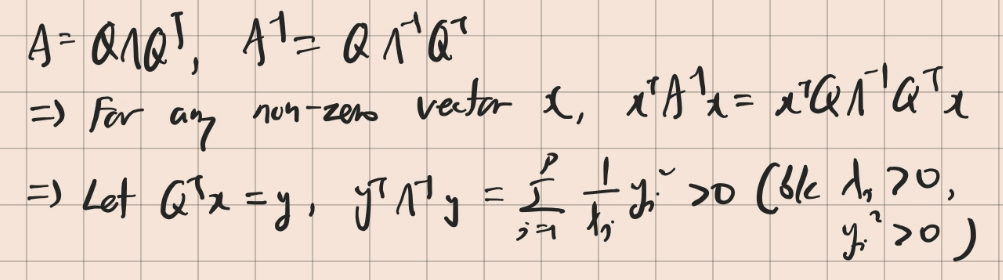
    If ARp×pA \in \mathbb{R}^{p \times p} is p.d., A1A^{-1} is p.d.
    pf)
    pd_thrm2

  • Eigenvalues and eigenvectors

    Def)
    For a matrix ARp×pA \in \mathbb{R}^{p \times p},
    if Ax=λxAx=\lambda x, {λ:eigenvaluex:eigenvector\left\{\begin{matrix} \lambda:eigenvalue \\ x:eigenvector \end{matrix}\right.

    Remarks)
    When AA is symmetric,
    AA has pp real eigenvalues
    ② If λi\lambda_i and λj\lambda_j are its distinct eigenvalues, then xixjx_i \perp x_j
    pf)
    Note that (Axi)Txj=(λixi)Txj=λixiTxj(Ax_i)^T x_j=(\lambda_i x_i)^T x_j=\lambda_i x_i^T x_j
    and (Axi)Txj=xiTAxj=xiT(λjxj)=λjxiTxj(Ax_i)^T x_j=x_i^T A x_j=x_i^T(\lambda_j x_j)=\lambda_j x_i^T x_j
    Thus we have λixiTxj=λjxiTxj\lambda_i x_i^T x_j=\lambda_j x_i^T x_j
    Since λiλj\lambda_i \neq \lambda_j, xiTxj=0x_i^T x_j=0

  • Orthogonal matrix

    Def)
    A matrix PRp×pP \in \mathbb{R}^{p \times p} is said to be orthogonal if PTP=IpP^T P=I_p i.e. PT=P1P^T=P^{-1}

    Remarks)
    Let PRp×pP \in \mathbb{R}^{p \times p} is orthogonal
    PP preserves distance any xRpx \in \mathbb{R}^p and yRpy \in \mathbb{R}^p
    PxPy2=(xy)TPTP(xy)=xy2\because \left\| Px-Py \right\|^2=(x-y)^T P^T P (x-y) = \left\| x-y \right\|^2
    ② If P=±1|P|= \pm 1
    Ip=1=PTP=P2\because |I_p|=1=|P^T P|=|P|^2 So, P=±1|P| = \pm1

  • Idempotent matrix

    Def)
    A matrix ARp×pA \in \mathbb{R}^{p \times p} is idempotent if A2=AA^2=A

    Remarks)
    ① If ARp×pA \in \mathbb{R}^{p \times p} is idempotent, its eigenvalues are either 0 or 1
    λx=Ax=A2x=λAx=λ2x\because \lambda x=Ax=A^2 x=\lambda Ax=\lambda^2 x So, λ=0 or 1\lambda=0 \space or \space 1

0개의 댓글