알고리즘 Kata
56.
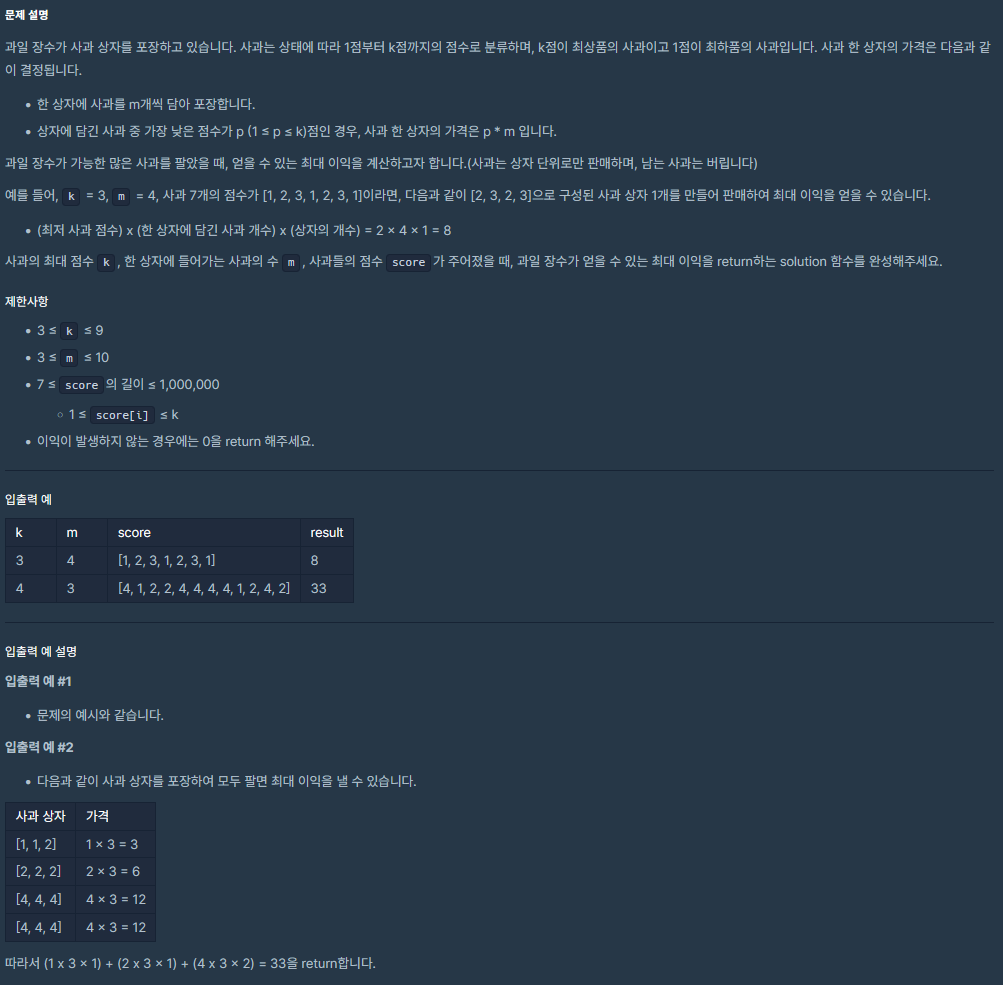
- 답안 :
import java.util.ArrayList;
import java.util.Arrays;
import java.util.Collections;

public class Solution {
	public int solution(int k, int m, int[] score) {
		int answer = 0;
		Arrays.sort(score);
		ArrayList<Integer> arr1 = new ArrayList<Integer>();
		int scoreidx = score.length - 1;
		int boxcnt = score.length / m;
		int boxsum = 0;
		for (int j = 0; j < boxcnt; j++) {
			for (int i = 0; i < m; i++) {
				arr1.add(score[scoreidx]);
				scoreidx--;
			}
			Collections.sort(arr1);
			boxsum = arr1.get(0) * arr1.size();
			answer = answer + boxsum;
			arr1.clear();
		}
		return answer;
	}

	public static void main(String[] args) {
		// TODO Auto-generated method stub
		Solution s = new Solution();
		int k = 4;
		int m = 3;
		int[] score = { 4, 1, 2, 2, 4, 4, 4, 4, 1, 2, 4, 2 };
		System.out.println(s.solution(k, m, score));
	}
}-
알고리즘 설명 : 나올수 있는 사과박스의 수는 한정되어있기에 사과박스수만큼의 반복문을 설정, 이후 정렬된 사과박스를 List에 넣어 정렬, idx0가 최저값이기에 해당 원소를 이용하여 값을 구함.
-
다른사람풀이 :
import java.util.*;

class Solution {
    public int solution(int k, int m, int[] score) {
        int answer = 0;

        Arrays.sort(score);

        for(int i = score.length; i >= m; i -= m){
            answer += score[i - m] * m;
        }

        return answer;
    }
}
- 간단하게 배열하나의 인덱스만으로도 풀어지는문제였음.. 조금 더 간단하게 생각할 필요가 있음.
SQL Kata
51.

- 답안 :
SELECT a1.ANIMAL_ID , a1.NAME
from ANIMAL_OUTS as a1
left join ANIMAL_INS as a2
on a1.ANIMAL_ID = a2.ANIMAL_ID
where a1.ANIMAL_ID is not null and a2.ANIMAL_ID IS NULL
order by 1- null에 관련된 문제기에 null 키워드만 잘활용하면 풀수있는 문제.
52.

- 답안 :
select a.FLAVOR
from
(SELECT f1.FLAVOR, f1.TOTAL_ORDER
from FIRST_HALF f1
left join ICECREAM_INFO f2
on f1.FLAVOR = f2.FLAVOR
where f1.TOTAL_ORDER>3000 AND f1.FLAVOR in('vanilla','peach','watermelon','mango','strawberry','melon','orange','pineapple')
order by 2 desc)a- 정렬은 총매출액이 필요하지만 결과테이블에선 나오면 안되기에 서브쿼리를 사용. 문제에는 안나왔지만 테이블구조에서 과일은 특정 단어를 포함하고있었음.
like를 사용하면 바보같이 in()으로 할필요가없었다는 뜻... 문제를 풀기전에 잘읽자

70살까지 개발하고싶은 개발자