알고리즘 Kata
61.
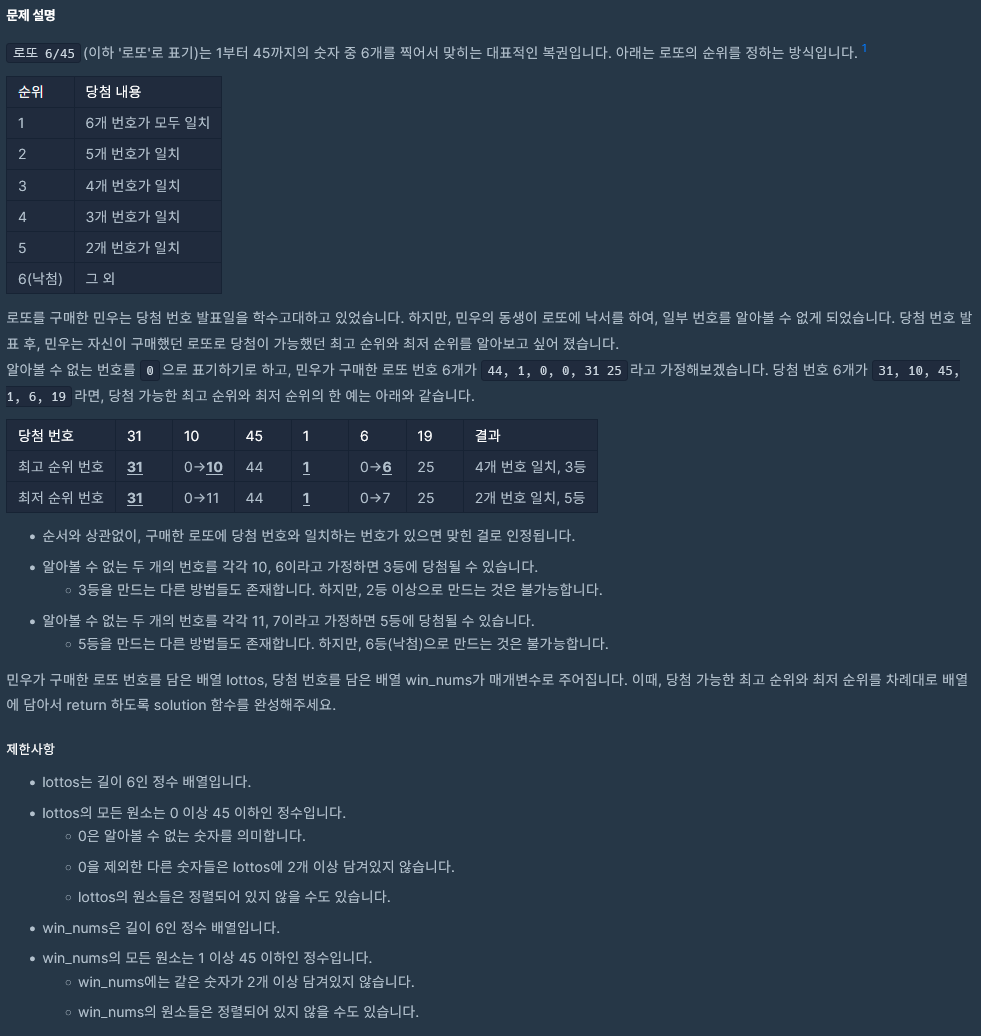
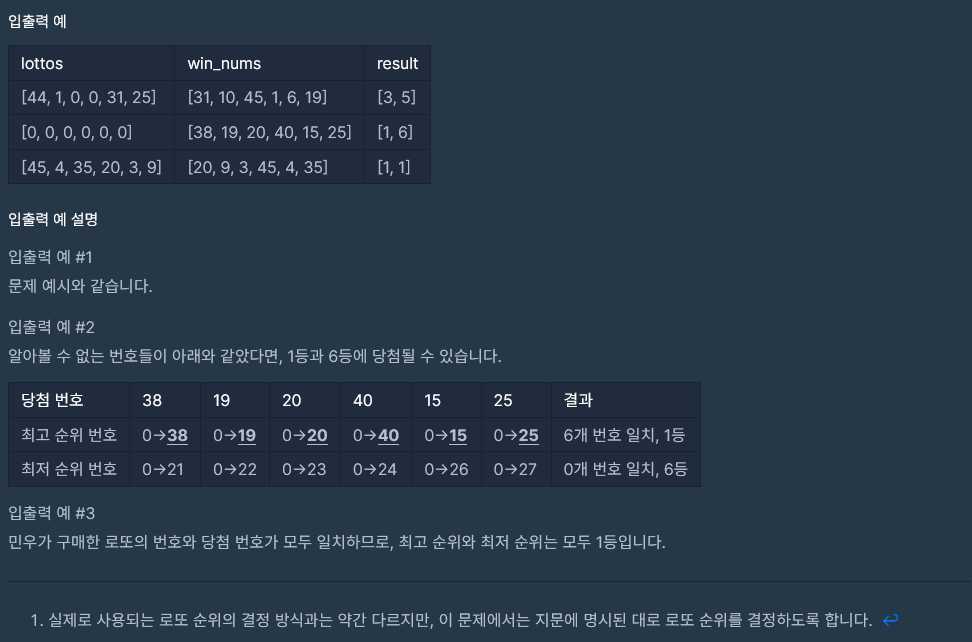
- 답안 :
package answer;

import java.util.ArrayList;
import java.util.Arrays;

public class Solution {

	public int[] solution(int[] lottos, int[] win_nums) {
		int bestcnt = 0;
		ArrayList<Integer> best = new ArrayList<>();
		ArrayList<Integer> worst = new ArrayList<>();
		Arrays.sort(lottos);
		Arrays.sort(win_nums);
		// best, worst List 삽입
		for (int i = 0; i < lottos.length; i++) {
			if (lottos[i] != 0) {
				best.add(lottos[i]);
			}
			for (int j = 0; j < win_nums.length; j++) {
				if (lottos[i] == win_nums[j]) {
					worst.add(lottos[i]);
					bestcnt++;
					break;
				}
			}
		}
		//best 근사치 값 삽입
		for (int j = 0; j < win_nums.length; j++) {
			if (!best.contains(win_nums[j]) && best.size() < 6) {
				best.add(win_nums[j]);
				bestcnt++;
			}
		}
		//등수 계산, 6등 초과시 6등으로 고정
		int[] answer = { 7 - bestcnt, 7 - worst.size() };
		if (answer[0] > 6)
			answer[0] = 6;
		if (answer[1] > 6)
			answer[1] = 6;
		return answer;
	}

	public static void main(String[] args) {
		// TODO Auto-generated method stub
		Solution s = new Solution();
		int lottos[] = { 0, 0, 0, 0, 0, 0 };
		int win_nums[] = { 38, 19, 20, 40, 15, 25 };
		System.out.println(s.solution(lottos, win_nums));
	}
}- 알고리즘 설명 : 2개의 best상황,worst상황 LIST를 활용해서 Best List의 경우 0부분을 제외하고 현재 번호를 넣어주며 최악상황인 주어진번호만 맞았을경우인 worst List에 번호를 넣어주며 정답을 카운트, 이후 비어있는 최고상황에 맞지않은 번호를 넣어주며 등수를 체크.
다른사람 풀이
import java.util.HashMap;
import java.util.Map;

class Solution {
    public int[] solution(int[] lottos, int[] win_nums) {
        Map<Integer, Boolean> map = new HashMap<Integer, Boolean>();
        int zeroCount = 0;

        for(int lotto : lottos) {
            if(lotto == 0) {
                zeroCount++;
                continue;
            }
            map.put(lotto, true);
        }


        int sameCount = 0;
        for(int winNum : win_nums) {
            if(map.containsKey(winNum)) sameCount++;
        }

        int maxRank = 7 - (sameCount + zeroCount);
        int minRank = 7 - sameCount;
        if(maxRank > 6) maxRank = 6;
        if(minRank > 6) minRank = 6;

        return new int[] {maxRank, minRank};
    }
}- 하나의 Map만을 가지고 정답을 활용할 수 있었음. 또한 반복문 갯수를 좀더 줄여 성능을 최적화 한것으로 보임.
SQL Kata
62.
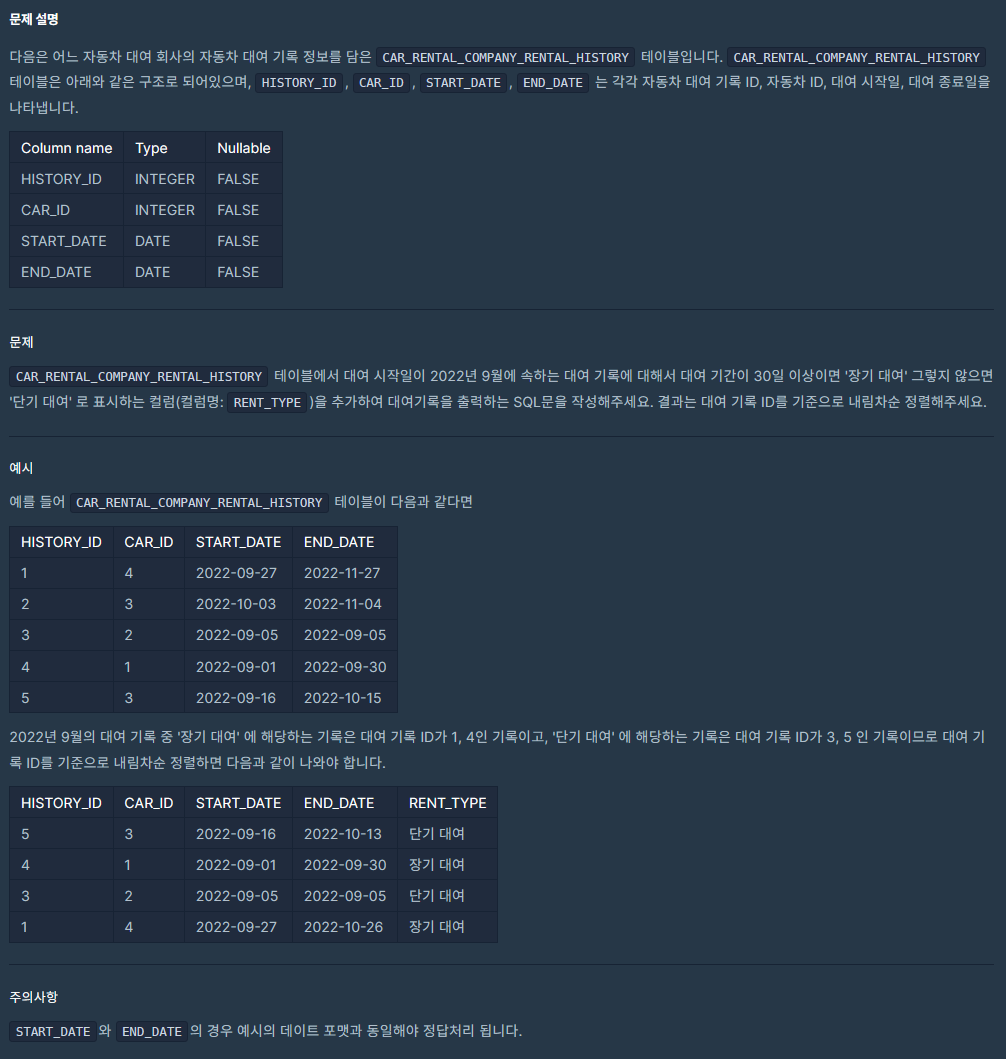
답안 :
SELECT HISTORY_ID, CAR_ID, date_format(START_DATE,'%Y-%m-%d') as 'START_DATE', date_format(END_DATE,'%Y-%m-%d') as 'END_DATE',
case when DATEDIFF(END_DATE,START_DATE)+1 >=30 then '장기 대여'
else '단기 대여' end as 'RENT_TYPE'
from CAR_RENTAL_COMPANY_RENTAL_HISTORY
where date_format(START_DATE,'%Y-%m')='2022-09'
order by 1 desc-
DATE 간의 차이를 구하는 DATEDIFF()를 사용하면 간단히 해결할수 있음.
DATEDIFF(Start_Date, End_DATE) : 시작날짜와 끝날짜의 날짜수 구하기
-
END_DATE - START_DATE를 하게되면 날짜계산이 아닌 숫자계산이 되버리기 때문에 31을 초과하는 숫자가 나올시 따로 정의해줘야함.
63.
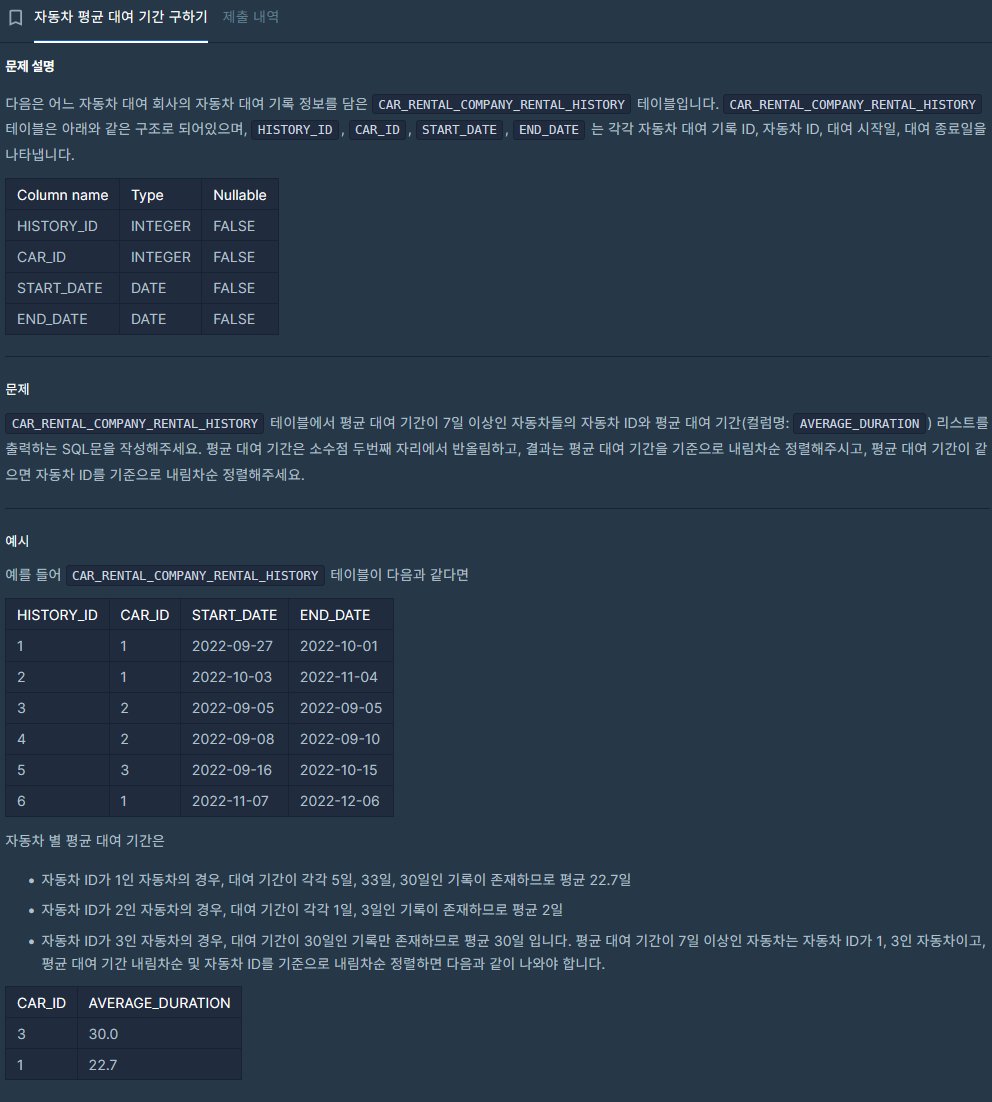
답안 :
SELECT car_id,ROUND(AVG(DATEDIFF(END_DATE,START_DATE)+1),1) as 'AVERAGE_DURATION'
from CAR_RENTAL_COMPANY_RENTAL_HISTORY
group by 1
Having 7<=AVERAGE_DURATION
order by 2 desc, 1 desc- 위 문제와 마찬가지로 DATEDIFF()를 활용하면 풀기쉬움.
- WHERE절보단 Group By절에서 조건을 거는게 좀 더 바람직해보임.

70살까지 개발하고싶은 개발자