Next-Gen Decentralized Exchange Development for Future Web3 Markets
Global businesses and professional participants in digital markets!!
Next-Gen Decentralized Exchange Development for Future Web3 Markets is now one of the most discussed topics among business leaders, professional traders, and long-term crypto investors. People normally talk about how Decentralized Exchange Development is changing the way digital assets are traded, owned, and protected. More importantly, many believe this shift will define how future Web3 markets grow, connect, and scale across global industries.
For modern businesses and serious investors, building and participating in next-generation decentralized exchanges is not only about technology. It is about owning market infrastructure, controlling liquidity flows, and gaining long-term strategic advantage in a digital economy that is becoming fully decentralized.
“Building the infrastructure that will power secure, scalable, and open Web3 trading ecosystems worldwide”How next-gen DEX fits into Web3 markets?Users & Traders
│
▼
Web3 Wallets ──► Decentralized Exchange Platform
│ │
▼ ▼
Smart Contracts ─────► On-chain Liquidity
│
▼
Global Web3 Markets
This structure shows why Next-Gen Decentralized Exchange Development becomes the foundation layer for future financial ecosystems.
What is a Decentralized Exchange?
A decentralized exchange (DEX) is a digital trading platform that allows users to trade crypto assets directly from their wallets without relying on a central authority or intermediary.
Traditional exchanges that store user funds and control order execution, a decentralized exchange operates using smart contracts. The platform itself never holds customer assets.
Every trade is settled transparently on the blockchain.
For business decision-makers and professional traders, this model offers:
Direct ownership of assets
Reduced counterparty risk
Transparent market operations
Open and global access to liquidity
A DEX is not just a trading tool. It becomes a programmable financial layer that supports future Web3 services such as decentralized lending, tokenized real-world assets, and automated investment strategies.
How does a decentralized exchange work?
At its core, a decentralized exchange is powered by automated and trust-free logic.
Here is the simplified flow:
Users connect their wallets to the platform
Trading rules are enforced by smart contracts
Liquidity is supplied by independent participants
Trades are matched and settled on-chain
Users receive assets directly in their wallets
There is no central operator controlling withdrawals, prices, or settlement.
Execution flow diagram:
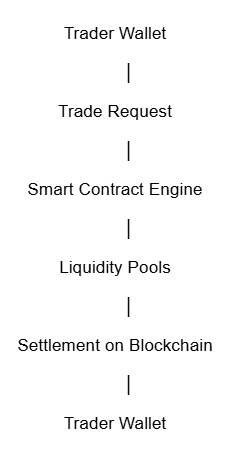
This automated flow is the reason decentralized exchange platforms can operate continuously, globally, and without operational downtime.
Why Next-Gen Decentralized Exchange Development crucial for business?
The next generation of decentralized exchanges is very different from early platforms. Modern exchange development focuses on enterprise performance, regulatory readiness, and institutional-grade infrastructure.
For business leaders and crypto investment firms, next-gen DEX platforms deliver:
High-performance trade execution
Deep and cross-chain liquidity access
Advanced risk and compliance layers
Real-time analytics for decision making
Infrastructure for tokenized business assets
In the coming years, many digital companies will not only use decentralized exchanges. They will operate them as revenue-generating platforms, liquidity hubs, and financial gateways for Web3 products.
How decentralized exchanges will modify trading and investment?
Future trading environments will not be limited to crypto assets. Tokenized equities, digital commodities, intellectual property, and real-world assets will enter decentralized markets.
Next-gen decentralized exchange development supports this transformation by enabling:
Programmable asset trading rules
Automated settlement and corporate actions
Embedded compliance logic
Fractional ownership and global participation
This allows institutional investors and enterprises to design market structures that were not possible in traditional financial systems.
Core values of next-generation decentralized exchange platforms**
**
Every serious business-grade decentralized exchange must be built on strong core values.
-
Transparency by design
All transactions, fees, and liquidity movements remain publicly verifiable. -
Ownership and control
Users always retain custody of assets and private keys. -
Operational resilience
Smart contracts replace centralized operational teams for trade execution and settlement. -
Open market access
Anyone can participate without geographical or banking barriers. -
Scalable infrastructure
Next-gen systems are designed to support institutional volumes and global traffic. -
Trustless automation
Trading logic cannot be manipulated after deployment.
These values create long-term trust for investors, traders, and corporate partners.
Business and investor advantages of decentralized exchange development
For businesses:
New revenue from fees and liquidity programs
Asset launch and trading infrastructure
Liquidity and market-making services
White-label trading platforms
On-chain financial data products
For traders:
Direct trading without custody risk
Less dependence on centralized platforms
Faster access to new markets
Early access to emerging digital assets
News and future updates in decentralized exchange development:
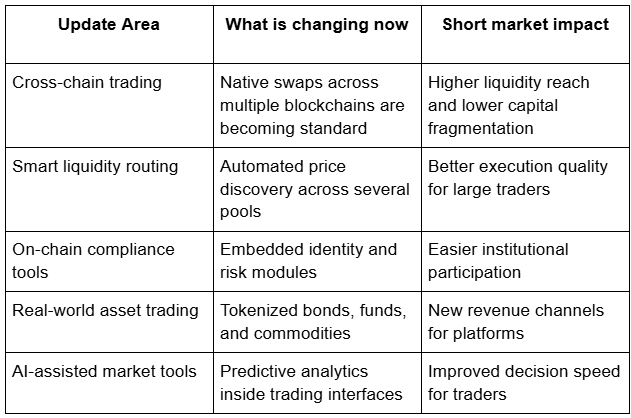
These updates clearly indicate that decentralized exchanges are evolving into full-scale financial infrastructure, not just crypto marketplaces.
The future outlook for Next-Gen Decentralized Exchange Development
Over the next decade, decentralized exchanges will become invisible infrastructure powering digital economies. Users will not always notice that they are interacting with a DEX.
Trading and settlement will happen perfectly inside business applications, gaming platforms, digital identity services, and real-world asset marketplaces.
Future decentralized exchanges will:
Support thousands of asset classes
Integrate compliance without sacrificing decentralization
Offer institutional-grade analytics and risk controls
Operate across multiple chains with unified liquidity
Enable programmable financial workflows for enterprises
For business leaders, traders, and crypto investors, understanding and adopting Next-Gen Decentralized Exchange Development today means positioning ahead of the next global shift in financial infrastructure.
Decentralized exchanges are no longer experimental platforms. They are becoming the digital trading backbone of future Web3 markets.