# API Testing Strategies That Actually Work in 2026
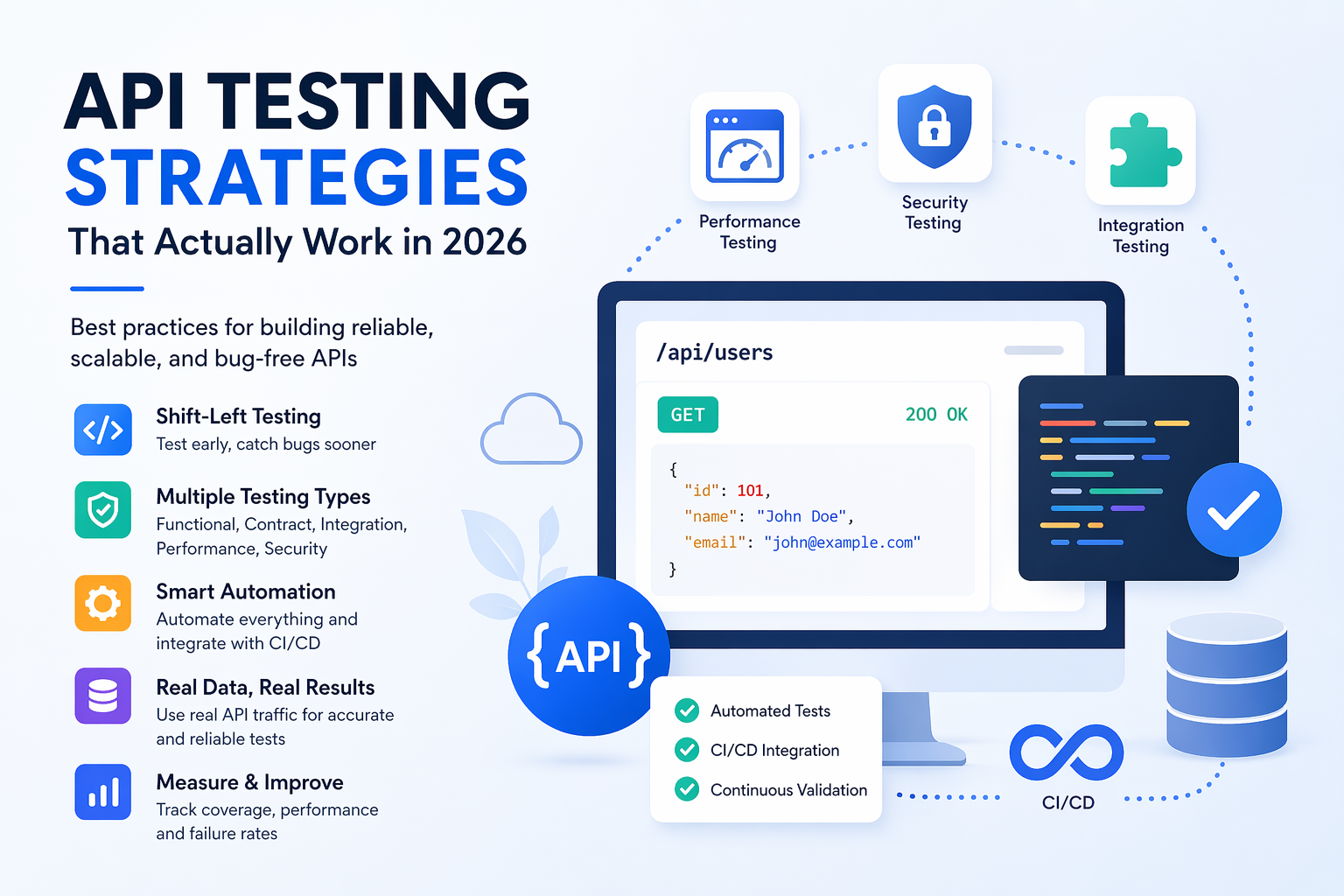
If you’re building modern applications, APIs are no longer just a backend component—they are the product. From mobile apps to SaaS platforms, everything depends on APIs working flawlessly.
But here’s the reality: most teams still treat API testing as an afterthought.
That’s a mistake.
A strong API testing strategy is what separates stable products from ones that constantly break in production. In this guide, we’ll break down practical, real-world API testing strategies—and how you can implement them without slowing down development.
Why API Testing Matters More Than Ever
APIs sit at the core of modern architectures like microservices and distributed systems. A single failure can cascade across services and impact users instantly.
A solid API testing strategy helps you:
- Catch bugs early (before UI even exists)
- Ensure reliable integrations between services
- Prevent regression issues in production
- Improve release confidence in CI/CD pipelines
According to API Testing Strategies Guide, modern API testing focuses on combining multiple testing types with automation and shift-left practices to improve reliability.
1. Start with Shift-Left Testing
Shift-left means testing APIs early in the development lifecycle—right when endpoints are created.
Instead of waiting for full integration:
- Test endpoints using mock data
- Validate request/response formats
- Catch schema issues early
This approach reduces debugging time and improves developer productivity.
2. Use Multiple API Testing Types (Not Just One)
A common mistake is relying only on functional testing. In reality, you need a mix of strategies:
Core API Testing Types:
- Functional Testing – Validates API behavior
- Contract Testing – Ensures API adheres to schema
- Integration Testing – Checks service interactions
- Performance Testing – Measures scalability under load
- Security Testing – Identifies vulnerabilities
Modern API testing strategies emphasize combining these approaches instead of relying on just one ([Keploy][1]).
3. Automate Everything (But Smartly)
Manual testing doesn’t scale.
Automation is critical—but writing test cases manually for every endpoint is time-consuming and fragile.
This is where modern tools like Keploy change the game.
Why automation matters:
- Faster test execution
- Consistent validation
- CI/CD integration
- Reduced human error
Tools like Keploy can automatically generate API test cases by capturing real traffic, eliminating the need to write tests from scratch ([Keploy][2]).
4. Use Real Data Instead of Mock-Heavy Testing
Mocks are useful—but overusing them creates unrealistic tests.
Instead:
- Capture real API traffic
- Use production-like data
- Validate real-world scenarios
Keploy uses a record-and-replay approach, capturing real API calls and turning them into test cases automatically ([GitHub][3]).
This ensures your tests reflect actual user behavior—not assumptions.
5. Integrate API Testing into CI/CD
Testing shouldn’t be a separate phase—it should be part of your pipeline.
Best practices:
- Run API tests on every commit
- Fail builds on broken endpoints
- Track coverage and performance
Modern API testing tools integrate directly with CI/CD pipelines, allowing continuous validation of every deployment ([Keploy][2]).
6. Focus on Edge Cases and Error Handling
Most bugs don’t come from happy paths—they come from edge cases.
Test scenarios like:
- Invalid inputs
- Missing parameters
- Rate limits
- Timeout handling
AI-powered tools can automatically discover such edge cases and improve test coverage significantly ([Kite Metric][4]).
7. Measure What Actually Matters
Don’t just run tests—measure effectiveness.
Key metrics:
- Test coverage
- Failure rate
- Response time
- Error rates
Advanced strategies even analyze runtime behavior and logs to improve coverage across different scenarios.
8. Keep Tests Maintainable
One of the biggest pain points in API testing is maintenance.
Avoid:
- Hardcoded values
- Fragile assertions
- Overly complex test suites
Instead:
- Use reusable test structures
- Auto-generate tests where possible
- Keep tests aligned with real API usage
The Future of API Testing: AI + Automation
API testing is rapidly evolving.
Traditional approaches:
- Manual test writing
- Static mocks
- Limited coverage
Modern approaches:
- AI-generated tests
- Real traffic replay
- Continuous validation
Keploy represents this shift by enabling developers to generate tests automatically, improve coverage, and reduce manual effort significantly.
Final Thoughts
API testing is no longer optional—it’s foundational.
If you want reliable, scalable applications, you need:
- Early testing (shift-left)
- Multiple testing strategies
- Automation + real-world data
- CI/CD integration
If you’re looking for a deeper dive into implementing these strategies, check out this detailed guide on API testing strategies:
👉 https://keploy.io/blog/community/api-testing-strategies
And if you want to simplify API testing with automation and AI, explore Keploy.
