Deployment Strategies: Choosing the Right Approach for Reliable Software Releases
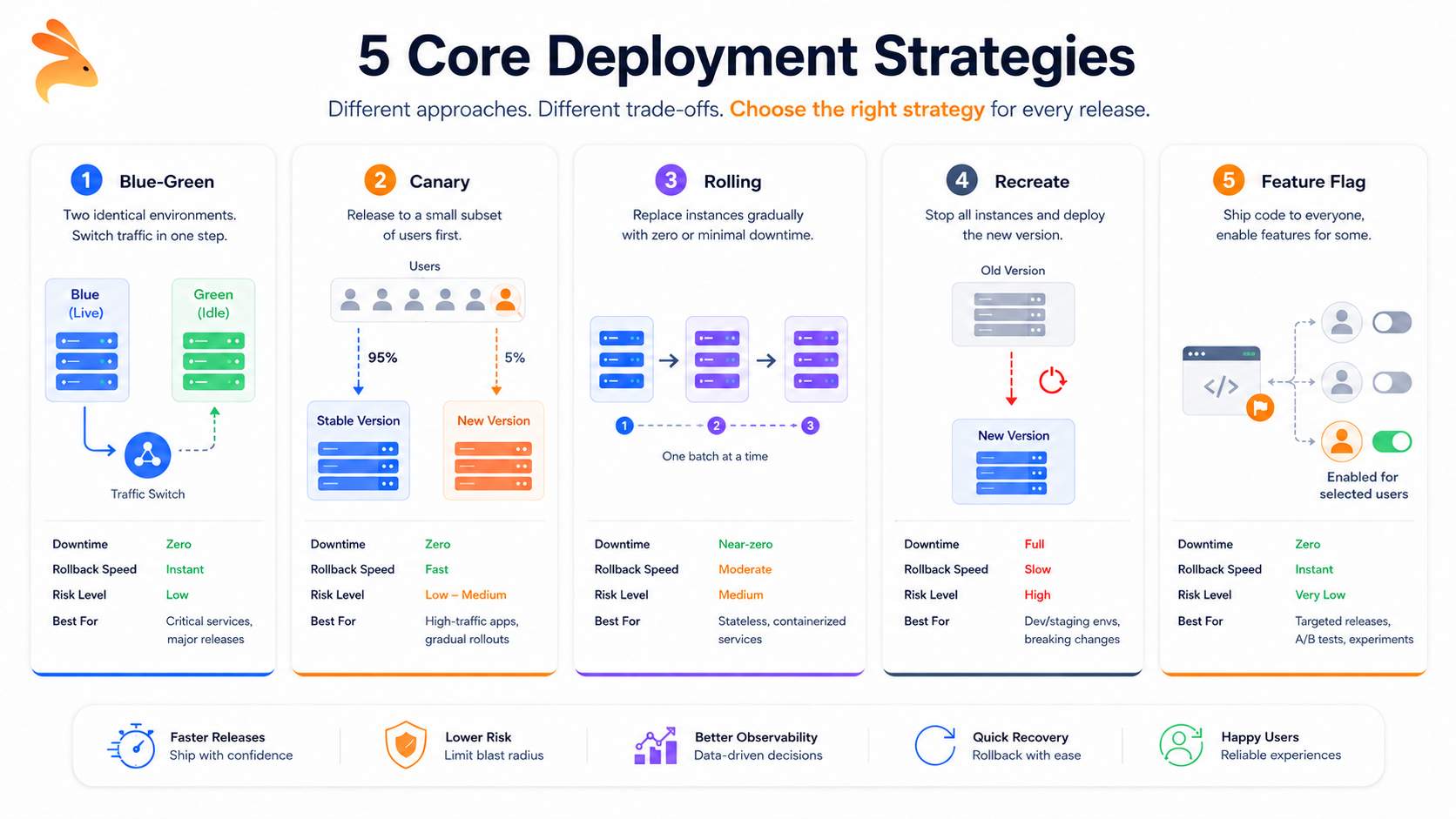
Modern software development is no longer just about writing code. Delivering updates quickly, safely, and consistently has become equally important. As organizations adopt Agile, DevOps, and continuous delivery practices, deployment strategies play a critical role in ensuring successful releases
A deployment strategy defines how new versions of an application are delivered to users. The right approach can minimize downtime, reduce risks, improve user experience, and enable faster innovation.
What Are Deployment Strategies?
Deployment strategies are structured methods used to release software updates into production environments. Instead of simply replacing an existing application with a new version, modern deployment strategies provide controlled ways to introduce changes while minimizing disruptions.
The goals of deployment strategies include:
- Reducing deployment risk
- Preventing service interruptions
- Improving release reliability
- Supporting rapid delivery cycles
- Enhancing user experience
Choosing the right strategy depends on application requirements, infrastructure, team maturity, and business objectives.
Why Deployment Strategies Matter
Deploying software without a defined strategy can lead to downtime, failed releases, and negative user experiences.
Effective deployment strategies help organizations:
Minimize Downtime
Users expect applications to remain available during updates.
Reduce Risk
Controlled rollouts make it easier to identify and address issues before they impact all users.
Improve Rollback Capabilities
Modern deployment approaches enable faster recovery when problems occur.
Support Continuous Delivery
Automated deployment processes allow teams to release updates more frequently.
Increase Customer Satisfaction
Reliable deployments result in fewer disruptions and better application performance.
Popular Deployment Strategies
Several deployment strategies are widely used in modern software development.
1. Recreate Deployment
The recreate strategy shuts down the current application version before deploying the new one.
Advantages
- Simple to implement
- Low infrastructure requirements
- Easy to manage
Disadvantages
- Causes downtime
- Higher risk during production updates
Best For
Small applications and non-critical systems.
2. Rolling Deployment
Rolling deployment gradually replaces old application instances with new ones.
Advantages
- Minimal downtime
- Resource efficient
- Widely supported by Kubernetes and cloud platforms
Disadvantages
- Multiple versions may run simultaneously
- Rollbacks can be more complex
Best For
Cloud-native applications and microservices.
3. Blue-Green Deployment
Blue-Green deployment uses two identical production environments.
The current version runs in the "Blue" environment, while the new version is deployed to the "Green" environment. Traffic is switched only after validation.
Advantages
- Near-zero downtime
- Easy rollback
- Reduced deployment risk
Disadvantages
- Higher infrastructure costs
- Requires duplicate environments
Best For
Mission-critical applications.
4. Canary Deployment
Canary deployment releases the new version to a small percentage of users before a full rollout.
Advantages
- Lower risk exposure
- Real user feedback
- Easier issue detection
Disadvantages
- Requires monitoring capabilities
- More operational complexity
Best For
Large-scale applications with significant user traffic.
5. A/B Testing Deployment
A/B testing delivers different application versions to different user groups.
Advantages
- Supports experimentation
- Data-driven decision making
- Improved feature validation
Disadvantages
- Complex implementation
- Requires advanced analytics
Best For
Product-driven organizations focused on optimization.
6. Shadow Deployment
Shadow deployment sends production traffic to a new application version without exposing responses to users.
Advantages
- Real-world testing
- No user impact
- Performance validation
Disadvantages
- Increased infrastructure costs
- Complex monitoring requirements
Best For
High-risk application updates.
Deployment Strategies in DevOps
DevOps practices emphasize automation, collaboration, and continuous delivery.
Modern deployment strategies support DevOps by enabling:
- Automated releases
- Continuous integration
- Continuous deployment
- Faster feedback cycles
- Improved system reliability
Organizations that integrate deployment automation into CI/CD pipelines can deploy updates more frequently and with greater confidence.
Key Factors When Choosing a Deployment Strategy
Not every deployment strategy is suitable for every application.
Consider the following factors:
Application Criticality
Business-critical systems often require Blue-Green or Canary deployments.
Infrastructure Costs
Some strategies require duplicate environments and additional resources.
User Traffic
High-traffic applications benefit from gradual rollout approaches.
Rollback Requirements
Fast rollback capabilities are essential for mission-critical services.
Team Expertise
Advanced strategies require strong operational and monitoring capabilities.
Common Deployment Challenges
Despite advances in automation, software deployments still present challenges.
Downtime Risks
Poor planning can lead to service interruptions.
Configuration Errors
Incorrect settings often cause deployment failures.
Dependency Issues
Application updates may introduce compatibility problems.
Monitoring Gaps
Insufficient visibility can delay issue detection.
Scaling Complexity
Large distributed systems require sophisticated deployment controls.
How Keploy Improves Deployment Confidence
Testing plays a vital role in successful deployments. Even the best deployment strategy cannot prevent failures caused by insufficient testing.
Keploy helps development teams automate API testing by capturing real application traffic and generating test cases automatically. This enables teams to validate software behavior before deployment and reduce the likelihood of production incidents.
By combining automated testing with reliable deployment strategies, organizations can improve release quality, accelerate delivery, and minimize operational risks.
Learn more about deployment approaches and best practices here:
https://keploy.io/blog/community/deployment-strategies
Best Practices for Successful Deployments
To maximize deployment success:
- Automate deployment workflows.
- Implement comprehensive testing.
- Use monitoring and observability tools.
- Create rollback plans.
- Validate deployments in staging environments.
- Deploy smaller, incremental changes.
- Continuously review deployment performance.
These practices help reduce risk and improve software reliability.
The Future of Deployment Strategies
Software deployment continues to evolve alongside cloud computing and platform engineering.
Emerging trends include:
- AI-assisted deployment decisions
- Progressive delivery techniques
- GitOps-driven deployments
- Automated rollback mechanisms
- Enhanced observability platforms
Organizations that adopt modern deployment practices will be better positioned to deliver software quickly and reliably.
Conclusion
Deployment strategies are a fundamental component of modern software delivery. Whether using Rolling, Blue-Green, Canary, Shadow, or A/B testing approaches, selecting the right strategy can significantly reduce deployment risk and improve user experience.
Combined with automated testing solutions like Keploy, effective deployment strategies help organizations achieve faster releases, higher software quality, and greater operational confidence in an increasingly competitive digital landscape.
