1️⃣ 1번 외톨이 알파벳
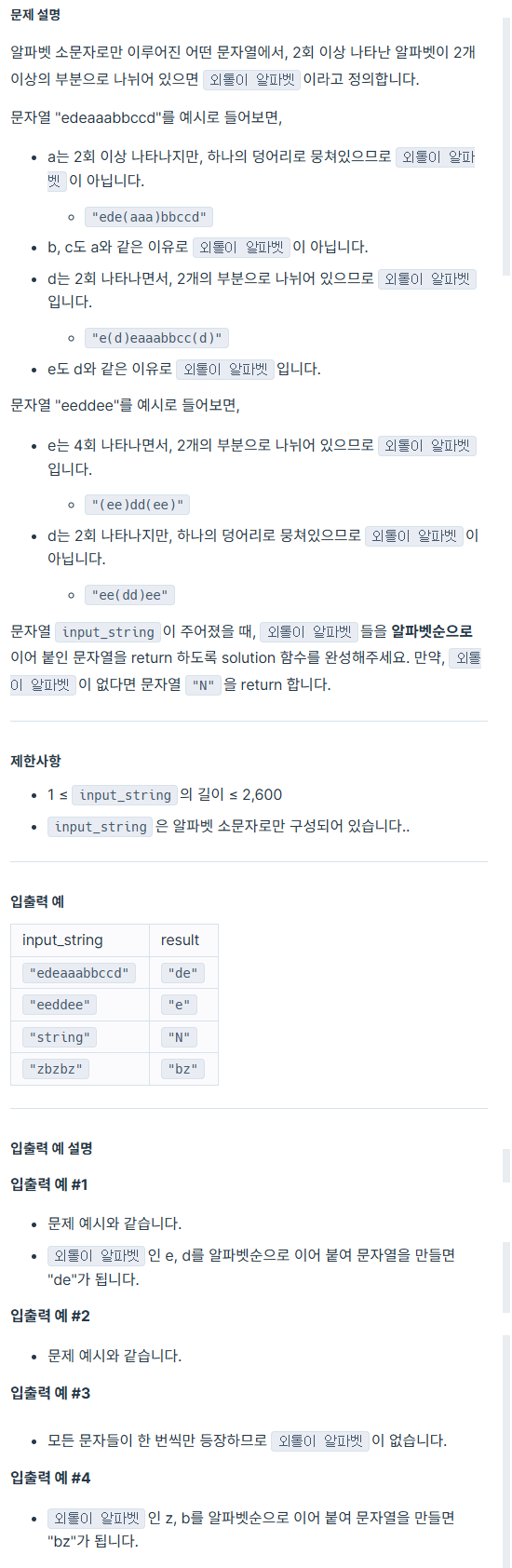
charAt 과 for 문 사용
import java.util.*;

public class Solution {

    public static String solution(String input_string) {

        String answer = "";
        HashMap<Character, Integer> map = new HashMap<>();

        for (int i = 0; i < input_string.length(); i++) {

            char current = input_string.charAt(i);

            // 새로운 구간이 시작될 때만 카운트
            if (i == 0 || current != input_string.charAt(i - 1)) {

                if (map.containsKey(current)) {
                    map.put(current, map.get(current) + 1);
                } else {
                    map.put(current, 1);
                }
            }
        }

        StringBuilder sb = new StringBuilder();

        for (char c = 'a'; c <= 'z'; c++) {

            if (map.containsKey(c) && map.get(c) >= 2) {
                sb.append(c);
            }
        }

        if (sb.length() == 0) {
            answer = "N";
        } else {
            answer = sb.toString();
        }

        return answer;
    }

    public static void main(String[] args) {
        System.out.println(solution("edeaaabbccd")); // de
        System.out.println(solution("eeddee"));      // e
        System.out.println(solution("string"));      // N
        System.out.println(solution("zbzbz"));       // bz
    }
}
Queue 사용
import java.util.*;

public class Solution {

	public static String solution(String input_string) {
		String answer = "";
		char tempChar;
		int tempCnt = 0;
		int repeatCnt = 0;

		Queue<Character> q = new LinkedList<>();
		HashMap<Character, Integer> originHm = new HashMap<>();
		HashMap<Character, Integer> repeatChkHm = new HashMap<>();
		ArrayList<Character> list = new ArrayList<>();

		for (int i = 0; i < input_string.length(); i++) {
			q.offer(input_string.charAt(i)); // e d e a a a b b c c d
		}

		while (!q.isEmpty()) {

			tempChar = q.poll();

			if (originHm.get(tempChar) == null) {
				originHm.put(tempChar, 1);
				repeatChkHm.put(tempChar, 1);
			} else {
				tempCnt = originHm.get(tempChar) + 1;
				originHm.put(tempChar, tempCnt);
			}

			if (!q.isEmpty()) {

				if (tempChar == q.peek()) { // 연속되는 알파벳이라면
					repeatCnt = repeatChkHm.get(tempChar) + 1;
					repeatChkHm.put(tempChar, repeatCnt);
				}
			}
		}

		for (char key : originHm.keySet()) {

			if (originHm.get(key) != repeatChkHm.get(key) && originHm.get(key) > 1) {
				list.add(key);
			}
		}

		if (list.size() == 0) {
			answer = "N";
		} else {
			Collections.sort(list);

			StringBuilder sb = new StringBuilder();

			for (int i = 0; i < list.size(); i++) {
				sb.append(list.get(i));
			}

			answer = sb.toString();
		}

		return answer;
	}

	public static void main(String[] args) {
		String input_string = "edeaaabbccd";

		System.out.println(solution(input_string));
	}
}
2️⃣ 2번 체육대회
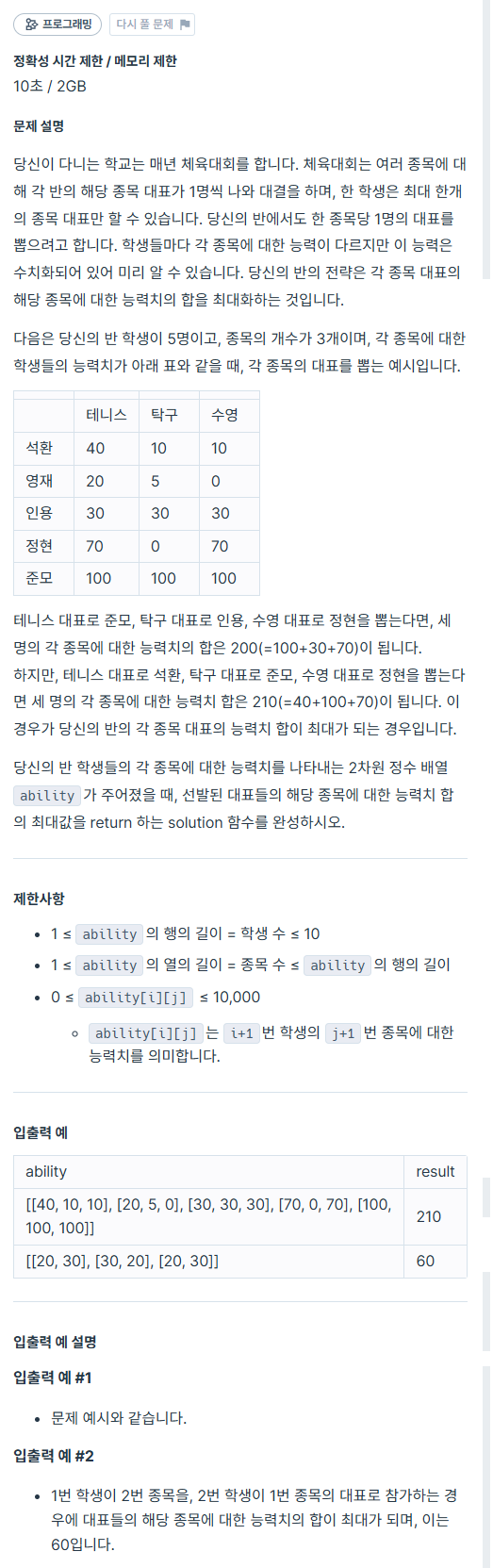
class Solution {
    // 최댓값을 저장할 변수
    private int maxScore = 0;
    private int numStudents;
    private int numSports;
    private boolean[] visited;

    public int solution(int[][] ability) {
        int answer = 0;
        numStudents = ability.length;    // 학생 수
        numSports = ability[0].length;    // 종목 수
        visited = new boolean[numStudents]; // 학생 선발 여부 체크 배열

        // 0번 종목, 현재 점수 0점부터 시작
        backtrack(0, 0, ability);

        return answer;
    }

    private void backtrack(int sportIdx, int currentSum, int[][] ability) {
        // 기저 사례: 모든 종목의 대표를 다 뽑았다면 최댓값 갱신 후 종료
        if (sportIdx == numSports) {
            maxScore = Math.max(maxScore, currentSum);
            return;
        }

        // 모든 학생을 순회하며 현재 종목(sportIdx)의 대표로 세워봄
        for (int studentIdx = 0; studentIdx < numStudents; studentIdx++) {
            // 아직 대표로 선발되지 않은 학생인 경우
            if (!visited[studentIdx]) {
                visited[studentIdx] = true; // 대표로 선발 (방문 체크)

                // 다음 종목(sportIdx + 1)의 대표를 뽑으러 재귀 호출
                backtrack(sportIdx + 1, currentSum + ability[studentIdx][sportIdx], ability);

                visited[studentIdx] = false; // 다른 경우의 수를 위해 선발 취소 (백트래킹)
            }
        }
    }
}
3️⃣ 3번 유전 법칙
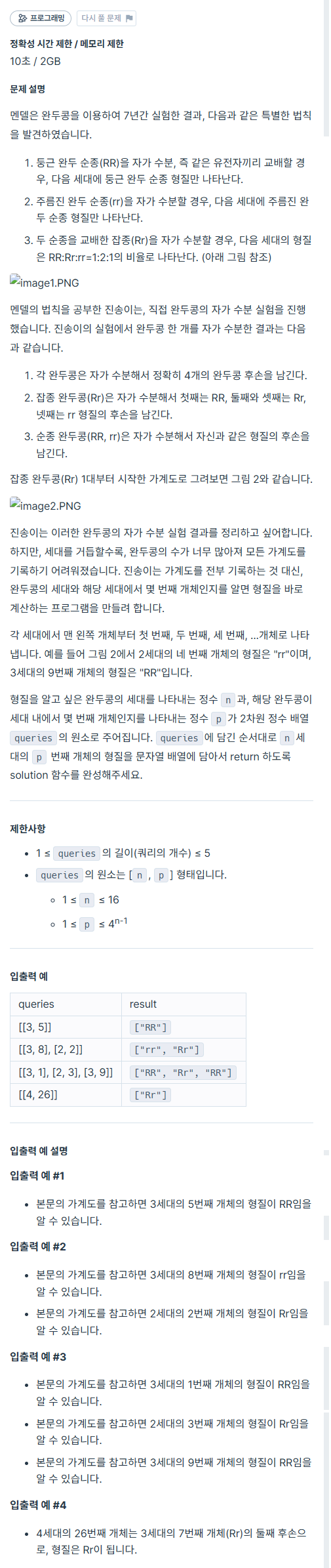
class Solution {
    public String[] solution(int[][] queries) {
        // 1. 쿼리 개수만큼 결과 배열의 크기를 지정합니다.
        String[] answer = new String[queries.length];

        // 2. 반복문을 돌며 각 쿼리([n, p])에 대한 dfs 결과를 answer 배열에 담습니다.
        for (int i = 0; i < queries.length; i++) {
            int n = queries[i][0];
            long p = (long) queries[i][1]; // p가 최대 4의 15제곱이므로 long 타입 변환이 안전합니다.

            answer[i] = dfs(n, p);
        }

        return answer;
    }

    public String dfs(int n, long p) {
        if (n == 1) return "Rr";

        long parentP = (p - 1) / 4 + 1;
        String parentType = dfs(n - 1, parentP);

        if (parentType.equals("RR")) return "RR";
        if (parentType.equals("rr")) return "rr";

        long groupIdx = (p - 1) % 4;
        if (groupIdx == 0) return "RR";
        else if (groupIdx == 3) return "rr";
        else return "Rr";
    }
}
4️⃣ 4번 운영체제
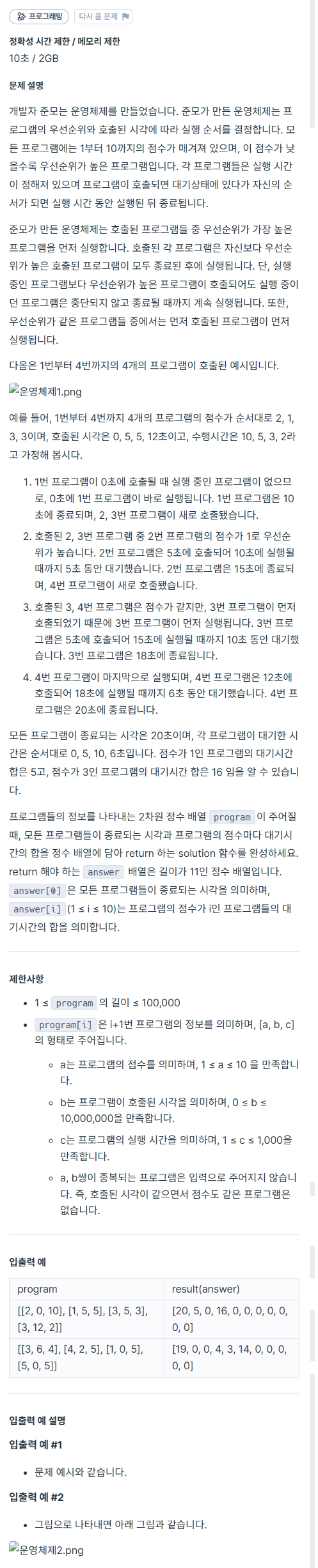
import java.util.*;

class Solution {
    public long[] solution(int[][] program) {
        // answer[0]: 모든 프로그램이 종료되는 시각
        // answer[1]~answer[10]: 각 점수(1~10)별 프로그램들의 대기시간 합
        long[] answer = new long[11];

        // 대기 중인 프로그램을 관리할 우선순위 큐 (실행 대기 큐)
        // 정렬 기준: 1순위 - 프로그램 점수 오름차순, 2순위 - 호출 시각 오름차순
        PriorityQueue<int[]> waitingQueue = new PriorityQueue<>((o1, o2) -> {
            if (o1[0] != o2[0]) {
                return Integer.compare(o1[0], o2[0]);
            }
            return Integer.compare(o1[1], o2[1]);
        });

        // 1. 전체 프로그램을 호출 시각 기준으로 오름차순(작은값→큰 값) 정렬
        Arrays.sort(program, (o1, o2) -> Integer.compare(o1[1], o2[1]));

        long currentTime = 0; // 현재 시각
        int programIdx = 0;   // program 배열을 순회할 인덱스
        int totalPrograms = program.length;

        // 2. 모든 프로그램을 처리할 때까지 반복
        while (programIdx < totalPrograms || !waitingQueue.isEmpty()) {

            // 3. 현재 시각 이하로 호출된 모든 프로그램을 대기 큐에 입장하는 조건문
            while (programIdx < totalPrograms && program[programIdx][1] <= currentTime) {
                waitingQueue.add(program[programIdx]); // 대기실에 넣기
                programIdx++; // 인덱스 1씩 증가
            }

            // 만약 대기 큐가 비어있다면 시간을 건너뛰는 조건문
	// 첫번째 배열의 호출시간이 0보다 늦거나, 한 배열이 끝나고 다음 배열이 들어올 때까지 시간 공백이 길 때 필요
            if (waitingQueue.isEmpty()) {
                currentTime = program[programIdx][1];
                continue; // 아래의 코드를 실행하지 않고 반복문의 처음 조건 검사 단계로 건너뜀
            }

            // 4. 대기 큐에서 우선순위가 높은 프로그램을 꺼내서 쪼개서
	int[] currentProgram = waitingQueue.poll();
            int score = currentProgram[0]; // 이 프로그램의 점수/우선순위
            int callTime = currentProgram[1]; // 이 프로그램의 호출 시간
            int executionTime = currentProgram[2]; // 수행하는데 걸리는 시간

            // 5. 대기 시간 = 현재 시간 - 호출 시간
            long waitTime = currentTime - callTime;
            answer[score] += waitTime; // 해당 점수의 대기시간 누적

            // 6. 프로그램이 수행되고 종료된 시간으로 현재 시간 업데이트
            currentTime += executionTime;
        }

        // 마지막. 모든 while 문을 탈출한 직후 0번 방에 최종 마감 시각 저장
        answer[0] = currentTime;

        return answer;
    }
}
개발일지