
객체와 속성 사용하기
변수를 사용하는 것처럼 객체의 속성에 접근하고 업데이트할 수 있다. 만약에 객체가 변수가 저장되어 있다면, 변수명을 먼저 지정하고 객체 연산자를 사용하여 작업하려는 속성을 지정한다.
속성에 저장된 값에 접근하려면 다음과 같이 한다.
echo $account->balance;이 코드는 계좌 잔고에 대한 값을 페이지에 어떻게 표시하는지 보여준다.
속성에 저장된 값을 업데이트하려면 다음과 같이 한다.
$account->number = 20148896;
$account->type = 'Checking';
$account->balance = 1000.00;
예시
<?php
  class Customer
  {
    public string $forename;
    public string $surname;
    public string $email;
    public string $password;
  }
  class Account
  {
    public int $number;
    public string $type;
    public float $balance;
  }
  $customer = new Customer();
  $account = new Account();
  $customer->email = 'ivy@eg.link';
  $account->balance = 1000.00;
?>
<?php include 'includes/header.php'; ?>
<p>Email: <?= $customer->email ?></p>
<p>Balance: $<?= $account->balance ?></p>
<?php include 'includes/footer.php'; ?>
메서드 정의하고 호출하기
메서드는 클래스 정의 내부에 작성된 함수다. 메서드를 호출하려면 객체를 보유하고 있는 변수 이름과 객체 연산자, 그리고 메서드 이름을 사용한다.
객체의 메서드 사용하기
예시
<?php
class Account
{
	public int    $number;
    public string $type;
    public float  $balance;
    public function deposit(float $amount): float
    {
    	$this->balance += $amount;
        return $this->balance;
    }
    public function withdraw(float $amount): float
    {
    	$this->balance -= $amount;
        return $this->balance;
    }
}
$account = new Account();
$account->balance = 100.00;
?>
<?php include 'includes/header.php'; ?>
<p>$<?= $account->deposit(50.00) ?></p>
<?php include 'includes/footer.php'; ?>
- $this->balance는 이 객체의 balance 속성을 가져온다.
- Account 클래스를 사용하여 객체를 생성하고 $account라는 변수에 저장한다.
생성자 메서드
클래스 정의에 __construct()라는 생성자 메서드를 추가했다면, 그 메서드 안의 구문은 클래스를 사용하여 객체가 생성될 때 자동으로 실행된다.
예시
<?php
declare(strict_types = 1);
class Account
{
  public int    $number;
  public string $type;
  public float  $balance;
  public function __construct(int $number, string $type, float $balance = 0.00)
  {
    $this->number  = $number;
    $this->type    = $type;
    $this->balance = $balance;
  }
  public function deposit(float $amount): float
  {
    $this->balance += $amount;
    return $this->balance;
  }
  public function withdraw(float $amount): float
  {
    $this->balance -= $amount;
    return $this->balance;
  }
}
  $checking = new Account(43161176, 'Checking', 32.00);
  $savings   = new Account(20148896, 'Savings', 756.00);
?>
<?php include 'includes/header.php'; ?>
<h2>Account Balances</h2>
<table>
  <tr>
    <th>Date</th>
    <th><?= $checking->type ?></th>
    <th><?= $savings->type ?></th>
  </tr>
  <tr>
    <td>23 June</td>
    <td>$<?= $checking->balance ?></td>
    <td>$<?= $savings->balance ?></td>
  </tr>
  <tr>
    <td>24 June</td>
    <td>$<?= $checking->deposit(12.00) ?></td>
    <td>$<?= $savings->withdraw(100.00) ?></td>
  </tr>
  <tr>
    <td>25 June</td>
    <td><?= $checking->withdraw(5.00) ?></td>
    <td><?= $savings->deposit(300.00) ?></td>
  </tr>
</table>
<?php include 'includes/footer.php'; ?>
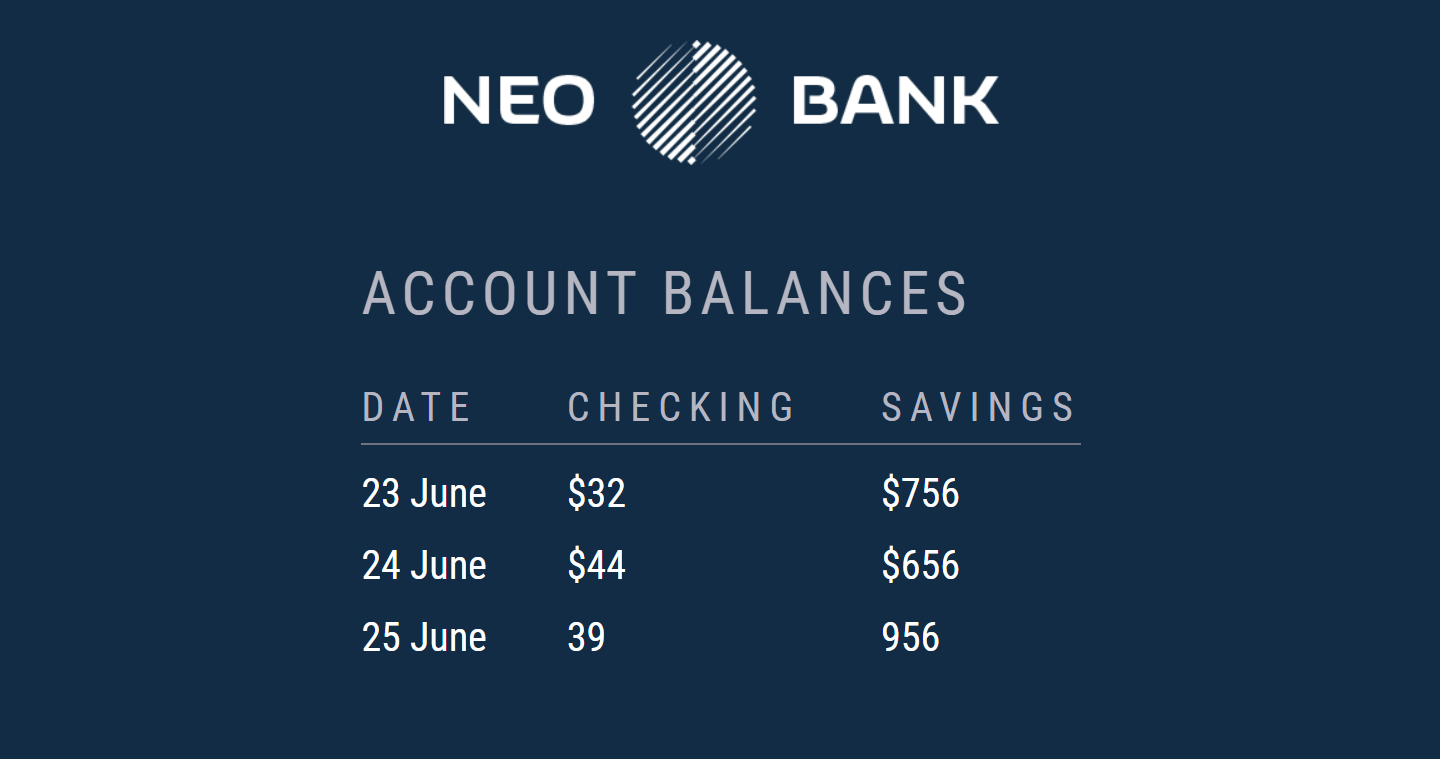
Account 클래스를 사용하여 객체를 생성하고 $checking, $savings라는 변수에 저장한다. PHP 인터프리터는 __construct 메서드를 클래스에서 찾는다.
결과
출처 - 존 두켓, <백엔드 프로그래밍을 위한 PHP & MySQL>, Jpub, 2022
