I/O Data Path
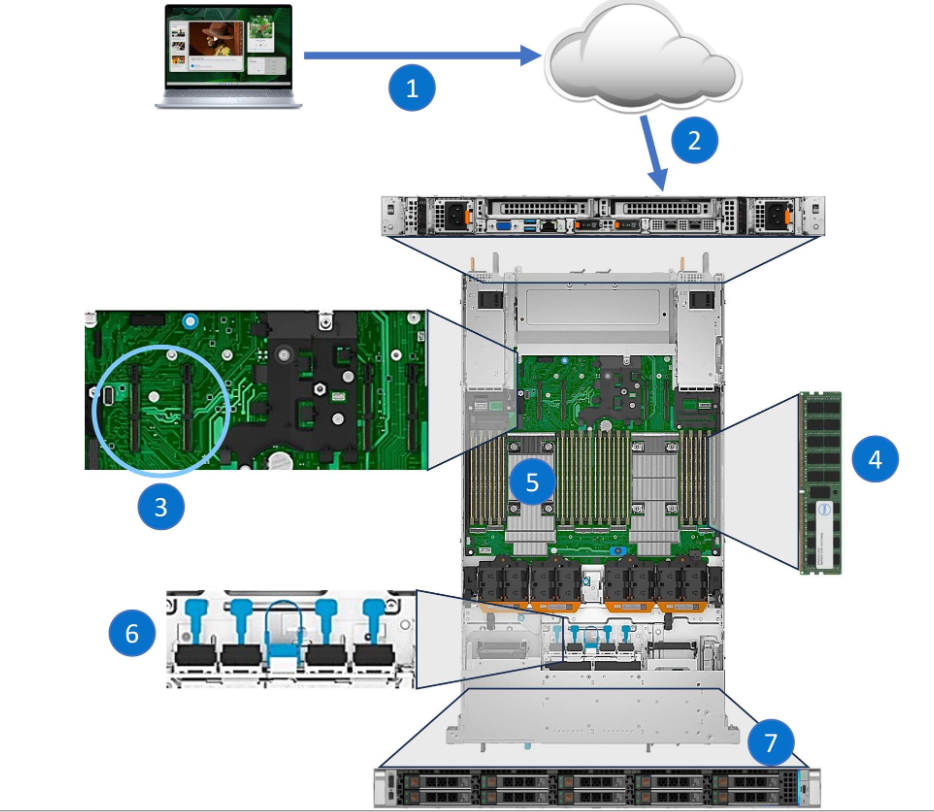
- 사용자 또는 애플리케이션의 요청은 LAN(로컬 영역 네트워크)을 통해 서버로 전달
- 서버에는 LAN에 연결되어 서버로의 I/O 트래픽을 가능하게 하는 하나 이상의 NIC가 장착되어 있음
- NIC는 시스템 보드에 내장된 형태일 수도 있고, 확장형 NIC일 수도 있습니다. 확장형 NIC는 시스템 보드의 라이저 포트에 장착됨
- 메모리 모듈은 데이터를 일시적으로 저장
- CPU는 연산 능력과 시스템 운영 제어 기능을 제공
- CPU의 디스크 제어 작업을 분산하기 위한 하드웨어 RAID 컨트롤러가 포함됨
- 디스크 드라이브는 메모리에 존재하지 않는 정보를 저장하거나 필요할 때 불러오는 역할을 함
Server Network Storage
Storage purpose to store, access, manage, and secure digital media.
Digital media includes files, data, and services.
Extended storage solutions are required to store, protect, and save large amounts of raw data and information.
DAS (Direct Attached Storage)
Server or system unit is directly attached to the storage.
DAS attaches to a server host bus adapter, or HBA, that has a direct connection to a storage device.
SAS(Serial Attached SCSI) is the common protocol that is used for DAS connection.
- SAS(Serial Attached SCSI) 는 서버와 스토리지를 연결하기 위해 사용되는 고성능 직렬 인터페이스 프로토콜로, 기존 병렬 SCSI를 대체하기 위해 만들어졌습니다. 주로 DAS(Direct Attached Storage) 연결에서 가장 널리 사용되는 프로토콜.
NAS (Network Attached Storage)
A NAS device is file level storage
In a NAS solution, servers and clients attach directly to a local area network, or LAN.
The NAS storage enables data sharing among network clients.
SAN (Storage Area Network)
A SAN is a networked storage infrastructure that refers to as a SAN fabric.
A SAN connects servers to storage devices by using either a Fibre Channel switch fabric or Internet Small Computer System Interface, called iSCSI, over an Ethernet LAN architecture.
Cloud Storage Solution
If the client workstation has Internet access rights to the remote storage server then the storage service is provided to the client workstation in any geo-location within an organization.
Capacity Planning
Storage Resource Manager (SRM) is a tool that data center managers use for capacity planning.
Components of Storage
SATA
A Serial Advanced Technology Attachment (SATA) interface is a standard for connecting and transferring data from a hard disk to other systems.
SATA 3 has a top speed of 6Gbs transfer rate.
Cable management helps support for extra cable length.
SATA has one drive per cable connector.
SAS
Serial attached SCSI (SAS) is a protocol that the servers use to access the storage device.
SAS allows digital transfer by the cables, employing 1 bit at a time for the transfer.
SAS is an ideal solution for a business enterprise requiring substantial use of storage and backup
SAS-1 supports up to 3 Gbps.
SAS-2 supports up to 6 Gbps.
SAS-3 supports up to 12 Gbps.
SAS-4 is the current version that is used in the 16G and 17G servers and supports up to 22.5 Gbps.
SSD
A solid state drive (SSD) is a nonvolatile storage device.
Stores the data into solid-state flash memory.
SSDs are known for their fault-tolerant architecture.
SSD performance is faster than an electromechanical disk drive.
NVMe
Non-Volatile Memory Express (NVMe) is a high-performance, optimized, and highly scalable storage that connects the host to the memory.
NVMe has higher performance in comparison to legacy SAS and SATA.
NVMe has multiple form factors such as 2.5" drive, M.2, and PCIe. Most PowerEdge servers use 2.5" NVMe drives.
E3
The Enterprise and Data Center Small Form Factor (EDSFF) is an SSD design for NAND Peripheral Component Interconnect Express (PCIe) storage drives.
EDSFF called E3, optimizes storage in enterprise, private, and public data centers.
Purpose
Higher interface speed with PCIe Gen5.
E3.x replaces the 2.5" and U.2 form factor.
Serve as a common form factor for accelerator and computational storage.
Benefits
Optimized for high-speed signal.
Better air impedance and thermal resistance.
Optimized to fit more frontend accessible devices and more future proof.
BOSS
Users can use Boot Optimized Storage Solution (BOSS).
The BOSS is a RAID solution card for booting the server operating system.
BOSS uses one or two read-intensive M.2 NVMe drives.
Features and benefits
- Fast initialization
- Import
- Auto rebuild
- Non-RAID migration
- Hot plug is supported for NVMe M.2 and SATA M.2 for BOSS S1 and S2.
- Supports management and firmware update using the iDRAC.
- Multiple form factors
NVDIMM
Non-Volatile Dual In-Line Memory Module (NVDIMM) retains information during service outages.
NVDIMM uses dynamic random access memory (DRAM) to store data in a memory cell.
NVDIMM also uses dedicated backup power on one memory subsystem.
An NVDIMM can either operate as a high-speed memory device or memory
but cannot do both simultaneously. NVDIMM increases storage performance and protects data.
Features and benefits
- Runs high-speed DRAM.
- NVDIMM offers application resilience and reliability with the addition of the nonvolatile feature to DRAM.
- NVDIMM multiplexers (MUX) isolate the host controller from the DRAM memory during 'save' and 'restore' operations.
- The operating system uses NVDIMMs as a data storage device for speed.
- NVDIMM supports non-RAID migration.
Backplane
A backplane is a high-speed communication board that connects multiple hard drives to a single controller.
Some of the features of the server backplane are:
Provide power, and the drive data connections.
A backplane failure may disconnect one or all hard drives.
Many PowerEdge servers provide various storage and backplane options.