AI Bot Architectures in 2025: From Orchestration to LLM-in-the-Loop
If you talk to engineering teams today, they’ll tell you that building bots no longer means designing rules. It means building minds, or at least something that behaves a little like one. Traditional AI orchestration systems still exist, of course, but the line between coordination and cognition is blurring. Enterprises that once trusted deterministic flows now experiment with an AI agent architecture that plans its own actions.
Market growth only hints at the story. What’s actually changing is the technical grammar behind AI workflow automation. Systems once built on rigid logic are being reimagined into adaptive AI bot frameworks that learn patterns on the fly. We’re moving from script execution to intelligent AI orchestration platforms, and that change is redefining reliability, compliance, and even trust.
But beyond the market dynamics, there’s a deeper technical evolution occurring. It challenges our assumptions about how intelligent systems should be designed.
To stay competitive in this evolving landscape, businesses are increasingly adopting AI development services that enable smarter orchestration and automation across systems.
Traditional Orchestrated Architecture
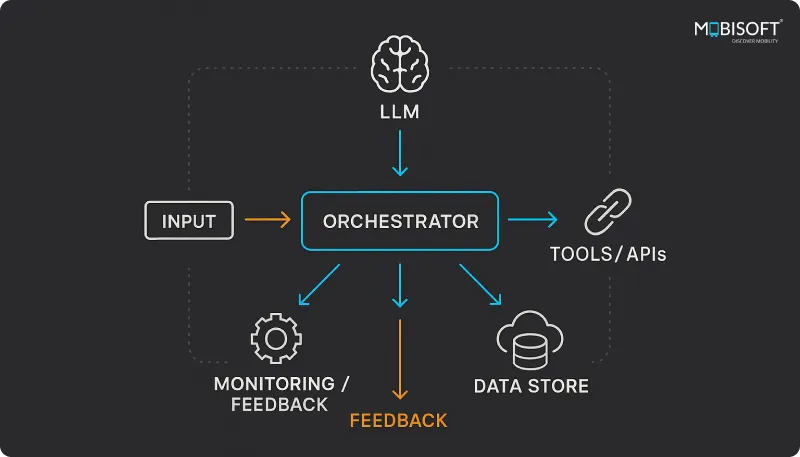
Let’s start where it all began. Classic AI bot architecture was, in many ways, an engineering masterpiece, clean, precise, and auditable. Every conversation route was manually mapped, every decision point explicitly defined. It felt almost comforting: no surprises, no improvisation, just repeatable accuracy.
Core Components and Design Philosophy
At the heart of traditional systems, Dialog Flow Controllers function as sophisticated state managers. They maintain conversation context through explicit transitions, ensuring that users move through predefined paths based on their inputs. Think of them as highly sophisticated decision trees implemented in code: deterministic, predictable, and completely auditable core aspects of early conversational AI architecture.
Intent recognition worked like a librarian who already knew what you’d ask. By categorizing each message into pre-labeled intents, it maintained order. The process wasn’t creative, but it was bulletproof. If you said “reset my password,” it triggered a path tested a thousand times before, an example of how AI chatbot frameworks delivered consistent reliability.
Memory management follows a hierarchical approach that prioritizes consistency over adaptability. Session stores maintain conversation history within strict boundaries, with deterministic rules governing what information to retain and what to discard. This isn’t a limitation but a design choice that ensures the system behaves identically across millions of interactions, a highly valued feature in enterprise AI automation.
Tool integration was another area of absolute order. Every API call, every parameter, every response mapping was predefined. There was no “thinking” about which system to consult; it was already written into the code. It might sound mechanical, but for industries like banking or healthcare, that rigidity was exactly what made it a trustworthy core to AI bot deployment best practices.
Organizations today are extending these classic architectures with data engineering for AI to ensure cleaner pipelines and stronger contextual insights for LLM integration.
Performance Characteristics and Trade-offs
Traditional architectures excel in scenarios requiring absolute reliability and complete auditability. In regulated industries, for example, healthcare, finance, and legal services, these systems provide the paper trail and predictability that compliance departments demand. They offer near-perfect accuracy for defined workflows, with error rates typically below 1% for predetermined paths.
However, this reliability comes with significant constraints. When faced with novel queries or edge cases, situations outside their explicit programming, these systems struggle. They fail gracefully, certainly, often with polite error messages or escalation to human agents, but they cannot adapt or learn from these encounters. Each new scenario requires developer intervention, code updates, and redeployment, highlighting the limits of traditional AI agent architecture.
Developers had to intervene for every new scenario. Updating the bot meant editing flows, redeploying code, and testing it again from scratch. It worked when user expectations were simple, like “check my balance” and “reset my password.” Yet as conversational AI architecture matured and users started treating bots like knowledgeable assistants, the rigid model began to crack under its own perfection.
Forward-thinking enterprises are now adopting custom AI agent development to bridge this adaptability gap through orchestrated, multi-LLM systems.
The LLM-in-the-Loop Revolution: Reasoning at the Core
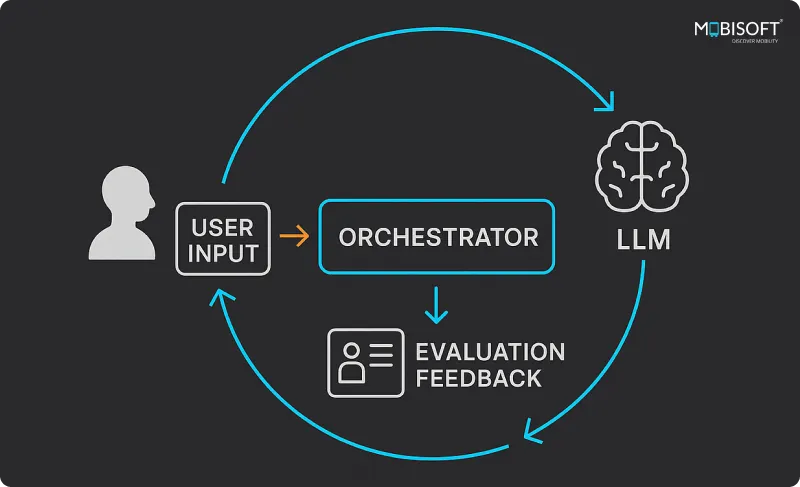
The emergence of LLM orchestration represents more than an incremental improvement; it’s a fundamental rethinking of how intelligent systems should operate. Rather than treating the language model as a tool to be invoked by predetermined logic, these architectures position the LLM as the primary reasoning engine, capable of orchestrating its own behavior and dynamically determining the best course of action, a defining shift in LLM in AI systems.
The ReAct Paradigm and Its Implications
The ReAct (Reasoning + Acting) framework has emerged as a particularly powerful approach within this new paradigm.
Research demonstrates that it achieves absolute improvements of 34% and 10% in success rates on ALFWorld and WebShop benchmarks, respectively, compared to traditional approaches.
ReAct’s importance isn’t just in numbers or benchmarks, though performance gains have been striking.
Instead of treating uncertainty as an error, ReAct systems treat it as part of the job. They hypothesize, test, and revise, much like human analysts do when facing incomplete data.
When applied to knowledge-intensive reasoning tasks, ReAct demonstrates superior effectiveness compared to zero-shot prompting, particularly in scenarios requiring the synthesis of information from multiple sources.
In real-world deployments, that translates into AI agents in enterprise that can synthesize information across multiple sources, reason through conflicting evidence, and produce coherent actions without explicit instructions for every edge case. For enterprises, it’s both thrilling and unnerving because unpredictability, while intelligent, can never be fully controlled.
Read More: AI Bot Architectures in 2025: From Orchestration to LLM-in-the-Loop