Custom, On-Premise, or White-Label? How to Choose the Right TMS for Your Logistics Strategy
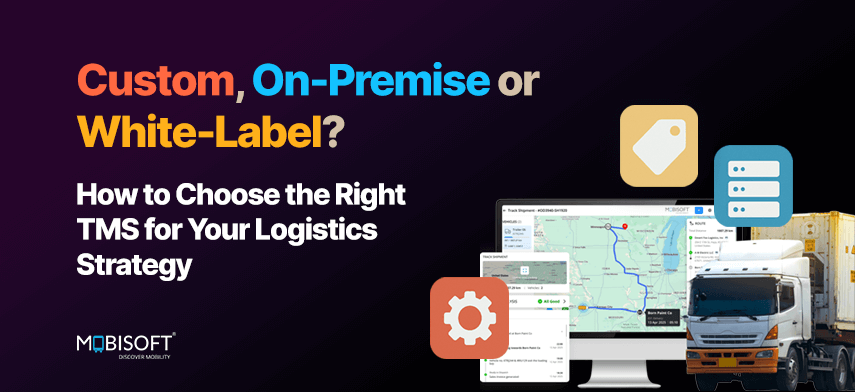
The movement and logistics industry is becoming increasingly difficult. As companies grow and their supply chain management operations expand across broader geographic areas, managing freight effectively has become more challenging. Transporters and logistics providers are under constant pressure to ensure operations run at peak performance, often relying on outdated tools and manual processes.
This is where a Transportation Management System (TMS) adds value not as a luxury, but as a critical component of transportation and logistics systems in today’s digital age. A TMS is more than just a tool; it’s an automated transportation management system that brings structure, speed, and visibility to the entire freight lifecycle from planning to execution, settlement, and transportation route optimization.
In this blog, we’ll explore what a TMS is, the problems it solves daily, and why companies are adopting custom transportation management systems, on-premise TMS software to stay agile and scalable in a fast-evolving logistics environment.
What Is a TMS? And Why Does It Matter in Modern Logistics?
A Transportation Management System (TMS) is a powerful piece of transportation management system software designed to streamline freight management operations. Whether you’re moving freight domestically or globally, a TMS serves as the central hub to orchestrate, execute, track, and analyze transport-related tasks in real time.
Think of it as your logistics management system control tower, replacing spreadsheets, phone calls, and manual coordination with smart dashboards and automation. You can select carriers, automate updates, optimize delivery paths, and execute payments all within one platform.
A robust TMS:
- Lowers Freight Costs
By optimizing load planning, automating carrier selection, and consolidating shipments, organizations can minimize fuel consumption, empty miles, and inefficient routing. These capabilities are core to any automated transportation management system, resulting in measurable operational savings. - Automates Manual Processes
A modern TMS eliminates redundant paperwork and manual intervention. From dispatch creation to digital proof of delivery and e-invoicing, everything is streamlined. This level of logistics automation significantly reduces errors and administrative overhead.
- Improves Delivery Performance
With real-time tracking and automated alerts, your team can act proactively when disruptions occur. Delays can be detected and rerouted early. This ensures better SLA compliance and reliability, all enabled through a best transportation management system.
- Provides Real-Time Visibility
TMS delivers visibility into the shipment process from the time it is scheduled to when it is delivered. Visibility can be accessed to see the status of a shipment, receive proactive updates to receive, and make decisions can be made without guessing.
- Enables Freight Audit and Billing Accuracy
Through its embedded verification and reconciliation functionalities, a TMS authenticates every invoice to properly capture services rendered. Hence, it minimizes the chances of overpayment, disputes, and loss of cash.
- Integrates with ERPs, WMS, GPS, and E-invoicing Systems
A robust TMS is not standalone; it seamlessly connects to systems like SAP, Oracle, or Microsoft Dynamics, enabling smooth ERP WMS integration. This allows data to flow freely across procurement, inventory, and compliance, a must for organizations pursuing custom ERP TMS integration.
Ultimately, a modern TMS transportation management system empowers logistics teams to work smarter. Whether through automation or real-time insight, it allows businesses to maintain competitiveness, especially in an era defined by rising expectations and shrinking margins.
Real-World Logistics Challenges and How a TMS Solves Them
Logistics today is far from a one-size-fits-all affair. Companies, carriers, and distributors all have their own sets of operational issues, the majority of which stem from outdated transportation and logistics systems, legacy tools, and a lack of real-time visibility
Let’s examine the issues in particular that each stakeholder has and how a Transportation Management System (TMS) provides particular, real-world solutions.
TMS Solutions For Enterprises
The Challenges
- Manual freight booking and poor visibility
Supply chains in business usually rely on email, spreadsheets, or old ERP modules to plan and track freight. These outdated processes hinder effective supply chain management and lead to delays, missed shipments, and poor shipment tracking once products leave the warehouse.
- Frequent discrepancies in billing
When freight information is dispersed across systems, payment of invoices against actual freight movement is time-consuming and prone to errors. Rate disputes, accessorials, or proof of delivery (POD) failures hold up payment and destroy vendor relationships.
Read More:- https://mobisoftinfotech.com/resources/blog/transportation-logistics/how-to-choose-right-tms
Choosing the right solution for your logistics operations can be challenging, but a custom transportation management system offers flexibility and scalability tailored to your business needs. It can streamline operations, improve tracking, and optimize resource allocation. More insights on building an effective system here: custom transportation management system.