Uber Business Model Explained: Revenue Strategy & Growth in 2026
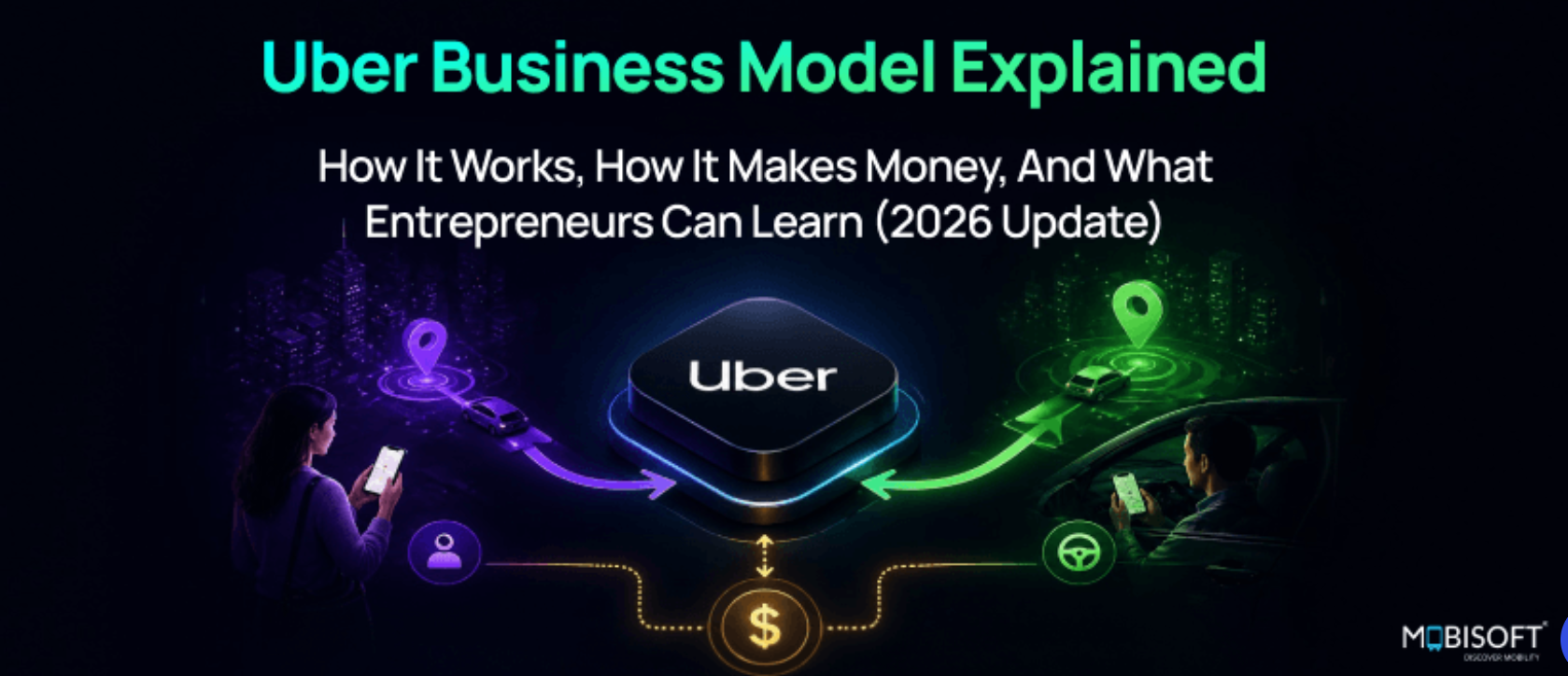
What Is Uber? How Uber Started and Why It Changed Everything
To call Uber a taxi service misses the mark because it is much more than that. It is a matching engine, which connects people who have a transport need with people who can provide it. Understanding how Uber started helps explain why the company disrupted an entire industry. In this guide, you will find the Uber business model explained from first principles, covering how it works, how it makes money, and what founders can learn from it. Ridesharing was just one example of what could be done with the technology.
What's interesting about the company's history is how the model was welcomed in the market, far beyond just adding some convenience to the customer experience. Traditionally, transportation capacity was regulated by medallions and dispatch centers, which had a fixed number of cars at their disposal, centrally coordinated the process, and received calls via phone.
With Uber, all that's needed now is an app, instead of medallion-controlled taxis. What began as a ride-hailing platform in San Francisco has since become the template for how on-demand marketplaces are built and scaled globally. Instead of a dispatch center, you have independent drivers operating in a distributed network and connected directly to potential customers.
That model has since expanded beyond moving people. Restaurants, couriers, and freight carriers now sit on the supply side. Diners, shoppers, and logistics companies sit on the demand side, and Uber takes a cut of every match. The company does not own the assets or employ the workers. It monetizes coordination at scale through a classic asset-light business model, which is the core of the business.
Company Snapshot (as of early 2025):
Attribute Detail
Founded March 2009 (as UberCab)
Headquarters San Francisco, California, USA
Legal Name Uber Technologies, Inc. (NYSE: UBER)
CEO Dara Khosrowshahi (since 2017)
Co-Founders Garrett Camp, Travis Kalanick, Oscar Salazar
Operating Countries 70+ countries
Cities Served 10,000+ cities globally
Uber in Numbers: Key Stats for 2024–2025
For years, Uber was a loss-making business. Investors kept investing anyway because of the potential in the model. The Uber financial results 2025–2026 data show a company that has learned to marketplace monetisation of its density.
Metric 2024 Figure Year-on-Year Change
Total Revenue $43.98 billion +18%
Gross Bookings $162.77 billion +18%
Total Trips Completed 11.27 billion +19%
Monthly Active Platform Consumers (MAPCs) ~171 million (Q4 2024) +14%
Active Drivers & Couriers 8+ million Growing
Net Profit $9.8 billion +444% vs. 2023
Adjusted EBITDA (Full Year) ~$6.5 billion +60%+
Consider daily trips, with more than 30 million people using Uber every day. That volume feeds better pricing algorithms. It also reduces wait times, attracting more riders and bringing more drivers.
Uber Eats provides a second example of the same engine. In 2024, food delivery platform generated nearly $14 billion in revenue. It is a parallel business built on identical infrastructure. Matching technology, driver network, and payment processing. The marginal cost of adding delivery to an existing rides platform is relatively low.
Profitability has become consistent as well. Adjusted EBITDA grew for eight consecutive quarters through late 2024. The $9.8 billion net profit figure for 2024 includes some investment gains, so treat it with caution. Uber is no longer burning cash to grow, thier marketplace business model is instead generating real returns from the matches it facilitates.
Truck visibility platform showing live fleet tracking before customers ask for updates
The Uber Business Model: How It Works
The Uber business model sells access to a machine that connects two groups of people. One group wants something moved. The other group owns something that can move it. The machine works best when both groups forget it is even there.
The company builds and maintains the digital infrastructure. That includes the mobile app, the matching logic, the payment system, and the safety features. Uber keeps a small percentage of each ride as a fee, the take rate, while the rest goes to the driver or courier
Read more- 링크텍스트https://mobisoftinfotech.com/resources/blog/uber-business-model-explained-2026