📕명령형 프로그래밍과 선언형 프로그래밍
1. 명령형 프로그래밍(Imperative Programming)
- OOP 객체 지향 프로그래밍
- How to do?
- 어떻게 하여야 하는가?
예시
- 이메일을 담을 리스트 선언
- 루프
- 유저 선언
- 검증되지 않았는지 체크
- 않았다면 변수에 이메일 추출
- 이메일 리스트에 넣기
2. 선언형 프로그래밍(Declarative Programming)
- Functional Programming
- What to do?
- 무엇을 하여야 하는가?
예시
- 유저리스트에서
(1) 검증되지 않은 유저만 골라내서
(2) 이메일을 추출해서 - 리스트로 받기
📙1급 시민의 조건
- 함수/메서드의 매개변수(parameter)로서 전달할 수 있는가
- 함수/메서드의 반환값(return)이 될 수 있는가
- 변수에 담을 수 있는가
☀️다양한 Function Package
java.util.function
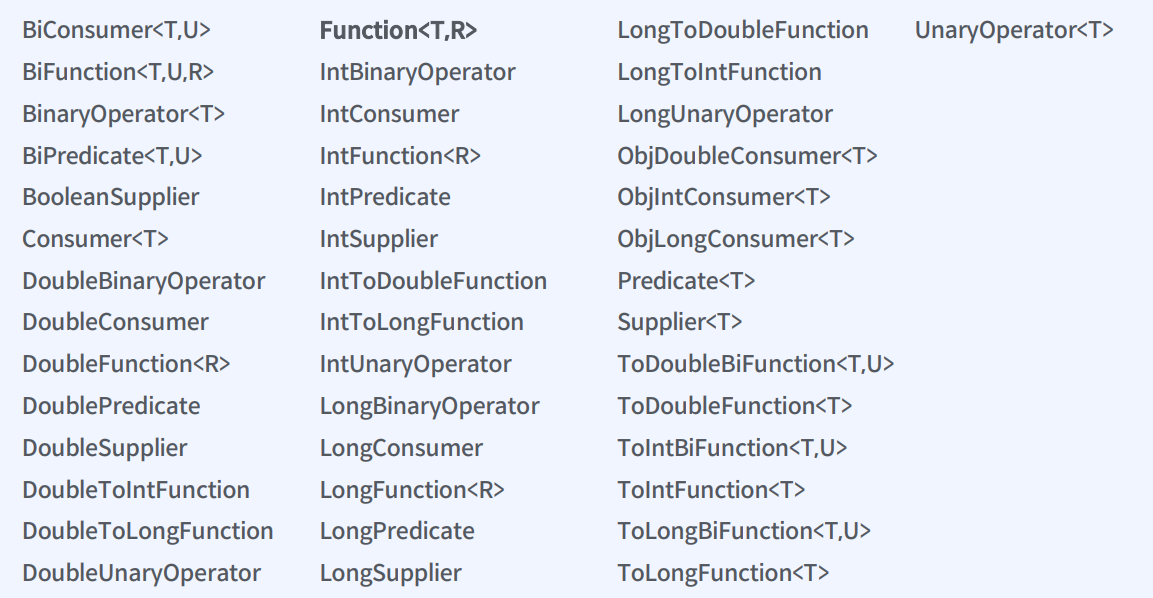
왜 이렇게 양이 많을까?
T만을 사용한다면 boxed 타입인 Integer, String과 같은 것들을 계속 사용해줘야 한다. 그러나 이것은 int 등에 비해 메모리를 훨씬 더 많이 사용하기에 primitive 타입을 다루는 interface를 만들었다.
1. Function interface
- T -> R
@FunctionalInterface
public interface Function<T, R> {
	R apply(T t);
}
그냥 사용
// 사용예제1
public class Main implements Function<Integer, Integer> {
    @Override
    public Integer apply(Integer x) {
        return x+10;
    }
}

public static void main(String[] args) {
    Function<Integer, Integer> myAdder = new Main();
    int result = myAdder.apply(5);
    System.out.println(result);
}
람다 사용
Function<Integer, Integer> myAdder = (Integer x) -> {
    return x + 10;
};
int result = myAdder.apply(5);
System.out.println(result);

Function<Integer, Integer> myAdder = x -> x + 10;
int result = myAdder.apply(5);
System.out.println(result);
더 단순하개 사용 가능
- 매개변수의 타입이 유추 가능할 경우 타입 생략 가능
- 매개변수가 하나일 경우 괄호 생략 가능
- 바로 리턴하는 경우 중괄호 생략 가능
2. BiFunction interface
- T, U -> R
@FunctionalInterface
public interface BiFunction<T, U, R> {
	R apply(T t, U u);
}BiFunction<Integer, Integer, Integer> add = (Integer x, Integer y) -> {
return x + y;
};
int result1 = add.apply(3, 5);
System.out.println(result1);3. 사용자 설정 interface
- T, U , V -> R
@FunctionalInterface
public interface TriFunction<T,U,V,R> {
    R apply(T t, U u, V v);
}
// 직접 만들어서 사용
TriFunction<Integer, Integer, Integer, Integer> addThree = (x, y, z) -> x + y + z;⭐Functional Interface
- 단 하나의 abstract method만을 가지는 인터페이스 (Single Abstract Method interface)
- Default method와 static method는 이미 구현이 되어있으므로 있어도 괜찮음
1. Supplier
- void -> T
@FunctionalInterface
public interface Supplier<T> {
	T get();
}Supplier<String> mySup = () -> "hello world";
System.out.println(mySup.get());
Supplier<Double> myRandom = () -> Math.random();
System.out.println(myRandom.get());
// 메서드를 만들어서 인수로 받아 사용
public static void printRandom(Supplier<Double> random, int count) {
for (int i = 0; i < count; i++) {
System.out.println(random.get());
}
}
// 새로 만든 메서드 사용
printRandom(myRandom,5);2. Consumer
- T -> void
@FunctionalInterface
public interface Consumer<T> {
	void accept(T t);
}Consumer<String> myConsumer = (String str) -> System.out.println(str);
myConsumer.accept("hello");
// 매서드를 만들어 사용
public static <T> void process(List<T> inputs, Consumer<T> processor) {
for (T input : inputs) {
processor.accept(input);
}
}
// consuemr 인터페이스 만들어 사용
Consumer<Integer> myDifferentIntegerProcessor = x ->
System.out.println("Processing integer in different way " + x);
process(integerInputs, myDifferentIntegerProcessor);
// 람다식으로 바로 사용
List<Double> doubleInputs = Arrays.asList(1.1, 2.2, 3.3);
process(doubleInputs, x -> System.out.println("Processing double " + x));3. BiConsumer
- T, U -> void
@FunctionalInterface
public interface BiConsumer<T, U> {
	void accept(T t, U u);
}
public static <T> void process(List<T> inputs, BiConsumer<Integer, T> processor) {
for (int i = 0; i< inputs.size(); i++) {
processor.accept(i, inputs.get(i));
}
}
BiConsumer<Integer, Double> myDoubleProcessor =
(index, input) ->
System.out.println("Processing " + input + " at index " + index);
List<Double> inputs = Arrays.asList(1.1, 2.2, 3.3);
process(inputs, myDoubleProcessor);4. Predicate
- T -> boolean
@FunctionalInterface
public interface Predicate<T> {
	boolean test(T t);
}Predicate<Integer> isPositive = x -> x > 0;
System.out.println(isPositive.test(-10));
//
public static <T> List<T> filter(List<T> inputs, Predicate<T> condition) {
List<T> output = new ArrayList<>();
for (T input : inputs) {
if (condition.test(input)) {
output.add(input);
}
}
return output;
}
// 인터페이스 내부에 디폴트 메서드 이용
List<Integer> inputs = Arrays.asList(10, -5, 4, -2, 0, 3);
System.out.println("Positive number: " + filter(inputs, isPositive));
System.out.println("Non-positive number: " + filter(inputs, isPositive.negate()));
System.out.println("Non-negative number: "
+ filter(inputs, isPositive.or(x -> x == 0)));
System.out.println("Positive even numbers: "
+ filter(inputs, isPositive.and(x -> x % 2 == 0)));
}5. Comparator
- 비교를 위한 인터페이스
- java.util 패키지 (다른 애들은 java.util.function)
@FunctionalInterface
public interface Comparator<T> {
	int compare(T o1, T o2);
}- 음수면 o1 < o2
- 0이면 o1 = o2
- 양수면 o1 > o2
List<User> users = new ArrayList<>();
users.add(new User(3, "Alice"));
users.add(new User(1, "Charlie"));
users.add(new User(5, "Bob"));
System.out.println(users);

Comparator<User> idComparator = (u1, u2) -> u1.getId() - u2.getId();
Collections.sort(users, (u1, u2) -> u1.getId() - u2.getId());
System.out.println(users);

Collections.sort(users, (u1, u2) -> u1.getName().compareTo(u2.getName()));
System.out.println(users);
꾸준히 빠르게