논문 과제
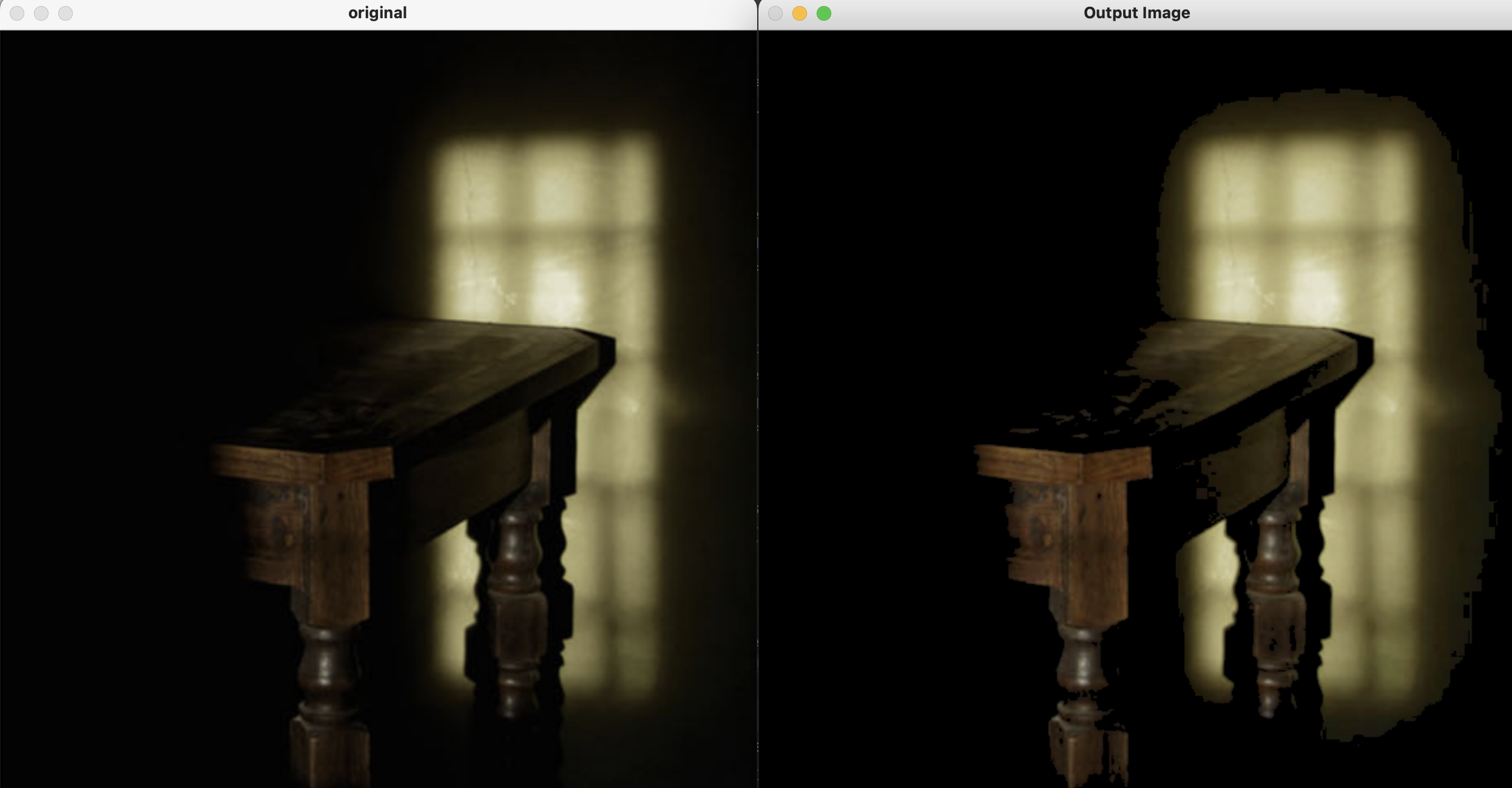
메인코드
import numpy as np
import math
import cv2


# 감마 보정 함수
def estimate_optimal_gamma(img, std, r):
    s = (img ** r)
    up = s - std
    down = s * np.log1p(img)

    optimal_r = r - (up / down)
    if (abs(r - optimal_r) < 0.0000001).all:
        return optimal_r
    else:
        estimate_optimal_gamma(img, std, optimal_r)


img = cv2.imread('chair.png')
cv2.imshow('original',img)

height, width, channel = img.shape

B = img[..., 0]
G = img[..., 1]
R = img[..., 2]
Y = np.zeros((height, width), dtype=np.float64)

# A.휘도 정규화

for x in range(height):
    for y in range(width):
        Y[x][y] = (0.299 * R[x][y] + 0.587 * G[x][y] + 0.114 * B[x][y])

# 'Y' 휘도 정규화
MAX = max(map(max, Y))
for x in range(height):
    for y in range(width):
        Y[x][y] = math.log((Y[x][y] + 1), MAX)

# B. 감마보정
bright = np.zeros((height, width), dtype=np.float64)
dark = np.zeros((height, width), dtype=np.float64)

# 밝은영역 어두운 영역 나누기

for x in range(height):
    for y in range(width):
        if Y[x][y] > 0.5:
            dark[x][y] = Y[x][y]
        else:
            bright[x][y] = Y[x][y]

# 표준편차
dark_std = np.std(dark)
bright_std = 1 - np.std(dark)

# 감마보정 적용
dark_r = estimate_optimal_gamma(dark, dark_std, 1.0)
bright_r = estimate_optimal_gamma(bright, bright_std, 1.0)
"""
print(dark_r)
print(bright_r)
"""

# 이미지 합성

w = np.zeros((height, width), dtype=np.float64)
Y_out = np.zeros((height, width), dtype=np.float64)

for x in range(height):
    for y in range(width):
        w[x][y] = math.exp(-(bright[x][y] ** 2) / (2 * (0.5) ** 2))
        Y_out[x][y] = (
                    (w[x][y]) * (((dark[x][y] ** dark_r[x][y]))) + ((1 - w[x][y]) * ((bright[x][y] ** bright_r[x][y]))))

# 색 복원

for x in range(height):
    for y in range(width):
        R[x][y] = Y_out[x][y] * np.power((R[x][y] / Y[x][y]), (1 - np.tanh(bright[x][y])))
        G[x][y] = Y_out[x][y] * np.power((G[x][y] / Y[x][y]), (1 - np.tanh(bright[x][y])))
        B[x][y] = Y_out[x][y] * np.power((B[x][y] / Y[x][y]), (1 - np.tanh(bright[x][y])))

result = (np.dstack((B, G, R)).astype(np.uint8))

cv2.imshow('Output Image', result)

cv2.waitKey(0)
PSNR SSIM 비교코드
코드
import cv2
import numpy as np
from skimage.metrics import structural_similarity as ssim

def calculate_psnr(img1, img2):
    mse = np.mean((img1 - img2) ** 2)
    if mse == 0:
        return float('inf')
    max_pixel = 255.0
    psnr = 20 * np.log10(max_pixel / np.sqrt(mse))
    return psnr

def calculate_ssim(img1, img2):
    return ssim(img1, img2, multichannel=True)

# 이미지 로드
low_image = cv2.imread('chair.png')
restored_image = cv2.imread('restored_image.png')


# 이미지를 그레이스케일로 변환
low_image_gray = cv2.cvtColor(low_image, cv2.COLOR_BGR2GRAY)
restored_image_gray = cv2.cvtColor(restored_image, cv2.COLOR_BGR2GRAY)

# PSNR 계산
psnr = calculate_psnr(low_image_gray, restored_image_gray)
print(f"PSNR: {psnr} dB")

# SSIM 계산
ssim_score = calculate_ssim(low_image_gray, restored_image_gray)
print(f"SSIM: {ssim_score}")
input이미지와 내가 짠 코드 output_image 사진과 값 비교
결과 이미지
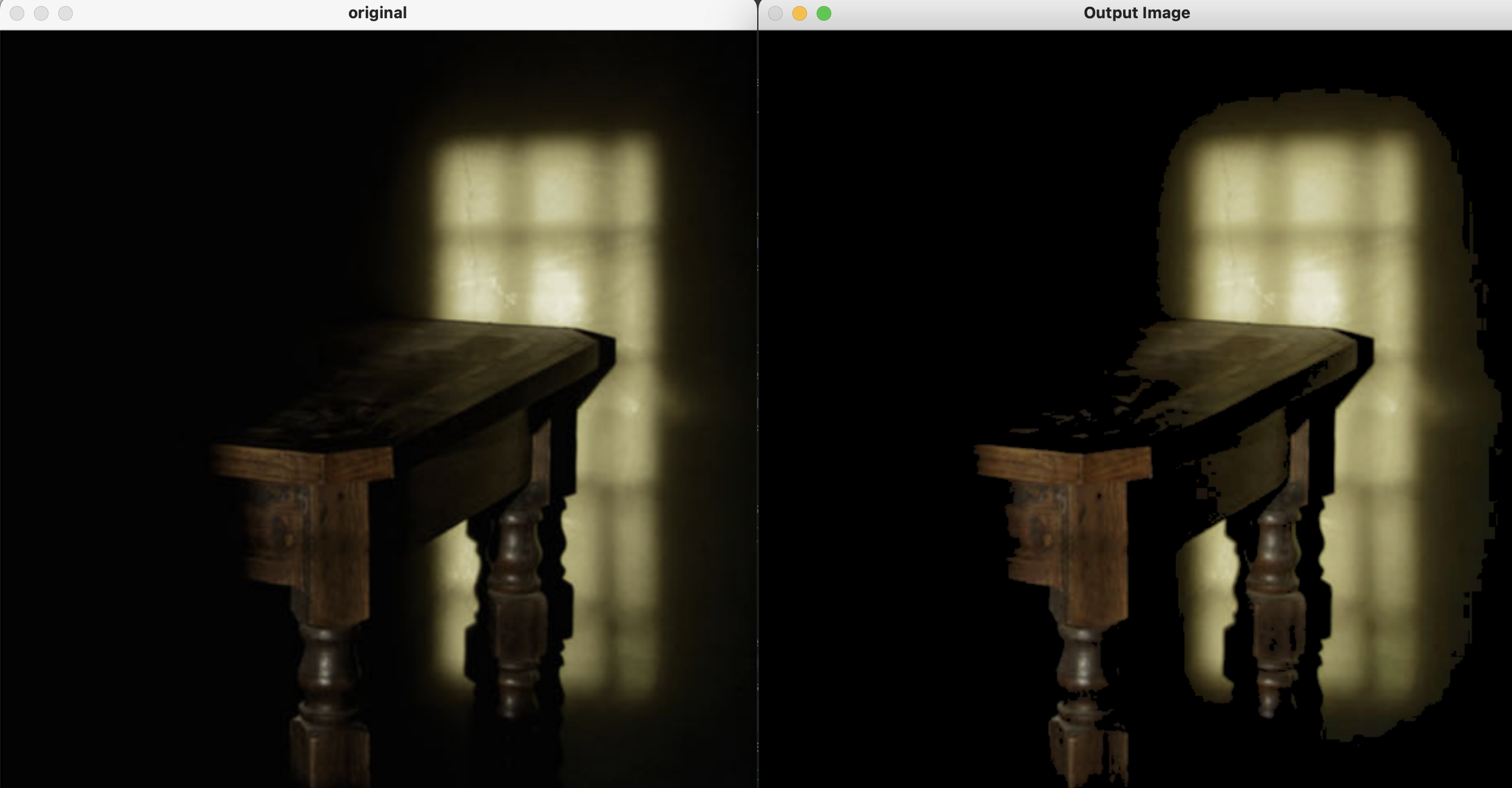
결과
PSNR: 30.782334103567116 dB
SSIM: 0.5385916414339124
input이미지와 논문 Table_average 값 비교
결과
PSNR: 30.240407956672627 dB
SSIM: 0.6787482216085202
input이미지와 논문 Table_median 값 비교
PSNR: 30.36245081307683 dB
SSIM: 0.63387279567819

코딩공부블로그