데이터 구조에서 락을 사용하는 방법에 대해 알아보자
데이터 구조에 락을 추가하면 해당 구조가 thread safe 하게 된다.
Concurrent Counters
가장 간단한 데이터 구조 중 하나는 카운터이다.
1 typedef struct __counter_t {
2 int value;
3 } counter_t;
4
5 void init(counter_t *c) {
6 c->value = 0;
7 }
8
9 void increment(counter_t *c) {
10 c->value++;
11 }
12
13 void decrement(counter_t *c) {
14 c->value--;
15 }
16
17 int get(counter_t *c) {
18 return c->value;
19 }
non-synchronized(비동기화된) 카운터는 단순하여 작은 양의 코드가 필요하다. 어떻게하면 이 코드를 thread-safe하게 만들 수 있을까?
Simple But Not Scalable
1 typedef struct __counter_t {
2 int value;
3 pthread_mutex_t lock;
4 } counter_t;
5
6 void init(counter_t *c) {
7 c->value = 0;
8 Pthread_mutex_init(&c->lock, NULL);
9 }
10
11 void increment(counter_t *c) {
12 Pthread_mutex_lock(&c->lock);
13 c->value++;
14 Pthread_mutex_unlock(&c->lock);
15 }
16
17 void decrement(counter_t *c) {
18 Pthread_mutex_lock(&c->lock);
19 c->value--;
20 Pthread_mutex_unlock(&c->lock);
21 }
22
23 int get(counter_t *c) {
24 Pthread_mutex_lock(&c->lock);
25 int rc = c->value;
26 Pthread_mutex_unlock(&c->lock);
27 return rc;
28 }
concurrent(동시) 카운터는 데이터 구조를 조작하는 루틴을 호출할 때 락을 얻고, 반환할 때 락을 푼다. 이 시점에서 working concurrent(작동하는 동시) 데이터 구조를 갖게된다.
한가지 고려해야할 사항은 성능이다. 각 스레드가 일정횟수의 업데이트를 수행하는 벤치마크를 실행하고 공유 카운터를 업데이트 해볼 수 있다. 그래서 활성 스레드가 하나에서 네 개 까지 인 경우에 걸리는 총 시간을 볼 수 있다. CPU가 많아지면 더 많은 작업을 수행하기를 기대한다. 하지만 동기화된 카운터의 성능이 나쁘게 보인다.
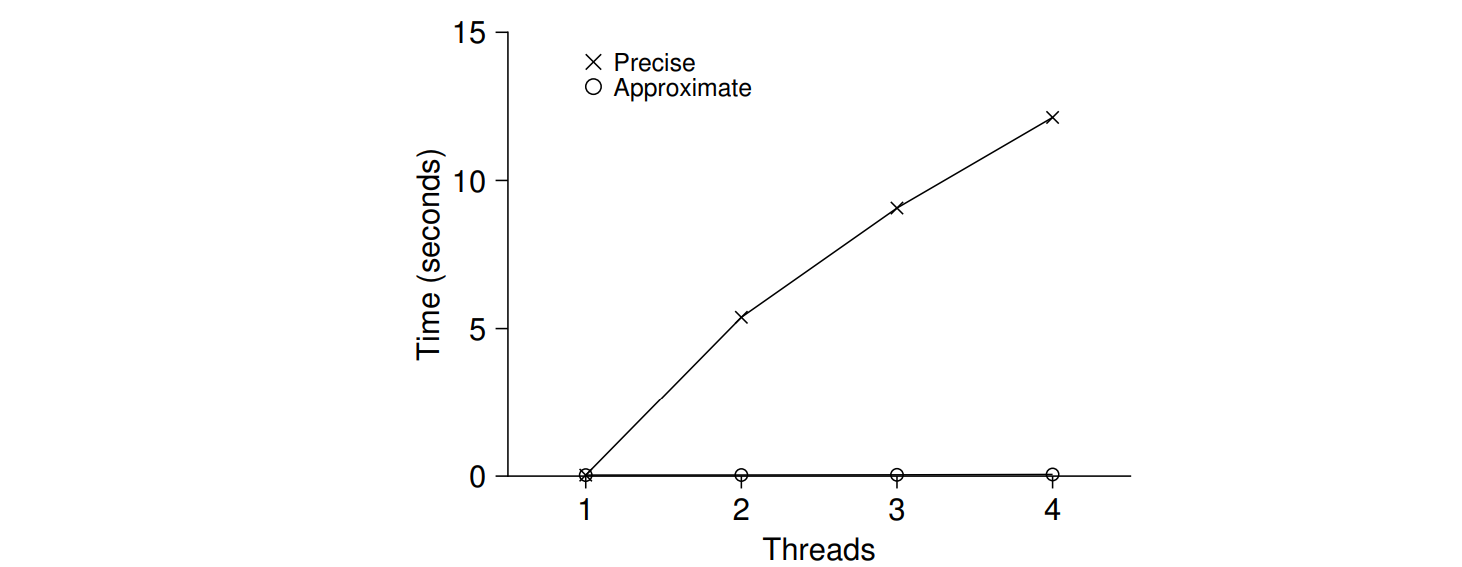
이상적으로는,여러 프로세스의 스레드도 단일스레드가 하나의 프로세서에서 수행하는 것과 같은 속도로 완료되기를 원한다. 이 목표를 달성하는 것을 perfect scaling(완벽한 스케일링)이라고 한다.
Scalable Counting
확장 가능한 counting이 없으면 리눅스의 일부 workload는 멀티코어머신에서 확장성 문제를 겪게된다. 이 문제를 해결하는 한가지 방식인 approximate counter(근사 카운터)에 대해서 알아보자
근사카운터는 다음과 같은 방식으로 작동한다. 각 CPU는 로컬 카운터를 각각 갖는다. 스레드들은 경합없이 로컬카운터를 업데이트 가능하기에 카운터의 업데이트는 확장 가능하다. 특정 코어에서 실행되는 스레드가 카운터를 증가시키려면 그 곳의 로컬 카운터를 증가시킨다. 이 로컬 카운터는 로컬 락으로 얻을 수 있다.
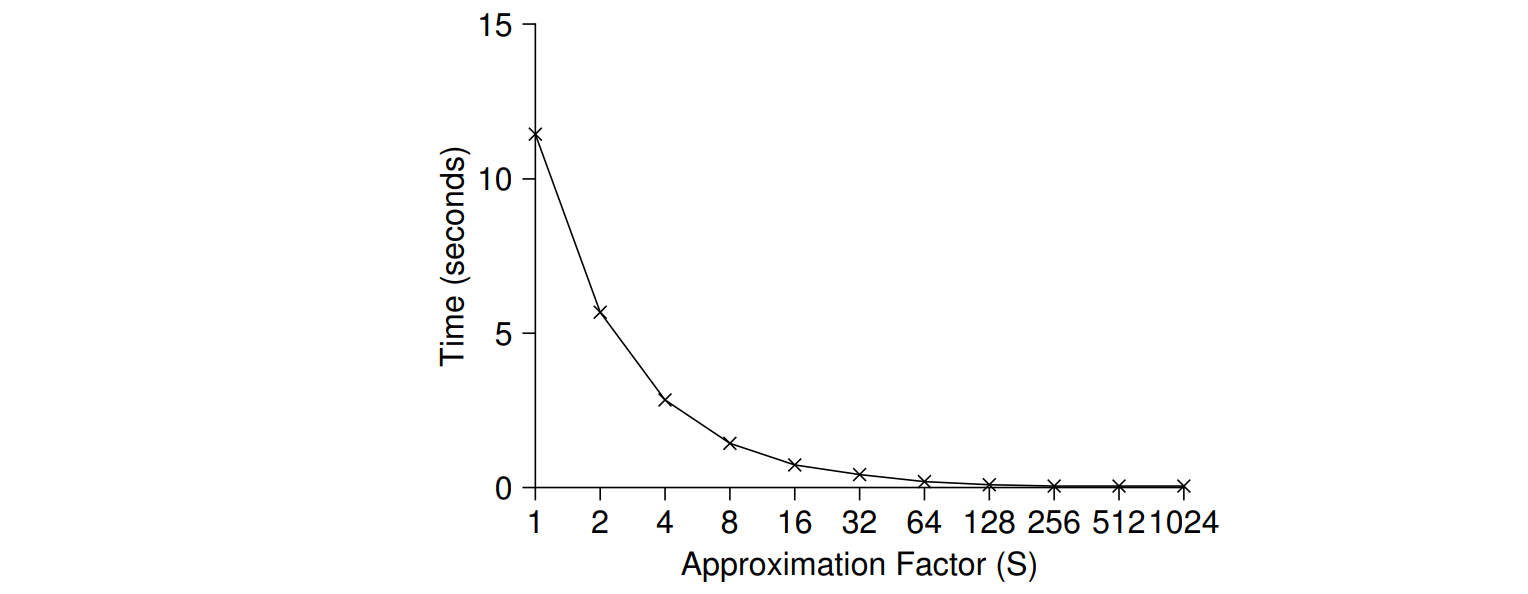
전역 카운터를 최신 상태로 유지하기 위해 로컬 카운터를 읽을 때, 전역 락을 획득하고 로컬 카운터의 값으로 전역 카운터의 값을 증가시킨다. 이 작업은 임계값 S에 의해 결정된다. S가 작을 수록 이전의 확장 불가한 카운터와 유사하게 작동하고, S가 클 수록 카운터는 확장가능하지만, 실제 카운트에서 멀어질 수 있다.
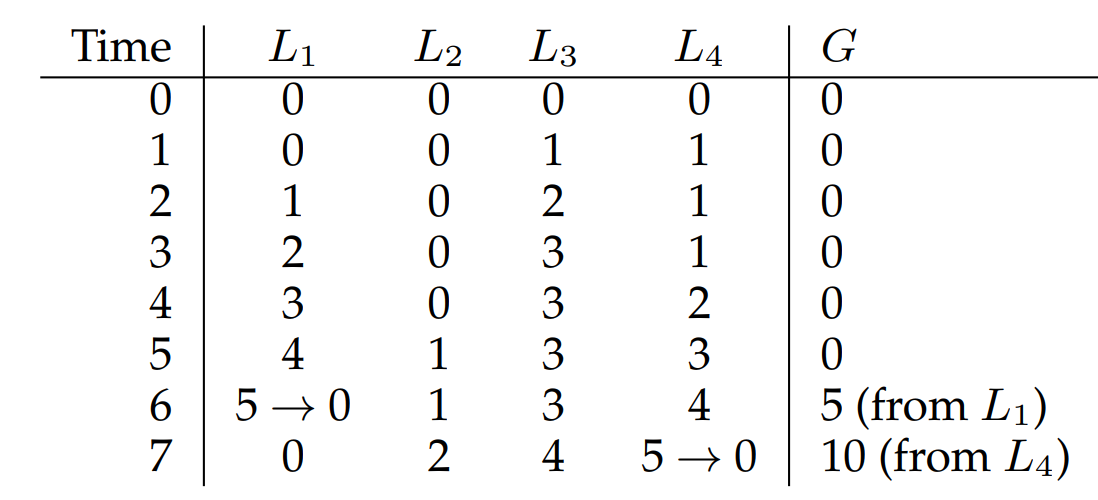
아래 사진에서는 S가 커질 수록 성능이 좋아지는 것을 볼 수 있다. 네개의 프로세서에서 카운터를 400만번 업데이트 하는 시간이 하나의 프로세서에서 100만번 업데이트하는 시간과 비슷하다.
근사 카운터의 대략적인 코드는 다음과 같다.
1 typedef struct __counter_t {
2 int global; // global count
3 pthread_mutex_t glock; // global lock
4 int local[NUMCPUS]; // per-CPU count
5 pthread_mutex_t llock[NUMCPUS]; // ... and locks
6 int threshold; // update freq
7 } counter_t;
8
9 // init: record threshold, init locks, init values
10 // of all local counts and global count
11 void init(counter_t *c, int threshold) {
12 c->threshold = threshold;
13 c->global = 0;
14 pthread_mutex_init(&c->glock, NULL);
15 int i;
16 for (i = 0; i < NUMCPUS; i++) {
17 c->local[i] = 0;
18 pthread_mutex_init(&c->llock[i], NULL);
19 }
20 }
21
22 // update: usually, just grab local lock and update
23 // local amount; once it has risen ’threshold’,
24 // grab global lock and transfer local values to it
25 void update(counter_t *c, int threadID, int amt) {
26 int cpu = threadID % NUMCPUS;
27 pthread_mutex_lock(&c->llock[cpu]);
28 c->local[cpu] += amt;
29 if (c->local[cpu] >= c->threshold) {
30 // transfer to global (assumes amt>0)
31 pthread_mutex_lock(&c->glock);
32 c->global += c->local[cpu];
33 pthread_mutex_unlock(&c->glock);
34 c->local[cpu] = 0;
35 }
36 pthread_mutex_unlock(&c->llock[cpu]);
37 }
38
39 // get: just return global amount (approximate)
40 int get(counter_t *c) {
41 pthread_mutex_lock(&c->glock);
42 int val = c->global;
43 pthread_mutex_unlock(&c->glock);
44 return val; // only approximate!
45 }
Concurrent Linked Lists
더 복잡한 구조인 연결 리스트에 대해 알아보자 간단함을 위해 동시 삽입,조회에만 집중하자
이에 대한 코드는 다음과 같다.
1 // basic node structure
2 typedef struct __node_t {
3 	int key;
4 	struct __node_t *next;
5 } node_t;
6
7 // basic list structure (one used per list)
8 typedef struct __list_t {
9 	node_t *head;
10 	pthread_mutex_t lock;
11 } list_t;
12
13 void List_Init(list_t *L) {
14 	L->head = NULL;
15 	pthread_mutex_init(&L->lock, NULL);
16 }
17
18 int List_Insert(list_t *L, int key) {
19 	pthread_mutex_lock(&L->lock);
20 	node_t *new = malloc(sizeof(node_t));
21 	if (new == NULL) {
22 		perror("malloc");
23 		pthread_mutex_unlock(&L->lock);
24 		return -1; // fail
25 	}
26 	new->key = key;
27 	new->next = L->head;
28 	L->head = new;
29 	pthread_mutex_unlock(&L->lock);
30 	return 0; // success
31 }
32
33 int List_Lookup(list_t *L, int key) {
34 	pthread_mutex_lock(&L->lock);
35 	node_t *curr = L->head;
36 	while (curr) {
37 		if (curr->key == key) {
38 		pthread_mutex_unlock(&L->lock);
39 		return 0; // success
40 		}
41 	curr = curr->next;
42 	}
43 	pthread_mutex_unlock(&L->lock);
44	 return -1; // failure
45 }
insert 루틴 진입시 락을 획들하고, 종료시 락을 해제한다. malloc()이 실패할 경우는 insert가 실패하기 전에 락을 해제해야한다. 이런 예외적인 흐름은 오류가 발생하기 쉽다는 것이 밝혀졌다. 따라서 삽입 실패 경로에서 락 해제를 추가하는 경우를 피하는 것이 중요하다.
수정사항은 다음과 같다.
1 void List_Init(list_t *L) {
2 	L->head = NULL;
3 	pthread_mutex_init(&L->lock, NULL);
4 }
5
6 int List_Insert(list_t *L, int key) {
7 	// synchronization not needed
8 	node_t *new = malloc(sizeof(node_t));
9 	if (new == NULL) {
10 		perror("malloc");
11 		return -1;
12 	}
13 	new->key = key;
14 	// just lock critical section
15 	pthread_mutex_lock(&L->lock);
16 	new->next = L->head;
17 	L->head = new;
18 	pthread_mutex_unlock(&L->lock);
19 	return 0; // success
20 }
21
22 int List_Lookup(list_t *L, int key) {
23 	int rv = -1;
24 	pthread_mutex_lock(&L->lock);
25 	node_t *curr = L->head;
26 	while (curr) {
27 		if (curr->key == key) {
28 			rv = 0;
29 			break;
30 		}
31 	curr = curr->next;
32 	}
33 	pthread_mutex_unlock(&L->lock);
34 	return rv; // now both success and failure
35 }
malloc() 자체가 thread-safe하다면 연결 리스트를 업데이트 할 때만 락을 획득하면 된다.
Scaling Linked Lists
연결 리스트 내에서 더 많은 동시성을 가능하게 하는 한 가지 방법은 hand-over-hand locking (또는 lock coupling)이라는 방법이다. 리스트 전체에 락을 하나 거는 대신에 각 노드마다 락을 추가한다. 리스트를 순회할 때 다음 노드의 락을 얻고 현재 노드의 락을 해제한다.
하지만 이 방법은 단순한 단일 락 접근 방식보다 더 빠르게 만드는 것이 어렵다. 노드를 순회할 때 마다 락을 획득하고 해제하는 것이 오버헤드가 크기 때문이다.
Concurrent Queues
큐 또한 앞선 방법들 처럼 하나의 큰 락을 추가하면 동시성 데이터 구조를 만들 수 있을 것이다.
그러니 우리는 Michael과 Scott가 설계한 약간 더 동시성이 있는 큐를 살펴보자
1 typedef struct __node_t {
2 int value;
3 struct __node_t *next;
4 } node_t;
5
6 typedef struct __queue_t {
7 node_t *head;
8 node_t *tail;
9 pthread_mutex_t head_lock, tail_lock;
10 } queue_t;
11
12 void Queue_Init(queue_t *q) {
13 node_t *tmp = malloc(sizeof(node_t));
14 tmp->next = NULL;
15 q->head = q->tail = tmp;
16 pthread_mutex_init(&q->head_lock, NULL);
17 pthread_mutex_init(&q->tail_lock, NULL);
18 }
19
20 void Queue_Enqueue(queue_t *q, int value) {
21 node_t *tmp = malloc(sizeof(node_t));
22 assert(tmp != NULL);
23 tmp->value = value;
24 tmp->next = NULL;
25
26 pthread_mutex_lock(&q->tail_lock);
27 q->tail->next = tmp;
28 q->tail = tmp;
29 pthread_mutex_unlock(&q->tail_lock);
30 }
31
32 int Queue_Dequeue(queue_t *q, int *value) {
33 pthread_mutex_lock(&q->head_lock);
34 node_t *tmp = q->head;
35 node_t *new_head = tmp->next;
36 if (new_head == NULL) {
37 pthread_mutex_unlock(&q->head_lock);
38 return -1; // queue was empty
39 }
40 *value = new_head->value;
41 q->head = new_head;
42 pthread_mutex_unlock(&q->head_lock);
43 free(tmp);
44 return 0;
45 }
이 코드에는 두개의 락이 있다. 이 두 락의 목표는 enqueue와 dequeue를 동시에 가능하게 하는 것이다. 일반적으로 enqueue 루틴은 꼬리쪽 락, dequeue 루틴은 머리쪽 락에만 접근한다.
Concurrent Hash Table
이전에 살펴보았던 동시 리스트를 사용하여 구현된다. 전체 구조에 대해 단일 락을 가지는 대신 각 해시 버킷마다 락을 사용해서 많은 동시성 작업이 이루어질 수 있다.
1 #define BUCKETS (101)
2
3 typedef struct __hash_t {
4 list_t lists[BUCKETS];
5 } hash_t;
6
7 void Hash_Init(hash_t *H) {
8 int i;
9 for (i = 0; i < BUCKETS; i++)
10 List_Init(&H->lists[i]);
11 }
12
13 int Hash_Insert(hash_t *H, int key) {
14 return List_Insert(&H->lists[key % BUCKETS], key);
15 }
16
17 int Hash_Lookup(hash_t *H, int key) {
18 return List_Lookup(&H->lists[key % BUCKETS], key);
19 }
아래 사진은 네 개의 스레드에서 동시 업데이트를 수행할 때 해시 테이블의 성능을 보여준다. 단일 락이 있는 연결 리스트에 비해서 훨씬 잘 작동하는 것을 볼 수 있다.
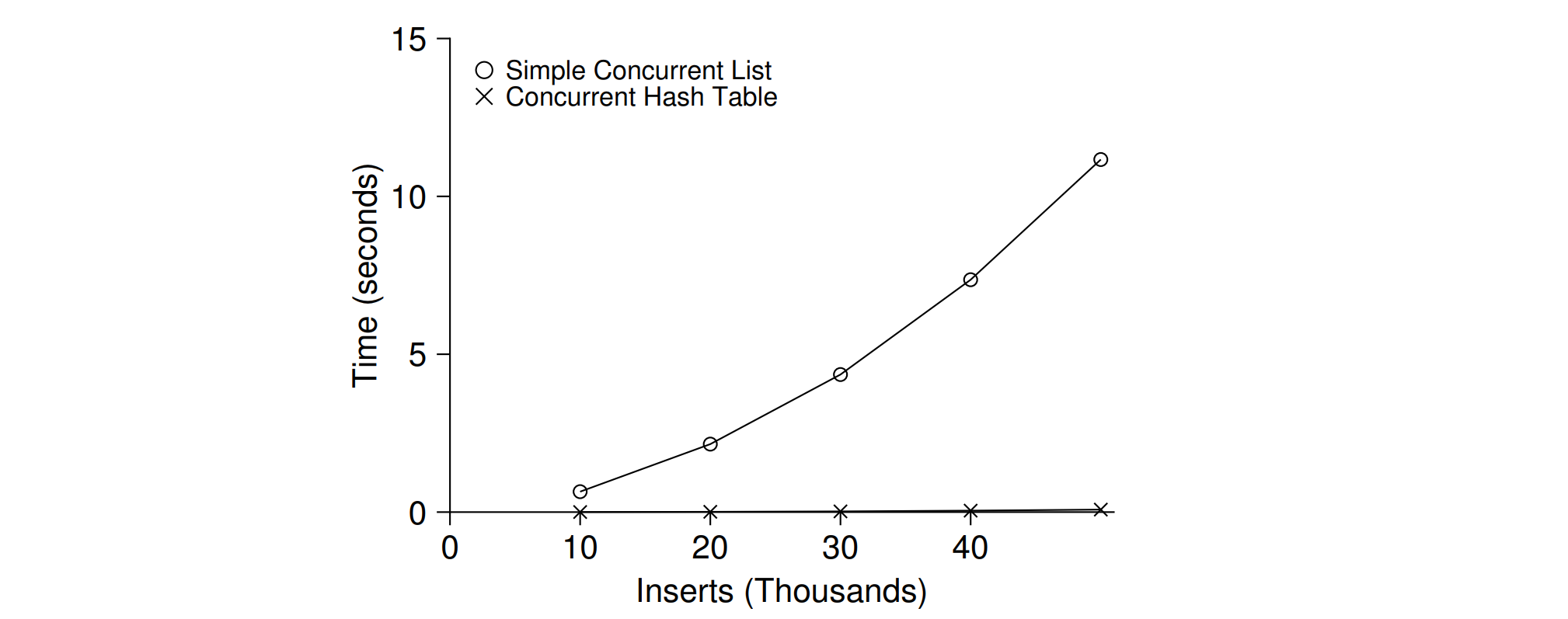
동시성이 반드시 더 빠르지는 않다.
동시성을 추가하는 것이 더 복잡해지고 비용이 많이 든다면 성능이 좋아지지 않을 것이다.