
얕은 복사
객체의 주소 값만 가져와 참조형 변수에 저장하고 하나의 객체를 두 변수가 참조하는 것
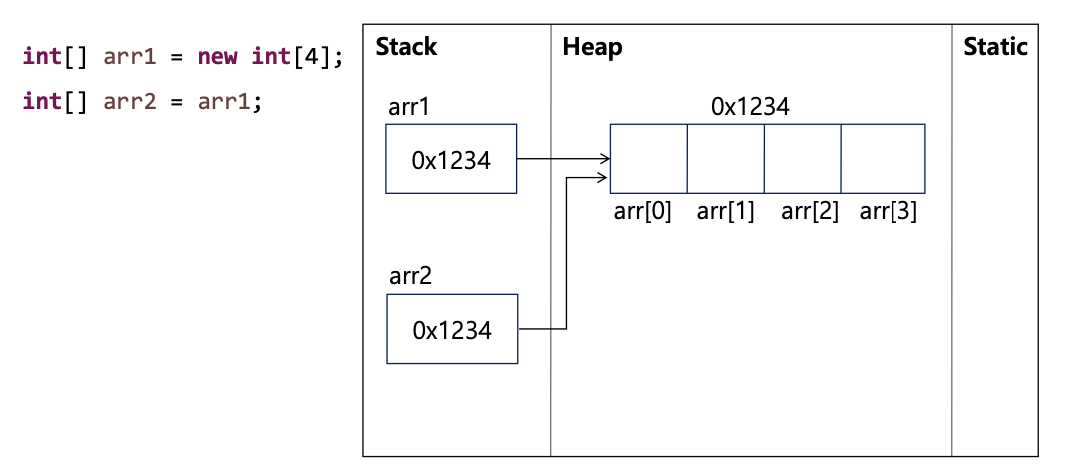
class ArrayExample2
package edu.kh.array.ex;

import java.util.Arrays;

public class ArrayExample2 {

	// 얕은 복사 (shallow : 얕은)
	// -> 주소를 복사하여 서로 다른 두 변수가
	// 	  하나의 배열(또는 객체)을 참조하는 상태를 만드는 복사 방법

	public void shallowCopy() {

		int[] arr = {1, 2, 3, 4, 5};

		// 얕은 복사 진행
		int[] copyArr = arr; // 주소만 복사

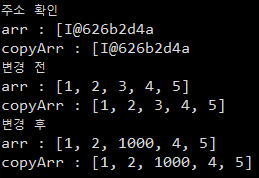
		System.out.println("주소 확인");
		System.out.println("arr : " + arr);
		System.out.println("copyArr : " + copyArr);

		// 배열 값 변경
		System.out.println("변경 전");
		System.out.println("arr : " + Arrays.toString(arr));
		System.out.println("copyArr : " + Arrays.toString(copyArr));

		// 얕은 복사한 배열의 값을 변경
		copyArr[2] = 1000;
		System.out.println("변경 후");
		System.out.println("arr : " + Arrays.toString(arr));
		System.out.println("copyArr : " + Arrays.toString(copyArr));
	}
}
깊은 복사
새로운 배열 객체를 생성하여 기존 배열의 데이터를 복사하는 것
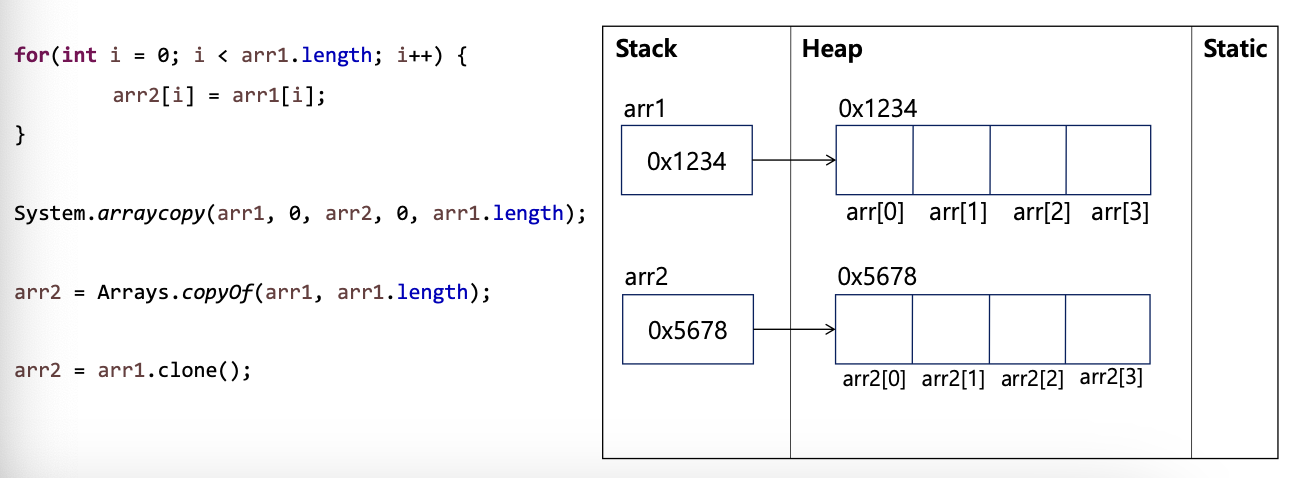
1) for(inti= 0; i< arr1.length; i++) {
arr2[i] = arr1[i];
}
가장 대표적인 방법
2) System.arraycopy(arr1, 0, arr2, 0, arr1.length);
3) arr2= Arrays.copyOf(arr1, arr1.length);
이클립스에서 제공하는 조금 편한 복사
4) arr2= arr1.clone() ;
위험하다, 최대한 자세하게 쓰지 않은 경우 사용하는 것을 추천하지 않음
class ArrayExample2
	public void deepCopy() {
		int[] arr = {1,2,3,4,5}; // 원본

		// 1. for문을 이용한 깊은 복사
		int[] copyArr1 = new int[arr.length]; // 5칸 짜리 배열 생성

		for(int i=0; i<arr.length; i++) {
			copyArr1[i] = arr[i];
		}


		// 2. System.arraycopy(원본배열, 원본 복사 시작 인덱스,
		//					   복사배열, 복사배열의 삽입 시작 인덱스, 복사길이);

		int[] copyArr2 = new int[arr.length];
		System.arraycopy(arr, 0, copyArr2, 0, arr.length);


		// 3. 복사할 배열 참조 변수 = Arrays.copyof(원본 배열, 복사할 길이);
		int[] copyArr3 = Arrays.copyOf(arr, arr.length);


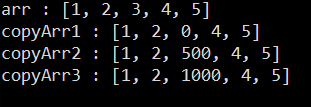
		// 값 변경 후 확인
		copyArr1[2]=0;
		copyArr2[2] = 500;
		copyArr3[2] = 1000;


		System.out.println("arr : " + Arrays.toString(arr));
		System.out.println("copyArr1 : " + Arrays.toString(copyArr1));
		System.out.println("copyArr2 : " + Arrays.toString(copyArr2));
		System.out.println("copyArr3 : " + Arrays.toString(copyArr3));
	}
class ArrayExample2
로또 번호 생성기
	// 배열을 이용한 중복 데이터 제거 + 정렬
	public void createLottoNumber() {
		// 로또 번호 생성기


		// 1. 1 ~ 45 사이 중복되지 않은 난수 6개 생성

		// 2. 생성된 난수가 오름차순으로 정렬


		// 1) 정수 6개를 저장할 배열 선언 및 할당
		int[] lotto = new int[6];

		// 2) 생성된 배열을 처음부터 끝까지 순차 접근하는 for문 작성
		for(int i=0; i<lotto.length; i++) {


			// 3) 1 ~ 45 사이의 난수 생성
			int random = (int)(Math.random() * 45 + 1);
			// 0.0 <= x < 1.0
			// 0.0 <= x * 45 < 45.0
			// 1.0 <= x * 45 + 1 < 46.0
			// i <= (int)(x * 45 + 1) < 46


			// 4) 생성된 난수를 순서대로 배열 요소에 대입
			lotto[i] = random;
			// System.out.println(lotto[i] + " ");

			// 5) 중복 검사를 위한 for문 작성
			for(int j=0; j<i; j++) {

				// 6) 현재 생성된 난수와 같은 수가
				//	  앞쪽 요소에 있는지 검사
				if(random == lotto[j]) {
					i--;

					// i가 1씩 증가할 때 마다 난수가 하나 생성
					// -> 중복 값이 있으므로 난수를 새로 하나 더 생성 해야함
					// --> i는 0~5까지 6회 반복 되지만
					// 	   i값을 인위적으로 1 감소시켜 7회 반복되는 모양을 만듦

					break;
					// 앞쪽에서 중복 데이터를 발견하면
					// 남은 값을 비교할 필요 없음
					// -> 효율 향상을 위해서 검사하는 for문 종료
				}
			}
		} // 바깥쪽 for문 끝

		// 7) 오름차순 정렬
		// -> 선택, 삽입, 버블, 퀵 등등
		// --> 자바가 정렬 방법을 미리 만들어서 제공하고 있음
		//     Arrays.sort(배열명) : 배열 내 값들이 오름차순으로 정렬됨
		Arrays.sort(lotto);

		// 내림차순 정렬
		// Collections.reverseOrder()
		// Arrays.sort(lotto, Collections.reverseOrder());

		// 결과 출력
		System.out.println(Arrays.toString(lotto));
	}
배열 실습 문제
실습문제 8
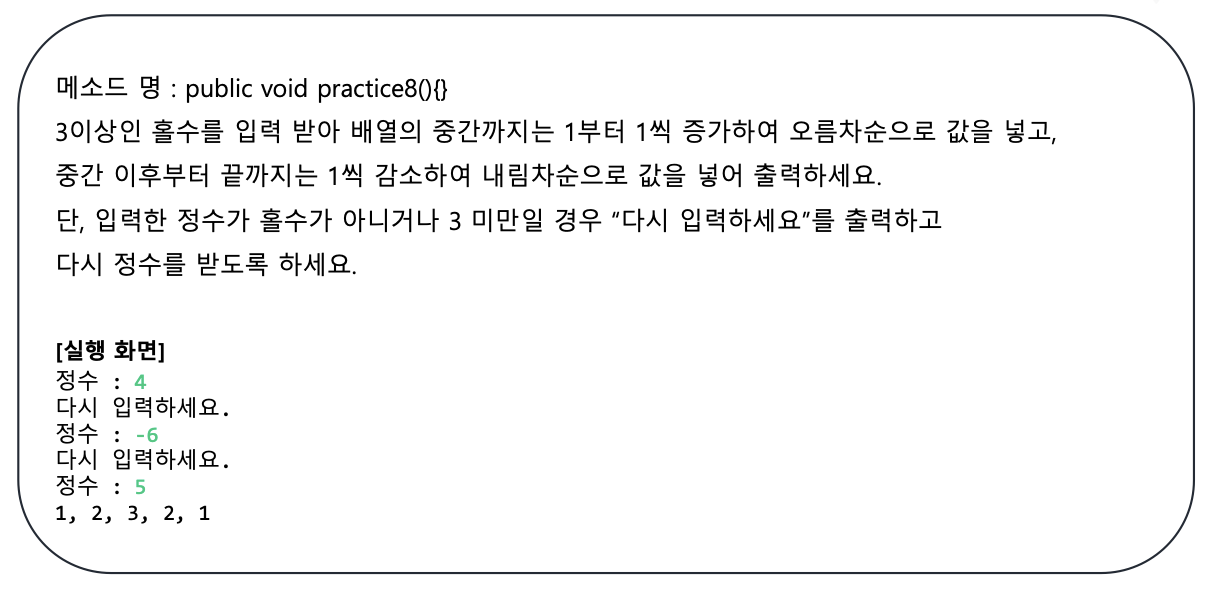
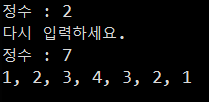
class ArrayPractice
public void practice8() {
		Scanner sc = new Scanner(System.in);

		while(true) { // 3 이상의 홀수가 입력 될 때 까지 무한 반복
			// -> 3 이상 홀수가 입력되면 break문으로 종료
			System.out.print("정수 : ");
			int input = sc.nextInt();


			if(input %2==0 || input<3){ // 짝수 또는 3 미만인 경우 -> 반복
				System.out.println("다시 입력하세요.");
			}
			else {
				// 입력 받은 정수 만큼의 크기를 가지는 배열 생성
				int[] arr = new int[input];

				int num = 0; // arr 배열에 대입될 값
				for(int i=0; i<arr.length; i++) {

					if(i<=arr.length/2) { // 중간 이전 까지 -> 증가
						arr[i] = ++num;
					} else { // 중간 이후 -> 감소
						arr[i] = --num;

					} // 출력 시, 추가 (단, 마지막 제외)
					if(i==arr.length-1) { // 마지막 바퀴
						System.out.print(arr[i]);
					}
					else {
						System.out.print(arr[i]+ " , ");
					}
				}
				break; // while 반복 멈춤
			}
		}
실습문제 9
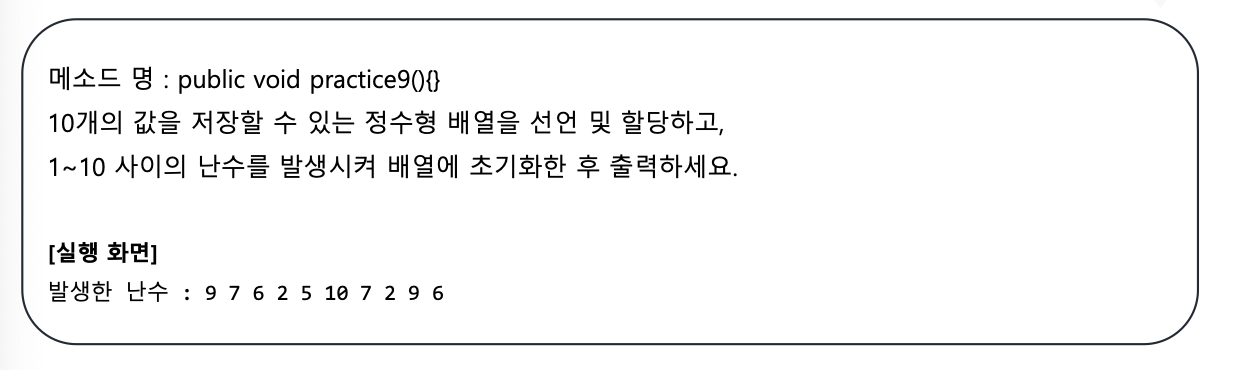
class ArrayPractice
	public void practice9() {
		Scanner sc = new Scanner(System.in);

		int[] input = new int[10]; // 10개의 값을 저장할 수 있는 정수형 배열 선언 및 할당

		System.out.print("발생한 난수 : ");

		for (int i=0; i<input.length; i++) { // 1~10 사이의 난수를 발생시켜 배열에 초기화한 후 출력하세요
			int random = (int)(Math.random() * 10 + 1);

			System.out.print(random + " ");
		}
	}
실습문제 10
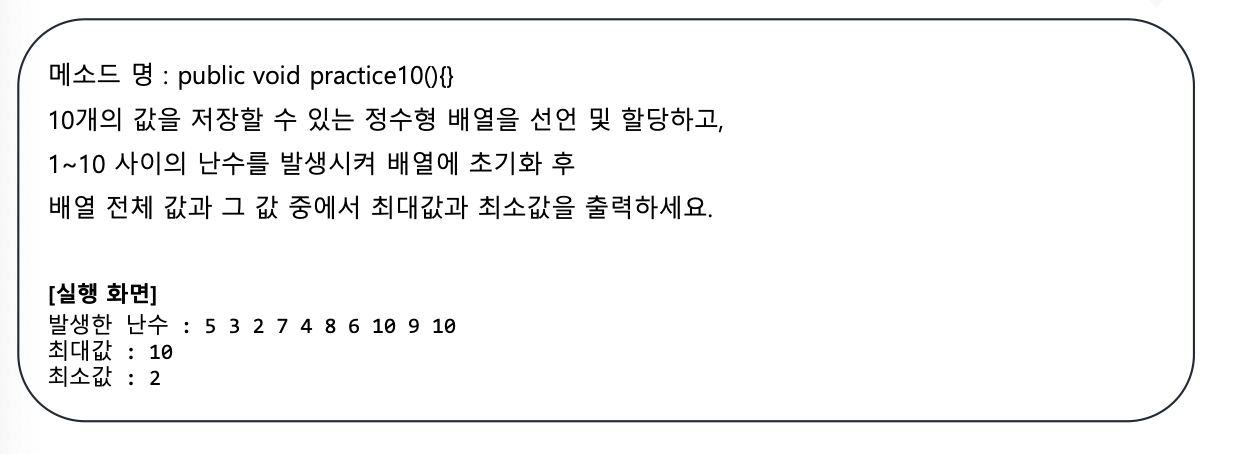
class ArrayPractice
	public void practice10() {

		int[] arr= new int[10];

		System.out.print("발생한 난수 : ");

		for(int i=0; i<arr.length; i++) {
			arr[i] = (int)(Math.random() * 10 + 1);
			System.out.print(arr[i] + " ");
		}

		int min = arr[0];
		int max = arr[0];

		for(int i=0; i<arr.length; i++) {

			if(max < arr[i]) {
				max = arr[i];

			} else if(arr[i] < min) {
				min = arr[i];
			}
		}
		System.out.println();
		System.out.println("최대값 : " + max);
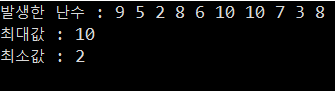
		System.out.println("최소값 : " + min);
	}
실습문제 11
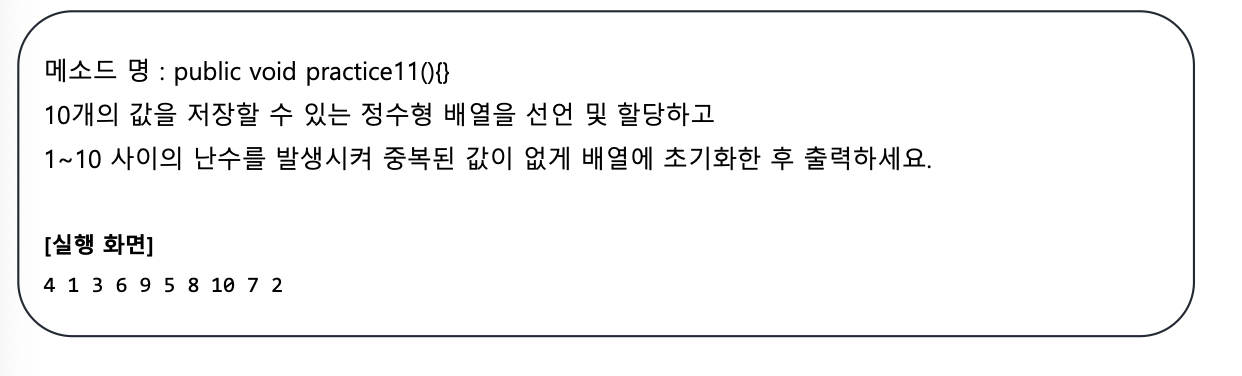
class ArrayPractice
public void practice11() {
		int[] arr = new int[10]; // 10개의 값을 저장할 수 있는 정수형 배열을 선언 및 할당

		System.out.print("발생한 난수 : ");

		for (int i=0; i<arr.length; i++) {
			// 난수 생성 -> 대입(단, 중복 제거)
			arr[i] = (int)(Math.random() * 10 + 1); // 1 ~ 10사이 난수

			// 중복 확인 시 i값을 감소 시켜
			// 다음 반복에서 현재 인덱스에 난수 덮어쓰기

			for(int j=0; j<i; j++) {
				if(arr[i] == arr[j]) { // 현재 생성된 난수가 앞서 대입된 난수와 같은 경우 == 중복
					i--; // i를 i 감소 시킴
						 // 바깥쪽 for문 반복 시 i가 다시 1 증가
						 // -1 + 1 == 0 (제자리)
					break;
				}
			}
		}
		for(int i=0; i<arr.length; i++) {
			System.out.print(arr[i] + " ");
		}
	}
실습문제 12
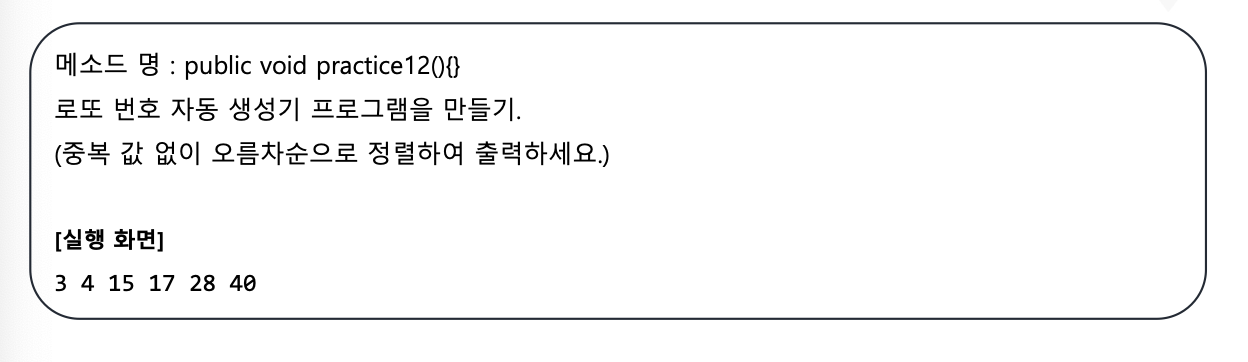
class ArrayPractice
	public void practice12() {
		// 1) 정수 6개를 저장할 배열 선언 및 할당
		int[] lotto = new int[6];
		// 2) 생성된 배열을 처음부터 끝까지 순차 접근하는 for문 작성

		for(int i=0; i<lotto.length; i++) {

			// 3) 1 ~ 45 사이의 난수 생성
			int random = (int)(Math.random() * 45 + 1);

			// 4) 생성된 난수를 순서대로 배열 요소에 대입
			lotto[i] = random;

			// 5) 중복 검사를 위한 for문 작성
			for(int j=0; j<i; j++) {

				// 6) 현재 생성된 난수와 같은 수가
				//	  앞쪽 요소에 있는지 검사
				if(random==lotto[j]) {
					i--;
					break;
				}
			}
		}
		Arrays.sort(lotto);
		System.out.println(Arrays.toString(lotto));
	}
실습문제 13
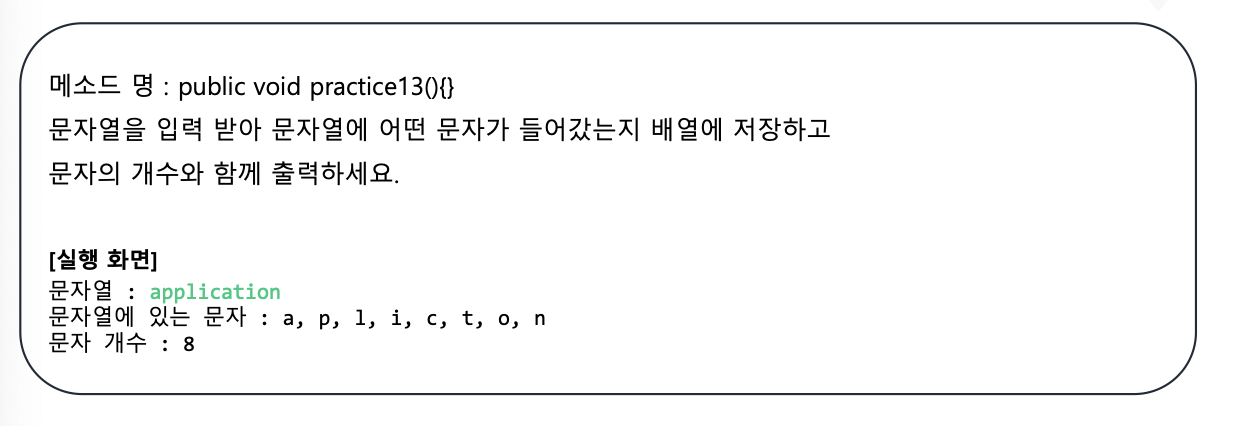
class ArrayPractice
	public void practice13() {
		Scanner sc = new Scanner(System.in);
		System.out.print("문자열 : "); // 문자열을 입력 받아
		String input = sc.nextLine();

		// 문자열에 어떤 문자가 들어갔는지 배열에 저장
		char[] str = new char[input.length()];

		int count = 0; // 카운트용 변수

		System.out.print("문자열에 있는 문자 : ");
		for(int i=0; i<str.length; i++) {
			str[i]=input.charAt(i); // 문자열에 있는 문자 : a, p, p, l, i, c, a, t, i, o, n


			boolean flag = true;
			// 중복 검사 + flag
			// application
			// 배열 : [a, p, p, l, i, c, a, t, i, o, n]
			// 화면 : a, p, l, i, c, t, o, n
			for(int j=0; j<i; j++) { // 중복 검사용 for문
				if(str[i] == str[j]) {
					flag = false;
					break;
				}
			}
			if(flag) { // flag가 true인 경우 == 중복이 없었다라는 의미

				if(i==0) { // 첫 바퀴인 경우
					System.out.print(str[i]);
				}
				else {
					System.out.print(", " + str[i]);
				}
				count++;
			}
		}
		System.out.println("\n문자 개수 : " + count);
	}
실습문제 14
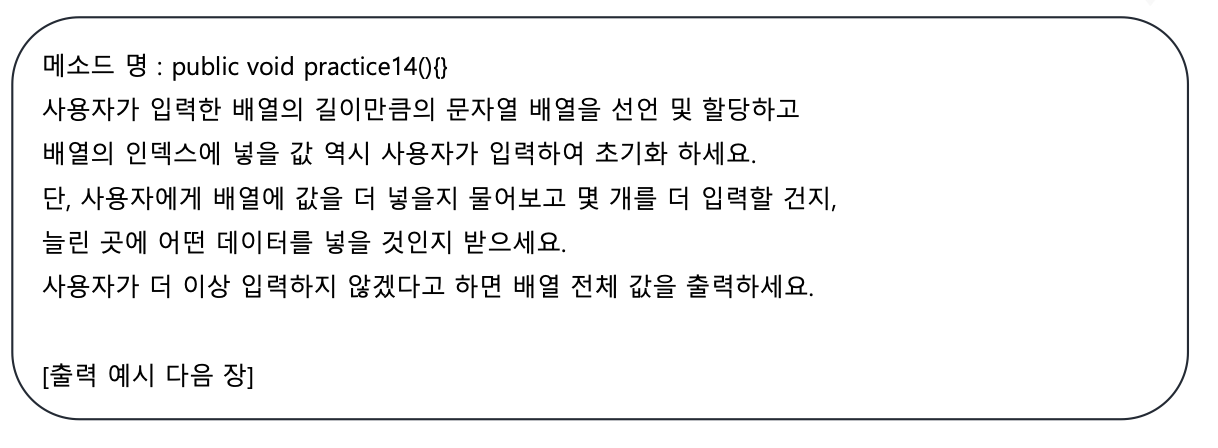
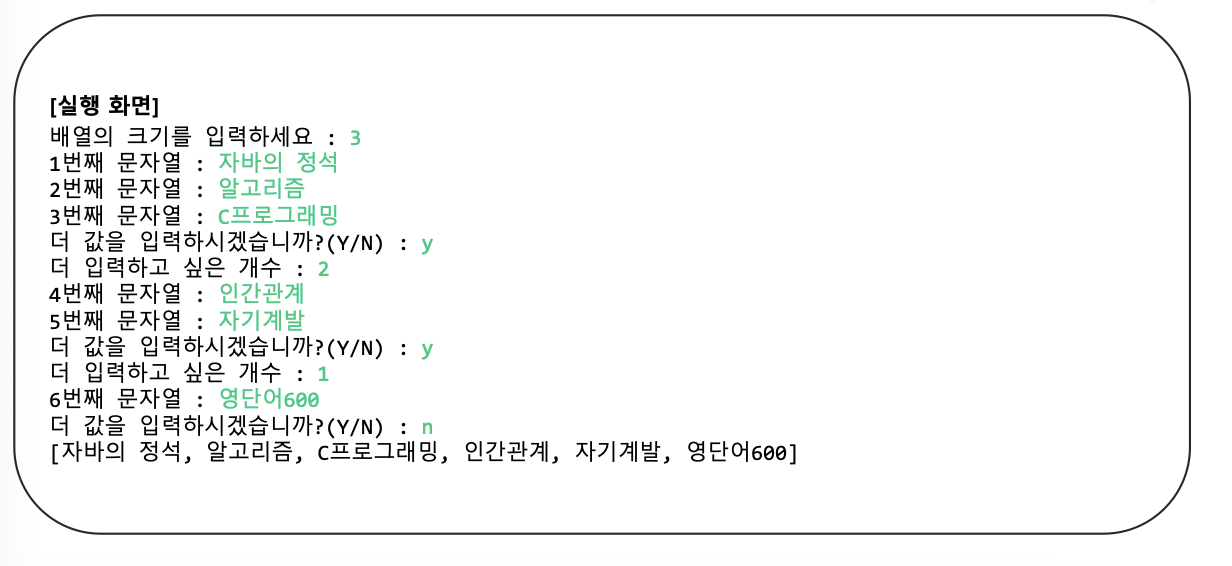
class ArrayPractice
public void practice14() {
	Scanner sc = new Scanner(System.in);

	System.out.print("배열의 크기를 입력하세요 : ");
	String[] arr = new String[sc.nextInt()];
	sc.nextLine();

	int index = 0;

	while (true) {
		for (int i = index; i < arr.length; i++) {
			System.out.print(i + 1 + "번째 문자열 : ");
			arr[i] = sc.nextLine();
		}

		index = arr.length;

		System.out.print("더 값을 입력하시겠습니까?(Y/N) : ");
		char plus = sc.next().charAt(0);

		if (plus == 'Y' || plus == 'y') {
			System.out.print("더 입력하고 싶은 개수 : ");
			String[] arr2 = new String[arr.length + sc.nextInt()];
			sc.nextLine();

			System.arraycopy(arr, 0, arr2, 0, arr.length);
			arr = arr2;

		} else if (plus == 'N' || plus == 'n') {
			System.out.println(Arrays.toString(arr));
			break;

		} else {
			System.out.println("잘못 입력하셨습니다.");
			continue;
		}
	}
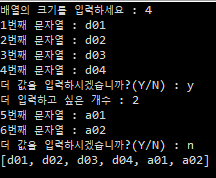
}
class PracticeRun
package edu.kh.array.practice;

public class PracticeRun {
	public static void main(String[] args) {
		ArrayPractice arrEx = new ArrayPractice();

		arrEx.practice1(); // O
		arrEx.practice2(); // O
		arrEx.practice3(); // O
		arrEx.practice4(); // O
		arrEx.practice5(); // O
		arrEx.practice6(); // O
		arrEx.practice7(); // O
		arrEx.practice8(); // O
		arrEx.practice9(); // O
		arrEx.practice10(); // O
		arrEx.practice11(); // O
		arrEx.practice12(); // O
		arrEx.practice13(); // O
		arrEx.practice14(); // O

	}
}

Hello! My Name is oYJo