
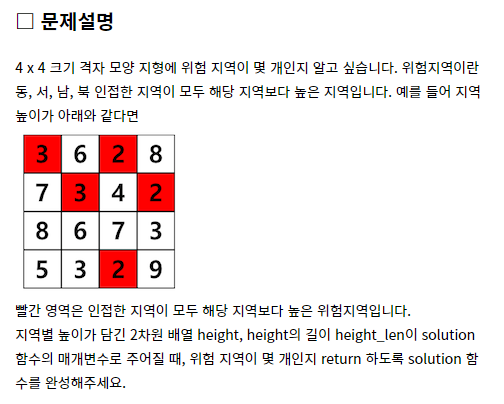
처음에 긴가민가 하면서 이해가 잘 안됐지만 두 번쯤 읽었을 때 아하!했다.
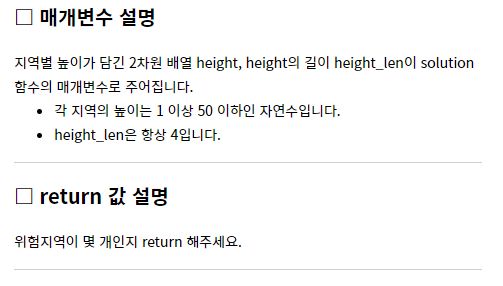
main 설명
int main() {
    int height[4][4] = {{3, 6, 2, 8}, {7, 3, 4, 2}, {8, 6, 7, 3}, {5, 3, 2, 9}};
    int height_len = 4;
    int ret = solution(height, height_len = 4);

    printf("solution 함수의 반환 값은 %d 입니다.\n", ret);
}- height 배열에 4행/4열 구조로 선언
- height 배열의 길이는 4
- ret 변수에 solution 함수 반환값을 저장
solution 설명
int solution(int height[][4], int height_len) {
    int count = 0;
		int test[6][6];

		for (int i = 0; i < 6; i++) {
			for (int j = 0; j < 6; j++) {
				test[i][j] = 51;
			}
		}

		for (int i = 1; i < 5; i++) {
			for (int j = 1; j < 5; j++) {
				test[i][j] = height[i-1][j-1];
			}
		}

		for (int i = 1; i <= height_len; i++) {
			for (int j = 1; j <= height_len; j++) {
				if (test[i][j] < test[i][j - 1] && test[i][j] < test[i + 1][j] && test[i][j] < test[i][j + 1] && test[i][j] < test[i - 1][j]) {
					count++;
				}
			}
		}
    return count;
}- 위험 지역 개수를 셀 count 변수를 0으로 초기화
- test 6행6열 배열을 선언한다.
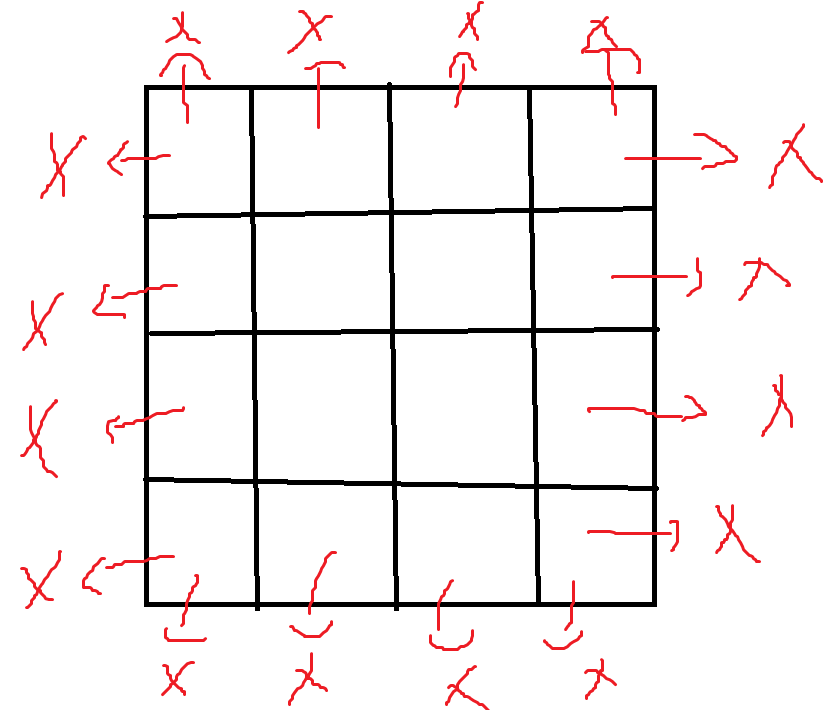
한 값과 상하좌우 값을 비교했을 때 한 값 < 상하좌우값 이면 count++
(그런데 벽에 있는 값들은 상하좌우 값을 비교했을 때 값이 없음)
6행 6열 배열안에 4행 4열이 들어갈 수 있도록 한다.
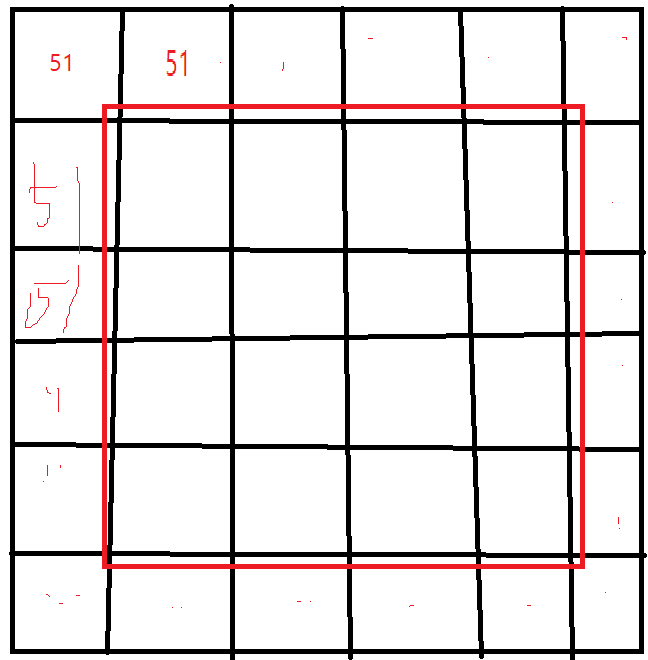
- test의 값을 모두 51로 초기화한다. (각 지역의 높이는 1이상 50이하인 자연수)
- 그리고 test 2행 2열부터 height 배열의 값을 차례대로 삽입한다.
- 그리고 이중 for문을 돌려 상하좌우를 비교하고 한 값 < 상하좌우값 이면 count++한다
빈칸 채우기
int solution(int height[][4], int height_len) {
    int count = 0;
		int test[6][6];

		for (int i = 0; i < 6; i++) {
			for (int j = 0; j < 6; j++) {
				test[i][j] = 51;
			}
		}

		for (int i = 1; i < 5; i++) {
			for (int j = 1; j < 5; j++) {
				test[i][j] = height[i-1][j-1];
			}
		}

		for (int i = 1; i <= height_len; i++) {
			for (int j = 1; j <= height_len; j++) {
				if (test[i][j] < test[i][j - 1] && test[i][j] < test[i + 1][j] && test[i][j] < test[i][j + 1] && test[i][j] < test[i - 1][j]) {
					count++;
				}
			}
		}
    return count;
}
전체 코드
int solution(int height[][4], int height_len) {
    int count = 0;
		int test[6][6];

		for (int i = 0; i < 6; i++) {
			for (int j = 0; j < 6; j++) {
				test[i][j] = 51;
			}
		}

		for (int i = 1; i < 5; i++) {
			for (int j = 1; j < 5; j++) {
				test[i][j] = height[i-1][j-1];
			}
		}

		for (int i = 1; i <= height_len; i++) {
			for (int j = 1; j <= height_len; j++) {
				if (test[i][j] < test[i][j - 1] && test[i][j] < test[i + 1][j] && test[i][j] < test[i][j + 1] && test[i][j] < test[i - 1][j]) {
					count++;
				}
			}
		}
    return count;
}

int main() {
    int height[4][4] = {{3, 6, 2, 8}, {7, 3, 4, 2}, {8, 6, 7, 3}, {5, 3, 2, 9}};
    int height_len = 4;
    int ret = solution(height, height_len = 4);

    printf("solution 함수의 반환 값은 %d 입니다.\n", ret);
}
실행 결과


안냥하세요