How jiu jitsu vs brazilian jiu jitsu differ in history, rules overview
Introduction
The debate around jiu jitsu vs brazilian jiu jitsu is one of the most common discussions among martial arts enthusiasts, beginners, and even experienced practitioners. Many people hear the terms used interchangeably and assume they describe the same discipline. Others sense there is a deeper distinction but struggle to explain it clearly. Understanding the difference matters because each system reflects a unique philosophy, training method, and purpose. Choosing the right path can shape how you train, how you think about self defense, and how you progress physically and mentally.
This article takes a professional and analytical look at jiu jitsu vs brazilian jiu jitsu, exploring their origins, technical focus, training environments, and real world applications. By the end, you will have a clear framework to decide which style aligns best with your goals, whether those goals involve tradition, competition, fitness, or practical self defense. Rather than relying on surface level comparisons, we will dive into the historical context and modern evolution that define both systems today.
Body Section 1: Historical Roots and Philosophical Foundations
To understand jiu jitsu vs brazilian jiu jitsu, history is the most logical starting point. The roots of both systems trace back centuries, yet their paths diverged in ways that shaped their identities.
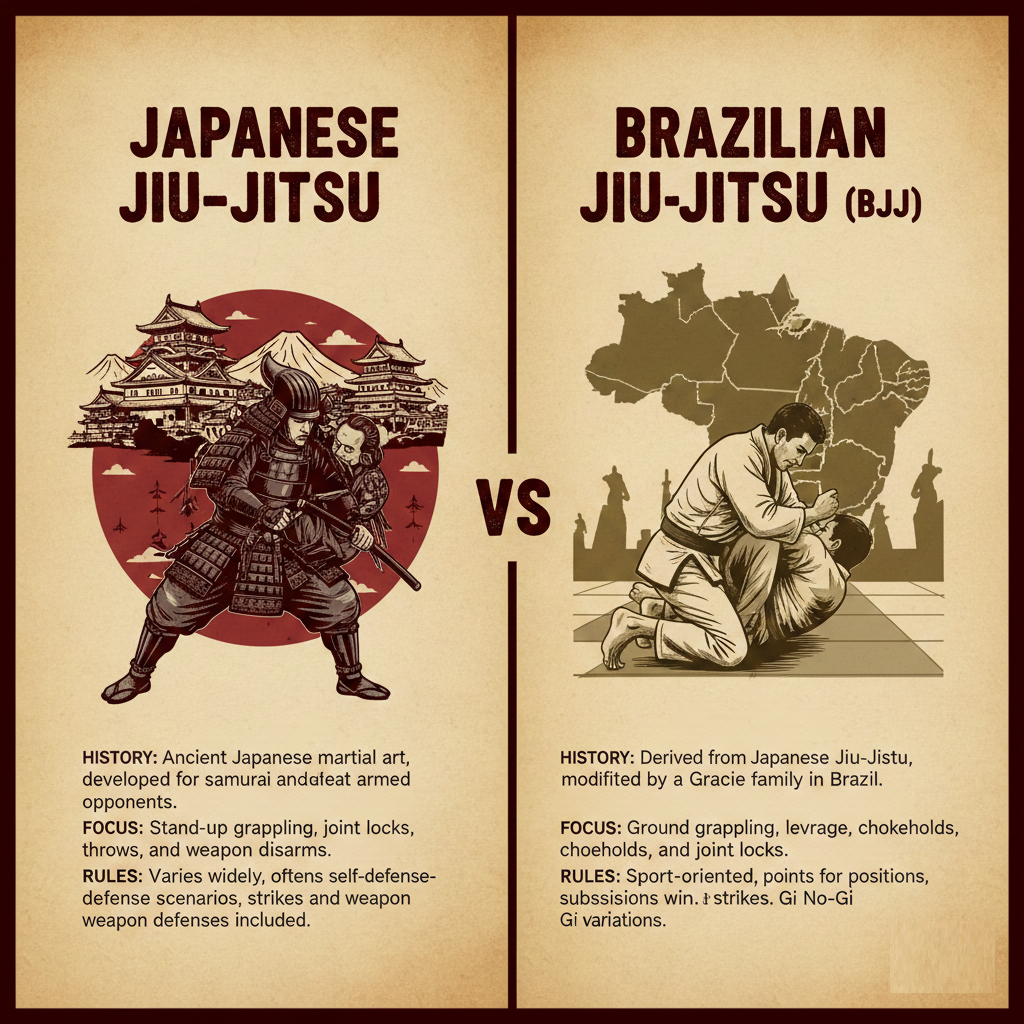
Traditional jiu jitsu originated in Japan and developed as a battlefield art. Samurai warriors needed a way to defend themselves when weapons were lost or impractical. This form of jiu jitsu emphasized balance, leverage, and the efficient use of an opponent’s force. Techniques included throws, joint locks, strikes, and weapon defenses. The philosophy was holistic and pragmatic, focused on survival rather than sport.
As Japan modernized, jiu jitsu influenced the creation of other martial arts such as judo and aikido. These systems refined and systematized techniques, making them safer and more suitable for training environments. However, traditional jiu jitsu retained its classical structure and emphasis on adaptability.
Brazilian jiu jitsu emerged in the early twentieth century when Japanese judo and jiu jitsu practitioners traveled to Brazil. The Gracie family played a pivotal role in adapting the art. They shifted the focus toward ground fighting and submissions, emphasizing technique over raw strength. This evolution was shaped by challenge matches and real combat scenarios, where effectiveness was constantly tested.
The philosophical difference between jiu jitsu vs brazilian jiu jitsu becomes clear here. Traditional jiu jitsu values a broad curriculum and preservation of historical techniques. Brazilian jiu jitsu values live resistance, refinement through sparring, and measurable effectiveness. Neither philosophy is inherently superior, but they reflect different priorities and training outcomes.
Body Section 2: Technical Focus and Training Methods
The technical differences between jiu jitsu vs brazilian jiu jitsu are often the most visible to practitioners and spectators alike. These differences influence how classes are structured, how students progress, and how skills are applied.
Traditional jiu jitsu includes a wide range of techniques. Students learn standing throws, joint manipulations, pins, and striking methods. Weapons training may also be part of the curriculum, depending on the school. The emphasis is on understanding principles such as balance disruption and leverage. Techniques are often practiced through prearranged forms and drills, allowing students to focus on precision and control.
Brazilian jiu jitsu, by contrast, narrows its technical focus to grappling, especially on the ground. Submissions such as chokes and joint locks form the core of the system. Positional control is paramount, with students learning how to advance from guard to mount or back control. Live sparring, commonly called rolling, is a defining feature. This constant testing against resisting opponents accelerates learning and builds confidence.
When comparing jiu jitsu vs brazilian jiu jitsu, it is important to note how training intensity differs. Traditional jiu jitsu classes may prioritize safety and structure, making them accessible to a wide age range. Brazilian jiu jitsu classes often involve high levels of physical engagement, which can be demanding but also deeply rewarding.
These methodological differences also affect skill transfer. Traditional jiu jitsu offers versatility and a broad defensive toolkit. Brazilian jiu jitsu offers depth and specialization, particularly in one on one grappling scenarios. Your preference depends on whether you value breadth or depth in your martial arts education.
Body Section 3: Competition, Self Defense, and Modern Applications
Another key aspect of jiu jitsu vs brazilian jiu jitsu lies in how each system engages with competition and self defense in the modern world. While both claim practical relevance, their approaches differ significantly.
Traditional jiu jitsu was not designed for sport. Its techniques assume unpredictable conditions and multiple variables. As a result, competition rules often limit its expression. Some schools participate in grappling tournaments or self defense demonstrations, but competition is not central to the art’s identity.
Brazilian jiu jitsu, on the other hand, has developed a robust competitive ecosystem. Tournaments exist at local, national, and international levels. Rulesets encourage technical innovation and athletic development. This competitive framework has driven rapid evolution, with new guards, submissions, and training strategies emerging regularly.
In terms of self defense, jiu jitsu vs brazilian jiu jitsu presents an interesting contrast. Traditional jiu jitsu includes strikes and situational awareness, which can be valuable in real world encounters. Brazilian jiu jitsu emphasizes control and submission without strikes, making it particularly effective in one on one confrontations where minimizing harm is a priority.
Modern applications also include cross training. Many law enforcement and military programs incorporate elements of both systems. Brazilian jiu jitsu’s focus on control has proven useful in restraint scenarios. Traditional jiu jitsu’s emphasis on adaptability complements this by addressing a wider range of threats.
This balance between sport, self defense, and practicality continues to shape how both arts are taught and perceived today.
Body Section 4: Choosing the Right Path for Your Goals
Selecting between jiu jitsu vs brazilian jiu jitsu ultimately comes down to personal goals, lifestyle, and learning preferences. There is no universal answer, only informed choices.
If you value tradition, cultural heritage, and a comprehensive curriculum, traditional jiu jitsu may appeal to you. It offers a structured environment where principles are emphasized alongside techniques. This path suits those who appreciate historical context and a methodical learning pace.
If your goals include competition, physical conditioning, and constant technical refinement, Brazilian jiu jitsu may be the better fit. The emphasis on live training fosters resilience and adaptability. Many practitioners are drawn to the clear progression system and measurable milestones.
Location and community also matter. Access to quality instruction can influence your experience more than the style itself. Some regions are known for strong Brazilian jiu jitsu communities, such as brazilian jiu jitsu huntsville al, while others may have established traditional jiu jitsu schools with deep roots.
It is also worth considering cross training. Many practitioners start in one system and later explore the other. This approach can provide a well rounded understanding of grappling and self defense.
Conclusion and Call to Action
The discussion around jiu jitsu vs brazilian jiu jitsu is not about declaring a winner. It is about recognizing how history, philosophy, and practical application shape each art. Traditional jiu jitsu offers breadth, cultural depth, and a holistic approach to self defense. Brazilian jiu jitsu offers specialization, competitive growth, and a proven framework for real world grappling effectiveness.
Your choice should reflect your goals, whether they involve tradition, fitness, competition, or personal development. Take the time to observe classes, speak with instructors, and consider how each style aligns with your values. Martial arts is a long term journey, and the right starting point can make all the difference.
If you are ready to begin, explore reputable schools in your area, attend a trial class, and experience the training firsthand. The best way to understand jiu jitsu vs brazilian jiu jitsu is not just through reading, but through stepping onto the mat and starting your own path.
