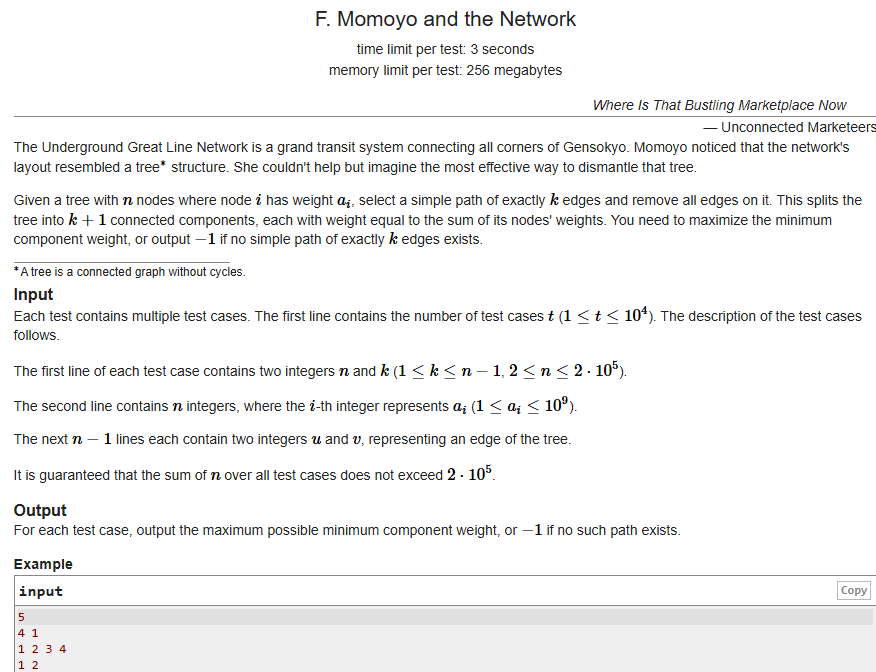
> F. Momoyo and the Network
time limit per test3 seconds
memory limit per test256 megabytes
Where Is That Bustling Marketplace Now— Unconnected Marketeers
The Underground Great Line Network is a grand transit system connecting all corners of Gensokyo. Momoyo noticed that the network's layout resembled a tree∗ structure. She couldn't help but imagine the most effective way to dismantle that tree.
Given a tree with n nodes where node i has weight ai, select a simple path of exactly k edges and remove all edges on it. This splits the tree into k+1 connected components, each with weight equal to the sum of its nodes' weights. You need to maximize the minimum component weight, or output −1 if no simple path of exactly k edges exists.
∗A tree is a connected graph without cycles.
Input
Each test contains multiple test cases. The first line contains the number of test cases t (1≤t≤104). The description of the test cases follows.
The first line of each test case contains two integers n and k (1≤k≤n−1, 2≤n≤2⋅105).
The second line contains n integers, where the i-th integer represents ai (1≤ai≤109).
The next n−1 lines each contain two integers u and v, representing an edge of the tree.
It is guaranteed that the sum of n over all test cases does not exceed 2⋅105.
Output
> For each test case, output the maximum possible minimum component weight, or −1 if no such path exists.
cpp
#include<iostream>
#include<vector>
#include<algorithm>
using namespace std;
long long arr[200001];
vector<vector<int>> edge;
vector<bool> visit;
vector<long long> edge_v,edge_min,edge_len;
long long n, k, t,edge_total=0;
bool dfs_find(int idx,long long mid)
{
    visit[idx] = true;
    edge_len[idx] = 0;
    vector<pair<long long, long long>> edges;
    for (int i : edge[idx])
    {
        if (visit[i])continue;
        if (dfs_find(i, mid)) return true;
        if (mid <= edge_v[i])
        {
            edges.push_back({ edge_v[i], edge_len[i] });
        }
        if (edge_min[i] >= mid) {
            edge_len[idx] = max(edge_len[i] + 1, edge_len[idx]);
        }
        if (edge_len[i] + 1 >= k && edge_total - edge_v[i] >= mid && edge_v[i] >= mid) {
            //자를 수 있음.
            return true;
        }
    }
    sort(edges.begin(), edges.end());
    int ii= -1;
    int l =-1, r = -1;
    for (int j = (int)edges.size() - 1; j >= 0; j--) {
        while (ii + 1 < edges.size() && edge_total- edges[j].first - edges[ii + 1].first >= mid) {
            ii++;
            if (edges[ii].second > l) {//l값이 크고 r값이 작음
                r =l;
                l = edges[ii].second;
            }
            else if (edges[ii].second > r) {
                r = edges[ii].second;
            }
            //이 과정이 잘 이해가 안갔는데 결국 k 값 이상되는 길이를 찾는 과정임.
        }
        if (ii == -1) {
            continue;
        }
        if (edge_total - 2 * edges[j].first >= mid &&l== edges[j].second) {
            //어 지금 제일 큰 길이와 동일하면 r을 써야함
            if (r + edges[j].second + 2 >= k) {
                return true;
            }
        }
        else {
            if (l + edges[j].second + 2 >= k) {
                return true;
            }
        }
    }
    return false;
}
void dfs(int idx)
{
    visit[idx] = true;
    edge_v[idx] = arr[idx];
    vector<int> e;
    for (int i : edge[idx])
    {
        if (visit[i])continue;
        dfs(i);
        edge_v[idx] += edge_v[i];
        e.push_back(i);
    }
    for (int i:e)
    {
        edge_min[i] = min(edge_v[idx] - edge_v[i], edge_v[i]);
    }
}
int main()
{
	ios_base::sync_with_stdio(false);
	cin.tie(NULL);
	cout.tie(NULL);
	int u,v;
	cin >> t;
	for (int a = 0; a < t; a++)
	{
		cin >> n >> k;
        edge.assign(n, {});
        edge_v.assign(n,0);
        edge_min.assign(n, 0);
        edge_len.assign(n, 0);
        edge_total = 0;
        visit.assign(n, false);
		for (int i = 0; i < n; i++)
		{
			cin >> arr[i];
            edge_total += arr[i];
		}
		for (int i = 0; i < n-1; i++)
		{
			cin >> u >> v;
            u--;
            v--;
            edge[u].push_back(v);
            edge[v].push_back(u);
		}
        dfs(0);
        long long l = 0, r = edge_total;
        long long result = -1;
        while(l<=r)
        {
            long long mid = (l + r) >> 1;
            visit.assign(n, false);
          if(  dfs_find(0, mid))
          {
              l=mid+1;
              result = mid;
          }
          else
          {
              r=mid-1;
          }
        }
        cout << result << "\n";
	}
	return 0;
}
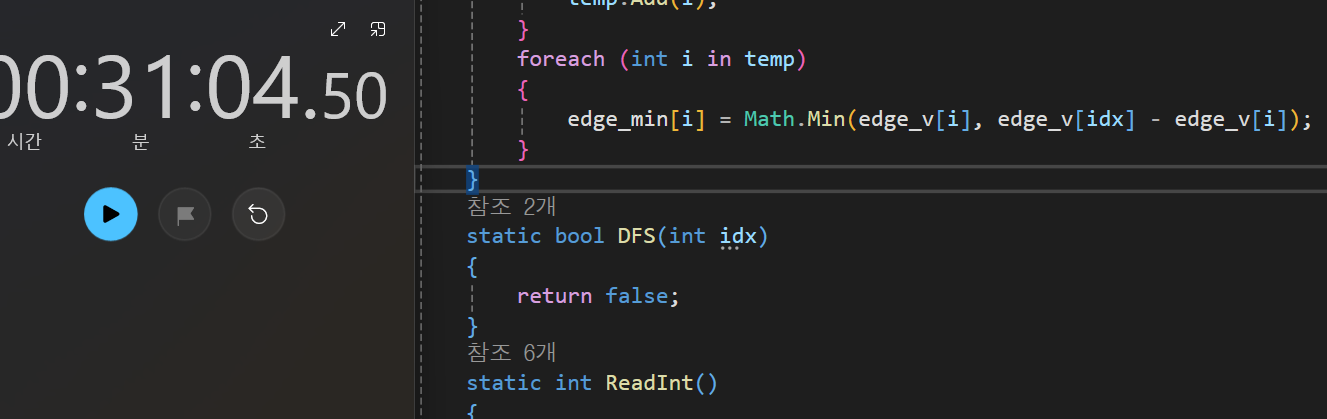
c#
using System;
using System.IO;
using System.Text;
using System.Collections.Generic;
class Program
{
    static BufferedStream sr = new BufferedStream(Console.OpenStandardInput());
    static StreamWriter sw = new StreamWriter(new BufferedStream(Console.OpenStandardOutput()), Encoding.Default);
    static int[] arr=new int [200001];
    static List<List<int>> edge = new List<List<int>>();
    static long[] edge_v = new long[200001], edge_min = new long[200001], edge_len = new long[200001];
    static bool[] visit = new bool[200001];
    static long total = 0;
    static void Set_Edge(int idx)
    {
        visit [idx] = true;
        edge_v[idx]   = arr[idx];
        List<int> temp=new List<int>();
        foreach (int i in edge[idx])
        {
            if (visit[i]) continue;
            DFS(i);
            edge_v[idx]  += edge_v[i];
            temp.Add(i);
        }
        foreach (int i in temp)
        {
            edge_min[i] = Math.Min(edge_v[i], edge_v[idx] - edge_v[i]);
        }
    }
    static bool DFS(int idx)
    {
        return false;
    }
    static int ReadInt()
    {
        int c = sr.ReadByte();
        while (c <= 32) { if (c == -1) return -1; c = sr.ReadByte(); }
        bool neg = false;
        if (c == '-') { neg = true; c = sr.ReadByte(); }
        int val = 0;
        while (c > 32)
        {
            val = val * 10 + (c - '0');
            c = sr.ReadByte();
        }
        return neg ? -val : val;
    }

    static void Main(string[] args)
    {
        int t=ReadInt();
        for (int i = 0; i < t; i++)
        {
            int n=ReadInt();
            int k = ReadInt();
            for (int j = 0; j < n; j++)
            {
                arr[j]=ReadInt();
            }
            for (int j = 0;j < n-1; j++)
            {
             int u=   ReadInt()-1;
                int v= ReadInt()-1;
                if (edge[u] == null)
                    edge[u] = new List<int>();
                if (edge[v] == null)
                    edge[v] = new List<int>();
                edge[u].Add(v);
                edge[v].Add(u);
            }
            Array.Clear(edge_v,0,n);
            Array.Clear(edge_min, 0, n);
            Set_Edge(0);
            long l = -1, r = total,answer=0;
            while(l<=r)
            {
                Array.Clear(visit, 0, n);
                Array.Clear(edge_len, 0, n);
                long mid = (l + r) >> 1;
                if(DFS(0))
                {
                 l=   mid + 1;
                    answer = mid;
                }
                else
                {
                    r = mid -1;
                }
            }
            sw.WriteLine(answer);
        }
        sw.Close();
    }
}
일단 DFS쪽 빼고 안보고 구현 완료.. 어째 추적하면서 하니까 되긴하네..
내일은 구현하고 통과하는걸로..