
◽ 문제 출처
https://school.programmers.co.kr/learn/courses/30/lessons/120875
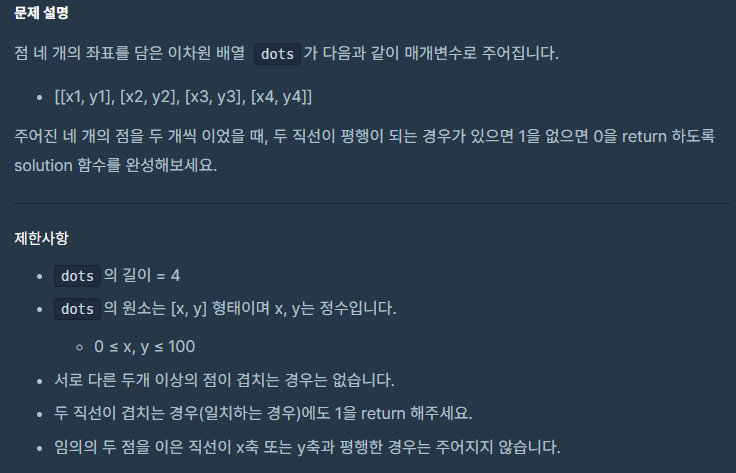
◽ 문제
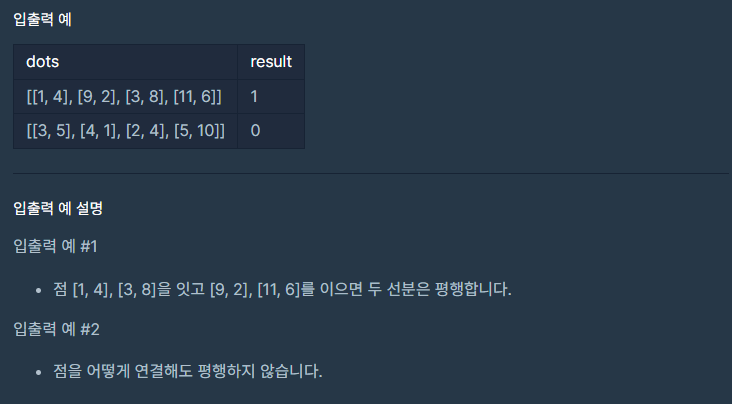
◽ 입력 & 출력
◽ 내 풀이
def solution(dots):
    def is_parallel(a, b, c, d):
        return (b[1] - a[1]) * (d[0] - c[0]) == (d[1] - c[1]) * (b[0] - a[0])

    # 가능한 선분 쌍 조합
    pairs = [
        (0, 1, 2, 3),
        (0, 2, 1, 3),
        (0, 3, 1, 2)
    ]

    for a, b, c, d in pairs:
        if is_parallel(dots[a], dots[b], dots[c], dots[d]):
            return 1
return 0pair배열을 통해 가능한 선분3쌍의 조합을 만들고,is_parallel()함수를 통해 기울기를 비교했다.- 하나라도 평행하면
1, 없으면0을 반환했다.
◽ 다른 사람 풀이
def solution(dots):
    [[x1, y1], [x2, y2], [x3, y3], [x4, y4]] = dots
    answer1 = ((y1 - y2) * (x3 - x4) == (y3 - y4) * (x1 - x2))
    answer2 = ((y1 - y3) * (x2 - x4) == (y2 - y4) * (x1 - x3))
    answer3 = ((y1 - y4) * (x2 - x3) == (y2 - y3) * (x1 - x4))
return 1 if answer1 or answer2 or answer3 else 0- 언패킹으로 각각의 좌표로 풀어서 저장하고, 위의
is_parallel()함수의 과정을 풀어서 쓴듯한 과정이다.
◽ 더 나아가기
- 원래 기울기는
dy / dx (y 변화량 / x 변화량)이지만, 분모를 처리하는 과정에서 부동소수점이 발생할 수 있으니, 벡터의 외적 결과처럼 곱셈으로 처리할 수 있다.
피드백은 언제나 환영입니다 :)

성장하고 싶은 개발자