빈 스코프?
빈 스코프란 해당 빈이 어떤 범위 내에서 생성되고, 관리되며, 존재하는지를 정의한 것으로 빈의 생명주기와 밀접하게 연관되어 있다.
- 싱글톤: 기본 스코프, 스프링 컨테이너 시작과 종료까지 유지되는 가장 넓은 범위의 스코프
- 프로토타입: 스프링 컨테이너는 프로토타입 빈의 생성과 의존관계 주입까지만 관여하고 더는 관리하지 않는다.
- 웹 관련 스코프:
- Request: 웹 요청이 들어오고 나갈 때까지 유지되는 스코프, 각 요청마다 서로 다른 인스턴스를 생성한다.
- Session: 웹 세션이 생성되고 종료될 때까지 유지되는 스코프
- Application: 웹의 서블릿 컨텍스와 같은 범위로 유지되는 스코프
프로토타입 스코프
- 싱글톤 스코프 빈을 조회하면 스프링 컨테이너는 항상 같은 인스턴스의 스프링 빈을 반환한다.
- 반면에 프로토타입 스코프를 스프링 컨테이너에서 조회하면 스프링 컨테이너는 항상 새로운 인스턴스를 반환한다.
- 스프링 컨테이너는 프로토타입 빈을 생성하고, 의존관계 주입, 초기화까지만 처리하며 그 이후에는 관리하지 않는다.
- 따라서 프로토타입 빈을 관리할 책임은 프로토타입 빈을 받은 클라이언트에 있다. 그래서
@PreDestroy같은 종료 메서드가 호출되지 않는다.
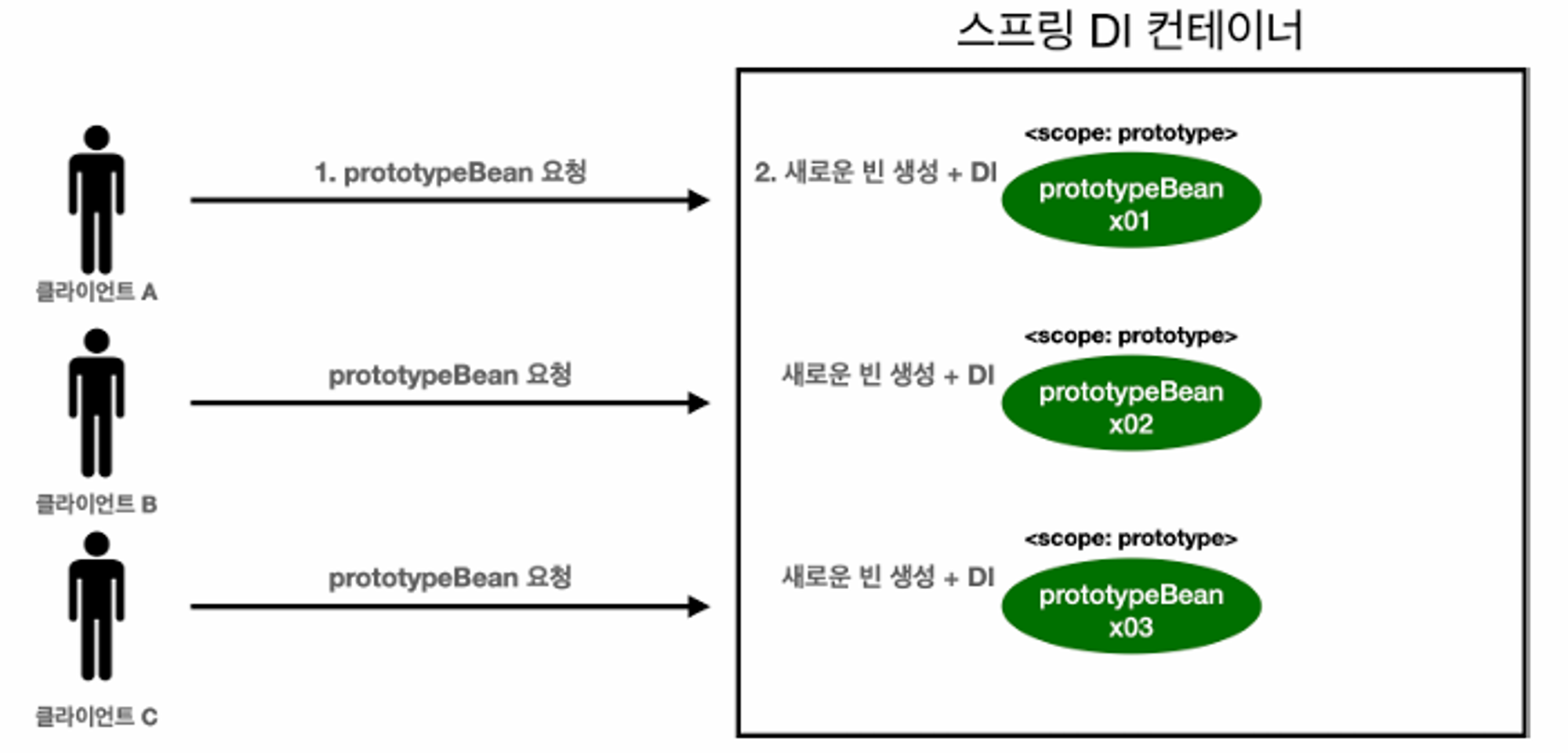
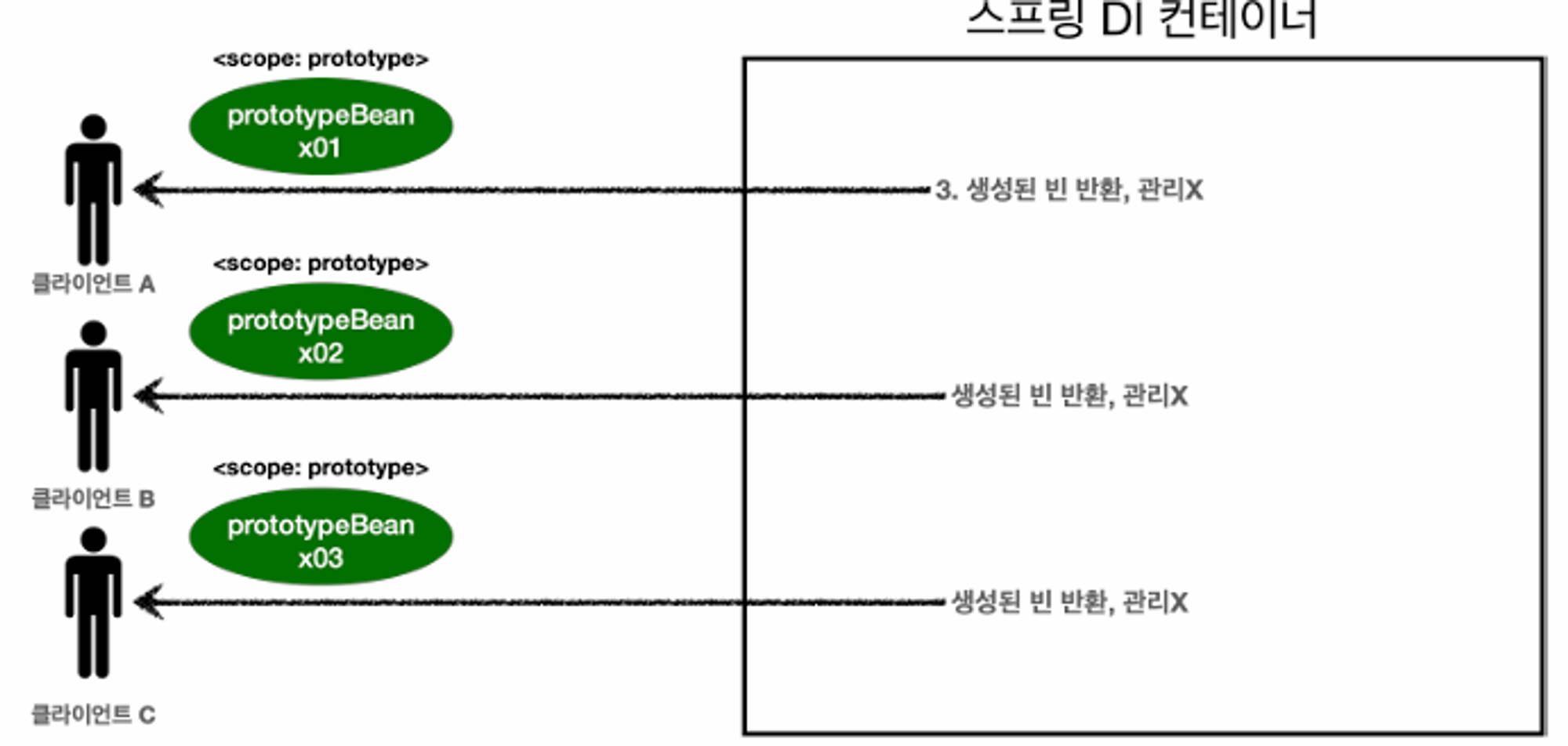
스프링 컨테이너는 프로토타입 빈을 생성하고 의존관계 주입 후, 초기화까지만 처리한다.
프로토타입 스코프 빈 테스트
void singletonBeanTest() {
        AnnotationConfigApplicationContext ac =
                new AnnotationConfigApplicationContext(PrototypeBean.class);

        System.out.println("find bean1");
        PrototypeBean bean1 = ac.getBean(PrototypeBean.class);

        System.out.println("find bean2");
        PrototypeBean bean2 = ac.getBean(PrototypeBean.class);

        System.out.println("bean1 : " + bean1);
        System.out.println("bean2 : " + bean2);

        Assertions.assertThat(bean1).isNotSameAs(bean2);

        bean1.destroy();
        bean2.destroy();

        ac.close();
    }

    @Scope("prototype")
    static class PrototypeBean{

        @PostConstruct
        public void init(){
            System.out.println("PrototypeBean.init");
        }

        @PreDestroy
        public void destroy(){
            System.out.println("PrototypeBean.destroy");
        }
    }
실행결과
find bean1
PrototypeBean.init
find bean2
PrototypeBean.init
bean1 : dev.highright96.core.scope.PrototypeTest$PrototypeBean@1efe439d
bean2 : dev.highright96.core.scope.PrototypeTest$PrototypeBean@be68757
PrototypeBean.destroy
PrototypeBean.destroy- 실행 결과를 보면 프로토타입 빈은 스프링 컨테이너 생성 시점이 아닌 조회 시점에 생성되고, 초기화 메서드도 실행된다.
- 프로토타입 빈은 스프링 컨테이너가 생성과 의존관계 주입 그리고 초기화 까지만 관여하고, 더는 관리하지 않는다.
- 따라서 프로토타입 빈은 스프링 컨테이너가 종료될 때
@PreDestory같은 종료 메서드가 전혀 실행되지 않는다. 위의 결과는 직접 destroy 메서드를 호출한 결과이다.
프로토타입 스코프(싱글톤 빈과 함께 사용 시 문제점)
싱글톤과 프로토타입 스코프를 함께 사용시( 정확히는 싱글톤 안에서 프로토타입 사용시) 이다.
스프링은 일반적으로 싱글톤 빈을 사용한다. 싱글톤 빈이 프로토타입 빈을 사용하게 되낟.
싱글톤 빈은 생성시점에만 의존관계 주입을 받기 때문에, 프로토 타입 빈이 새로 생성되기는 하지만, 싱글톤 빈과 함께 유지되는 것이 문제다.
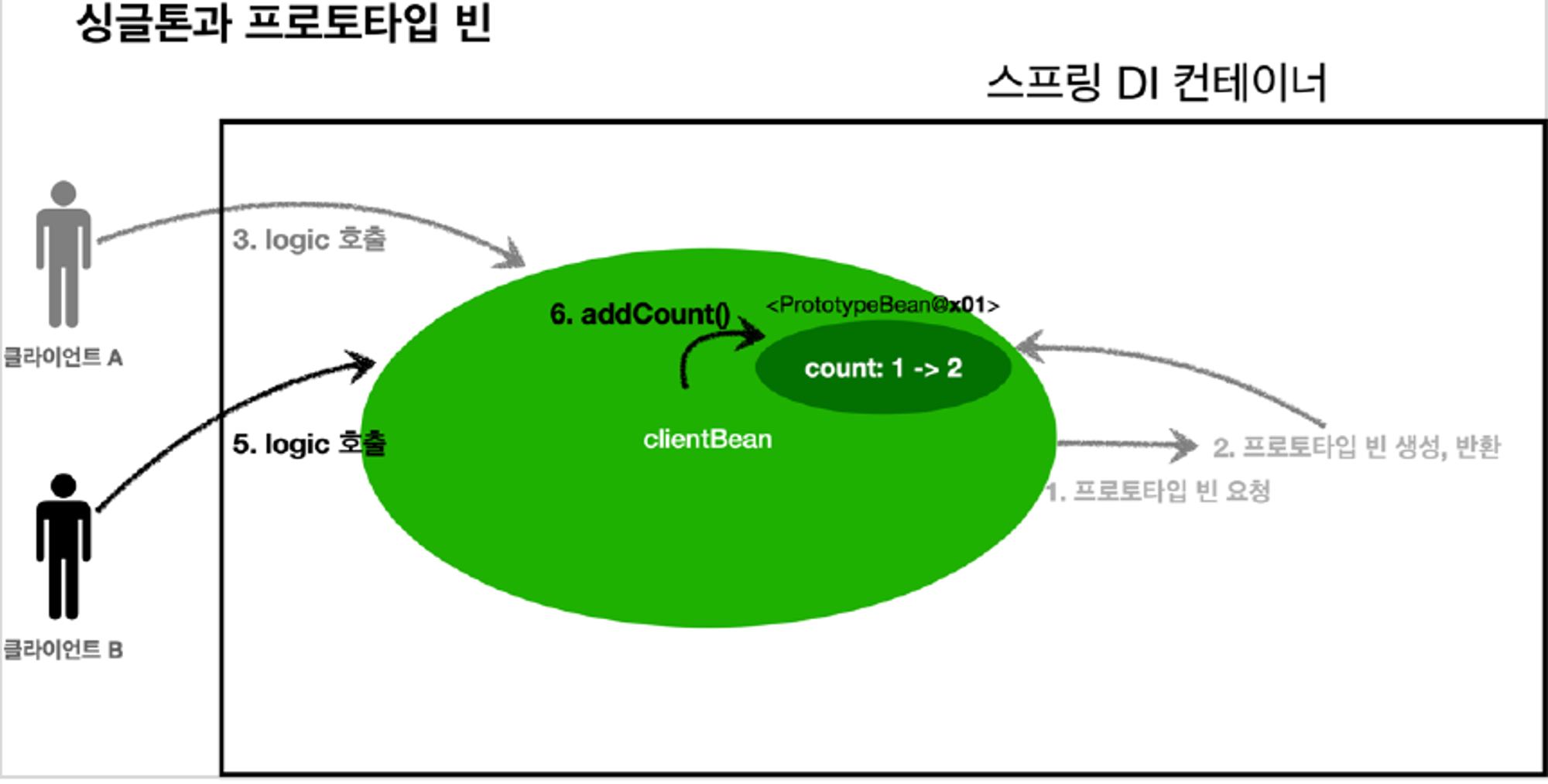
우리가 원하는 결과는 A, B 모두 count=1 이다. 하지만 결과는 클라이언트A는 1 클라이언트B는 2가 저장된다.
그 이유는 싱글톤 빈이 내부에 가지고 있는 프로토타입 빈은 이미 과거(싱글톤 빈이 생성될때)에 주입이 끝난 빈이기 때문에 이후에 새로 생성될 일이 없기 때문이다. 따라서 프로토타입 빈의 특징을 잃어버린다.
프로토타입 스코프(싱글톤 빈과 함께 사용시 문제해결)
싱글톤 빈과 프로토타입 빈을 함께 사용할 때, 어떻게 하면 사용할 때 마다 항상 새로운 프로토타입 빈을 생성할 수 있을까?
필요한 의존관계를 찾는 Dependency Lookup(DL) 의존관계 조회를 제공하는 무언가를 사용하면 된다.
컨테이너에서 싱글톤 빈과 프로토타입 빈을 분리해서 조회
 public class PrototypeProviderTest {
   @Test
	 void providerTest() {
		 AnnotationConfigApplicationContext ac = new
			 AnnotationConfigApplicationContext(ClientBean.class, PrototypeBean.class);

		 ClientBean clientBean1 = ac.getBean(ClientBean.class);
		 int count1 = clientBean1.logic();
		 assertThat(count1).isEqualTo(1);

		 ClientBean clientBean2 = ac.getBean(ClientBean.class);
		 int count2 = clientBean2.logic();
		 assertThat(count2).isEqualTo(1);
	   }

	static class ClientBean {

	 ***@Autowired
	 private ApplicationContext ac;
	 public int logic() {
		 PrototypeBean prototypeBean = ac.getBean(PrototypeBean.class);
	   prototypeBean.addCount();
		 int count = prototypeBean.getCount();
		 return count;
	   }***
	  }

	 @Scope("prototype")
	 static class PrototypeBean {
	 private int count = 0;
	 public void addCount() {
            count++;
   }

	 public int getCount() {
	 return count;
   }

   @PostConstruct
	 public void init() {
	 System.out.println("PrototypeBean.init " + this);
   }

   @PreDestroy
	 public void destroy() {
	 System.out.println("PrototypeBean.destroy");
    }
  }
}
이렇게 스프링의 애플리케이션 컨텍스트 전체를 주입받게 되면, 스프링 컨테이너에 종속적인 코드가 되고, 단위테스트가 어려워진다.
지정한 프로토타입 빈을 컨테이너에서 대신 찾아주는 DL 정도의 기능만 제공하는 무언가 있다.
ObjectFactory, ObjectProvider
지정한 빈을 컨테이너에서 대신 찾아주는 DL 서비스를 제공하는 것이 바로 ObjectProvider 이다. 과거에는 ObjectFactory가 있었는데 ObjectProvider가 기능이 더 많다.
@Autowired
 private ObjectProvider<PrototypeBean> prototypeBeanProvider;

 public int logic() {
		 PrototypeBean prototypeBean = prototypeBeanProvider.getObject();
	   prototypeBean.addCount();
		 int count = prototypeBean.getCount();
		 return count;
}- 실행해보면
prototypeBeanProvider.getObject()을 통해서 항상 새로운 프로토타입 빈이 생성되는 것을 확인할 수 있다. ObjectProvider의getObject()를 호출하면 내부에서는 스프링 컨테이너를 통해 해당 빈을 찾아서 반환한다. (DL)- 스프링이 제공하는 기능을 사용하지만, 기능이 단순하므로 단위테스트를 만들거나 mock 코드를 만들기는 훨씬 쉬워진다.
- ObjectProvider 는 지금 딱 필요한 DL 정도의 기능만 제공
JSR-330 Provider
javax.inject.Provider 라는 JSR-330 자바 표준을 사용하는 방법이다. 스프링 부트 3.0에서는 jakarta.inject.Provider 를 사용한다.
스프링 부트 3.0 jakarta.inject.Provider 사용
 @Autowired
 private Provider<PrototypeBean> provider;
 public int logic() {
		PrototypeBean prototypeBean = provider.get();
    prototypeBean.addCount();
	  int count = prototypeBean.getCount();
		return count;
 }
get()메소드 하나로 기능이 매우 단순해진다.- 별도의 라이브러리가 필요하다.
- 자바 표준이므로 다른 컨테이너에서도 사용할 수 있다.
- 매번 사용할 때마다 의존관계 주입이 완료된 새로운 객체가 필요할 때 사용한다.
- 실무에서 대부분 문제는 싱글톤 빈으로 해결가능하며, 프로토타입 빈은 드물다.
- ObjectProvider가 편의기능을 제공해주고 있으나, 다른 컨테이너에서도 사용하려면 JSR-330 Provider를 사용해야한다.
웹 스코프
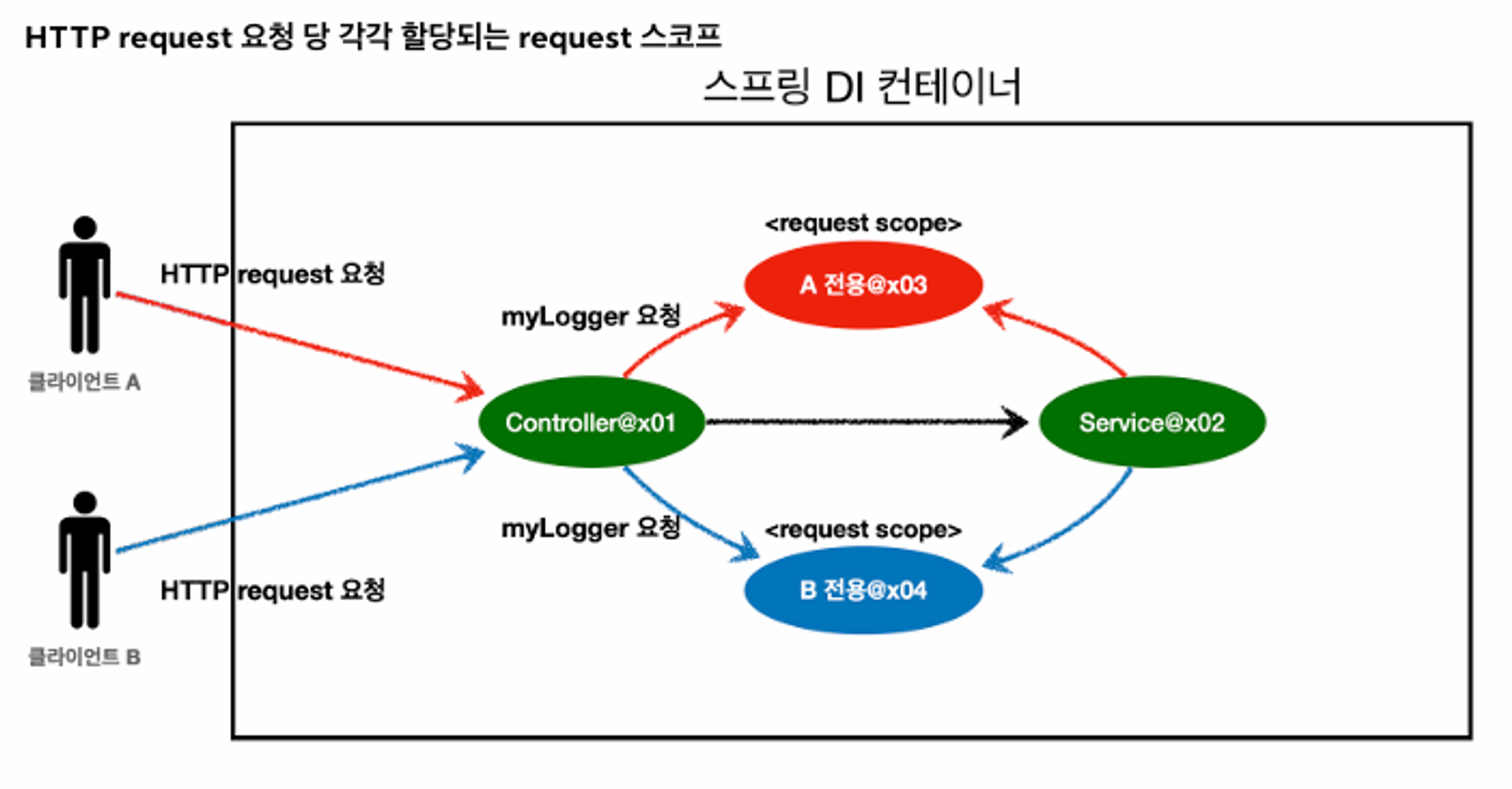
웹 스코프는 웹 환경에서만 동작하며 프로토타입과 다르게 스프링이 스코프의 종료시점까지 관리한다. 따라서 종료 메서드가 호출된다.
웹 스코프의 종류
request: HTTP 요청 하나가 들어오고 나갈 때 까지 유지되는 스코프, 각각의 HTTP 요청마다 별도의 인스턴스가 생성되고 관리된다.session: HTTP Session과 동일한 생명주기를 가지는 스코프apllication: 서블릿 컨텍스트와 동일한 생명주기를 가지는 스코프websocket: 웹 소켓과 동일한 생명주기를 가지는 스코프
어려웠던 내용
- 웹 스코프 실습을 진행해보려 했으나, 버전차이 인지 오류가 발생했다.
- 웹 스코프는 지금은 개념만 익히고, 구현은 추후 스프링 웹기술을 익히고 다시 살펴봐야겠다.
궁금한 내용/부족한 내용
- DI(의존성 주입)과 DL(의존성 조희)의 차이점은 무엇일까?
- 의존성 주입 (Dependency Injection): 객체가 생성될 때 외부(주로 컨테이너)로부터 필요한 의존성을 주입받는다. 이는 객체가 의존성의 구체적인 생성 방법을 알 필요가 없게 만들어, 코드의 결합도를 낮추고 유연성 및 테스트 용이성을 높인다.
- 의존성 조회 (Dependency Lookup): 객체가 자신이 필요로 하는 의존성을 직접 찾아 사용하는 방식이다. 이 경우 객체는 의존성을 얻기 위한 메커니즘(컨테이너 호출 등)을 알아야 하므로, 결합도가 상대적으로 높아진다.
- 싱글톤, 프로토타입, 프록시 등 객체지향 디자인 패턴에 기반함을 알 수 있다. 추가적으로 디자인 패턴에 공부해야겠다.
- 웹 기술에 대한 공부도 필요하다.
느낀 점
스프링 핵심 원리-기본편 을 마치게 되었다. 생소한 개념, 헷갈리는 용어 투성이었지만, 욕심보다 70% 정도 이해만 되면 넘어가면서 진도를 맞추기 위해 노력했다. 아직 백엔드 개발자로는 너무 부족하다. 열심히 하자…