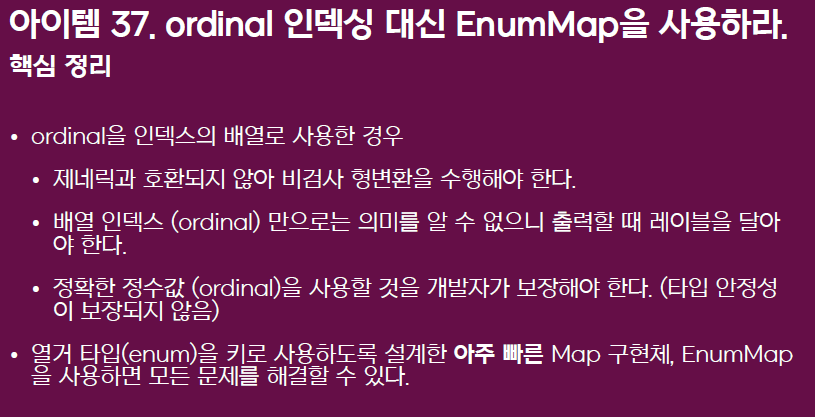
package me.whiteship.chapter06.item37.plant_ordinal;

import java.util.*;

import static java.util.stream.Collectors.groupingBy;
import static java.util.stream.Collectors.toSet;

// EnumMap을 사용해 열거 타입에 데이터를 연관시키기 (226-228쪽)

// 식물을 아주 단순하게 표현한 클래스 (226쪽)
class Plant {
    enum LifeCycle { ANNUAL, PERENNIAL, BIENNIAL }

    final String name;
    final LifeCycle lifeCycle;

    Plant(String name, LifeCycle lifeCycle) {
        this.name = name;
        this.lifeCycle = lifeCycle;
    }

    @Override public String toString() {
        return name;
    }

    public static void main(String[] args) {
        Plant[] garden = {
            new Plant("바질",    LifeCycle.ANNUAL),
            new Plant("캐러웨이", LifeCycle.BIENNIAL),
            new Plant("딜",      LifeCycle.ANNUAL),
            new Plant("라벤더",   LifeCycle.PERENNIAL),
            new Plant("파슬리",   LifeCycle.BIENNIAL),
            new Plant("로즈마리", LifeCycle.PERENNIAL)
        };

        // ANNUAL -> 바질, 딜
        // PERENNIAL -> 라벤더, 로즈마리
        // BiENNIAL -> 캐러웨이, 파슬리

        // 코드 37-1 ordinal()을 배열 인덱스로 사용 - 따라 하지 말 것! (226쪽)
        Set<Plant>[] plantsByLifeCycleArr =
                (Set<Plant>[]) new Set[LifeCycle.values().length];

        for (int i = 0; i < plantsByLifeCycleArr.length; i++)
            plantsByLifeCycleArr[i] = new HashSet<>();

        for (Plant p : garden)
            plantsByLifeCycleArr[p.lifeCycle.ordinal()].add(p);

        // 결과 출력
        for (int i = 0; i < plantsByLifeCycleArr.length; i++) {
            System.out.printf("%s: %s%n", LifeCycle.values()[i], plantsByLifeCycleArr[i]);
            //ENUM에 이미 내용이 적혀져 있는데 해당 값을 잘 활용을 못하고 있다.
        }
    }
}
package me.whiteship.chapter06.item37.plant_enummap;

import java.util.*;

import static java.util.stream.Collectors.groupingBy;
import static java.util.stream.Collectors.toSet;

// EnumMap을 사용해 열거 타입에 데이터를 연관시키기 (226-228쪽)

// 식물을 아주 단순하게 표현한 클래스 (226쪽)
class Plant {
    enum LifeCycle { ANNUAL, PERENNIAL, BIENNIAL }

    final String name;
    final LifeCycle lifeCycle;

    Plant(String name, LifeCycle lifeCycle) {
        this.name = name;
        this.lifeCycle = lifeCycle;
    }

    @Override public String toString() {
        return name;
    }

    public static void main(String[] args) {
        Plant[] garden = {
            new Plant("바질",    LifeCycle.ANNUAL),
            new Plant("캐러웨이", LifeCycle.BIENNIAL),
            new Plant("딜",      LifeCycle.ANNUAL),
            new Plant("라벤더",   LifeCycle.PERENNIAL),
            new Plant("파슬리",   LifeCycle.BIENNIAL),
            new Plant("로즈마리", LifeCycle.PERENNIAL)
        };

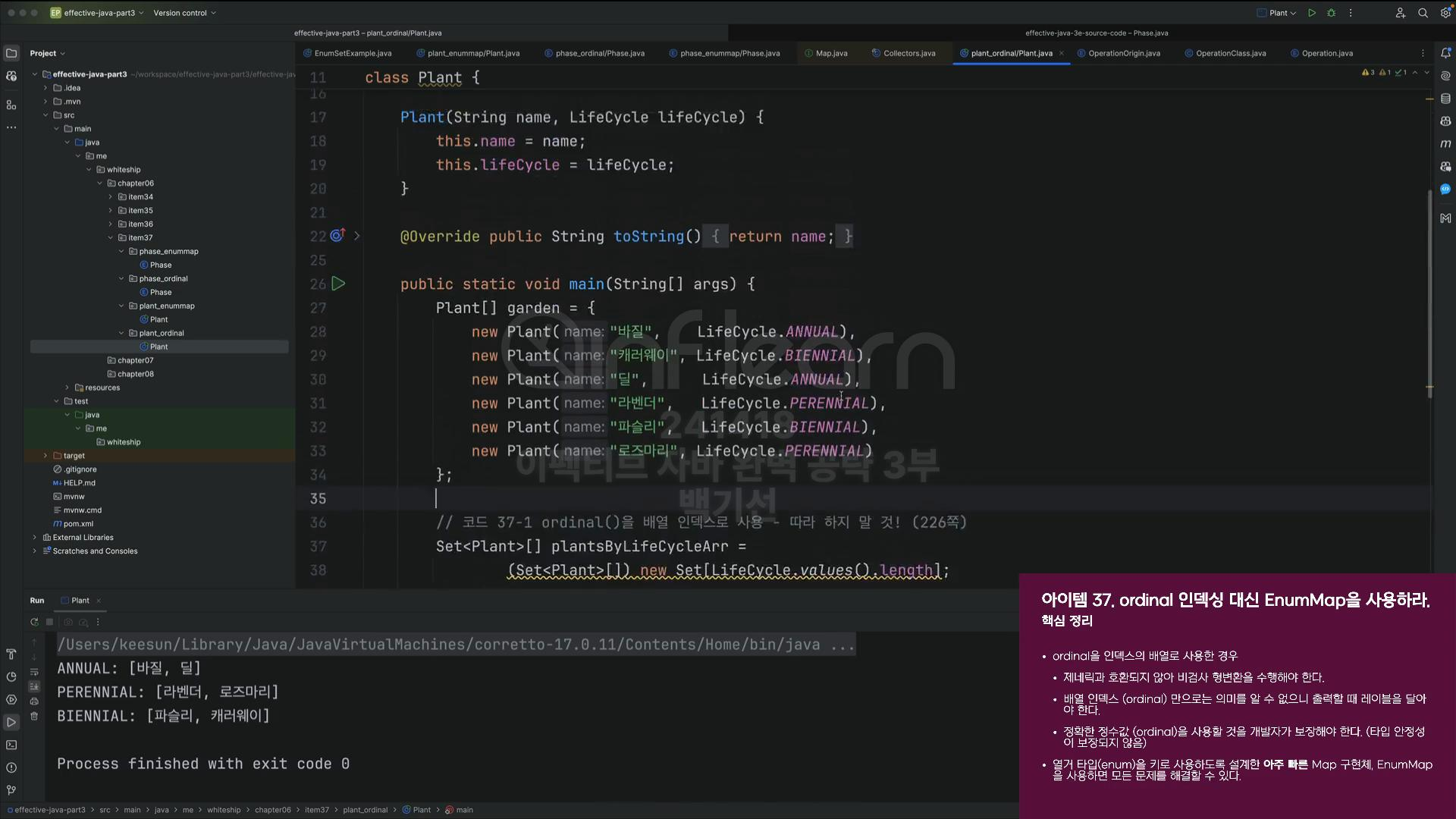
        // 코드 37-2 EnumMap을 사용해 데이터와 열거 타입을 매핑한다. (227쪽)
        Map<LifeCycle, Set<Plant>> plantsByLifeCycle =
                new EnumMap<>(LifeCycle.class);

        for (LifeCycle lc : LifeCycle.values())
            plantsByLifeCycle.put(lc, new HashSet<>());

        for (Plant p : garden)
            plantsByLifeCycle.get(p.lifeCycle).add(p);

        System.out.println(plantsByLifeCycle);

        // 코드 37-3 스트림을 사용한 코드 1 - EnumMap을 사용하지 않는다! (228쪽)
        Map<LifeCycle, List<Plant>> collect = Arrays.stream(garden)
                .collect(groupingBy(p -> p.lifeCycle));
        System.out.println(collect);

        // 코드 37-4 스트림을 사용한 코드 2 - EnumMap을 이용해 데이터와 열거 타입을 매핑했다. (228쪽)
        EnumMap<LifeCycle, Set<Plant>> collect1 = Arrays.stream(garden)
                .collect(groupingBy(p -> p.lifeCycle,
                        () -> new EnumMap<>(LifeCycle.class), toSet()));
        System.out.println(collect1);
    }
}
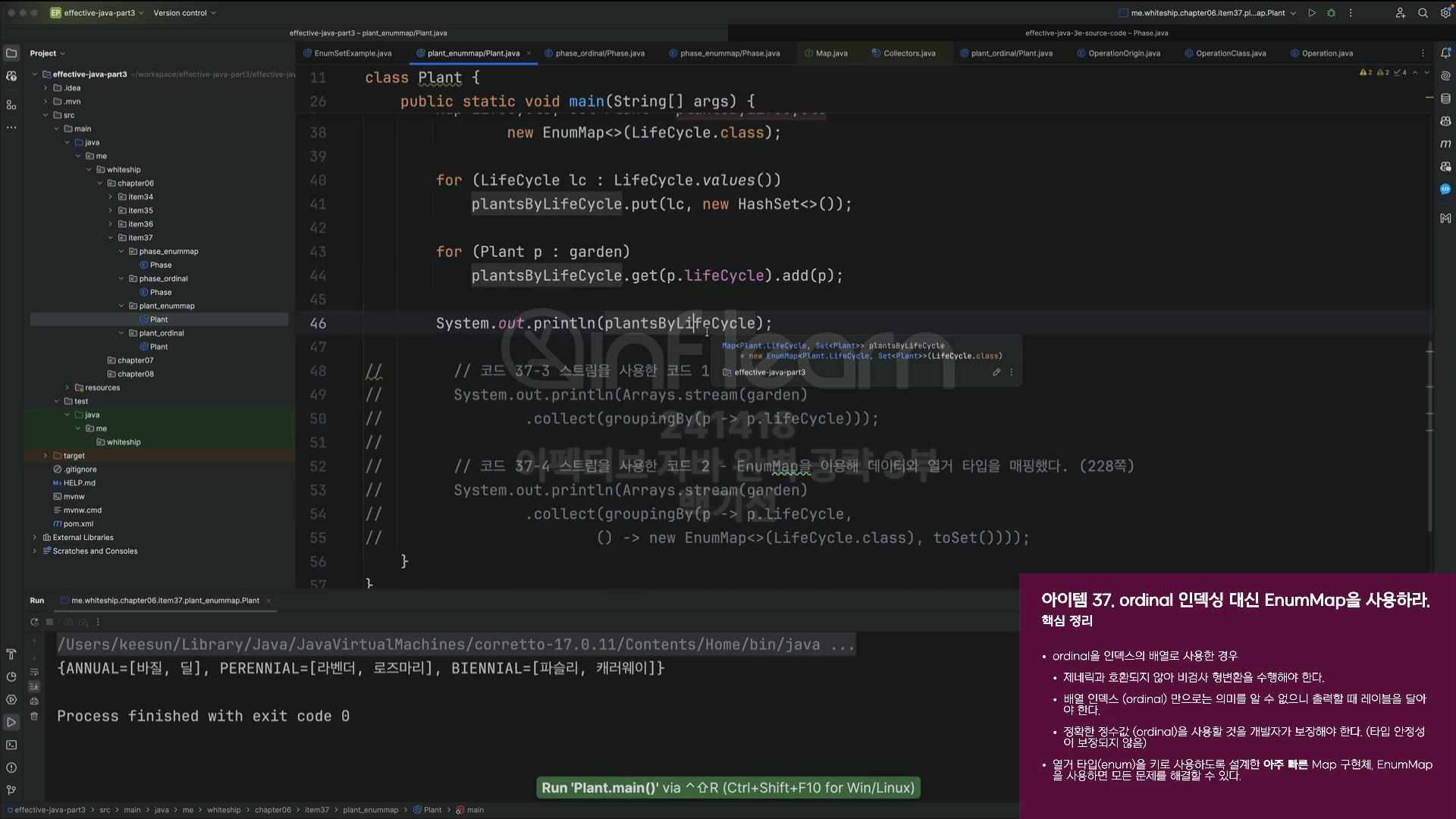
stream을 사용하면 짧게 사용할 수 있다. stream을 사용하면 EnumMap을 사용하지 않는다. HashMap을 사용한다.
그렇게 하지 않으려면 맵을 만들어주고, Set으로 담는다.
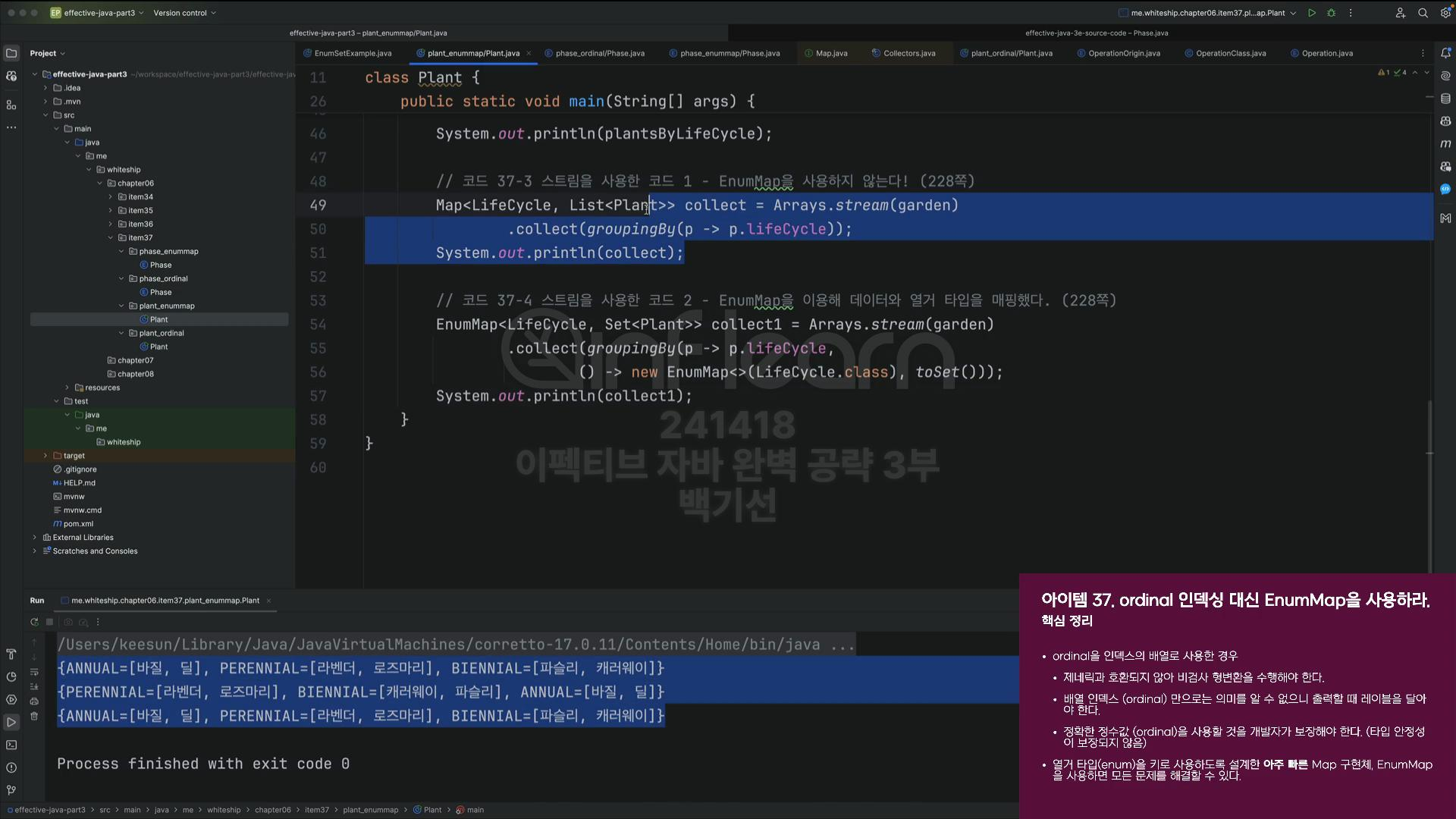
없는 종류는 EnumMap을 만들어주지 않아서 더 효율적이다.
아이템 37. 핵심 정리 2
package me.whiteship.chapter06.item37.phase_ordinal;

import java.util.EnumMap;
import java.util.Map;
import java.util.stream.Stream;

import static java.util.stream.Collectors.groupingBy;
import static java.util.stream.Collectors.toMap;

// 코드 37-6 중첩 EnumMap으로 데이터와 열거 타입 쌍을 연결했다. (229-231쪽)
public enum Phase {
    SOLID, LIQUID, GAS;

    public enum Transition {
        MELT, FREEZE, BOIL, CONDENSE, SUBLIME, DEPOSIT;

        private static final Transition[][] TRANSITIONS = {
                {null, MELT, SUBLIME},
                {FREEZE, null, BOIL},
                {DEPOSIT, CONDENSE, null}
        };

        public static Transition from(Phase from, Phase to) {
            return TRANSITIONS[from.ordinal()][to.ordinal()];
        }

    }

    public static void main(String[] args) {
        for (Phase src : Phase.values()) {
            for (Phase dst : Phase.values()) {
                Transition transition = Transition.from(src, dst);
                if (transition != null)
                    System.out.printf("%s에서 %s로 : %s %n", src, dst, transition);
            }
        }
    }
}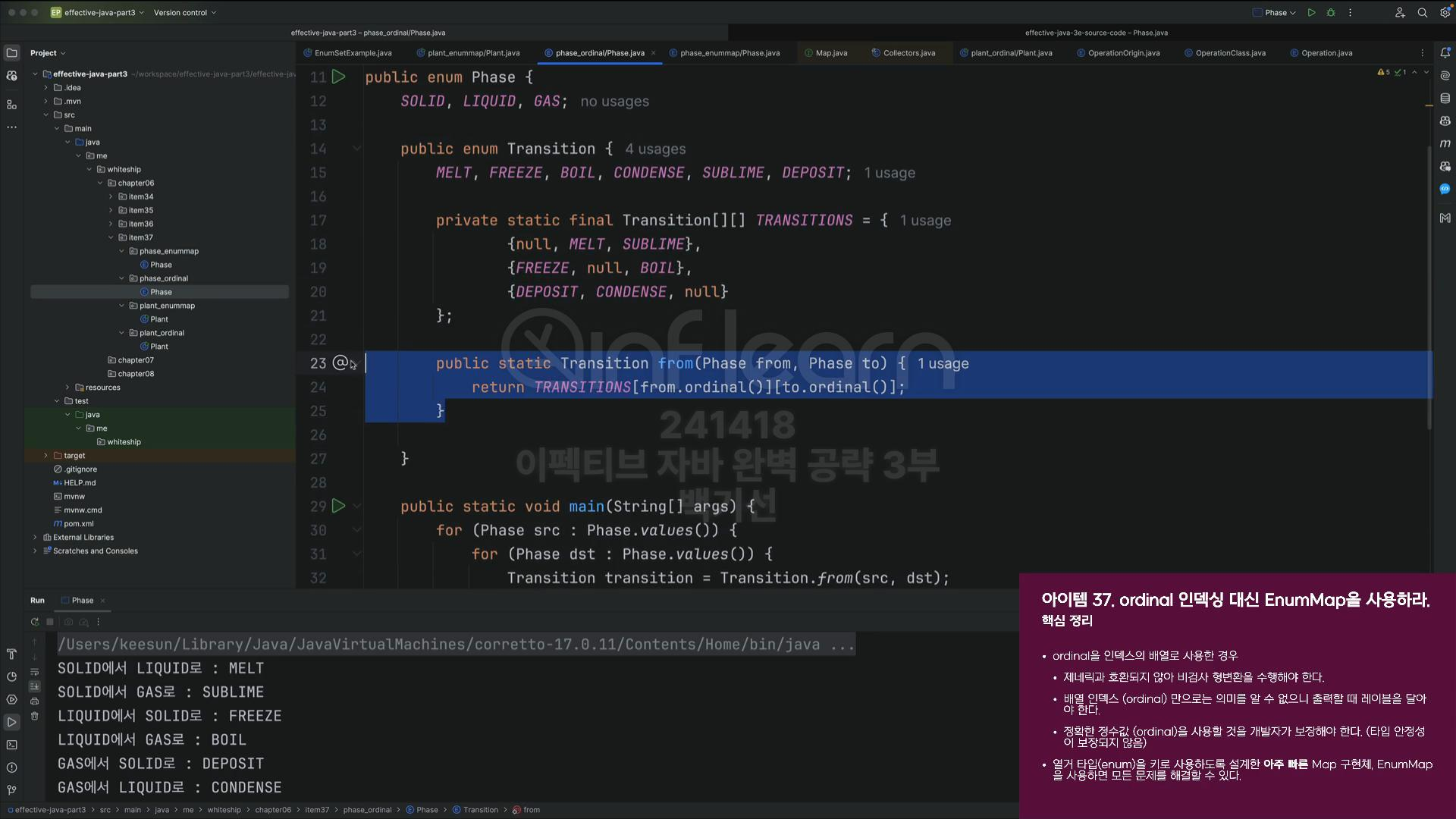
ordinal을 사용해서 문제가 잇는 것이다.
package me.whiteship.chapter06.item37.phase_enummap;

import java.util.EnumMap;
import java.util.Map;
import java.util.stream.Stream;

import static java.util.stream.Collectors.groupingBy;
import static java.util.stream.Collectors.toMap;

// 코드 37-6 중첩 EnumMap으로 데이터와 열거 타입 쌍을 연결했다. (229-231쪽)
public enum Phase {
    SOLID, LIQUID, GAS;

    public enum Transition {
        MELT(SOLID, LIQUID), FREEZE(LIQUID, SOLID),
        BOIL(LIQUID, GAS), CONDENSE(GAS, LIQUID),
        SUBLIME(SOLID, GAS), DEPOSIT(GAS, SOLID);

//        // 코드 37-7 EnumMap 버전에 새로운 상태 추가하기 (231쪽)
//        SOLID, LIQUID, GAS, PLASMA;
//        public enum Transition {
//            MELT(SOLID, LIQUID), FREEZE(LIQUID, SOLID),
//            BOIL(LIQUID, GAS), CONDENSE(GAS, LIQUID),
//            SUBLIME(SOLID, GAS), DEPOSIT(GAS, SOLID),
//            IONIZE(GAS, PLASMA), DEIONIZE(PLASMA, GAS);

        private final Phase from;
        private final Phase to;

        Transition(Phase from, Phase to) {
            this.from = from;
            this.to = to;
        }

//        private static final Map<Phase, Map<Phase, Transition>> m = new EnumMap<>(Phase.class);
//        static {
//            for (Transition t : Transition.values()) {
//                m.computeIfAbsent(t.from, k -> new EnumMap<>(Phase.class)).put(t.to, t);
//            }
//        }

//        static {
//            for (Transition t : Transition.values()) {
//                Map<Phase, Transition> innerMap = m.get(t.from);
//                if (innerMap == null) {
//                    innerMap = new EnumMap<>(Phase.class);
//                    m.put(t.from, innerMap);
//                }
//                innerMap.put(t.to, t);
//            }
//        }

        // @formatter:off
        // 상전이 맵을 초기화한다.
        private static final Map<Phase, Map<Phase, Transition>>
            m = Stream.of(values()).collect(groupingBy(
                t -> t.from,
                () -> new EnumMap<>(Phase.class),
                toMap(t -> t.to, t -> t, (x, y) -> y, () -> new EnumMap<>(Phase.class)))
        );
        // @formatter:on

        public static Transition from(Phase from, Phase to) {
            return m.get(from).get(to);
        }
    }

    // 간단한 데모 프로그램 - 깔끔하지 못한 표를 출력한다.
    public static void main(String[] args) {
        for (Phase src : Phase.values()) {
            for (Phase dst : Phase.values()) {
                Transition transition = Transition.from(src, dst);
                if (transition != null)
                    System.out.printf("%s에서 %s로 : %s %n", src, dst, transition);
            }
        }
    }
}
        private static final Map<Phase, Map<Phase, Transition>>
            m = Stream.of(values()).collect(groupingBy(
                t -> t.from,
                () -> new EnumMap<>(Phase.class),
                toMap(t -> t.to, t -> t, (x, y) -> y, () -> new EnumMap<>(Phase.class)))
        );
from => to 일 때 Transition을 사용한다는 것이다.
        static {
            for (Transition t : Transition.values()) {
                Map<Phase, Transition> innerMap = m.get(t.from);
                if (innerMap == null) {
                    innerMap = new EnumMap<>(Phase.class);
                    m.put(t.from, innerMap);
                }
                innerMap.put(t.to, t);
            }
        }
private static final Map<Phase, Map<Phase, Transition>> m = new EnumMap<>(Phase.class);
static {
for (Transition t : Transition.values()) {
m.computeIfAbsent(t.from, k -> new EnumMap<>(Phase.class)).put(t.to, t);
}
} private static final Map<Phase, Map<Phase, Transition>>
m = Stream.of(values()).collect(groupingBy(
t -> t.from,
() -> new EnumMap<>(Phase.class),
toMap(t -> t.to, t -> t, (x, y) -> y, () -> new EnumMap<>(Phase.class)))
);위 3개는 다 동일한 코드이다. 위에서부터 밑으로 줄일만큼 줄인 코드이다.
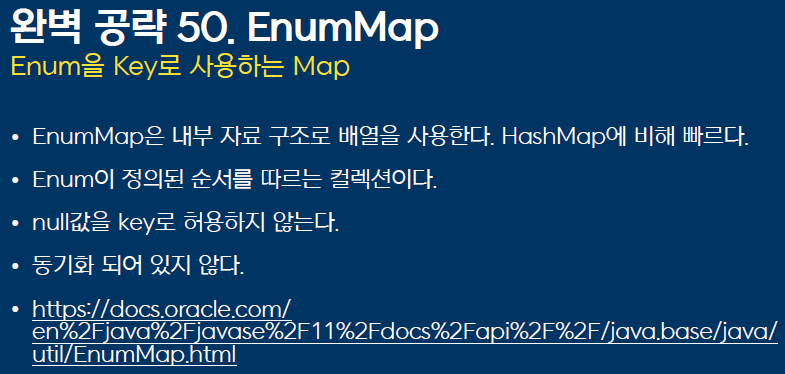
아이템 37 완벽 공략 50. EnumMap
package me.whiteship.chapter06.item37.enummap;

import java.util.Collections;
import java.util.EnumMap;
import java.util.Map;

public class EnumMapExample {

    enum LifeCycle {
        ANNUAL, PERENNIAL, BIENNIAL
    }

    public static void main(String[] args) {
        Map<LifeCycle, String> plantsByLifeCycle = new EnumMap<>(LifeCycle.class);
        plantsByLifeCycle.put(LifeCycle.PERENNIAL, "라벤더");
        plantsByLifeCycle.put(LifeCycle.ANNUAL, "바질");
        plantsByLifeCycle.put(LifeCycle.BIENNIAL, "파슬리");
        System.out.println(plantsByLifeCycle);

        Map<LifeCycle, String> plantsByLifeCycle2 = Collections.synchronizedMap(new EnumMap<>(LifeCycle.class));
        plantsByLifeCycle2.put(LifeCycle.PERENNIAL, "라벤더");
    }
}
타입을 필요로 하기 때문에 해당 타입을 같이 줘야 한다.
동기화가 되어있지 않다.
ordinal로 사용하지 말자.
Collections.synchronizedMap로 감싸면 멀티스레드에 안전하다.
