Simple and Clear Notes on Like Fractions – Class 6
Simple and Clear Notes on Like Fractions – Class 6
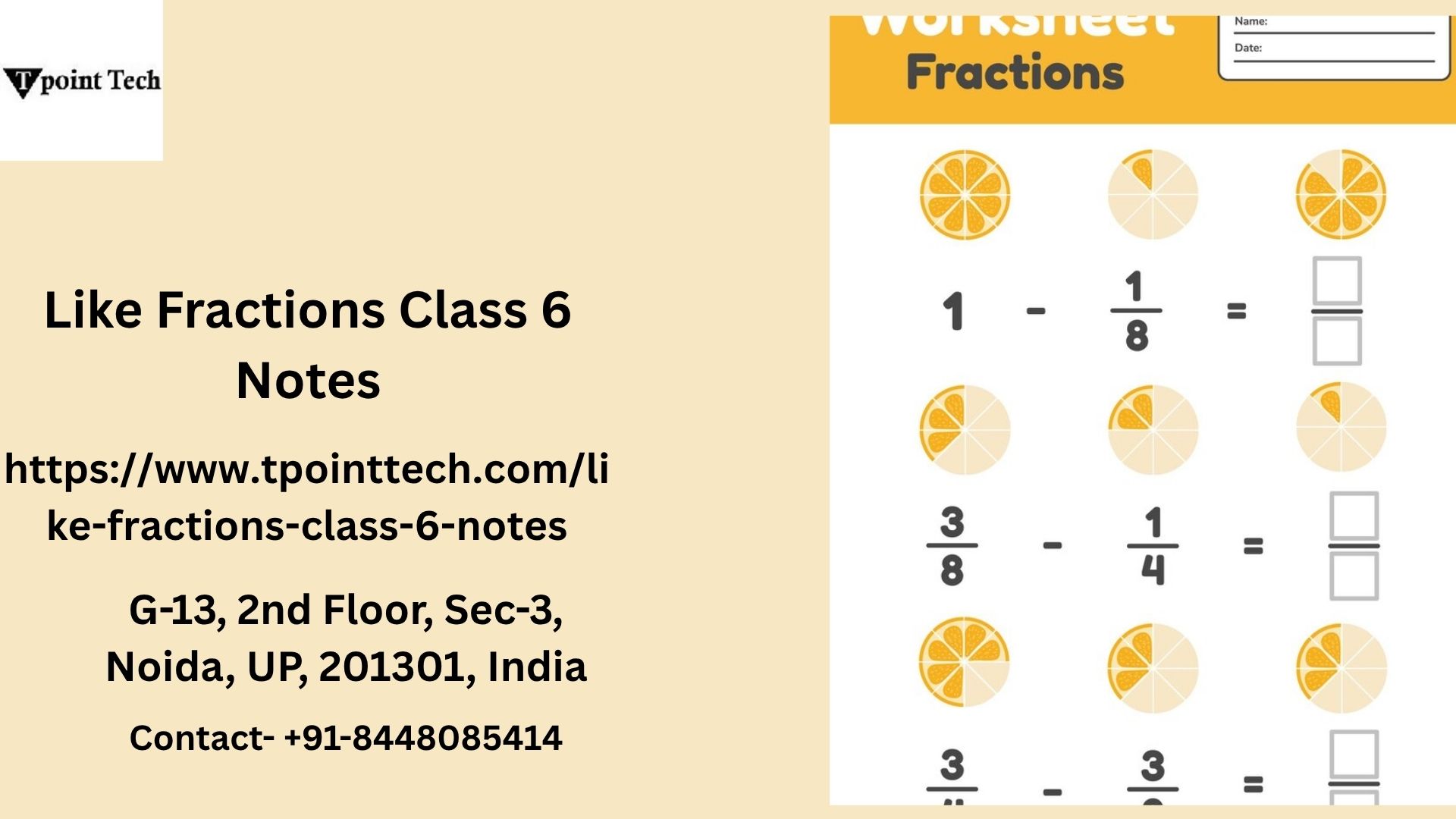
Fractions can feel confusing at first, but with the right explanation, they become simple and fun! One of the easiest types of fractions to understand is like fractions. If you’re a Class 6 student, this blog is here to guide you step by step with clear explanations and real-life examples. Whether you're studying for an exam or trying to build a strong foundation in maths, these Like Fractions Class 6 Notes** are just what you need.
What Are Fractions?
Let’s quickly revise the basics.
A fraction represents a part of a whole. It has two parts:
- Numerator: The top number – shows how many parts we have.
- Denominator: The bottom number – shows how many equal parts the whole is divided into.
For example, in 3/5, the number 3 is the numerator, and 5 is the denominator. This means we have 3 out of 5 equal parts.
What Are Like Fractions?
Like fractions are fractions that have the same denominator.
For example:
- 1/4, 2/4, and 3/4 are like fractions because all have 4 as the denominator.
This means each fraction is divided into the same number of equal parts. Since the “size” of each part is the same, comparing, adding, or subtracting like fractions becomes very easy!
Examples of Like Fractions
Let’s look at a few examples to understand it better:
- 2/7 and 5/7 → Same denominator (7), so they are like fractions.
- 3/10, 6/10, and 9/10 → All have 10 as the denominator.
- 1/3 and 2/5 → These are not like fractions because the denominators (3 and 5) are different.
Why Are Like Fractions Important?
Like fractions are often the first step toward understanding how to perform operations like:
- Addition of fractions
- Subtraction of fractions
- Comparing fractions
Since their denominators are the same, students don’t need to find the least common multiple (LCM). This makes calculations much faster and helps build confidence.
How to Add Like Fractions
When you add like fractions, simply add the numerators and keep the denominator the same.
Example:
2/5 + 1/5 = (2 + 1)/5 = 3/5
It’s as easy as adding apples: If you have 2 pieces out of 5 and get 1 more, you now have 3 out of 5.
How to Subtract Like Fractions
Just like addition, subtracting like fractions involves subtracting the numerators.
Example:
5/8 - 3/8 = (5 - 3)/8 = 2/8 = 1/4 (simplified)
👉 Tip: Always simplify your answer if possible.
Visualizing Like Fractions
One of the best ways to understand like fractions is through pictures.
Imagine a pizza cut into 4 equal slices (denominator = 4). If one person eats 1/4 and another eats 2/4, they’re both eating parts of the same-sized pizza slices.
So:
- 1/4 + 2/4 = 3/4 of the pizza is eaten.
Visual tools like pie charts or fraction bars help you “see” how like fractions work, making learning much easier.
Comparing Like Fractions
Since the denominators are the same, just compare the numerators.
Example:
Which is greater: 3/7 or 5/7?
Answer: 5/7 is greater, because 5 > 3.
👉 This is another reason why like fractions are easy to work with—you don’t have to change anything to compare them.
Common Mistakes to Avoid
Here are a few things to watch out for:
-
Don’t add or subtract the denominators. They stay the same!
- Wrong: 2/6 + 3/6 = 5/12 ❌
- Right: 2/6 + 3/6 = 5/6 ✅
-
Always simplify your answers.
- 4/8 = 1/2 (Divide both numerator and denominator by 4)
-
Check that the denominators are actually the same. Some students mistake unlike fractions for like fractions if they don’t look carefully.
Real-Life Use of Like Fractions
- Sharing Food: If you and a friend each eat 1/4 of the same cake, you’ve eaten 2/4 together.
- Measuring Ingredients: If a recipe uses 1/3 cup of sugar and you accidentally add another 1/3, you’ve used 2/3 cup total.
- Classroom Activities: Dividing pencils, books, or time into equal parts often involves like fractions.
Practice Time!
Try solving these:
- Add: 4/9 + 2/9 = ?
- Subtract: 7/10 - 5/10 = ?
- Compare: Which is bigger – 3/6 or 5/6?
(Answers: 6/9 or 2/3, 2/10 or 1/5, 5/6 is greater)
Final Thoughts
Like fractions are a simple and essential concept in Class 6 maths. Once you understand them, you'll find it much easier to work with other types of fractions too. This blog has given you simple and clear Like Fractions Class 6 Notes that you can use for revision, homework, or exam preparation.
Whether you’re adding, subtracting, or comparing them, like fractions are the easiest to handle. Keep practicing, try visualizing them, and soon you’ll be a pro at fractions!
For more help, worksheets, or interactive lessons, keep exploring other Like Fractions Class 6 Notes online or through your school textbooks. And don’t forget to ask your teacher if you get stuck—that’s what they’re there for!