How Long Are Hockey Games? A Complete Guide for Fans
Hockey matches are not slow and are exciting in many cases, yet the question many new spectators have is: how many minutes are hockey matches? Although clocked time spent playing a game is quite constant, overall time spent watching a game may differ depending on the league, level of play, and game scenarios.
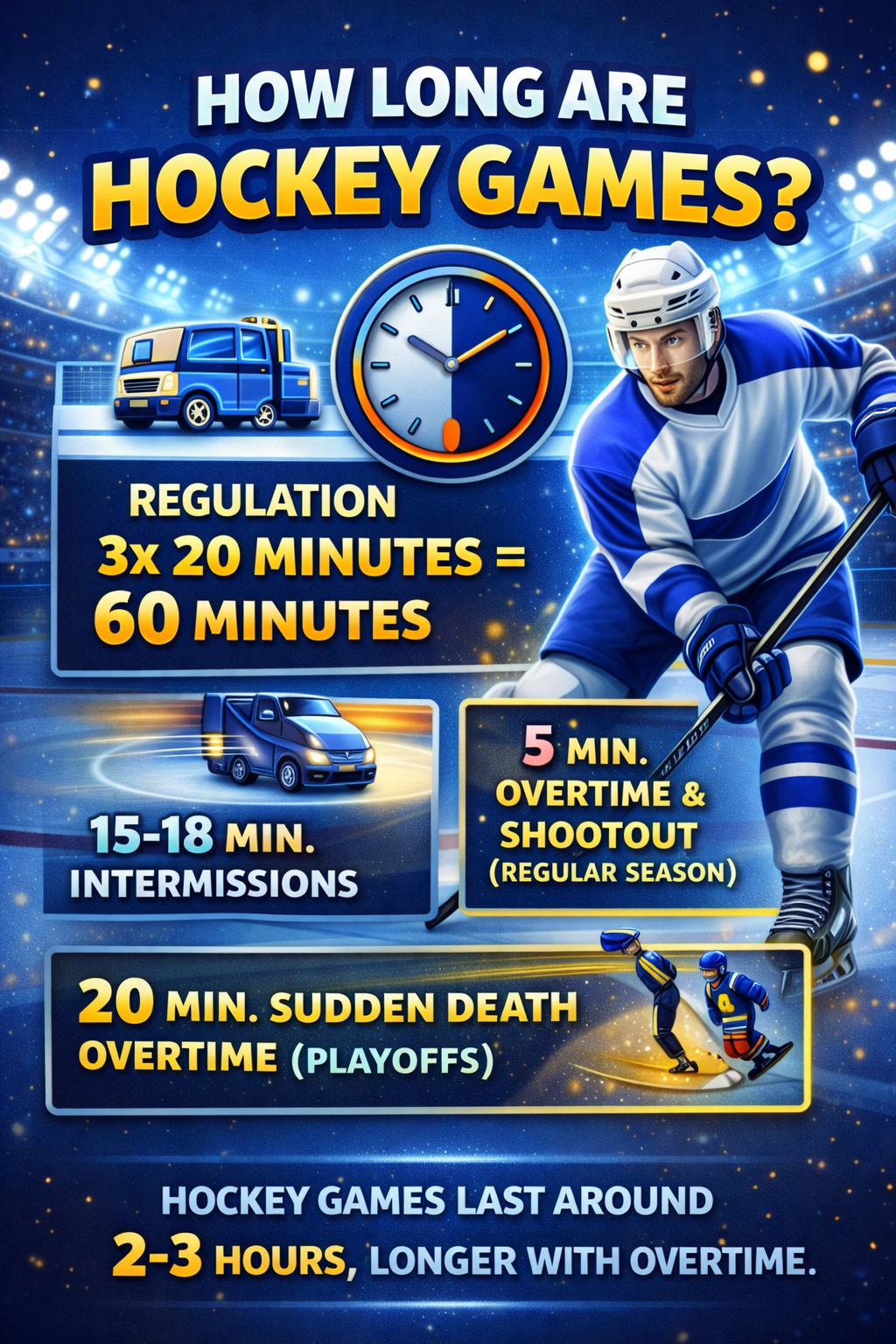
In professional ice hockey, such as the NHL (National Hockey League), a regular game has three periods that are 20 minutes each. This implies that the game will last 60 minutes. The clock is, however, frozen often due to penalties, goals, off-sides, icing calls, and any other stoppage, which makes the length of a hockey game far longer than an hour.
Average NHL games take a duration of 2 to 2.5 hours. This is accompanied by intermissions, which are normally 15 to 18 minutes between two periods. The intermissions allow the players to take a break, the ice to be refurbished, and broadcasters to present analysis and commercials.
In case the game is drawn after the regulation time, there is overtime. During the regular NHL season, overtime is 5 minutes long and is contested with three skaters from each team to score the goal. In case of no goal scored in overtime, the game goes into a shootout, which may increase the overall time of the game by another 10-15 minutes.
There are also rules of overtime that do not apply during the Stanley Cup Playoffs. Playoff games do not have any shootouts. Rather, each team will have an endless 20-minute sudden-death overtime until one of them scores. This may significantly prolong the duration of a game, with the playoff games occupying more than four or five hours.
At the college and amateur tiers, there exist hockey games that bear similarity in form but with a slight variation in time. College hockey also plays in three 20-minute periods, but overtime rules differ depending on the conference. Youth hockey and high school have frequently shorter periods (12-15 minutes) and thus end up being shorter.
Game formats, Olympic and IIHF International hockey games are also structured to be played in three periods, though with varying intermission periods and overtime periods. Such matches normally take between 2 and 2.5 hours, depending on the stoppage and overtime cases.
To conclude, a 60-minute regulation play of a hockey game is typically a two to three-hour commitment.
Penalties, intermissions, shootouts, and overtime are all adding to the final length. The knowledge of the duration of hockey games will enable the fans to organize their time and not miss the game.