Representation Learning: What It Really Means
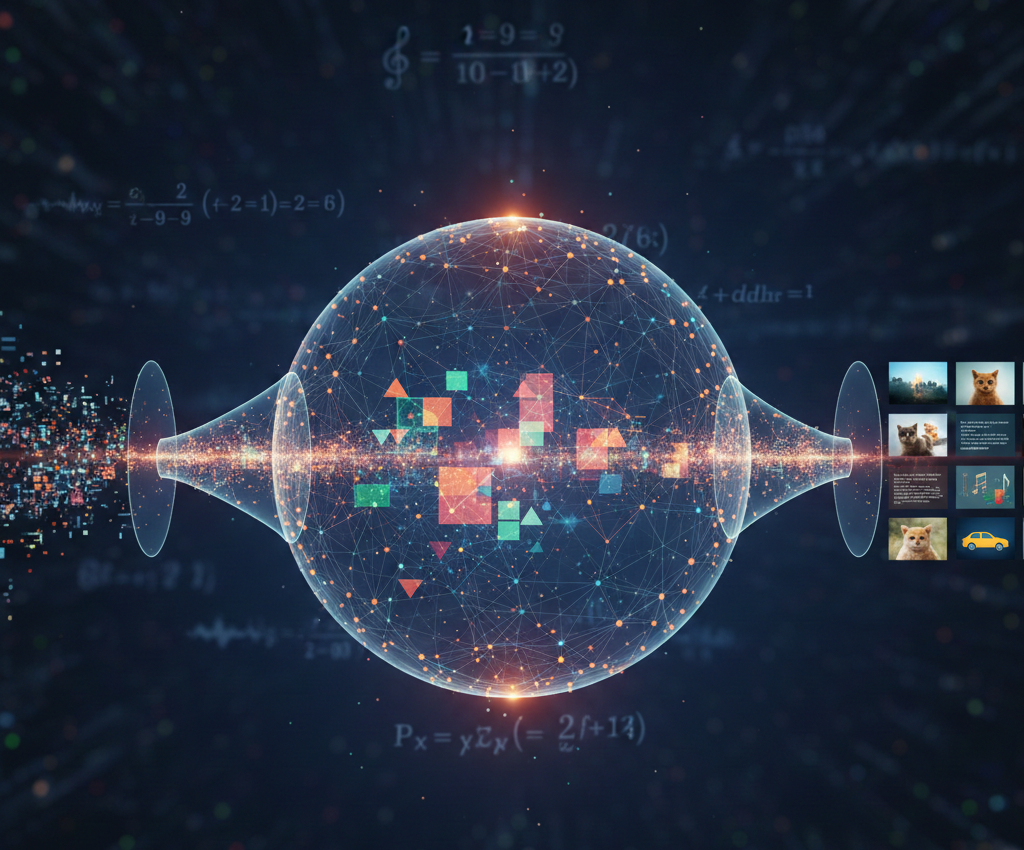
So… what is representation learning?
At a basic level, representation learning is just about letting a model figure out how to describe data in a useful way instead of us telling it exactly what to look for.
Traditionally, people would manually design features like deciding which signals matter, what thresholds to use, or how to summarize data. Representation learning flips that idea: you feed the model raw or lightly processed data, and it learns patterns on its own.
You’ll often hear terms like “embeddings” or “latent space.” Don’t let that sound intimidating, it just means the model builds an internal summary of what it sees.
Why people care about it
Because real-world data is messy.
Systems generate logs, sensors produce noisy readings, users behave unpredictably and it’s hard to write rules that cover everything. When models learn representations, they can capture patterns that humans might not notice.
For example, instead of saying:
If CPU > 80% and memory > 70%, something is wrong
a model can learn:
This combination of signals doesn’t look like normal behavior.
That’s a big difference.
A simple way to think about it
Imagine you’re observing a sys tem every day. Over time, you get a feel for what “normal” looks like even if you can’t explain it precisely.
Representation learning is basically teaching a machine to build that intuition.
How it usually works
Most approaches follow a similar idea:
- Take raw data (metrics, images, text, signals, etc.)
- Transform it into a compact internal representation
- Use that representation for a task like prediction or anomaly detection
The transformation step is where the “learning” happens.
Common tools people use
- Autoencoders - compress data and try to reconstruct it
- PCA - find directions where data varies the most
- Neural networks - learn hierarchical patterns
- Contrastive learning - learn by comparing similar vs different samples
- Transformers - capture relationships over time or context
Each method has its tradeoffs, but they all aim to capture useful structure.
Where you’ll see it in practice
Representation learning shows up everywhere, often quietly:
- Detecting unusual server behavior
- Understanding images or video
- Modeling user activity
- Learning robot perception
- Monitoring industrial systems
- Analyzing sensor data
- Language models understanding text
If a system needs to “make sense” of complex data, representation learning is probably involved.
In anomaly detection (a very practical example)
If you train a model on normal behavior, it learns what typical patterns look like internally. Then when something unusual happens, the representation shifts and the model can flag it.
This works even when anomalies are rare or hard to label, which is why it’s popular in monitoring systems.
Things people don’t always mention
Representation learning isn’t magic.
- It still depends on good data
- Results can be hard to interpret
- Models can learn shortcuts
- Representations may drift as systems change
So it needs monitoring and iteration.
Why it’s becoming more important
As systems get more complex, writing rules doesn’t scale. Learning representations allows models to adapt and generalize instead of relying on brittle heuristics.
You’ll see this idea at the core of foundation models, robotics systems, and modern AI pipelines.
Final thought
Representation learning is less about fancy algorithms and more about letting models build their own understanding of data. When done well, it makes systems more flexible and better at handling real-world variability.
If you’re working with complex signals or trying to detect subtle changes, chances are you’re already leaning on representation learning whether you call it that or not.
