Practice1 (파스칼의 삼각형)
파스칼의 삼각형(Pascal's triangle)은 수학에서 이항계수를 삼각형 모양의 기하학적 형태로 배열한 것이다.
파스칼의 삼각형은 다음과 같이 만들 수 있다.
1. 첫 번째 줄에는 숫자 1을 쓴다.
2. 그 다음 줄은 바로 위의 왼쪽 숫자와 오른쪽 숫자를 더한다.
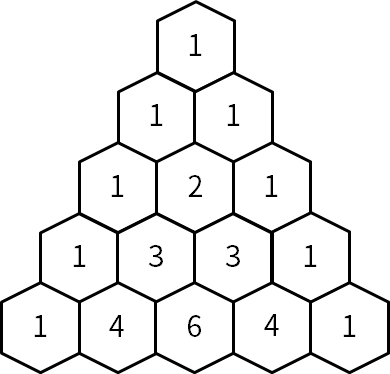
삼각형의 행의 수가 입력으로 주어졌을 때,
파스칼의 삼각형을 출력하시오.
입출력 예시
| 입력 | 출력 |
|---|---|
| 1 | [[1]] |
| 3 | [[1], [1, 1], [1, 2, 1]] |
| 5 | [[1], [1, 1], [1, 2, 1], [1, 3, 3, 1], [1, 4, 6, 4, 1]] |
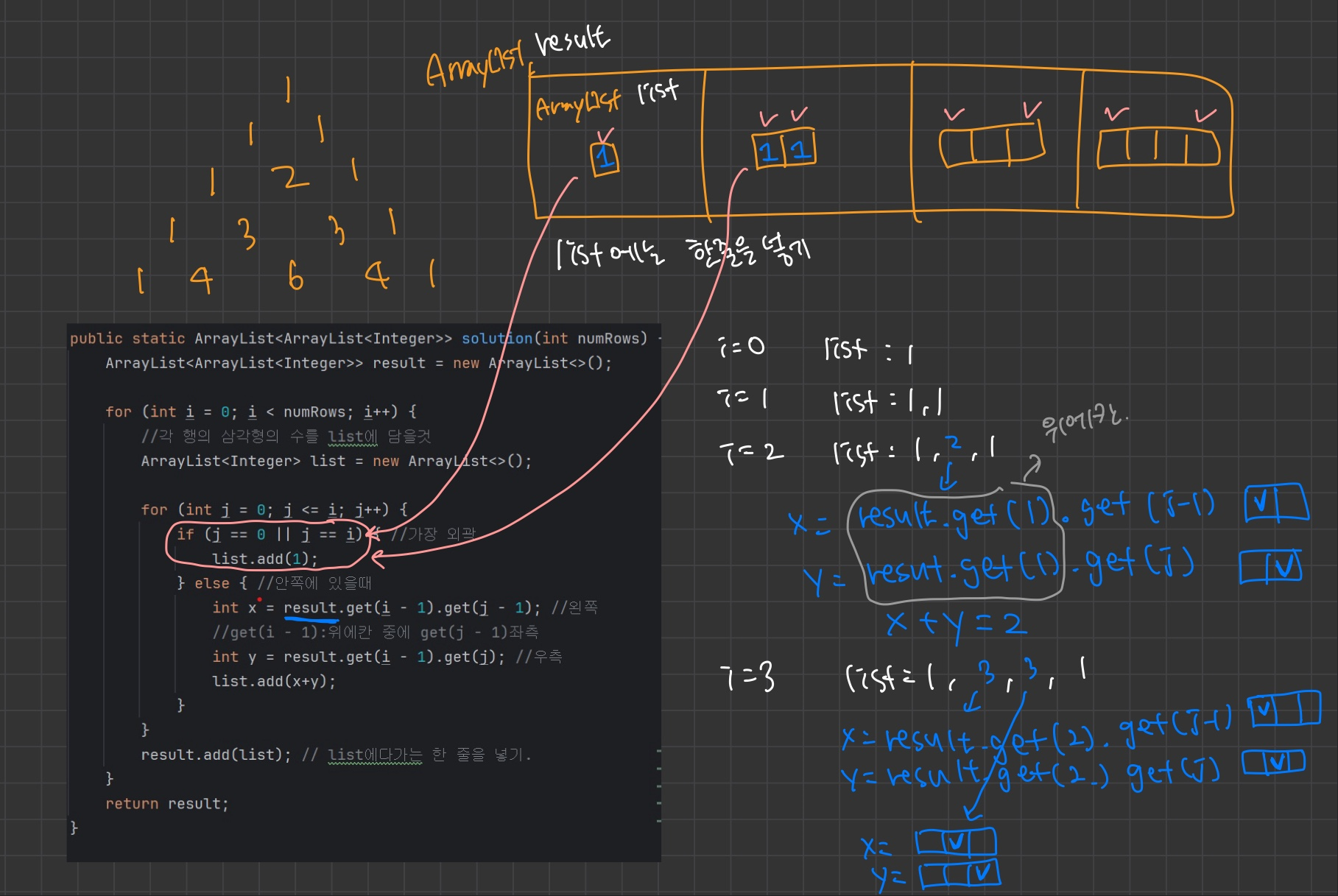
import java.util.ArrayList;

public class Practice1 {
    public static ArrayList<ArrayList<Integer>> solution(int numRows) {
        ArrayList<ArrayList<Integer>> result = new ArrayList<>();

        for (int i = 0; i < numRows; i++) {
            //각 행의 삼각형의 수를 list에 담을것
            ArrayList<Integer> list = new ArrayList<>();

            for (int j = 0; j <= i; j++) {
                if (j == 0 || j == i) { //가장 외곽
                    list.add(1);
                } else { //안쪽에 있을때
                    int x = result.get(i - 1).get(j - 1); //왼쪽
                    //get(i - 1):위에칸 중에 get(j - 1)좌측
                    int y = result.get(i - 1).get(j); //우측
                    list.add(x+y);
                }
            }
            result.add(list); // list에다가는 한 줄을 넣기.
        }
        return result;
    }

    public static void main(String[] args) {
        // Test code
        System.out.println(solution(1));
        System.out.println(solution(2));
        System.out.println(solution(3));
        System.out.println(solution(4));
        System.out.println(solution(5));
    }
}
Practice2
양의 정수로 이루어진 arr 배열이 주어졌을 때
해당 데이터로 만들 수 있는 permutation 중에서 다음과 같은 데이터를 출력하는 프로그램을 작성하세요.
- 현재 데이터보다 이전의 큰 수를 출력
- 한 번의 swap 으로 출력 가능한 큰 수를 출력
입출력 예시
| 입력 | 출력 |
|---|---|
| 3, 2, 1 | 3, 1, 2 |
| 1, 9, 4, 7, 6 | 1, 9, 4, 6, 7 |
| 1, 1, 2, 3 | 1, 1, 2, 3 |
import java.util.ArrayList;
import java.util.Arrays;

public class Practice2 {
    public static void solution(int[] arr) {
        if (arr == null || arr.length < 2) {
            return;
        }

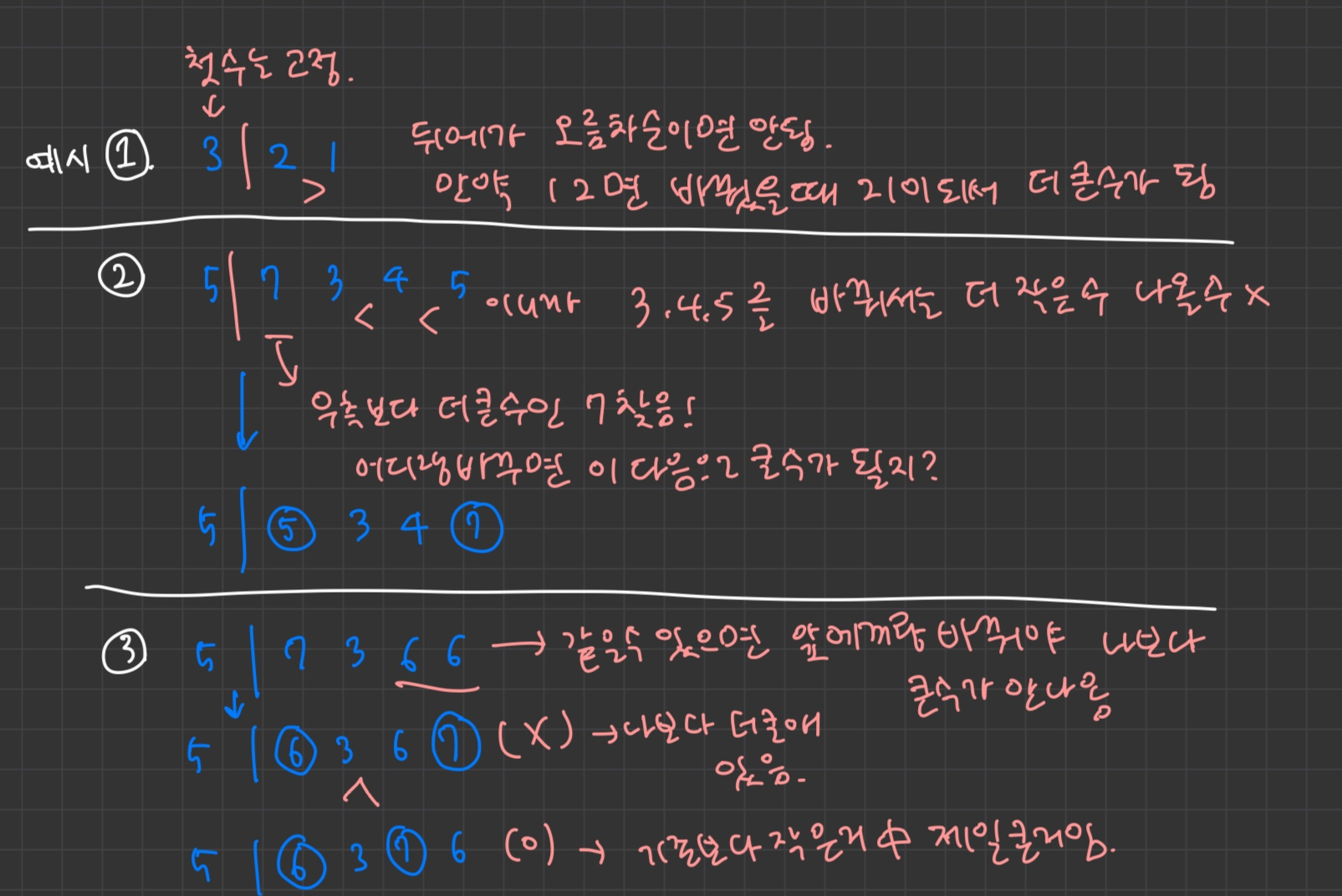
        int idx = -1;
        for (int i = arr.length - 1; i >= 1; i--) {
            if (arr[i] < arr[i - 1]) {
                idx = i - 1;
                break; //바꿔줄 대상 고름
            }
        }

        if (idx == -1) { //이미 정렬된 상태인것임.
            System.out.println(Arrays.toString(arr));
            return;
        }

        for (int i = arr.length - 1; i > idx; i--) {
            if (arr[i] < arr[idx] && arr[i] != arr[i - 1]) { //같으면 왼쪽꺼랑 바꿔야되니까
                int tmp = arr[i];
                arr[i] = arr[idx];
                arr[idx] = tmp;
                break;
            }
        }
        System.out.println(Arrays.toString(arr));
    }

    public static void main(String[] args) {
        // Test code
        int[] arr = {3, 2, 1};
        solution(arr);

        arr = new int[]{1, 9, 4, 7, 6};
        solution(arr);

        arr = new int[]{1, 1, 2, 3};
        solution(arr);

        arr = new int[]{5, 7, 3, 4, 5}; // [5, 5, 3, 4, 7]
        solution(arr);

        arr = new int[]{5, 7, 3, 6, 6}; // [5, 6, 3, 7, 6]
        solution(arr);

    }
}
Practice3
문자열 s1 과 s2 가 주어졌을 때,
s1 을 permutation 한 문자열이 s2 의 부분 문자열에 해당하면 true 를 반환하고
그렇지 않으면 false 를 반환하는 프로그램을 작성하세요.
입출력 예시
| s1 | s2 | 출력 |
|---|---|---|
| "ab" | "adbak" | true |
| "ac" | "car" | true |
| "ak" | "aabbkk" | false |
import java.util.ArrayList;

public class Practice3 {
    // # 1 기본 permutation 방법
    public static boolean solution(String s1, String s2) {
        boolean[] visited = new boolean[s1.length()];
        char[] out = new char[s1.length()];
        ArrayList<String> list = new ArrayList<>();
        permutation(s1.toCharArray(), 0, s1.length(), s1.length(), visited, out, list);
        //permutation된 결과가 list에 들어옴

        for (String s : list) {
            if (s2.contains(s)) {
                return true;
            }
        }

        return false;
    }

    public static void permutation(char[] arr, int depth, int n, int r, boolean[] visited, char[] out, ArrayList<String> list) {
        if (depth == r) {
            list.add(new String(out));
        }

        for (int i = 0; i < n; i++) {
            if (visited[i] != true) {
                visited[i] = true;
                out[depth] = arr[i];
                permutation(arr, depth + 1, n, r, visited, out, list);
                visited[i] = false;
            }
        }
    }


    // # 2 문제 규칙 찾아 해결 (permutation없이 푸는 법)
    public static boolean solution2(String s1, String s2) {
        final int ALPHABET = 26;

        if (s1.length() > s2.length()) {
            return false;
        }

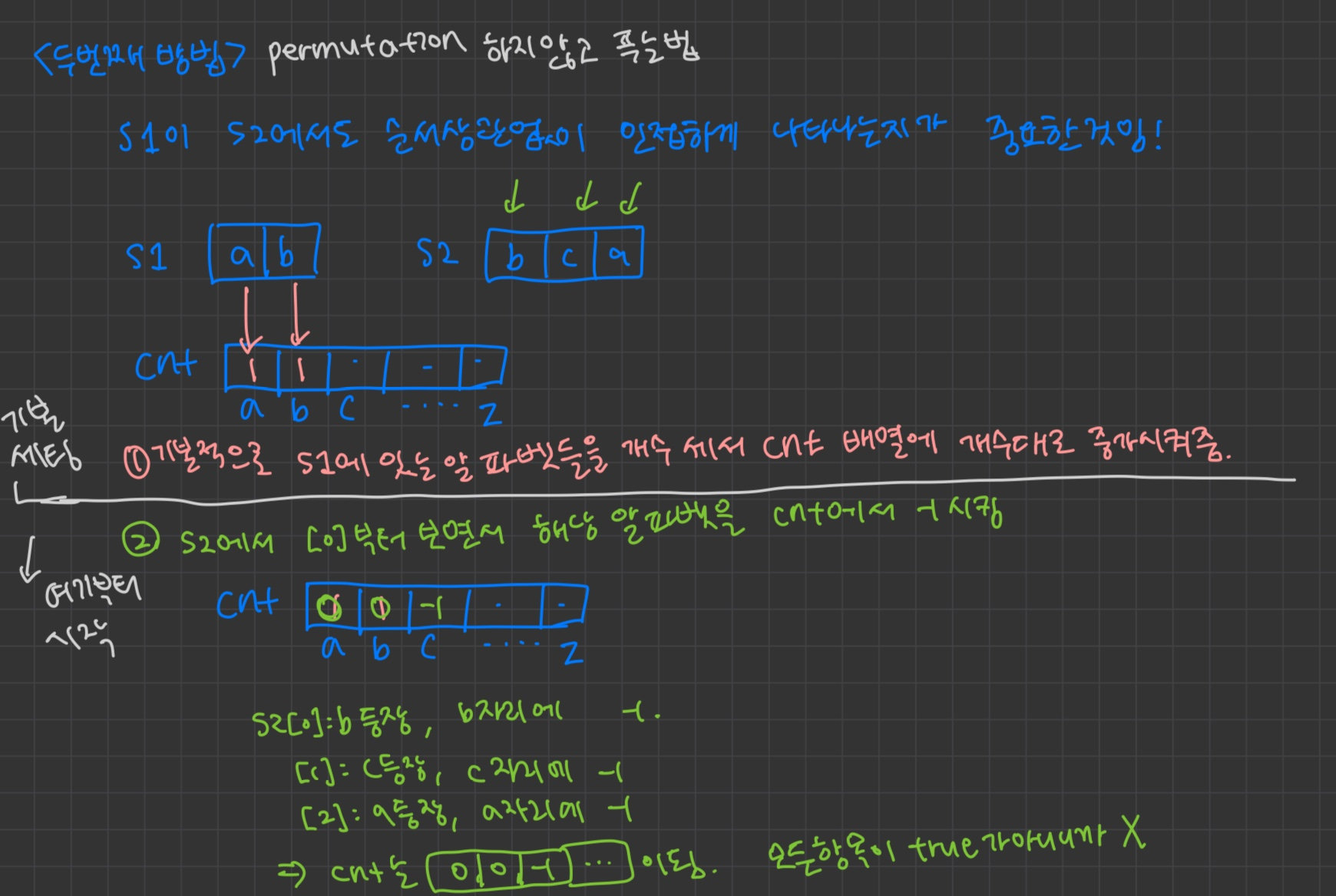
        int[] cnt = new int[ALPHABET];
        for (int i = 0; i < s1.length(); i++) {
            cnt[s1.charAt(i) - 'a']++;
        }

        for (int i = 0; i < s2.length(); i++) {
            cnt[s2.charAt(i) - 'a']--;

            if (i - s1.length() >= 0) {
                cnt[s2.charAt(i - s1.length()) - 'a']++; //다시 복원
            }

            boolean isZero = true;
            for (int j = 0; j < cnt.length; j++) {
                if (cnt[j] != 0) {
                    isZero = false;
                    break;
                }
            }

            if (isZero) {
                return true;
            }
        }

        return false;
    }

    public static void main(String[] args) {
        // Test code
        String s1 = "ab";
        String s2 = "adbak";
        System.out.println(solution(s1, s2));
        System.out.println(solution2(s1, s2));
        System.out.println();

        s1 = "ac";
        s2 = "car";
        System.out.println(solution(s1, s2));
        System.out.println(solution2(s1, s2));
        System.out.println();

        s1 = "ak";
        s2 = "aabbkk";
        System.out.println(solution(s1, s2));
        System.out.println(solution2(s1, s2));
    }
}
두번째 방법에 대한 설명
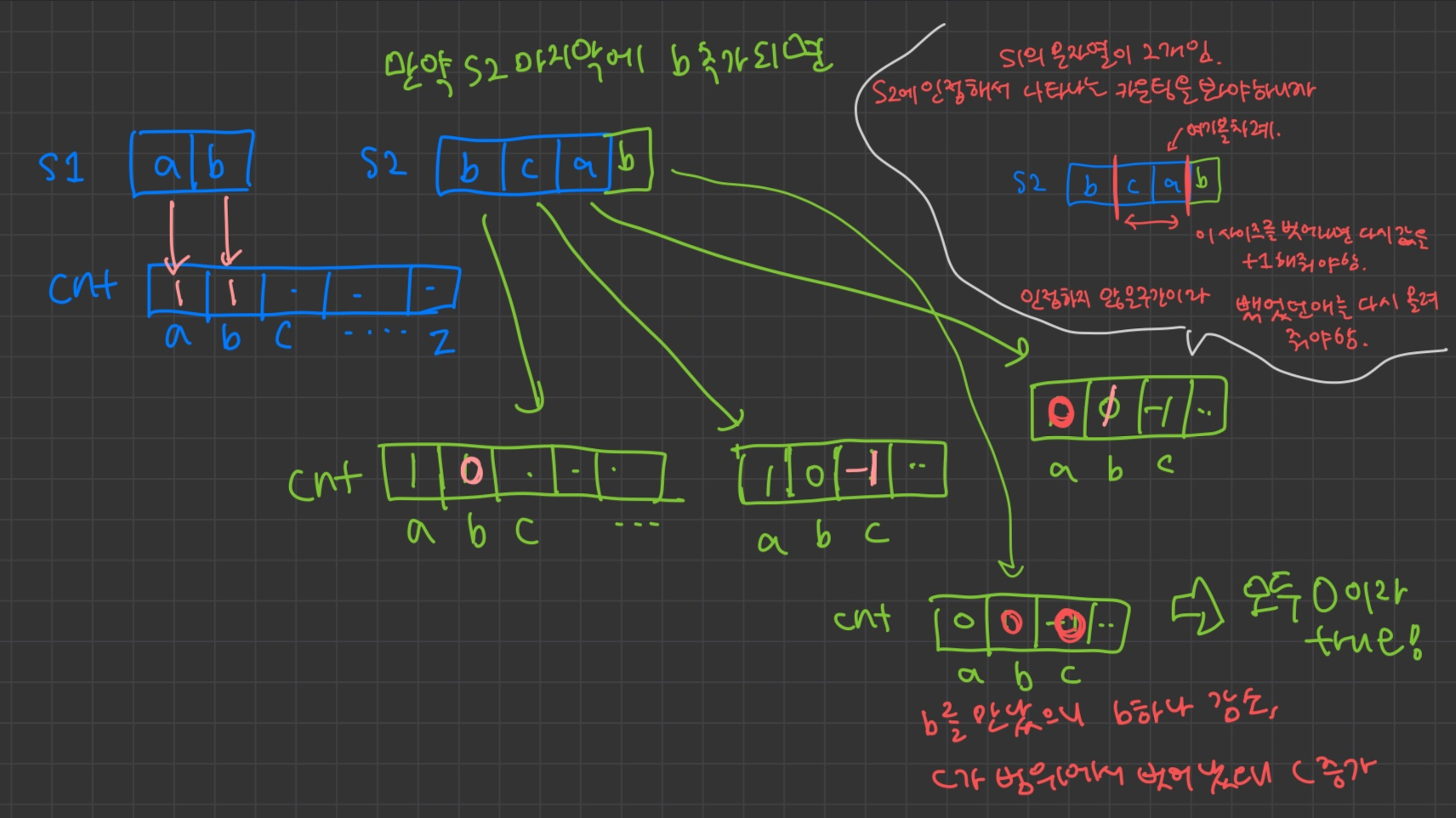
Practice4
주어진 양의 정수가 행복한 수 인지를 판별하는 프로그램을 작성하세요.
행복한 수란,
각 자리수를 제곱한 것을 더하는 과정을 반복했을 때 1로 끝나는 수 이다.
행복한 수가 아니라면 1에 도달하지 못하고 같은 수열이 반복하게 된다.
'행복한 수'를 찾는 과정 예시
19 가 행복한 수인지 확인하는 과정
1^2 + 9^2 = 82
8^2 + 2^2 = 68
6^2 + 8^2 = 100
1^2 + 0^2 + 0^2 = 1
입출력 예시
| 입력 | 출력 |
|---|---|
| 19 | true |
| 2 | false |
| 61 | false |
import java.util.HashSet;

public class Practice4 {
    public static boolean solution(int n) {
        HashSet<Integer> set = new HashSet<>();
        while (true) {
            int result = 0;

            while (n > 0) {
                int remain = n % 10;
                result += (int)Math.pow(remain,2);
                n /= 10;
            }

            if (result == 1) {
                return true;
            } else {
                n = result;
                if(!set.add(result)){
                    return false;
                }
            }
        }
    }

    public static void main(String[] args) {
        // Test code
        System.out.println(solution(19));
        System.out.println(solution(2));
        System.out.println(solution(61));
    }
}
Practice5
영토에 대한 지도 정보가 row x col grid 맵 형태로 다음과 같이 주어졌다.
이 때, grid[i][j] 가 1이 면 땅 영역을 의미하고
grid[i][j] 가 0 이면 물 영역을 의미한다.
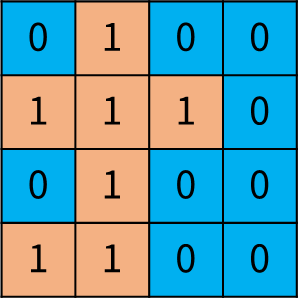
이와 같이 영토에 대한 지도 정보가 주어졌을 때 땅의 둘레를 구하는 프로그램을 작성하세요.
- grid 한 cell 의 변의 길이는 1 이다.
- 지도에는 하나의 독립된 영토만 있다. (분리된 땅 없음)
- 땅 내부에 물이 존재하지 않는다.
입출력 예시
| 입력 | 출력 |
|---|---|
| {{1}} | 4 |
| {{0, 1, 0, 0}, {1, 1, 1, 0}, {0, 1, 0, 0}, {1, 1, 0, 0}} | 16 |
public class Practice5 {
    // 반복문 풀이
    public static int solution(int[][] grid) {
        int sum = 0;

        for (int i = 0; i < grid.length; i++) {
            for (int j = 0; j < grid[0].length; j++) {
                if (grid[i][j] == 1) {
                    if (i == 0 || grid[i - 1][j] == 0) { // 위
                        sum++;
                    }
                    if (i == grid.length - 1 || grid[i + 1][j] == 0) { // 아래
                        sum++;
                    }
                    if (j == 0 || grid[i][j - 1] == 0) { // 왼
                        sum++;
                    }
                    if (j == grid.length - 1 || grid[i][j + 1] == 0) { //오
                        sum++;
                    }
                }
            }
        }
        return sum;
    }

    // 재귀 풀이
    public static int solution2(int[][] grid) {
        int[][] directions = {{0, 1}, {1, 0}, {-1, 0}, {0, -1}};

        for (int i = 0; i < grid.length; i++) {
            for (int j = 0; j < grid[0].length; j++) {
                if (grid[i][j] == 1) {
                    return recursion(grid, directions, i, j);
                }
            }
        }
        return 0;
    }

    public static int recursion(int[][] grid, int[][] directions, int i, int j) {
        int row = grid.length;
        int col = grid[0].length;

        grid[i][j] = -1; //지나온데는 다시가면 안되니까 -1로 체크
        int cnt = 0;
        for (int[] d : directions) {
            int x = i + d[0];
            int y = j + d[1];
            if (x < 0 || y < 0 || x >= row || y >= col || grid[x][y] == 0) {
                cnt++;
            } else {
                if (grid[x][y] == 1) {
                    cnt += recursion(grid, directions, x, y);
                }
            }
        }

        return cnt;
    }

    public static void main(String[] args) {
        // Test code
        int[][] grid = {{1}};
        System.out.println(solution(grid));
        System.out.println(solution2(grid));
        System.out.println();

        grid = new int[][]{{0, 1, 0, 0}, {1, 1, 1, 0}, {0, 1, 0, 0}, {1, 1, 0, 0}};
        System.out.println(solution(grid));
        System.out.println(solution2(grid));
    }
}
Practice1
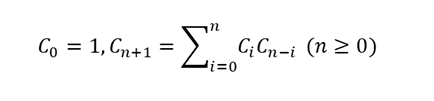
카탈랑 수는 0번, 1번, 2번, ... 순으로 아래와 같이 구성되는 수열을 의미한다.
- 1, 1, 2, 5, 14, 42, 132, 429, 1430, 4862, …
이를 점화식으로 나타내면 아래와 같다.
카탈랑 수의 n 번째 값을 구하는 프로그램을 작성하세요.
입력 예시
| 입력 | 출력 |
|---|---|
| 0 | 1 |
| 2 | 2 |
| 5 | 42 |
| 7 | 429 |
public class Practice1 {

    public static int solution(int n) {
        int result = 0;

        if (n <= 1) {
            return 1;
        }

        for (int i = 0; i < n; i++) {
            result += solution(i) * solution(n - i - 1);
        }
        return result;
    }


    public static void main(String[] args) {
        // Test code
        System.out.println(solution(0));
        System.out.println(solution(2));
        System.out.println(solution(5));
        System.out.println(solution(7));
    }
}
Practice2
회문 또는 팰린드롬(palindrome)은 앞 뒤 방향으로 같은 순서의 문자로 구성된 문자열을 말한다.
- 예시) ‘abba’ ‘kayak’, ‘madam’
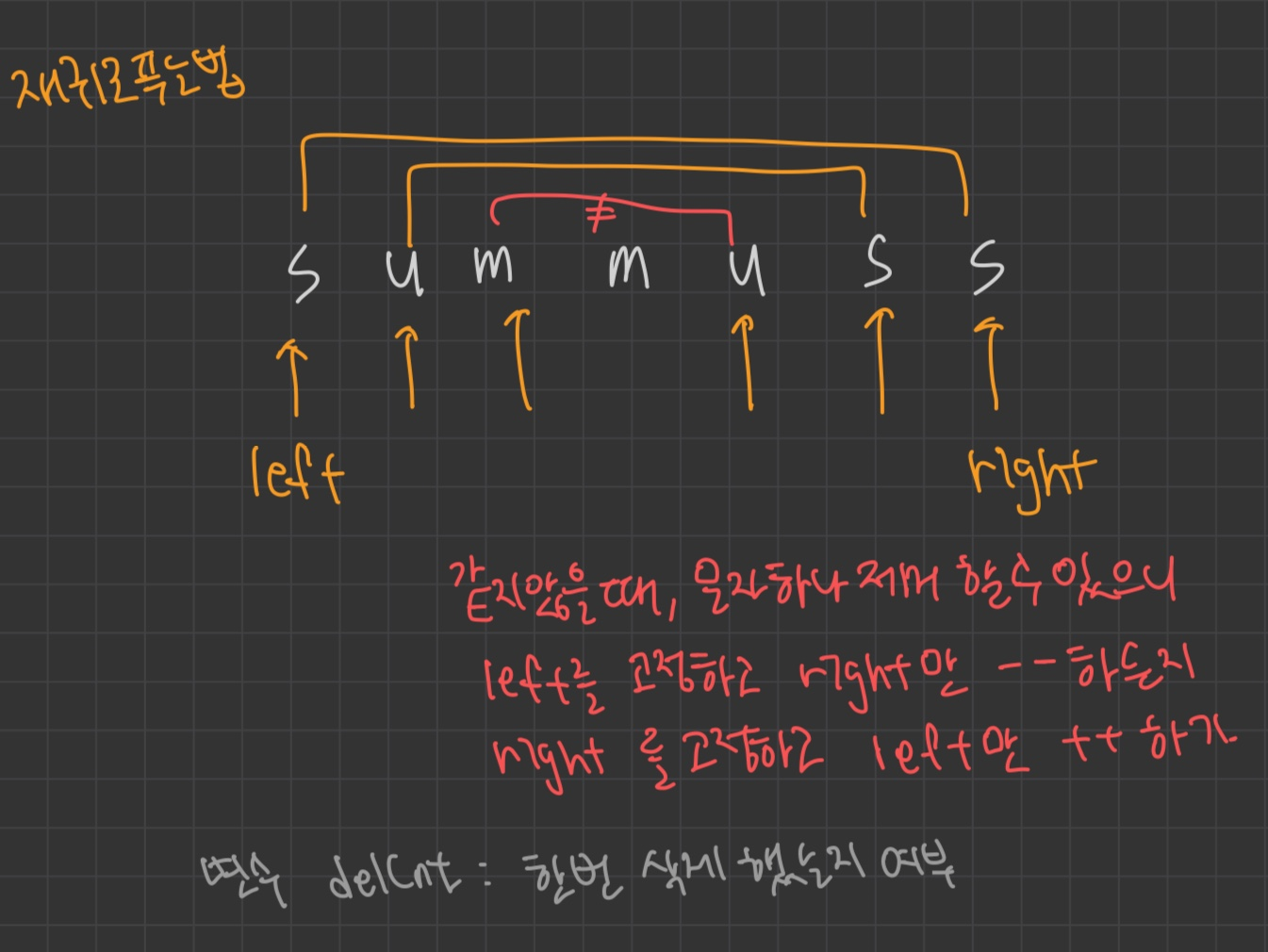
유사회문은 문자열 그 자체는 회문이 아니지만 한 문자를 삭제하면 회문이 되는 문자열을 말한다.
- 예시) ‘summuus’의 5번째 또는 6번째 문자 ‘u’를 제거하면 ‘summus’인 회문을 만들 수 있다.
주어진 문자열을 확인한 후 문자열 종류에 따라 다음과 같이 출력하는 프로그램을 작성하세요.
- 회문: 0
- 유사회문: 1
- 기타: 2
입력 예시
| 입력 | 출력 |
|---|---|
| abba | 0 |
| summuus | 1 |
| xabba | 1 |
| xabbay | 2 |
| comcom | 2 |
| comwwmoc | 0 |
| comwwtmoc | 1 |
public class Practice2 {
    public static int solution(String str) {
        return isPalindrome(0, str.length() - 1, str.toCharArray(), 0);
    }

    public static int isPalindrome(int left, int right, char[] arr, int delCnt) {
        while (left < right) {
            if (arr[left] != arr[right]) {

                if (delCnt == 0) {
                    if (isPalindrome(left + 1, right, arr, 1) == 0 ||
                            isPalindrome(left, right - 1, arr, 1) == 0) { // 이 둘중 하나가 회문이면
                        return 1; // 유사회문이다.
                    } else {
                        return 2;
                    }
                } else {
                    return 2;
                }
            } else {
                left++;
                right--;
            }
        }
        return 0;
    }

    public static void main(String[] args) {
        // Test code
        String[] str = {"abba", "summuus", "xabba", "xabbay", "comcom", "comwwmoc", "comwwtmoc"};
        System.out.println(solution("abba"));
        System.out.println(solution("summuus"));
        System.out.println(solution("xabba"));
        System.out.println(solution("xabbay"));
        System.out.println(solution("comcom"));
        System.out.println(solution("comwwmoc"));
        System.out.println(solution("comwwtmoc"));
    }
}
Practice3 (+정규표현식 사용)
주어진 1차 방정식에 대해 풀이를 하는 프로그램을 작성하세요.
- 해당 방정식은 '+', '-', 'x' 와 '상수'로만 이루어져 있다.
- 해가 없으면 "No solution" 을 출력,
해가 무한대인 경우 "Infinite solutions" 를 출력,
해가 있는 경우 x의 값을 "x=" 형태로 출력 하세요.
입력 예시
| 입력 | 출력 |
|---|---|
| "x+5-3+x=6+x-2" | "x=2" |
| "x=x" | "Infinite solutions" |
| "2x=x" | "x=0" |
public class Practice3 {
    public static String solution(String equation) {
        String[] parts = equation.split("=");
        int[] leftSide = evaluate2(parts[0]);
        int[] rightSide = evaluate2(parts[1]);

        if (leftSide[0] == rightSide[0] && leftSide[1] == rightSide[1]) {
            return "Infinite solution";
        } else if (leftSide[0] == rightSide[0]) {
            return "No solution";
        } else {
            return "x=" + (rightSide[1] - leftSide[1]) / (leftSide[0] - rightSide[0]);
        }
    }

    public static int[] evaluate(String str) {
        int[] result = new int[2]; // 0: x의 계수, 1: 상수항들

        boolean isMinus = false;
        int idx = 0;
        while (idx != str.length()) {
            char c = str.charAt(idx++);

            if (c == '+') {
                continue;
            }

            if (c == '-') {
                isMinus = true;
                continue;
            }

            if (c == 'x') {
                result[0] += isMinus ? -1:1;
            } else { // 상수
                if (idx < str.length() && str.charAt(idx) == 'x') { // 다음항 체크
                    result[0] += isMinus ? -(c - '0'):(c - '0');
                } else {
                    result[1] += isMinus ? -(c - '0'):(c - '0');
                }
            }
            isMinus = false;
        }

        return result;
    }

    // # 2 정규표현식 사용
    public static int[] evaluate2(String str) {
        int[] result = new int[2];

        for (String s : str.split("(?=[+-])")) { //+,-는 포함해서 스플릿해줘
            if (s.equals("+x") || s.equals("x")) { //여기서 s는 char가 아니라 String이니까 eqauls로 비교해야됨
                // +나 -가 딸려서 파싱되기땜에 비교할때 저렇게 비교하기
                result[0]++;
            } else if (s.equals("-x")) {
                result[0]--;
            } else if (s.contains("x")) { //위에서 안걸린경우(앞에 상수항이 있는경우)
                result[0] += Integer.parseInt(s.substring(0,s.length()-1));
            } else {
                result[1] += Integer.parseInt(s); // +,-도 같이 떨어지니까 자연스럽게 연산됨
            }
        }

        return result;
    }

    public static void main(String[] args) {
        // Test code
        String equation = "x+5-3+x=6+x-2";
        System.out.println(solution(equation));

        equation = "x=x";
        System.out.println(solution(equation));

        equation = "2x=x";
        System.out.println(solution(equation));
    }
}
Practice4
아래와 같이 구성되는 좋은 수라고 한다.
- 짝수 인덱스 위치에는 짝수
- 홀수 인덱스 위치에는 소수 (2, 3, 5, 7)
- 인덱스는 0 부터 시작
예를 들면,
2582 는 좋은 수다.
- 짝수 인덱스 위치에는 짝수인 2와 8로, 홀수 위치에는 소수인 5와 2로 구성된다.

반면,
3245 는 좋은 수가 아니다.
- 짝수 인덱스 위치에 홀수인 3이 위치하고 있다.
1 이상의 정수 n이 주어졌을 때, n 자리로 구성될 수 있는 좋은 수의 개수를 출력하는 프로그램을 작성하세요.
단, n 의 값에 따라 값이 클 수 있으니 결과는 10^9 + 7로 나머지 연산을 한 결과로 출력하시오.
입력 예시
| 입력 | 출력 |
|---|---|
| 1 | 5 |
| 2 | 20 |
| 3 | 100 |
| 4 | 400 |
| 50 | 564908303 |
public class Practice4 {
    final static int mod = (int) 1e9 + 7;

    public static int solution(long n) {
        return (int) recursion(1, n);
    }

    public static long recursion(long x, long y) {
        if (y == 0) {
            return x;
        }

        if (y % 2 == 1) { //홀수
            return recursion((x * 4) % mod, y - 1);
        } else {
            return recursion((x * 5) % mod, y - 1);
        }
    }

    public static void main(String[] args) {
        // Test code
        System.out.println(solution(1));
        System.out.println(solution(2));
        System.out.println(solution(3));
        System.out.println(solution(4));
        System.out.println(solution(50));
    }
}
Practice5

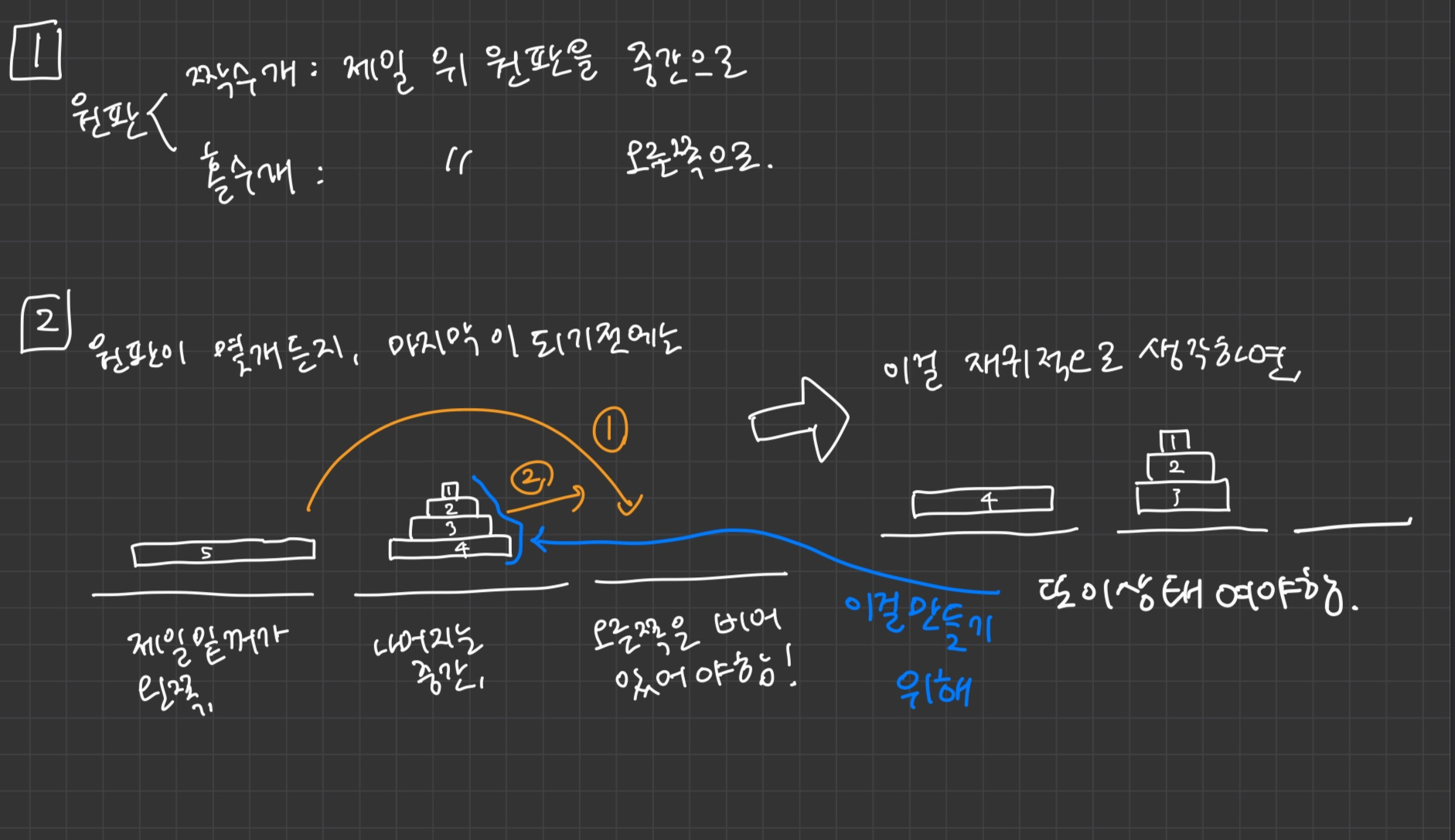
하노이의 탑은 퍼즐의 일종이다.
하노이의 탑 퍼즐 게임 규칙은 다음과 같다.
- 한 번에 한 개의 원판 만 옮길 수 있다.
- 큰 원판이 작은 원판 위에 있어서는 안된다.
원판의 개수 n 이 주어졌을 때
가장 왼쪽 기둥으로부터 끝 기둥으로 이동하는 과정에 대해 출력하는 프로그램을 구현하세요.
입력 예시
| 입력 | 출력 |
|---|---|
| 2 | 1 2 1 3 2 3 |
| 3 | 1 3 1 2 3 2 1 3 2 1 2 3 1 3 |
public class Practice5 {
    static StringBuffer sb;

    public static void solution(int n) {
        sb = new StringBuffer();

        hanoi(n, 1, 2, 3);
        System.out.println(sb);
    }

    public static void hanoi(int n, int start, int mid, int to) {
        if (n == 1) {
            sb.append(start + " " + to + "\n");
            return;
        }

        hanoi(n - 1, start, to, mid);

        sb.append(start + " " + to + "\n");

        hanoi(n - 1, mid, start, to);
    }

    public static void main(String[] args) {
        // Test code
        solution(2);
        System.out.println();

        solution(3);
        System.out.println();
 -
        solution(4);
    }
}