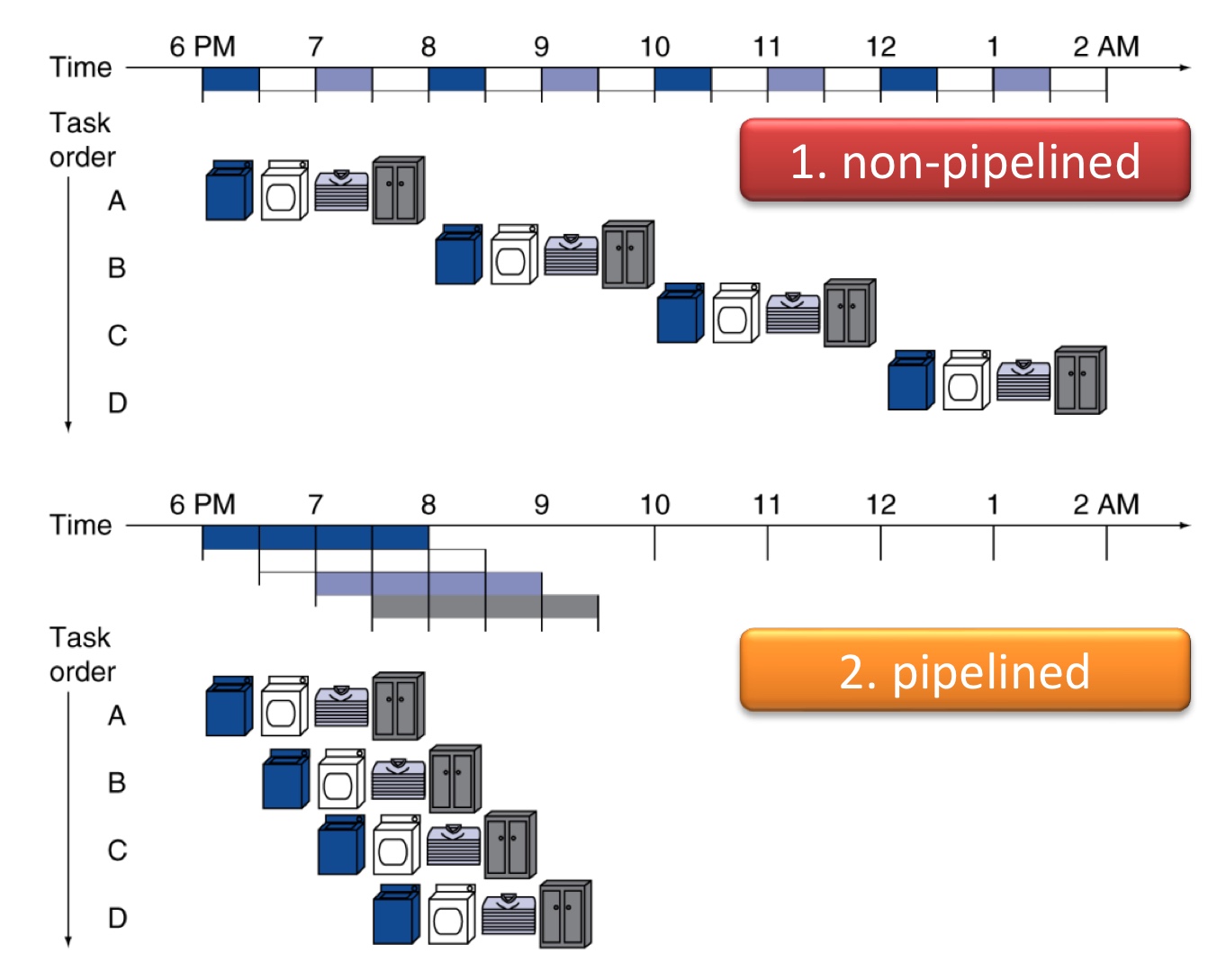
Pipelining
One instruction is executed through multiple stages.
Stages
Typically, an instruction execution consists of the following stages:
- Fetch (IF - Instruction Fetch): The instruction is retrieved from memory.
- Decode (ID - Instruction Decode): The fetched instruction is decoded to determine the operation and the operands involved.
- Execute (EX): The operation specified by the instruction is performed, which may involve arithmetic or logical calculations.
- Memory Access (MEM): If the instruction requires reading from or writing to memory (for load/store instructions), this stage handles those operations.
- Write Back (WB): The results of the execution are written back to the register file.
Example
I1: ADD R1, R2, R3I2: SUB R4, R5, R6I3: LW R7, 100(R8)
Without Pipelining:
| Cycle | Fetch (IF) | Decode (ID) | Execute (EX) | Memory (MEM) | Write Back (WB) |
|---|---|---|---|---|---|
| 1 | I1 | ||||
| 2 | I1 | ||||
| 3 | I1 | ||||
| 4 | I1 | ||||
| 5 | I1 | ||||
| 6 | I2 | ||||
| 7 | I2 | ||||
| 8 | I2 | ||||
| 9 | I2 | ||||
| 10 | I2 | ||||
| 11 | I3 | ||||
| 12 | I3 | ||||
| 13 | I3 | ||||
| 14 | I3 | ||||
| 15 | I3 |
With Pipelining
| Cycle | Fetch (IF) | Decode (ID) | Execute (EX) | Memory (MEM) | Write Back (WB) |
|---|---|---|---|---|---|
| 1 | I1 | ||||
| 2 | I2 | I1 | |||
| 3 | I3 | I2 | I1 | ||
| 4 | I3 | I2 | I1 | ||
| 5 | I3 | I2 | I1 | ||
| 6 | I3 | I2 | |||
| 7 | I3 |
There's some pitfalls such as problems from branching, but pipelining obviously improves performance

People live above layers of abstraction beneath which engineers reside