‼️ 개인 학습 내용으로, 오류가 있을 수 있습니다.
논문 URL - https://arxiv.org/abs/2501.09136
Title
Agentic Retrieval-Augmented Generation: A Survey on Agentic RAG
-> 에이전틱* RAG 연구 동향 분석
*정교한 추론과 반복적인 계획을 사용해 복잡한 다단계 문제를 자율적으로 해결하는 것(출처 : NVIDIA)
Abstract
LLM의 한계를 극복하는 RAG도 한계가 있다.
-
Large Language Models (LLMs) have revolutionized artificial intelligence (AI) by enabling humanlike text generation and natural language understanding.
-> LLM은 인간처럼 텍스트를 생성하고 자연어를 이해함으로써 AI 분야에 혁신을 가져왔다. -
However, their reliance on static training data limits their ability to respond to dynamic, real-time queries, resulting in outdated or inaccurate outputs.
-> 그러나 LLM은 정적인 학습 데이터에 의존하기 때문에, 변화하는 실시간 질의에 대응하는 능력이 제한되어 있어 결과적으로 오래되었거나 부정확한 출력이 발생할 수 있다. -
Retrieval-Augmented Generation (RAG) has emerged as a solution, enhancing LLMs by integrating real-time data retrieval to provide contextually relevant and up-to-date responses.
-> RAG(검색 증강 생성)은 실시간 데이터 검색 기능을 통합하여 LLM의 성능을 향상시키고, 맥락에 맞는 최신 정보를 기반으로 한 응답을 제공하는 솔루션으로 부상했다. -
Despite its promise, traditional RAG systems are constrained by static workflows and lack the adaptability required for multi-step reasoning and complex task management.
-> 그러나 전통 RAG 시스템은 정적인 워크플로우에 제한되어 있어 다단계 추론과 복잡한 작업 관리에 필요한 적응성이 부족한 한계를 지닌다.
Agentic RAG의 등장
-
Agentic Retrieval-Augmented Generation (Agentic RAG) transcends these limitations by embedding autonomous AI agents into the RAG pipeline.
-> 에이전틱 RAG는 RAG 파이프라인에 자율적 AI 에이전트를 내장함으로써 이러한 한계를 극복한다. -
These agents leverage agentic design patterns reflection, planning, tool use, and multi-agent collaboration to dynamically manage retrieval strategies, iteratively refine contextual understanding, and adapt workflows through clearly defined operational structures ranging from sequential steps to adaptive collaboration.
-> 이러한 에이전트는 반성(reflection), 계획(planning), 도구 활용(tool use), 다중 에이전트 협업(multi-agent collaboration)과 같은 에이전트 설계 패턴을 활용하여, 동적으로 검색 전략을 관리하고, 맥락적 이해를 반복적으로 개선하며, 순차적 단계부터 적응적 협업까지 명확한 운영 구조를 통해 워크플로우를 조정한다. -
This integration enables Agentic RAG systems to deliver unparalleled flexibility, scalability, and context-awareness across diverse
applications.
-> 이러한 통합을 통해 에이전트 기반 RAG 시스템은 다양한 애플리케이션에서 비교할 수 없는 유연성, 확장성, 맥락 인식 능력을 제공할 수 있다.
본 연구의 범위
-
This survey provides a comprehensive exploration of Agentic RAG, beginning with its foundational principles and the evolution of RAG paradigms.
-> 본 연구는 에이전트 기반 RAG의 기본 원리와 RAG 패러다임의 진화 과정을 시작으로, 이를 종합적으로 탐구한다. -
It presents a detailed taxonomy of Agentic RAG architectures, highlights key applications in industries such as healthcare, finance, and education, and examines practical implementation strategies.
-> 에이전트 RAG 구조의 세부 분류 체계를 제시하고, 의료·금융·교육 등의 산업 분야에서의 주요 응용 사례를 강조하며, 실용적인 구현 전략을 분석한다.
- Additionally, it addresses challenges in scaling these systems, ensuring ethical decision-making, and optimizing performance for real-world applications, while providing detailed insights into frameworks and tools for implementing Agentic RAG.
-> 에이전트 기반 RAG 시스템의 확장 문제, 윤리적 의사결정 보장, 실제 애플리케이션 성능 최적화 과제를 다루며, 에이전트 RAG 구현을 위한 프레임워크와 도구에 대한 세부적인 통찰을 제공한다.
Figures
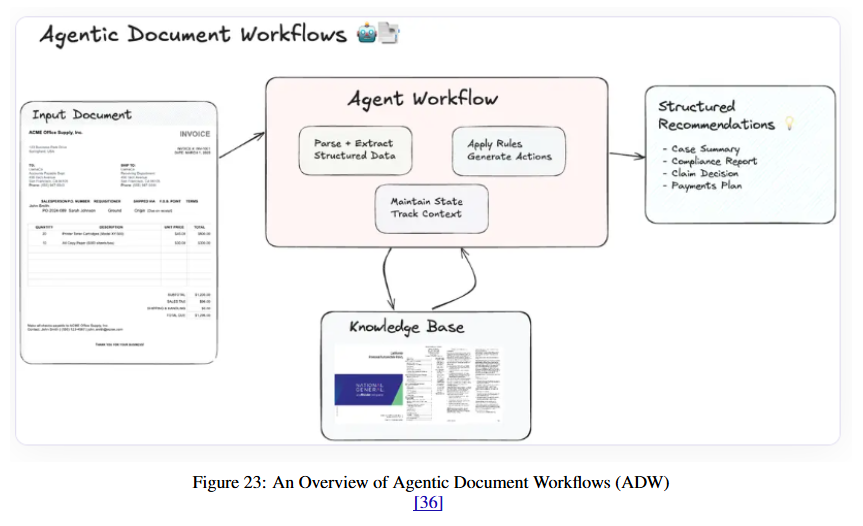
01. 에이전틱 RAG 개요
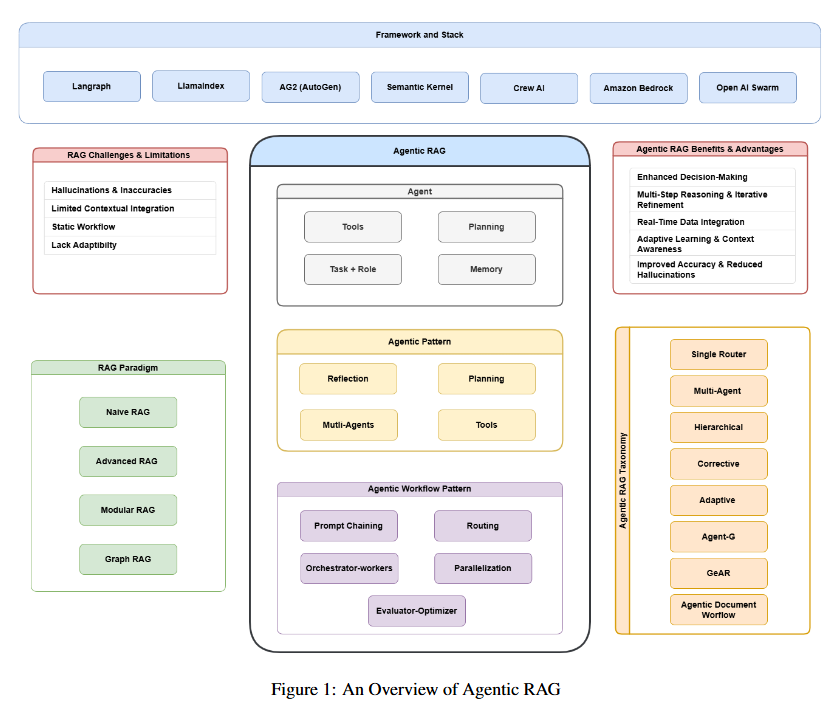
02. RAG 핵심 요소
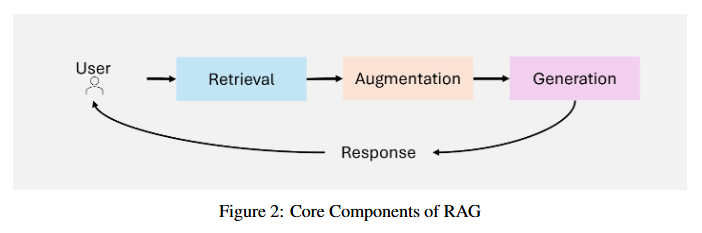
03. Naive RAG 개요
04. Advanced RAG 개요
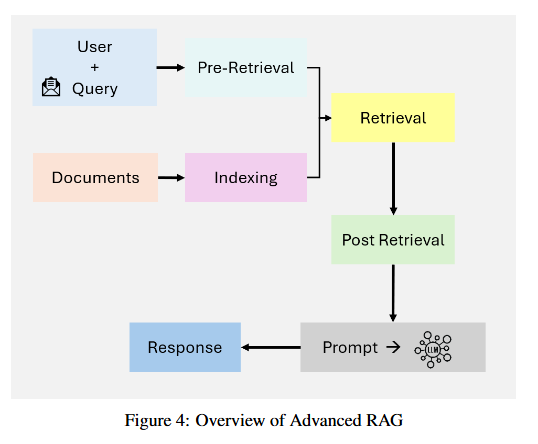
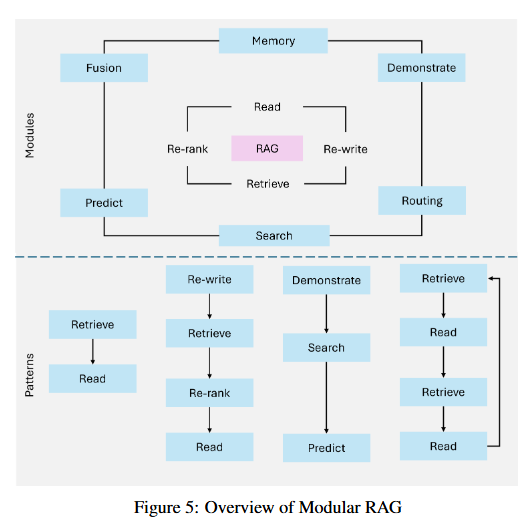
05. Modular RAG 개요
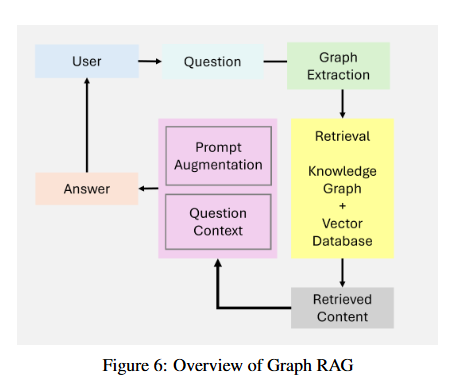
06. Graph RAG 개요
- Graph RAG : 지식 그래프(Knowledge Graph)를 활용해 RAG의 정확성과 맥락 이해 능력을 향상시키는 기술
- 그래프 데이터 내의 관계와 계층 구조를 활용해 다단계 추론(multi-hop reasoning)과 맥락적 풍부화를 강화한다.
- 그래프 기반 검색 방식을 도입함으로써, Graph RAG는 관계적 이해가 필요한 작업에서 특히 풍부하고 정확한 생성 결과를 제공한다.
- Graph RAG는 구조적 관계 분석이 핵심인 도메인에서 혁신적 가능성을 보이지만, 데이터 품질과 시스템 복잡성 관리가 향후 과제이다.
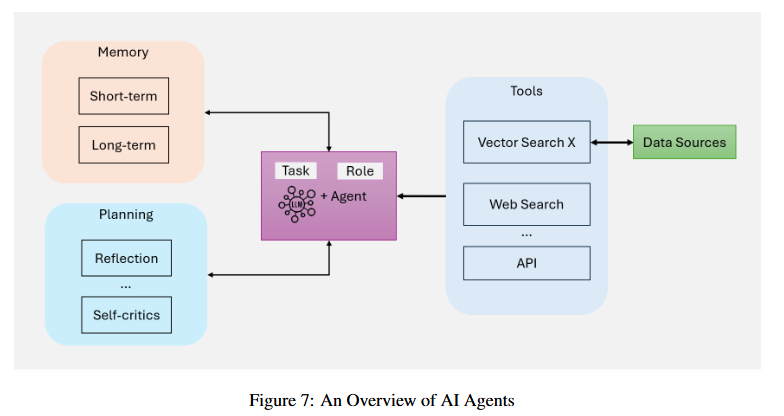
07. AI Agents 개요
-
에이전트 기반 지능(Agentic Intelligence)
- 정적 RAG의 한계 극복: 전통적 RAG의 수동적·반응적 특성을 자율적 에이전트 통합으로 발전
- 동적 의사결정: 실시간 데이터 추출 및 도구 활용을 통한 자율적 문제 해결 능력 강화
-
AI 에이전트 구성 요소
구성 요소 기능 LLM - 역할 및 작업 정의된 추론 엔진
- 사용자 쿼리 해석 및 응답 생성메모리 - 단기: 대화 상태 추적
- 장기: 축적된 지식 저장계획 - 반성(Self-Critique) 및 쿼리 라우팅
- 복잡 작업 분해도구 - 벡터 검색/웹 검색/API 연동
- 실시간 데이터 접근
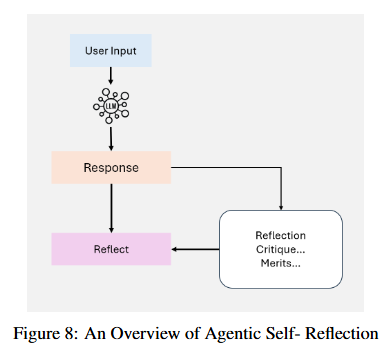
08. Agentic Self-Reflection 개요
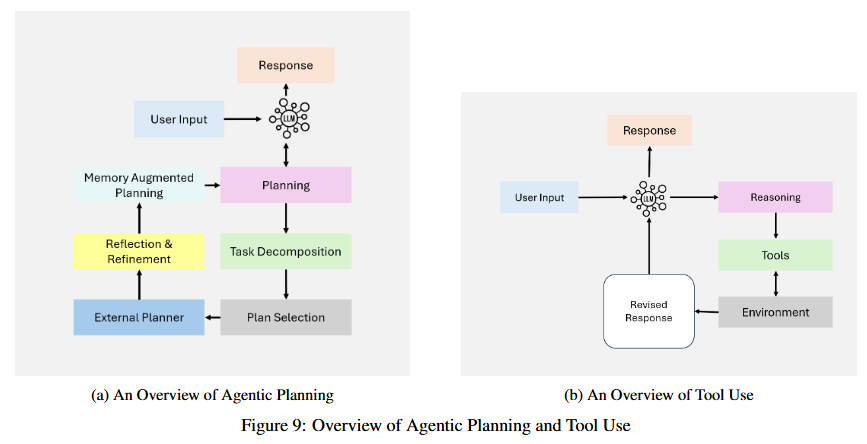
09. Agentic Planning과 Tool Use 개요
- Planning
- 에이전트 워크플로우의 핵심 설계 패턴으로, 복잡한 작업을 소규모 하위 작업으로 분해하여 다단계 추론과 동적 문제 해결을 가능하게 한다.
- Tool Use
- 에이전트가 외부 도구·API·계산 자원과 상호작용하여 사전 학습된 지식을 넘어 정보 수집, 계산 수행, 데이터 조작을 가능하게 하는 패턴
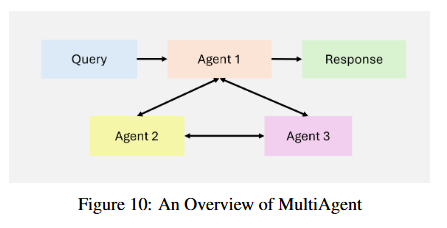
10. MultiAgent의 개요
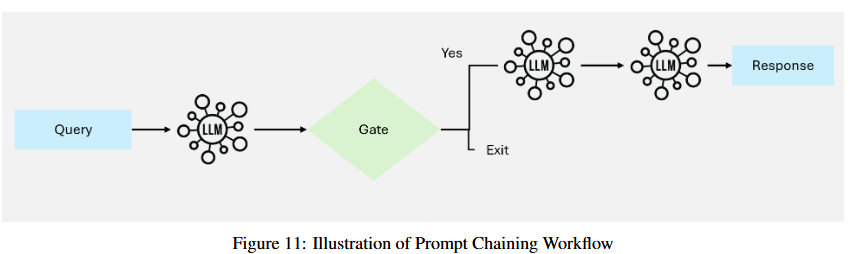
11. Prompt Chaining 작동 흐름
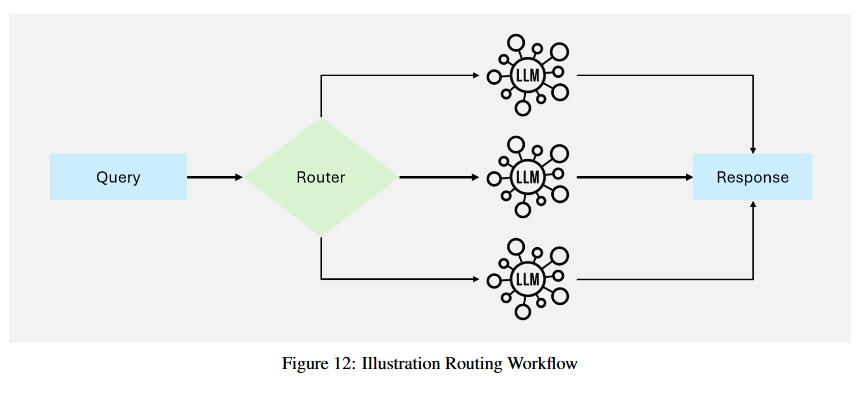
12. Routing 작동 흐름
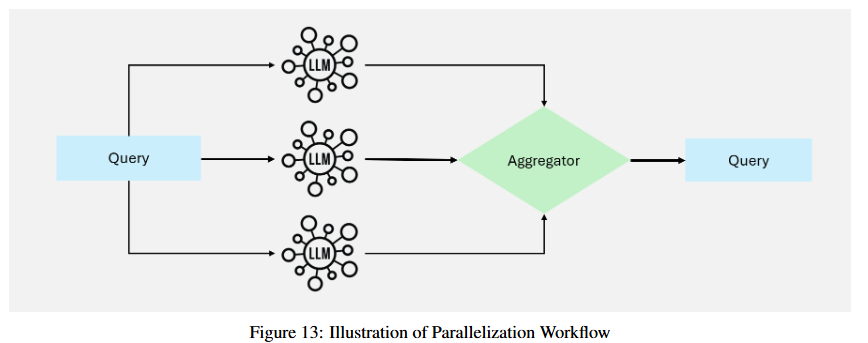
13. Parallelization(병렬화) 작동 흐름
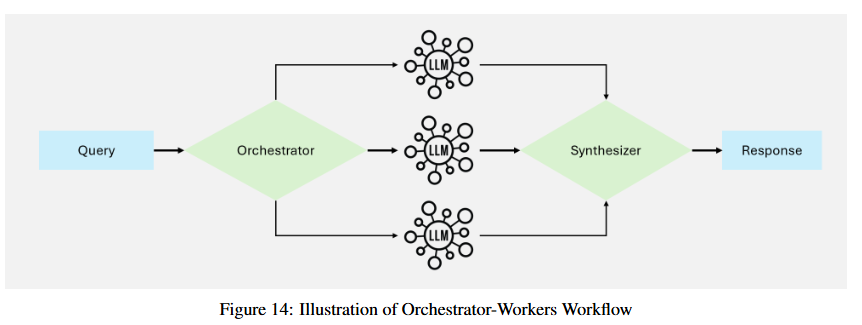
14. Orchestrator-Workers 작동 흐름
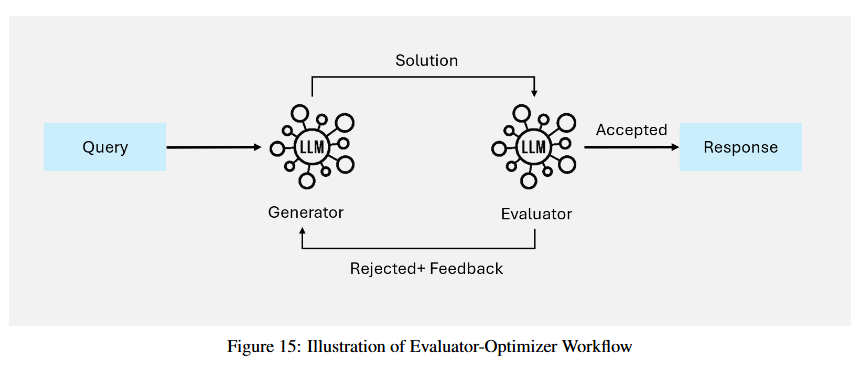
15. Evaluator-Optimizer 작동 흐름
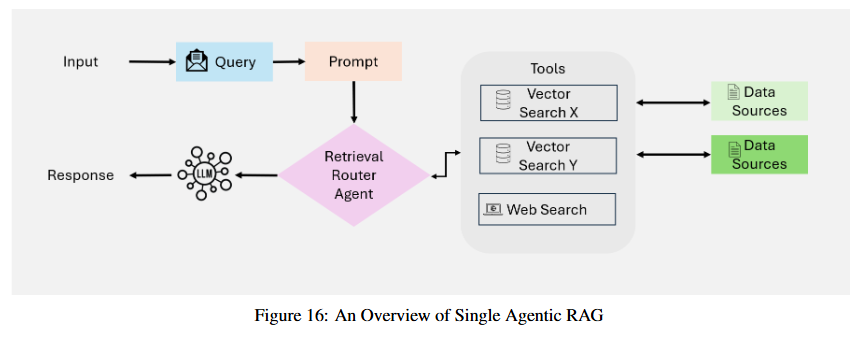
16. Single Agentic RAG 개요
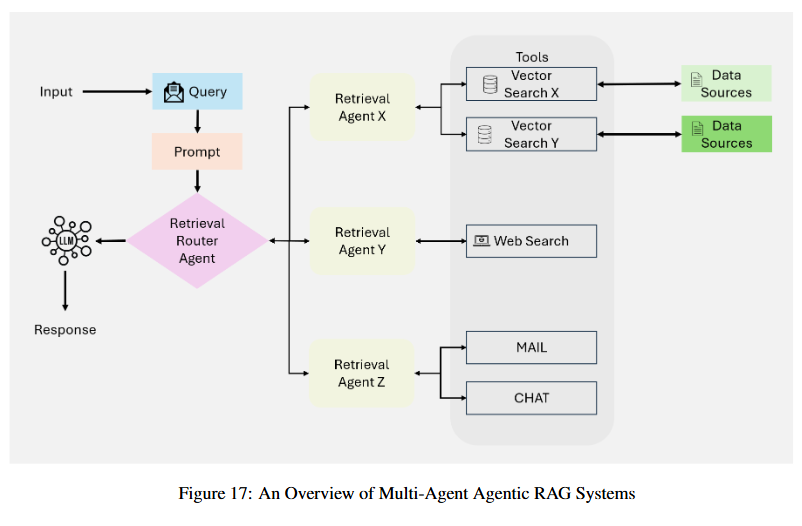
17. Multi-Agent Agentic RAG 시스템 개요
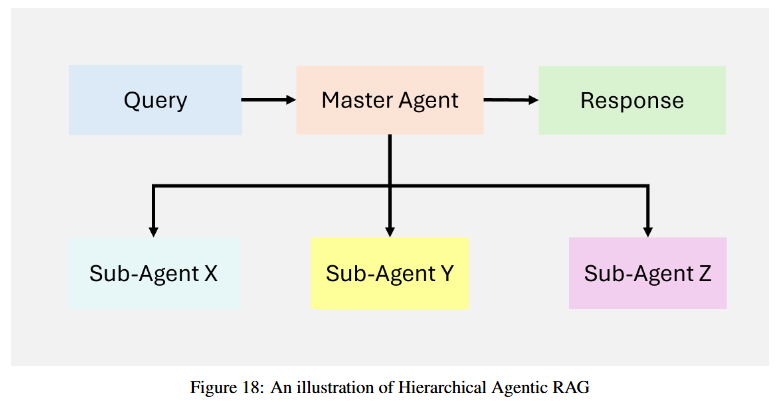
18. Agentic RAG의 계층 구조
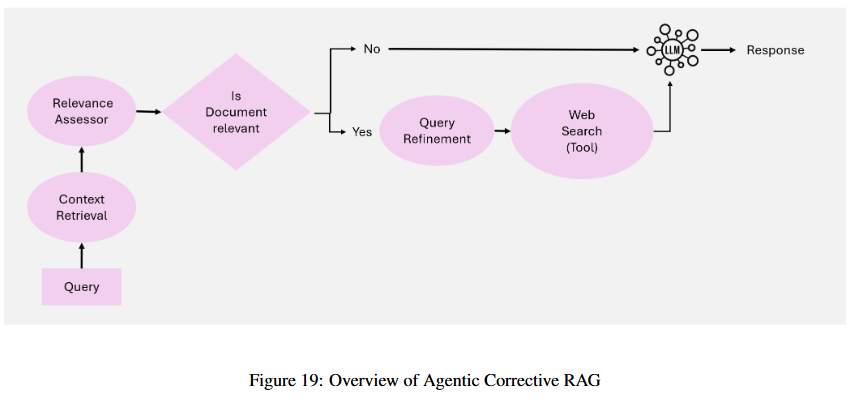
19. Agentic Corrective RAG 개요
20. Adaptive Agentic RAG 개요
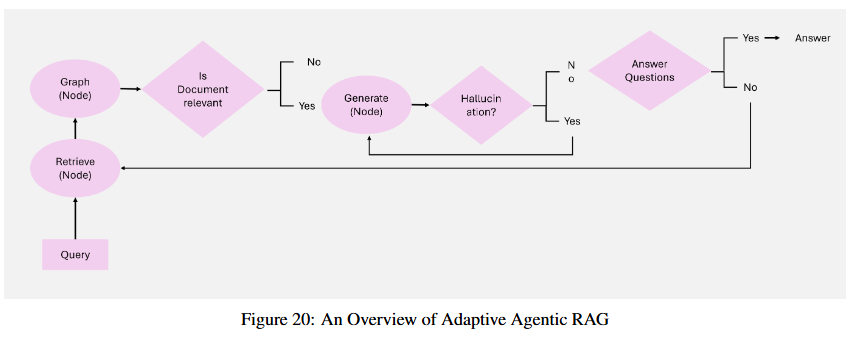
21. Agent-G 개요 : Graph RAG를 위한 Agentic Framework
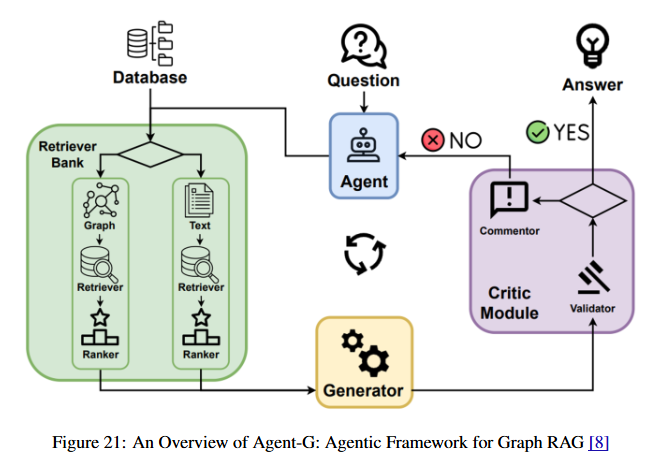
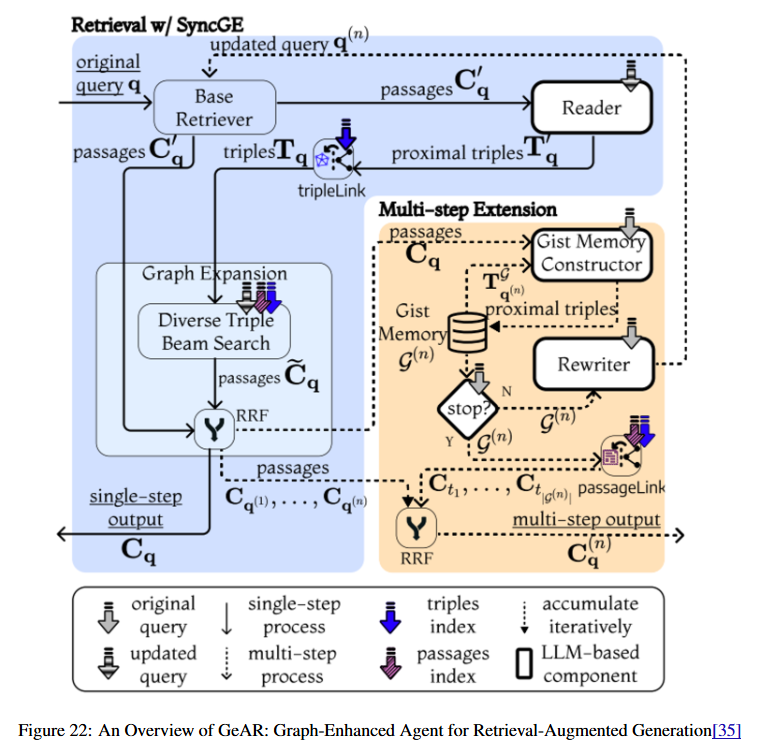
22. GeAR(RAG를 위한 Graph-Enhanced Agent) 개요
-
Figure 원본 출처 : https://arxiv.org/pdf/2412.18431
전체 구조 -
GeAR 구성
-
검색(Retrieval w/ SyncGE):
- Base Retriever: 초기 쿼리(q)를 받아 관련 passage(C'q) 추출
- Graph Expansion: 그래프 탐색을 통해 다양한 triple(지식)을 검색하고 passage 확장(C̃q)
- RRF(Rank Reciprocal Fusion): 검색 결과를 융합하여 단일 단계 출력 생성(Cq)
-
다단계 확장(Multi-step Extension):
- Gist Memory Constructor: passage(Cq)에서 핵심 정보를 추출하여 Gist Memory(G(n)) 구축
- Rewriter: Gist Memory를 활용하여 쿼리를 재작성(q(n))
- passageLink: 재작성된 쿼리를 바탕으로 multi-step output 생성(C(n)q)
-
-
핵심 요소
- SyncGE: 그래프 기반 검색 강화 모듈
- Triple: 지식 그래프의 기본 단위(주어-술어-목적어)
- RRF: 다양한 검색 결과 랭킹 융합 알고리즘
- Gist Memory: 핵심 정보 요약 저장소
- LLM 기반 구성 요소: Reader, Rewriter 등 언어 모델 활용 모듈
-
데이터 흐름
- 초기 쿼리(original query q) → Base Retriever
- 검색된 passage(C'q) → Graph Expansion 또는 Reader
- Graph Expansion → RRF → single-step output(Cq)
- passage(Cq) → Gist Memory Constructor → Gist Memory(G(n))
- Gist Memory(G(n)) → Rewriter → updated query(q(n))
- updated query(q(n)) → passageLink → multi-step output(C(n)q)
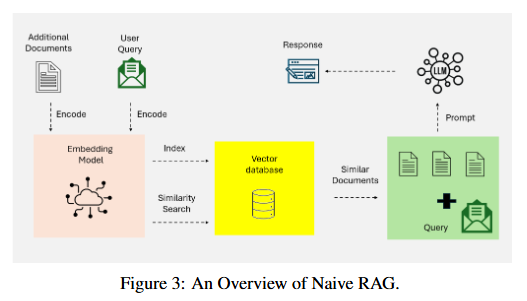
23. Agentic Document Workflows 개요