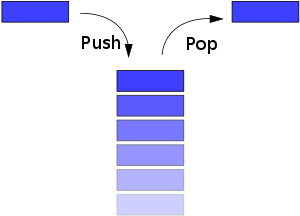
자료 저장 형태 중 스택에 대해 설명
- 스택은 데이터를 후입선출(LIFO, Last-In-First-Out)의 원리로 관리한다.
즉, 가장 최근에 삽입된 데이터가 가장 먼저 삭제되는 구조이다. - 데이터를 삽입하는 함수를 push(), 데이터를 삭제하는 함수를 pop()이라고 하며, 스택의 최상단에 위치한 요소를 top이라고 한다.
- 작업 대기열, 메시지 큐, 버퍼 등이 스택의 예로 사용된다.
배열을 이용한 스택
//배열을 이용한 스택 자료구조

#include <stdio.h>
#include <stdlib.h>		//malloc, realloc(기존의 메모리 복사 -> 새 메모리에 저장)

#pragma warning (disable : 4996)

typedef struct stack
{
	int* arr;		//동적 메모리의 주소를 저장(동적할당)
	int top;		//배열을 저장하려는 위치(배열의 인덱스)
	int capacity;	//배열의 최대 용량
}stack;

void stackInitialize(stack* p, int size)	//top = 0 & capacity = 3(size)
{
	p->arr = (int*)malloc(sizeof(int) * size);
	p->top = 0;
	p->capacity = size;
}

void push(stack* p, int data)
{
	if (p->top >= p->capacity)
	{
		//printf("\n\n\t\tstack overflow\n");
		//return;

		p->capacity = p->capacity * 2;
		//새 메모리의 주소 = realloc (원래 메모리의 주소, 재할당된 크기)
		p->arr = realloc(p->arr, sizeof(int) * p->capacity);
		printf("\n\n\t\t스택 메모리의 크기가 2배로 확장됐습니다.\n");
	}

	p->arr[p->top] = data;
	printf("\n\n\t\t%d push\n", p->arr[p->top]);
	(p->top)++;

}

void print(stack stk)	//LIFO
{
	int i;
	printf("\n\nInteger stack : ");
	for (i = stk.top - 1; i >= 0; i--)
		printf("%d", stk.arr[i]);
	puts("");
}

void pop(stack *p)
{
	if (p->top == 0)
	{
		printf("\n\n\t\t stack underflow\n");
		return;
	}

	(p->top)--;
	printf("\n\n\t\t %d pop!!", p->arr[p->top]);
}

int main()
{
	int size, choice, data;
	stack stk;	//구조체 변수 선언

	printf("\n스택 크기 입력 :");
	scanf("%d ", &size);
	while (getchar() != '\n');

	stackInitialize(&stk, size);	//stack = call by address	// size = call by value

	while (1)
	{
		system("cls");
		printf("\n\n\t\t ***Integer stack***\n\n");
		printf("1. push		2. pop		3. print    	4.clear		0.terminate\n");
		printf("choice : [ ]\b\b");
		scanf("%d", &choice);
		while (getchar() != '\n');

		switch (choice)
		{
		case 1:
			printf("\n\nenter integer : ");
			scanf("%d", &data);
			while (getchar() != '\n');

			push(&stk, data);	//push함수 호출
			break;

		case 2:
			pop(&stk);
			break;

		case 3:
			print(stk);
			break;

		case 4:
			stk.top = 0;
			break;

		case 0:
			free(stk.arr);	//동적 메모리 해제
			exit(0);
			break;

		}
		printf("\n\n\t\t");
		system("pause");
	}
	return 0;

}
연결리스트를 이용한 스택
#include <stdio.h>
#include <stdlib.h>

#pragma warning (disable : 4996)

typedef struct node
{
	int value;
	struct node* next;
}node;

node* head = NULL;

void push(int data)
{
	node *newNode = (node*)malloc(sizeof(node));
	newNode->value = data;
	newNode->next = NULL;

	if (head == NULL)	//첫 노드인 경우
	{
		head = newNode; //새 노드를 head로 설정
	}
	else
	{
		newNode->next = head;
		head = newNode;
	}
		printf("\n\n\t\t%d push!!", head->value);

	}

void pop()
{
	node* delNode = head;	//delNode를 첫 노드(head)로 설정
	if (head == NULL)
	{
		printf("\n\n\t\tstack underflow\n");
		return;
	}
	//LIFO : 첫 노드 삭제
	head = head->next;	//다음 노드로 head 변경
	printf("\n\n\t\t%d pop!!", delNode->value);
	free(delNode);
}

void print()
{
	node* curNode = head;

	if (head == NULL)
		return;

	printf("\n\nstack display : ");

	while (curNode->next != NULL)	//다음 노드가 있다면
	{
		printf("%d => ", curNode->value);
		curNode = curNode->next;	//방문 노드를 다음 노드로 이동
	}
	printf("%d\n", curNode->value);	//마지막 노드 출력
}

void clear()
{
	node* delNode = head;

	if (head == NULL)
		return;

	while (head)		//방문 노드가 있다면
	{
		head = head->next;	//head를 다음 노드로 변경
		free(delNode);	// 노드 제거
		delNode = head;	// head가 있는 곳으로 delNode 이동

	}
}

int main()
{
	int choice, data;

	while (1)
	{
		system("cls");
		printf("\n\n\t\t ***Integer stack(linked list)***\n\n");
		printf("1. push		2. pop		3. print    	4.clear		0.terminate\n");
		printf("choice : [ ]\b\b");
		scanf("%d", &choice);
		while (getchar() != '\n');

		switch (choice)
		{
		case 1:
			printf("\n\nenter integer : ");
			scanf("%d", &data);
			while (getchar() != '\n');

			push(data);		//노드 맨 앞 삽입
			break;

		case 2:
			pop();
			break;

		case 3:
			print();
			break;

		case 4:
			clear();	//모든 노드 삭제
			break;

		case 0:
			clear();
			exit(0);
			break;

		}
		printf("\n\n\t\t");
		system("pause");
	}
	return 0;

}
그래도 해야지