10 Questions to Ask Mobile App Development Companies Before Signing a Contract
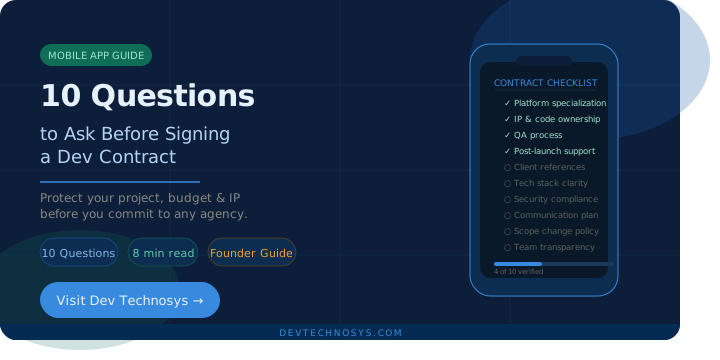
You've got a brilliant app idea. You've sketched the wireframes on a napkin, rehearsed your elevator pitch, and Googled your way through a dozen agency websites. But somewhere between "this looks promising" and "where do I sign," a trap opens up that swallows budgets, timelines, and founder dreams whole.
The trap? Signing a contract without asking the right questions first.
Most founders focus on price and portfolio — and miss the ten questions that actually separate great partners from expensive mistakes. Whether you're a startup founder, a product manager at an enterprise, or a business owner going digital for the first time, this guide gives you the exact questions to ask any Mobile App Development Company before you commit a single rupee or dollar.
Why Due Diligence Is Non-Negotiable
The global app economy is worth over $935 billion. Every week, thousands of businesses hand over contracts to development agencies — and a significant number of those projects fail, stall, or wildly exceed budgets. Not because the idea was bad, but because the partnership was built on assumptions instead of answers.
Asking hard questions upfront isn't distrust. It's intelligence.
Here are the ten questions that will protect your project, your timeline, and your investment.
Question 1: What Is Your Core Specialization — iOS, Android, or Cross-Platform?
Not every agency is built the same. Some teams live and breathe native iOS development. Others have mastered React Native or Flutter for cross-platform builds. A few try to do everything — which sometimes means doing nothing brilliantly.
Ask specifically: Do you specialize in the platform my target users prefer?
If 80% of your audience uses Android and the agency's portfolio is 90% iOS apps, that's a mismatch worth addressing before a contract exists. The best Mobile App Development Services come from teams who have deep, repeated expertise in the exact ecosystem your product will live in.
Follow-up: Ask to see two or three recent apps they've shipped on your target platform. Download them. Use them. Read the reviews.
Question 2: Who Exactly Will Be Working on My Project?
Agency websites are carefully curated highlight reels. The senior developer showcased in the pitch deck may have zero involvement in your actual build. Junior developers, offshore contractors, or outsourced QA teams might handle the bulk of the work.
This isn't inherently bad — but you deserve to know.
Ask for the names and LinkedIn profiles of the core team: the project manager, lead developer, UI/UX designer, and QA engineer. Request their availability percentages. Will your dedicated lead spend 20% of their week on your project, or 80%?
Transparency here is a green flag. Evasiveness is a red one.
Question 3: How Do You Handle Scope Changes Mid-Project?
Every project evolves. A feature you considered essential in Month 1 might look very different by Month 3 — and new requirements will emerge that nobody predicted. The question isn't whether scope will change. It's how the agency handles it when it does.
Some companies use fixed-price contracts that punish every change request with bloated change orders. Others use agile, sprint-based models that absorb reasonable pivots naturally. Understanding this dynamic is critical to understanding the true Mobile App Development Cost — not just the number on the first proposal, but the total cost over the project's lifecycle.
Ask: Can you walk me through a real example where a client changed requirements mid-project and how you managed it?
The answer will tell you everything about their process maturity and client empathy.
Question 4: What Does Your QA and Testing Process Look Like?
Apps that crash on launch are not just embarrassing — they're brand-killers. The App Store is littered with 1-star reviews for bugs that should have been caught before release.
Testing is where many agencies quietly cut corners to hit a deadline. Ask specifically about:
Device testing (do they test on real devices or only simulators?)
OS version coverage (Android fragmentation is notoriously complex)
Performance testing under load
Security testing, especially if your app handles payments or personal data
Beta testing processes before the public launch
A serious agency will have a documented QA protocol. If they respond with "we test as we build," that's not a process — it's a prayer.
Question 5: Who Owns the Source Code and Intellectual Property?
This seems obvious, but it catches founders off guard more than almost any other issue. Some agencies retain ownership of the codebase until final payment. Others use proprietary frameworks that technically belong to them. A few restrict your ability to take the code to another vendor if the relationship sours.
Get absolute clarity before signing. You should own:
100% of the source code
All design assets and UI components
All API keys and third-party service accounts
App Store and Play Store developer accounts
Make sure the contract explicitly states this — not implied, not assumed. Written. In the contract.
Question 6: What Is Your Post-Launch Support Model?
Launch day is not the finish line. It's the starting gun for a different race: bug fixes, OS update compatibility, performance optimization, and feature iteration.
Ask: What happens after the app goes live?
Some agencies offer retainer-based maintenance packages. Others provide a 30 or 90-day warranty period, then charge standard rates. Some essentially disappear. None of these models is wrong by default — but you need to know which one you're getting, and factor it into your real cost projections.
Also ask specifically about OS updates. When Apple releases iOS 20 or Google updates Android, who ensures your app stays compliant?
Question 7: Can You Provide Three Client References I Can Contact Directly?
Portfolios are curated. Case studies are polished. References are real.
Any Mobile App Development Companies worth their retainer should be able to provide three recent client contacts — not testimonial quotes on a website, but actual people you can call or email with specific questions.
When you speak to references, ask them:
Did the project deliver on time and on budget?
How did the agency handle problems when they arose?
Would you hire them again, and why or why not?
The pattern across multiple references reveals far more than a single five-star Google review.
Question 8: What Tech Stack Will You Use — and Why?
You don't need to be a developer to ask this question intelligently. The goal isn't to evaluate the technical merits of React Native versus Flutter — it's to understand why they're recommending what they're recommending for your specific product.
If an agency always defaults to the same stack regardless of the project, that's a workflow optimization for them — not necessarily the best decision for you.
Ask: What tech stack do you recommend for my app, and why does it fit my use case better than alternatives?
If they can explain their recommendation clearly in non-technical terms, they understand both the technology and your business. That's exactly the kind of team you want building your product.
Question 9: How Do You Structure Communication and Project Reporting?
Communication failures kill more projects than technical failures. Misaligned expectations, delayed feedback loops, and unclear accountability create the kind of slow-motion disasters that are entirely avoidable with the right structure upfront.
Ask about:
Project management tools (Jira, Asana, Trello, Linear?)
Reporting cadence (weekly status calls? Bi-weekly sprint reviews?)
Communication channels (Slack, email, dedicated project portal?)
Escalation paths if something goes wrong
A professional agency will have clear, documented answers. They should also tell you what they need from you — response time expectations, feedback turnaround, and decision-making access.
Good communication is a two-way street, and the best partners will say so directly.
Question 10: How Do You Approach Security, Compliance, and Data Privacy?
This question matters infinitely more than it did five years ago. GDPR in Europe, DPDP Act in India, CCPA in California — regulatory environments around data privacy are tightening globally. If your app collects user data, handles payments, or operates in a regulated industry (healthcare, finance, education), compliance isn't optional.
Ask:
Do you build with security-first practices from Day 1, or treat it as a final-phase checklist?
How do you handle third-party SDK security risks?
Can you ensure GDPR/CCPA/local regulatory compliance if required?
What's your data encryption approach for sensitive user information?
The right agency won't just answer these questions — they'll have already thought about them. Mobile App Development done properly means security is baked into the architecture, not bolted on at the end.
Bonus: The Red Flags Checklist
Before you walk into that final meeting, watch for these warning signs in any agency you're evaluating:
Vague pricing without a clear breakdown of deliverables
No defined project management methodology
Unwillingness to provide direct client references
Guaranteed timelines that seem impossibly short for the scope
Pressure to sign quickly without adequate review time
No questions about your business goals — just your features list
Cookie-cutter proposals that clearly weren't tailored to your project
Any single red flag warrants more scrutiny. Multiple red flags warrant walking away.
Choosing the Right Partner for Your Mobile App Development Solutions
The right development partner isn't just technically capable — they're genuinely invested in your product's success. They ask as many questions as you do. They push back on bad ideas. They flag risks proactively rather than absorbing them silently until they become crises.
Use these ten questions as your filter, not your checklist. The goal isn't to catch agencies off guard — it's to find the team that answers every question with clarity, specificity, and confidence.
That team exists. And now you know exactly how to find them.
Final Thought
The contract you sign with a development agency sets the terms of a relationship that could last 6 months, 18 months, or years. Spending an extra two weeks in due diligence before signing is never a waste of time — it's an investment that pays every single sprint.
Check Out Dev Technosys — explore their portfolio, request a free consultation, and see firsthand how a serious development partner operates.
Your app deserves more than a vendor. It deserves a partner.