https://github.com/leejaymin/llvm8-tutorials-jemin/tree/master?tab=readme-ov-file
해당 주소에 있는 튜토리얼로 진행하였다.
해당 실습에서는 LLVM의 ModulePass를 활용하여, 새로운 함수와 명령어를 생성한다.
모듈패스란, LLVM의 분석 단위이다. 프로그램 전체 즉 여러 함수와 글로벌 변수를 한꺼번에 다루어 효율적으로 처리한다. 클래스에서 runOnModule이라는 메서드를 구현하여 실제 작업을 수행한다.
간단한 함수를 삽입하고, 해당 함수에 필요한 Basic block과 명령어를 추가하는 코드를 작성하여 보자.
- InsertInFuction class 구현: ModulePass를 상속하여 새로운 패스 생성
- inc 함수 생성
- Basic Block 직접 생성
- 명령어 삽입
- 최적화 도구로 적용
목표는 int inc(int n) { return n+1; } 함수를 LLM 모듈에 삽입하는 패스를 작성하는 것이다.
작성해야 하는 파일은 다음과 같다.
-
InsertInc.cpp
- Inc 함수 삽입 패스의 실제 로직 구현 소스
- ModulePass 상속 클래스 코드와 inc 함수 생성, 관련 명령어 삽입 포함
-
InsertInc.h
- InsertInc.cpp의 클래스 및 함수 선언부
- 재사용 및 코드 구조 관리를 위한 헤더 파일
-
Makefile
- 컴파일, 빌드, 테스트 자동화 빌드 스크립트
- 소스코드와 의존성, 빌드 순서 명시
-
test.c
- 패스 적용을 확인할 테스트용 C 소스
- 함수 삽입, 호출 정상 여부 검증 사례 코드 포함
-
test.ll
- test.c를 LLVM IR로 변환한 파일
- 패스 적용 결과를 IR 수준에서 점검하고 확인
InsertInc.cpp
//===- Hello.cpp - Example code from "Writing an LLVM Pass" ---------------===//
//
//                     The LLVM Compiler Infrastructure
//
// This file is distributed under the University of Illinois Open Source
// License. See LICENSE.TXT for details.
//
//===----------------------------------------------------------------------===//
//
// docs/WritingAnLLVMPass.html 문서의 Hello World 패스 예제 코드(2가지 버전 구현)
//
//===----------------------------------------------------------------------===//

#include "llvm/Support/raw_ostream.h"        // LLVM용 출력 지원
#include "llvm/IR/IRBuilder.h"               // IR 명령어 생성용 빌더
#include "llvm/IR/DerivedTypes.h"            // 함수 타입 등 파생 타입
#include "llvm/IR/Instructions.h"            // IR 명령어 관련
#include "InsertInc.h"                       // 본인 패스 선언부(헤더)
#include "llvm/IR/Value.h"                   // Value 타입 관련

#define DEBUG_TYPE "hello"                   // 디버그용(디버그 메시지 필터 등)

// InsertInc 패스 본체 (레거시 패스 방식)
bool InsertInc::runOnModule(Module &M) {

  LLVMContext &Context =M.getContext();      // LLVM 컨텍스트(타입, 상수 등 생성에 사용)

  // "inc"라는 함수(시그니처: int inc(int))를 모듈에 삽입 또는 이미 있으면 반환
  Constant *newF = M.getOrInsertFunction("inc", \
    Type::getInt32Ty(Context),               // 리턴 타입: int32
    Type::getInt32Ty(Context));              // 파라미터 타입: int32

  // inc 함수의 "entry" 기본 블록 생성, 함수에 연결
  BasicBlock *BB = BasicBlock::Create(Context, "entry",
    dyn_cast<Function>(newF));

  // 함수의 첫 번째(유일한) 인자 포인터 획득 (int n)
  Argument *Arg = dyn_cast<Function>(newF)->arg_begin();

  // 1이라는 상수 생성(int32)
  Constant *One = ConstantInt::get(Type::getInt32Ty(Context), 1);

  // IR 명령어를 BB에 삽입할 빌더 초기화(BB 끝에 명령어 자동 추가)
  IRBuilder<> Builder(BB);

  // n + 1 (Add 명령어) 삽입, 결과를 result 변수에 저장
  Value *result = Builder.CreateAdd(Arg, One);

  // result를 반환하는 Return 명령어 삽입
  Builder.CreateRet(result);

  // 모듈을 수정했으니 true 반환(새 함수와 명령어를 추가)
  return true;
}

// 다른 분석 패스 결과를 전혀 깨뜨리지 않겠다고 명시(패스 실행 전후로 변화 없음)
void InsertInc::getAnalysisUsage(AnalysisUsage &AU) const {
  AU.setPreservesAll();
}

// 레거시 패스 매니저용 ID(필수, 글로벌 변수)
char InsertInc::ID = 0;

// 패스 등록 (opt 등에서 "InsertInc"로 사용, "InsertInc Pass" 설명 표시)
static RegisterPass<InsertInc> X("InsertInc", "InsertInc Pass ");
- 함수 만들기
- 함수 정의 블록(Entry Point) 생성
- 기본 블록 조립
- 함수에 연결
InsertInc.h
Github에서 해당 프로젝트의 소스코드를 보면, Legacy Pass Manager 기반으로 작성되어 있는 것을 확인할 수 있다. 하지만 최신 LLVM에서는 New Pass Manager을 사용하므로 해당 API에 맞게 코드를 수정해야 한다.
레거시 패스 관리자와 새로운 패스 관리자 차이점
-
패스 등록 방식
- 레거시: RegisterPass 매크로 사용, 상속 방식
- new: PassPluginLibraryInfo, PassBuilder 등 구조체 기반, 플러그인 방식
-
패스 실행 구조
- 레거시: 암묵적/묵시적 구조, 함수·모듈 패스 혼합 등록 가능
- new: 명시적으로 어떤 패스가 어디에 등록될지 구분, 파이프라인 구조 명확
-
결과 반환
- 레거시: 함수에서 true/false 반환(모듈 변경 여부)
- new: PreservedAnalyses 객체로 어떤 분석 결과가 보존되는지 반환
-
코드 사용 및 관리
- 레거시: 초기 등록 절차 복잡, 글로벌 변수 필요
- new: 플러그인 중심, 깔끔한 확장 구조
#ifndef LLVM_TUTORIAL_OPTIMIZATION_INSERTINCFUN_INSERTINC_H
#define LLVM_TUTORIAL_OPTIMIZATION_INSERTINCFUN_INSERTINC_H

// 여러 번 포함되어도 문제 없도록 인클루드 가드 설정

#include "llvm/IR/PassManager.h"
#include "llvm/IR/Module.h"
#include "llvm/Passes/PassPlugin.h"

// 다른 파일과 이름 충돌 막기 위해 익명 네임스페이스 사용
namespace {

class InsertInc : public llvm::PassInfoMixin<InsertInc> {
public:
  // New Pass Manager에서 패스 로직이 들어가는 함수 선언
  // M: 전체 LLVM 모듈(프로그램 전체)
  // ModuleAnalysisManager &: 분석 도구 제공
  // 반환값: 어떤 분석 결과가 보존되는지 나타내는 PreservedAnalyses
  llvm::PreservedAnalyses run(llvm::Module &M,
                              llvm::ModuleAnalysisManager &);
};

} // end anonymous namespace

#endif // LLVM_TUTORIAL_OPTIMIZATION_INSERTINCFUN_INSERTINC_H
test.c
#include <stdio.h>

#define MATSIZE 1024

int add(int x, int y);

int main(){
  int x = 1;
  int y = 2;
  int i, j, k;
  int a[MATSIZE][MATSIZE];
  int b[MATSIZE][MATSIZE];
  int c[MATSIZE][MATSIZE];

  printf("Hello world!\n");
  printf("%d + %d = %d \n",x,y,add(x,y));

  for (i = 0; i < MATSIZE; i++) {
    for (j = 0; j < MATSIZE; j++) {
      a[i][j] = i;
      b[i][j] = j;
    }
  }

  // TODO: Optimize this loop
  for (i = 0; i < MATSIZE; i++) {
    for (k = 0; k < MATSIZE; k++) {
      for (j = 0; j < MATSIZE; j++) {
        c[i][j] += a[i][k] * b[k][j];
      }
    }
  }

  printf("%d",c[i][j]);

  return 0;
}

int add(int x, int y){
  return x+y;
}
실행
빌드 후,
test.ll 파일을 읽어 패스를 적용 한 뒤, test.out.ll 에 저장.
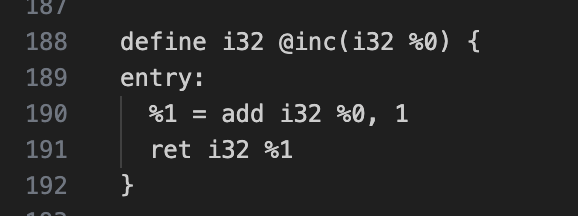
위에서 정의했던 inc 함수 정의가 삽입되어 있다.
-
빌드
- InsertInc.cpp 등 패스 소스 코드 컴파일
- LLVM 패스(InsertInc.so) 생성
-
test.ll 파일 준비
- 테스트 코드(test.c)를 LLVM IR 파일(test.ll)로 변환
-
패스 적용
- opt 명령어로 test.ll에 InsertInc 패스 적용
- inc 함수 등 새로운 IR 코드가 삽입됨
-
결과 저장(test.out.ll)
- 패스가 적용된 IR 코드(수정본)를 test.out.ll 파일에 저장
- 기존 코드 + inc 함수가 포함된 IR

.