1-1 Introduction to Algorithms
Insertion Sort
- Incremental approach
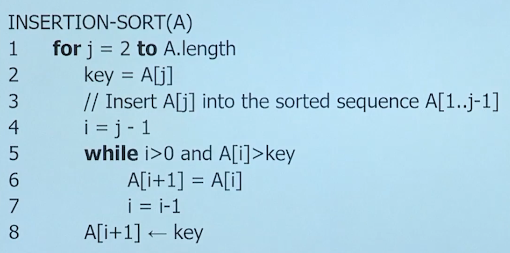
Loop Invariants and the Correctness Proof
- We must show three things about a loop invariant
- Initialization
- Maintenance
- Termination
Loop Invariants
- A condition that is always true for each iteration of a loop
- The subarray A[1…j−1] consists of the elements originally in A[1…j−1] but in ascending order
1. Initialization
- True prior to the first iteration
- When j=2, A[1…j−1] consists of the element A[1] which is original one in A[1]
Moreover, the subarray is sorted
2. Maintenance
- If it is true before an iteration of the loop, it remains true before the next iteration
- The subarray A[1…j] consists of the elements originally in A[1…j] in sorted order
- Incrementing j for the next iteration of the for loop preserves the loop invariant
3. Termination
- When the loop terminates, show that the algorithm is correct
- When j=n+1, the for loop terminates
- We have that A[1…n] consists of the elements originally in A[1…n] but in ascending order
- Hence the entire array is sorted, which means that the algorithm is correct
Divide and Conquer
Solve a problem recursively by applying three steps at each level of the recursion
- Divide the problem into a number of subproblems
- Conquer the subproblem by solving them recursively
- Combine the solutions to the subproblems into the solution for the original problem
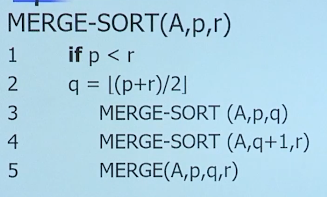
Merge Sort
- Divide
- Divide the n-element sequence to be sorted into two subsequences of n/2 elements each
- Compute the middle of the subarray, which takes Θ(1) time
- Conquer
- Sort the two subsequences recursively using merge sort
- Recursively solve two subproblems each of size n/2, which contribute 2T(n/2) to the running time
- Combine
- Merge the two sorted subsequences to produce the sorted answer
- Take Θ(n) time
- The recursion bottoms out when the sequence has length 1, every sequence of length 1 is already in sorted order
- Running time T(n) is 2T(n/2)+n)
MERGE Procedure
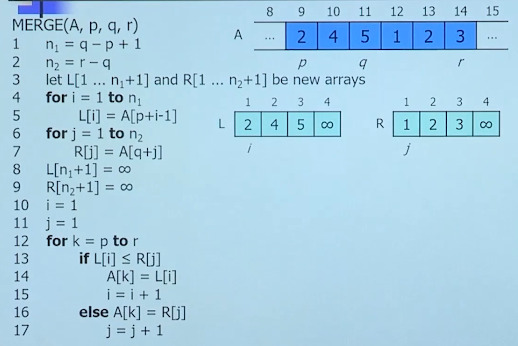
- Assume that the subarrays A[p…q] and A[q+1…r] are in sorted order
- Merge them to form a single sorted subarray that replaces the current subarray A[p…r]
- MERGE(A,p,q,r) where A is an array and p,q,r are indices into the array such that p≤q<r
Loop Invariant and the Correctness Proof
Loop Invariant
- At the start of each iteration, the subarray A[p…k−1] contains the (k−p) smallest elements
- L[i] and R[j] are the smallest elements of their arrays that have not been copied back into A
Initialization
- We have k=p, so the subarray A[p…k−1] is empty
- Since i=j=1, both L[i] and R[j] are the smallest elements of their arrays that have not been copied back into A
Maintenance
- When L[i]≤R[j]
- L[i] is the smallest element
- After line 14, the subarray will contain the k−p+1 smallest elements
- Incrementing k and i reestablishes the loop invariant for the next iteration
- When L[i]>R[j]
- Line 16, 17 perform the appropriate action
Termination
- At termination, k=r+1
- The subarray A[p…r] contains smallest elements of L and R in sorted order

와 멋져요