Polynomial time algorithms
- Inputs of size n, worst case time is O(nk) for some constant k
- All problems cannot be solved in polynomial time
NP-Complete problem
NP-Complete problems
- Status is unknown
- No polynomial time algorithm has yet been discovered
nor has anyone yet been able to prove that no polynomial time algorithm can exist for any one of them
Class P
- Problems that are solvable in polynomial time O(nk) for some constant k
Class NP
- Problems that are verifiable in polynomial time
- Verifiable?
- If we were somehow given a certificate of a solution,
then we could verify that the certificate is correct in polynomial time
Example
- Hamiltonian cycle
- Hamiltonian cycle of an undirected graph G=(V,E) is a simple cycle that contains every vertex in V
- Does G have a Hamiltonian cycle?
- Certificate is a sequence <v1,v2,…,v∣V∣> of ∣V∣ vertices
- We could check in polynomial time that (Vi,Vi+1)∈E for i=1,2,…,∣V∣ and (V∣V∣,V1)∈E
Class P vs Class NP
- P ⊆ NP
- The open question is whether or not P is a proper subset of NP. P=NP?
Class NPC
- A problem is in NP and is as hard as any problem in NP
- If any NP-complete problem can be solved in polynomial time,
then every problem in NP has a polynomial time algorithm
- When we demonstrate that a problem is NP-complete,
we are making a statement about how hard it is
How to solve a problem
- Usually can cast a given optimization problem as a related decision problem by imposing a bound on the value to be optimized
- What is the shortest path length from u to v?
⇒ Is there a path from u to v with length ≤k?
- Decision problem is in a sense easier or at least no harder than the optimization problem
Reduction
Reduction
- Let a decision problem A,B
- Suppose that we have a procedure that transforms any instance α of A into some instance β of B such that
- The transformation takes polynomial time
- The answer for α is same as the answer for β
- We call such a procedure a polynomial time reduction algorithm
- If such a reduction algorithm exist,
we say A is reducible to B and denote it by A≤pB
Reduction Algorithm
- Given an instance α of A, use a polynomial time reduction algorithm to transform it to an instance β of B
- Run the polynomial-time decision algorithm for B on β
- Use the answer for β as the answer for α
- If there is no polynomial time algorithm can exist for A,
and A polynomial time reduction algorithm exist for transforming instances of A to instances of B,
No Polynomial time algorithm can exist for B
Reducibility
- A problem Q can be reduced to another problem Q′
if any instance of Q can be easily rephrased as an instance of Q′,
the solution to which provides a solution to the instance of Q
Example
- Solving linear equations in an indeterminate x reduces to the problem of solving quadratic equations
- Given an instance ax+b=0, we transform it to 0x2+ax+b=0, whose solution provides a solution to ax+b=0
- Thus if a problem Q reduces to another problem Q′,
then Q is no harder to solve than Q′
Definition
A problem A is NP-Hard
- If we can solve this problem in polynomial time,
we can solve all NP problems in polynomial time
(A′≤pA all A′∈NP)
A problem A is NP-Complete
- It is in NP
- It is NP-Hard
- A′≤pA all A′∈NP
- Alternatively, A′≤pA for some known NP-Complete problem A′
- If any one is solvable in polynomial time, then they all are
- Conversely, if any one is not solvable in polynomial time, then none are
- Once there is any one problem that is proved NP-complete, we can use polynomial time reducibility as a tool to prove other problems to be NP-complete
Example
Circuit-SAT Problem
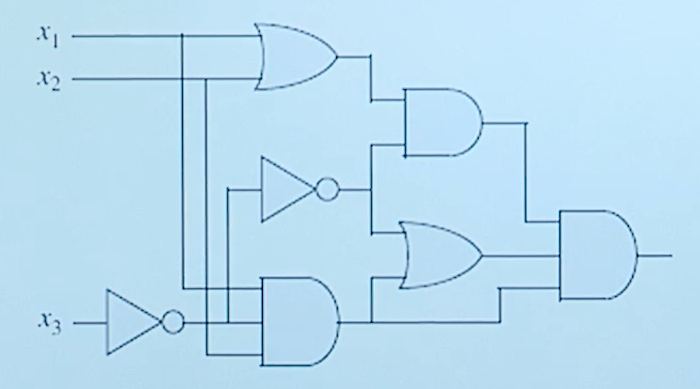
Circuit-SAT Problem
- What is the input that makes a true output?
Lemma
- Circuit satisfiability problem belongs to the class NP, NP-Hard
⇒ Circuit-SAT problem is NP-Complete
SAT Problem
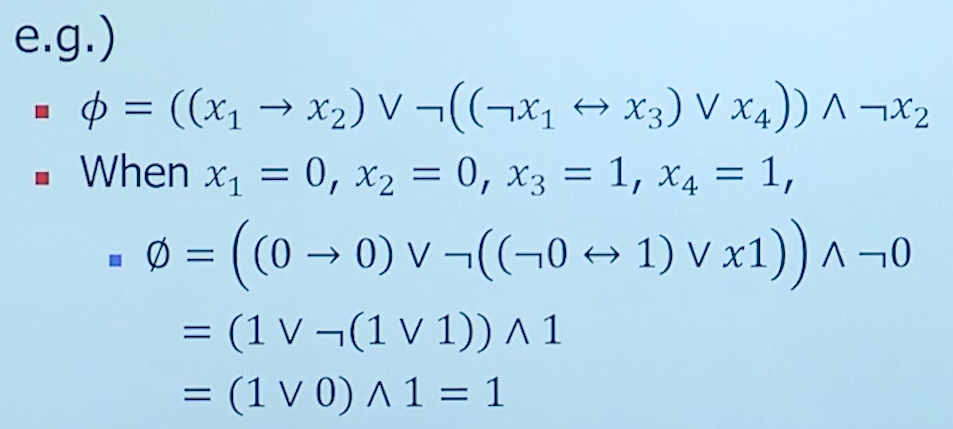
- Input: A boolean formula
- Question: Is there some way to assign truth value to the variables so that the formula evaluates to true?
Lemma
- SAT problem is NP-Complete
Cook's Theorem
- SAT is NP-Complete
- Circuit-SAT ≤p SAT
3-CNF-SAT Problem

- Input: A boolean formula in 3-conjunctive normal form
- Question: Operations in clause are OR,
operations outside the clause are AND.
CLIQUE
Clique
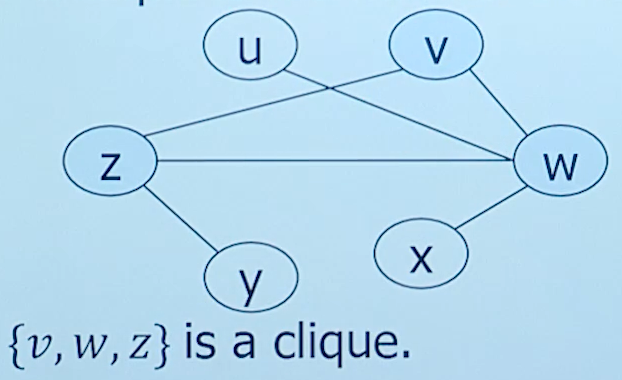
- A clique in an undirected graph G=(V,E) is a subset V′⊆V of vertices,
each pair of which is connected by an edge in E
- A clique is a complete subgraph of G
Optimization problem
- Input: An undirected graph G=(V,E)
- Question: Find a clique of maximum size in a graph
Decision problem
- Input: An undirected graph G=(V,E) and an integer k
- Question: Is there a clique of a given size k in the graph?
Naive algorithm
- Check whether a sub-graph of size k forms a clique
- Running time is Ω(k2×(∣V∣k)) which is polynomial if k is a constant
- In general, however, k could be near ∣V∣/2,⇒ superpolynomial
CLIQUE (NPC proof)
1. Problem is NP
- Clique ∈ NP for a given graph G=(V,E)
- Use the set V′⊆V of vertices in the clique as a certificate of G
- Checking whether V′ is a clique can be accomplished in polynomial time
by checking whether for each pair u,v∈V′, the edge (u,v) belong to E
2. Problem is NP-Hard
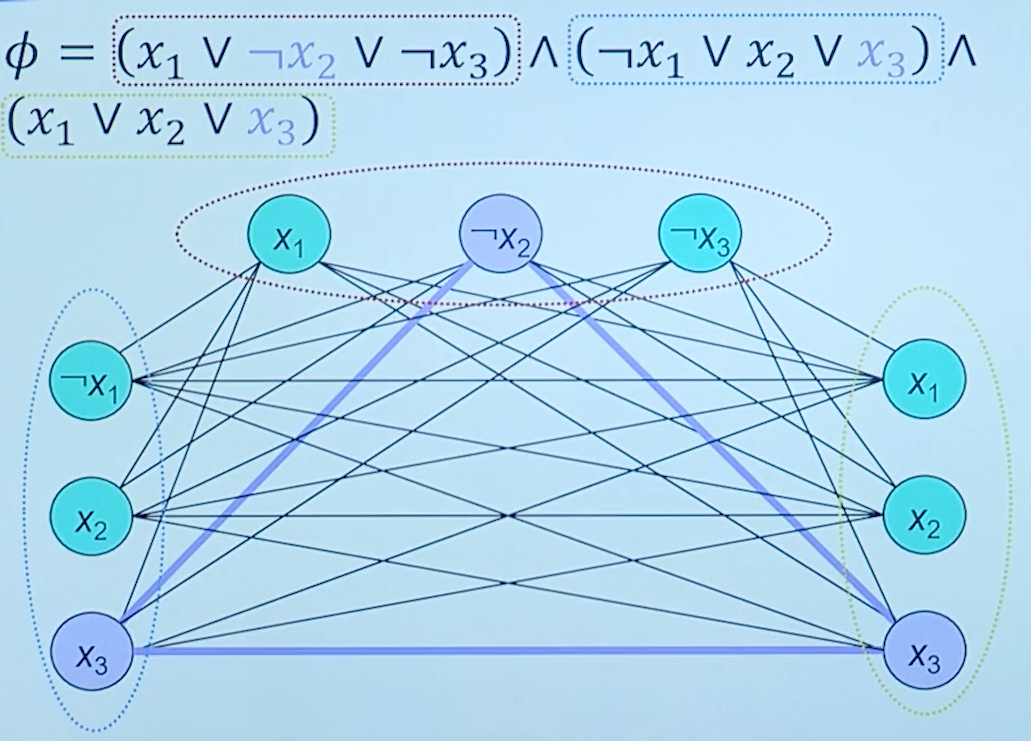
- 3-CNF-SAT ≤p CLIQUE (CLIQUE is NP-Hard)
- The reduction algorithm begins with an instance of 3-CNF-SAT
- Logical formula → Graph
- 모든 vertex 연결
- 자기 자신의 not 인 경우 X
- 같은 괄호 안의 vertex 끼리 X
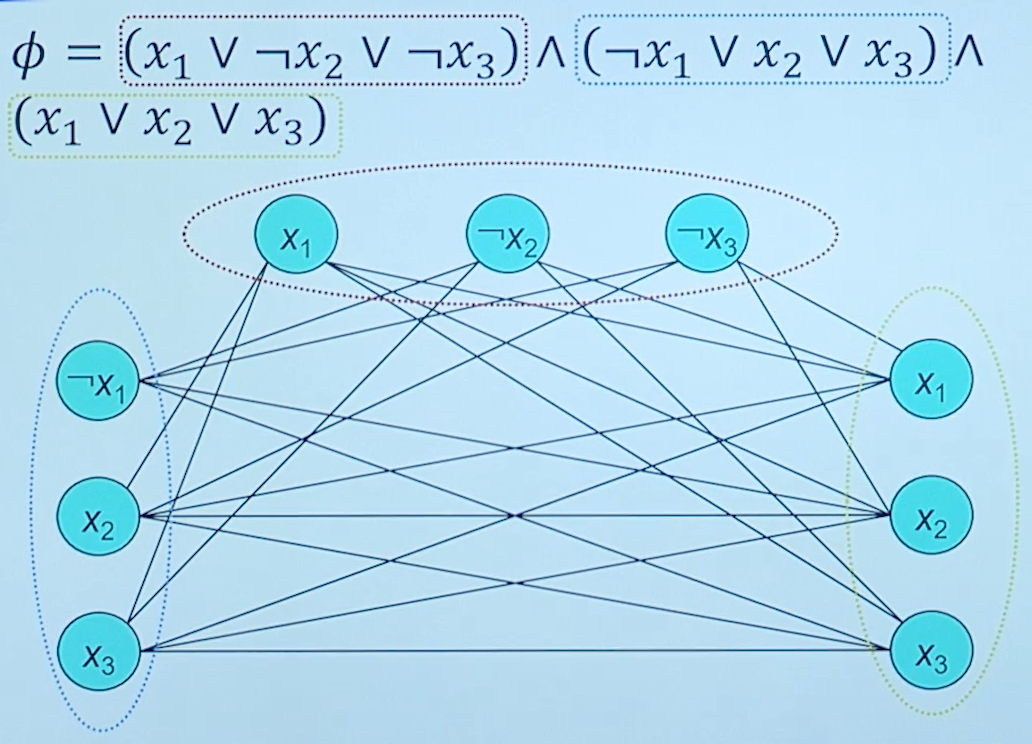
- k = 3 (괄호의 개수)
- Show that this transformation of ϕ into G is a reduction
- For each clause Cr=(l1r∨l2r∨l3r) in ϕ,
replace a triple of vertices v1r,v2r,v3r into V
- 3-CNF-SAT → CLIQUE
- Output이 true 이려면 clause 마다 literal 하나씩은 true 이어야함
- 자신의 not 과는 edge 를 생성하지 않았기 때문에 3-clique 생성됨
- CLIQUE → 3-CNF-SAT
- 3-clique이 있다는 것은 clause 마다 반드시 하나씩 선택됨
- 선택된 edge는 vertex와 그의 not 이 존재할 수 없기 때문에 3-CNF-SAT 도 true