Choosing the right frontend framework in 2026 is no longer just about picking a popular tool; it is about selecting a technical foundation that aligns with your business's long-term scalability and AI integration needs. The "Big Three"—React, Angular, and Vue—have matured significantly, each carving out a distinct territory in the modern web ecosystem.
Whether you are looking to hire web developers to hold projects to revitalize a legacy system or starting a fresh build, understanding the nuances of these frameworks is critical. As businesses move toward "server-first" architectures and AI-driven user interfaces, the decision you make today will determine your maintenance costs for the next decade. For those looking to hire web app developer talent, the choice often boils down to team expertise versus project requirements.
React: The Flexible Ecosystem Leader
React continues to dominate the market in 2026, not just as a library, but as a massive ecosystem. Maintained by Meta, its "learn once, write anywhere" philosophy has expanded into every corner of web and mobile development.
The 2026 Evolution: React Server Components (RSC)
The biggest shift in React has been the full stabilization of React Server Components. Unlike traditional SPAs (Single Page Applications) that send massive JavaScript bundles to the client, RSCs allow developers to keep heavy logic on the server. This results in:
Near-zero bundle sizes for static parts of the page.
Instant initial loads, which are crucial for SEO and user retention.
Automatic performance optimization through the React Compiler (formerly "React Forget"), which eliminates the need for manual memoization like useMemo.
Why Choose React?
React is the "safe bet" for most startups and high-growth companies. Its massive community means that if you need to scale your team quickly, finding qualified talent is easier than with any other framework. It is ideal for highly dynamic interfaces, such as social media dashboards, e-commerce platforms, and real-time collaborative tools.
Angular: The Enterprise Powerhouse
If React is the flexible artist, Angular is the disciplined architect. Developed by Google, Angular is a comprehensive, opinionated framework that provides everything out of the box—from routing and state management to form validation and HTTP clients.
The "Renaissance": Signals and Zoneless Performance
For years, Angular was criticized for being "heavy." However, the recent introduction of Signals has transformed its performance. Signals allow for fine-grained reactivity, meaning the framework knows exactly which part of the UI needs to update without checking the entire application tree. Additionally, the move toward "Zoneless" Angular has significantly reduced runtime overhead, making it as fast as, if not faster than, its competitors for large-scale data processing.
Why Choose Angular?
Angular is the gold standard for enterprise-grade applications. If you are building a complex ERP system, a banking portal, or a healthcare dashboard that requires strict structure and long-term maintainability, Angular’s built-in TypeScript support and modular architecture are unmatched. It ensures that large teams (often 50+ developers) can work on the same codebase without creating a "spaghetti code" mess.
Vue: The Progressive Developer Favorite
Vue has always been known as the "middle ground" between React’s flexibility and Angular’s structure. Created by Evan You, it remains the most approachable framework for teams transitioning from traditional HTML/CSS or jQuery backgrounds.
Vapor Mode: Redefining Vue Performance
In 2026, Vue’s Vapor Mode has become a game-changer. By opting into Vapor Mode, developers can compile Vue components into highly efficient, vanilla JavaScript that bypasses the Virtual DOM entirely. This brings Vue’s performance close to "solid-state" frameworks like SolidJS while keeping the developer-friendly syntax that made Vue famous.
Why Choose Vue?
Vue is perfect for businesses that need to move fast. It is widely used for MVPs (Minimum Viable Products), internal admin panels, and medium-scale applications. Its "progressive" nature means you can start by using it as a simple script tag and scale it into a full-blown SPA as your project grows. For companies seeking web app development services, Vue often offers the fastest time-to-market.
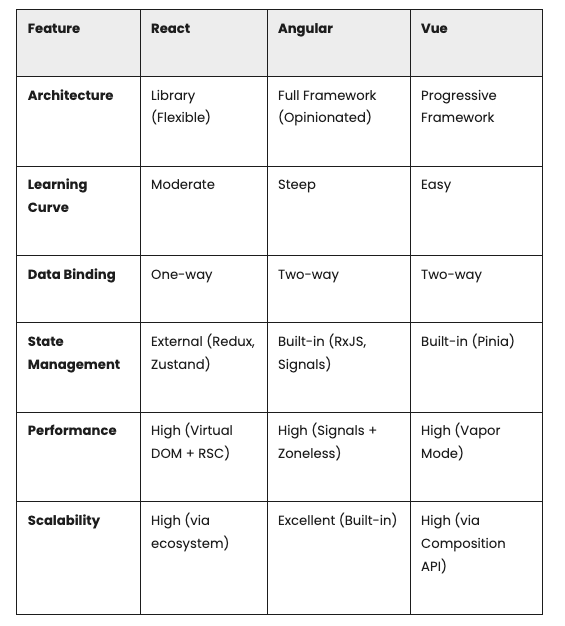
Feature Comparison: At a Glance
The Business Perspective: Which One Is Best for You?
Choosing a framework is rarely a purely technical decision; it is a business strategy. Your choice impacts hiring costs, development speed, and the ability to pivot.
1. For Startups and MVPs
Time-to-market is the most critical factor for startups. Vue is often the winner here because of its low barrier to entry and rapid prototyping capabilities. However, if the startup anticipates rapid scaling and needs to attract VC funding, React is often preferred because of the sheer volume of available developers and the ecosystem of pre-built UI components.
2. For Large-Scale Enterprises
Enterprises value consistency and security. Angular wins in this category because it enforces a specific way of writing code. When you have multiple teams working on different modules of a global application, Angular’s strictness ensures that everyone speaks the same language. This reduces "technical debt" over long periods.
3. For High-Performance Web Apps
If your application handles massive amounts of real-time data—like a stock trading platform or a data visualization dashboard—the choice between React (with its Server Components) and Vue (with Vapor Mode) is a toss-up. Both offer incredible performance optimizations that minimize the browser's workload. In these cases, your choice should depend on which paradigm your current team is more comfortable with.
Revitalizing Projects: The "Hold" Factor
Many companies find themselves with "hold projects"—applications that were started but never finished, or legacy systems that have become too expensive to maintain. Often, the question is: Should we migrate or rewrite?
If you are stuck with a legacy Angular.js (1.x) or an old React Class-based app, 2026 is the year of "Hybrid Migration." Modern tools allow you to run React and Vue side-by-side using "Island Architecture" (via frameworks like Astro). This allows you to hire web developer specialists who can slowly replace old modules with high-performance modern components without a total, high-risk rewrite.
Providing comprehensive web app development solutions often involves this strategic modernization. By slowly integrating Signals into an old Angular app or adding Server Components to a React site, you can extend the life of your software by years while improving the user experience immediately.
Hiring Trends in 2026
The landscape of hiring has shifted. In 2026, companies aren't just looking for "coders"; they are looking for "AI-augmented engineers." Whether you use React, Angular, or Vue, your developers must be proficient in:
AI Pair Programming: Using tools to accelerate boilerplate generation.
Performance Budgeting: Ensuring that the JavaScript bundle doesn't bloat.
Accessibility (a11y): Building apps that are usable by everyone, which is now a legal requirement in many jurisdictions.
When you look for professional web app development services, ensure the provider has a deep bench of talent across these specific frameworks. A "one-size-fits-all" agency is often a red flag; the best partners will analyze your specific business needs before recommending a stack.
Final Verdict: Which Is Best?
The "best" framework depends entirely on your context:
Choose React if you want the largest talent pool, the most flexible ecosystem, and are building a dynamic, high-traffic consumer app.
Choose Angular if you are an enterprise that needs a robust, secure, and highly structured foundation for a long-term, complex project.
Choose Vue if you want a lightweight, high-performance application with a gentle learning curve and fast development cycles.
The most successful companies in 2026 are those that don't get emotionally attached to a framework but instead choose the tool that minimizes friction for their developers and maximizes value for their users. If you are ready to scale, now is the time to audit your current stack and decide which of these three giants will carry you into the future of the web.