Super Apps in 2026: Trends, Predictions, and Opportunities
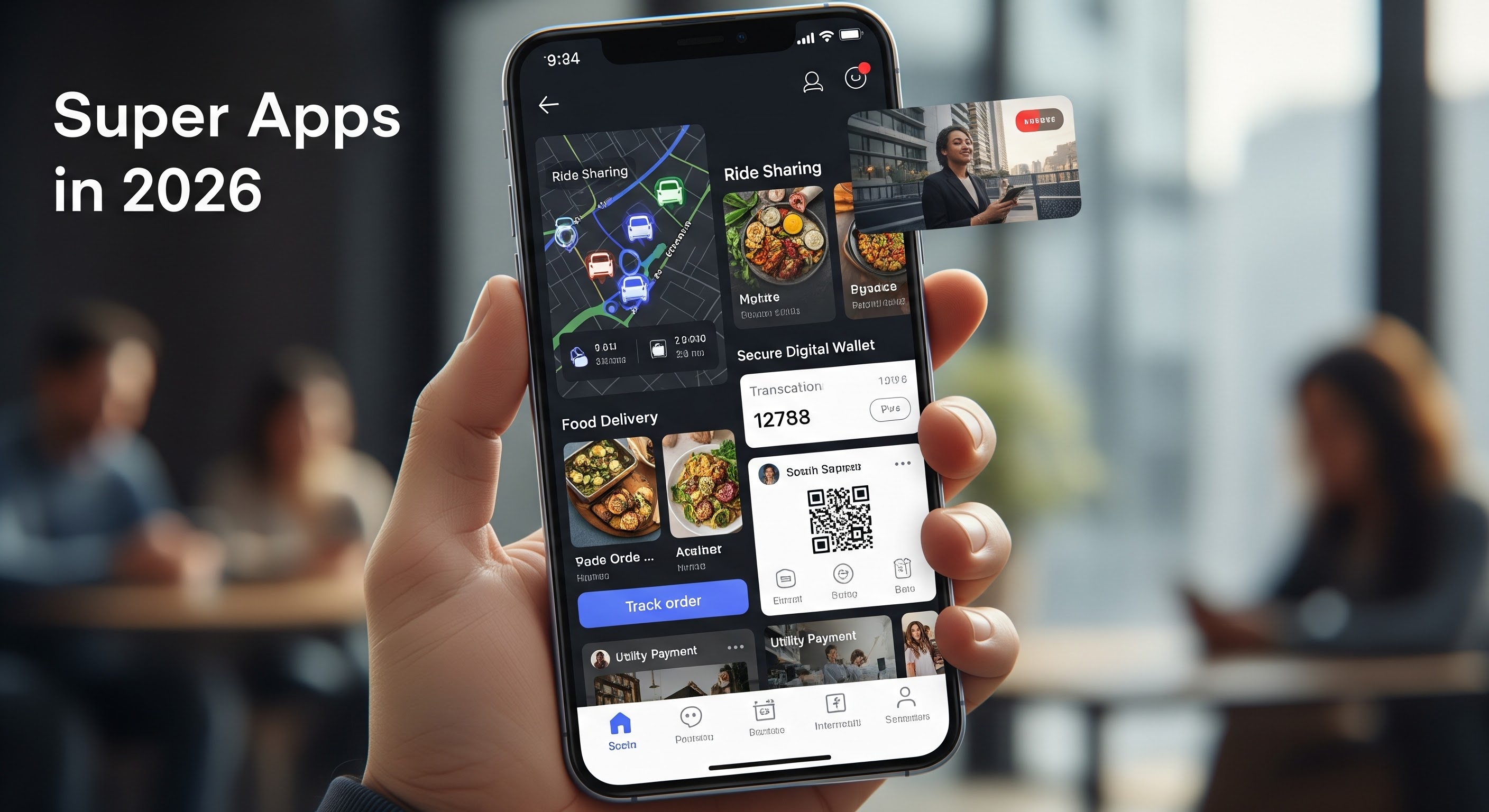
The digital landscape of 2026 is no longer defined by a cluttered home screen of fifty single-purpose applications. Instead, we are witnessing the "Great Consolidation." As user fatigue reaches its peak, the "Super App"—an all-in-one ecosystem that integrates messaging, finance, commerce, and lifestyle services—has transitioned from an Asian phenomenon into a global standard.
For businesses, this shift represents more than just a change in UI; it is a fundamental transformation in how brands interact with consumers. Navigating this transition requires a deep understanding of the technical and strategic shifts currently underway. Many enterprises are already partnering with a specialized super app development company to consolidate their digital offerings into a unified "personal operating system" for their users.
The Global Market Shift: Why 2026 is the Tipping Point
Historically, super apps like WeChat and Meituan dominated the East, while the West remained fragmented. However, by 2026, several factors have converged to break these regional barriers:
User Exhaustion: The average user is tired of managing dozens of accounts, subscriptions, and notifications. 2026 is the year of "Digital Minimalism," where users gravitate toward platforms that solve multiple problems in one place.
Infrastructure Maturity: With 5G reaching near-ubiquity and 6G trials entering the public consciousness, the bandwidth and latency requirements for complex, multi-modular apps are no longer a bottleneck.
Financial Integration: The distinction between a "bank" and a "lifestyle app" has blurred. Embedded finance is now the backbone of every successful super app, allowing for frictionless, one-tap transactions across diverse services.
Market analysts estimate the global super app market will exceed $500 billion by 2026, growing at a CAGR of over 20%. This growth is driven not just by retail, but by sectors like healthcare, government services, and enterprise productivity.
Key Trends Shaping the Super App Era
1. The Rise of Agentic AI
In 2026, AI is no longer a "feature" or a sidebar chatbot; it is the core engine of the super app. We have moved from Generative AI to Agentic AI. Instead of you searching for a flight, booking a hotel, and then finding a restaurant, the AI agent within the super app understands your intent. It coordinates across mini-apps to present a complete itinerary based on your historical preferences and current budget.
2. The Mini-App Revolution
Modern architecture favors modularity. Rather than building a massive, monolithic application that is slow to update, 2026's leading platforms utilize a "Mini-App" framework. Third-party developers can build lightweight modules that run inside the host app’s environment. This creates a win-win: the super app owner gains a rich ecosystem without having to build every service, and the third-party developer gains access to a massive, pre-authenticated user base.
3. Hyper-Personalization through Behavioral Analytics
With access to cross-service data—knowing what a user buys, where they travel, and how they pay—super apps in 2026 offer a level of personalization previously thought impossible. If the app sees you frequently book late-night rides and order high-protein meals, it might proactively suggest a personalized wellness plan or a discount on gym memberships. This data-driven approach is a core component of modern super app development solutions aimed at maximizing Customer Lifetime Value (CLV).
4. Spatial Computing and XR Integration
As devices like the Apple Vision Pro and Meta Quest 4 become mainstream in 2026, super apps are expanding into the third dimension. Shopping is no longer about scrolling through 2D grids; it is about walking through a virtual showroom within the app. Real estate mini-apps allow for instant AR walkthroughs, while social modules enable "co-watching" of live events in immersive virtual environments.
Opportunities Across Industries
The "Super App-ification" of the economy offers unique opportunities for various sectors to reclaim their market share and reduce customer acquisition costs (CAC).
Fintech and Embedded Finance
Fintech remains the most lucrative entry point for super apps. By 2026, the digital wallet has become the "hub."
Opportunity: Banks are moving from being "vaults" to being "platforms." By embedding lending, insurance, and investment tools directly into daily lifestyle services (like grocery shopping or ride-hailing), financial institutions can capture users at the exact moment of intent.
Healthcare: The "Wellness Hub"
We are seeing the emergence of health-focused super apps that combine telemedicine, prescription delivery, wearable data tracking, and insurance claims.
Opportunity: A health super app can use AI to monitor your wearable data (sleep, heart rate) and automatically schedule a doctor's appointment if it detects an anomaly, even arranging the ride to the clinic—all within one interface.
Enterprise and B2B Super Apps
The trend isn't limited to consumers. Enterprises are building internal super apps to replace the "SaaS sprawl." Instead of separate apps for HR, payroll, project management, and communication, employees use a single workspace app that integrates these functions through custom mini-apps.
Industry
Primary Super App Function
Secondary Value Stream
Retail
E-commerce / Groceries
Loyalty Points & BNPL Credit
Logistics
Ride-hailing / Delivery
Fuel Rewards & Vehicle Insurance
Hospitality
Booking / Check-in
Local Tour Discovery & Currency Exchange
The Technology Stack of 2026
Building a super app in 2026 requires a sophisticated tech stack that prioritizes security, scalability, and seamless integration.
Frontend: Cross-platform frameworks like Flutter and React Native remain dominant, but they are now optimized for "Micro-Frontends," allowing different teams to work on different mini-apps simultaneously.
Backend: Serverless architectures and Edge Computing are critical. By processing data closer to the user, super apps can maintain the "zero-latency" feel that 2026 consumers demand.
Identity & Security: Decentralized Identity (DID) and Biometric Authentication (Palm-vein or Iris scanning) have replaced passwords. Security is built into the mini-app sandbox, ensuring that a vulnerability in a third-party module cannot compromise the core app's data.
Strategic Considerations for Businesses
Entering the super app space is a high-stakes move. In 2026, the "build it and they will come" mentality has been replaced by "partner and they will stay."
Start with a "Hook"
A successful super app always starts with a high-frequency use case. Whether it is messaging, payments, or transportation, you need a service that users open daily. Once you own the "daily habit," you can cross-sell lower-frequency, higher-margin services like insurance or electronics.
The "Build vs. Buy" Dilemma
Many organizations struggle with whether to develop the entire ecosystem in-house or leverage existing platforms. The most successful players in 2026 are those that adopt an "Open Ecosystem" strategy. They build the core "Hook" and then provide the APIs and SDKs for others to build your own super apps and modules within their framework. This allows for rapid scaling without the overhead of managing thousands of disparate services.
Data Ethics and Trust
With great data comes great responsibility. The super apps that will survive 2026 are those that prioritize "Privacy-by-Design." Users are willing to trade their data for convenience, but only if they feel in control. Transparent data-sharing agreements and localized data storage (to comply with regional regulations like GDPR 2.0) are non-negotiable.
Predictions: What Lies Beyond 2026?
As we look toward the end of the decade, the super app will likely evolve into a "Cognitive Twin." It will not just react to your commands but anticipate your life's requirements. We expect:
Voice-First Interaction: The screen will become secondary. You will interact with your super app primarily through voice and neural interfaces.
Autonomous Economy: Your super app will have the authority to make small financial decisions on your behalf—like automatically switching your energy provider to a cheaper rate or re-ordering groceries when the smart fridge is low.
Hyper-Localism: While the technology is global, the content and services will be hyper-localized, reflecting the specific cultural and economic needs of every city.
Conclusion
The era of the fragmented mobile experience is over. In 2026, the super app will be the primary gateway to the digital world. For businesses, this is a moment of choice: become the platform, or become a module within someone else's platform. Those who embrace the ecosystem model, leverage Agentic AI, and prioritize user trust will define the next decade of commerce and connection.
The opportunity is vast, but the window for entry is closing as market leaders solidify their positions. Success in this new era requires a blend of technical excellence and strategic foresight—transforming a simple application into a vital, daily companion for the global consumer.