Roy, A., Katerina, N., McGinn, R., Safiya, J., Klement, W., & Kaminsky, Z. A. (2020). A machine learning approach predicts future risk to suicidal ideation from social media data. NPJ Digital Medicine, 3(1) doi:https://doi.org/10.1038/s41746-020-0287-6
Summary
- The objective was to generate an algorithm termed “Suicide Artificial Intelligence Prediction Heuristic (SAIPH)” capable of predicting future risk to suicidal thought by analyzing publicly available Twitter data.
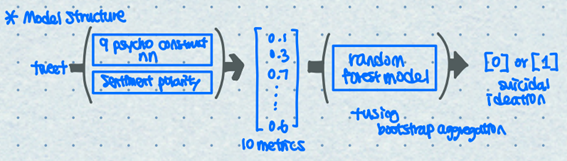
- The study trained a series of neural networks on Twitter data queried against suicide associated psychological constructs including burden, stress, loneliness, hopelessness, insomnia, depression, and anxiety. Using 512,526 tweets from N = 283 suicidal ideation (SI) cases and 3,518,494 tweets from 2655 controls, the authors then trained a random forest model using neural network outputs to predict binary SI status.
- The model predicted N = 830 SI events derived from an independent set of 277 suicidal ideators relative to N = 3159 control events in all non-SI individuals with an AUC of 0.88 (95% CI 0.86–0.90).
- The authors validated our model using regionally obtained Twitter data and observed significant associations of algorithm SI scores with county-wide suicide death rates across 16 days in August and in October, 2019, most significantly in younger individuals.
- Algorithmic approaches like SAIPH have the potential to identify individual future SI risk and could be easily adapted as clinical decision tools aiding suicide screening and risk monitoring using available technologies.
Key takeaways
ML using psychological constructs to predict SI risk
- The study used ML constructs developed loosely around IPTS, HT, and associations of depression, anxiety, and insomnia with suicide. The NNs were designed to read text and infer psychological weights across a range of constructs including
- Stress
- Loneliness, burdensomeness, hopelessness (factors of IPTS)
- Depression, anxiety, and insomnia (empirically found risk factors)
- And, sentiment polarity (as it most accurately measures depression, anxiety, stress, and lack of sleep.)